
Custom AI Solutions vs Off-the-Shelf Tools: How to Decide in 2026
Custom AI solutions are not just a technical choice—they are a strategic lever that can reshape your entire competitive landscape. You’re staring at a six-figure AI investment proposal. One path promises a quick, off-the-shelf solution live in weeks. The other is a custom AI solution that perfectly fits your operations but takes months. The wrong choice could haunt your P&L for years.
Most leadership teams lack a clear framework to decide between custom AI solutions and off-the-shelf tools. The result? They either overpay for generic software that never quite fits or burn months building something they could have bought—sometimes both.
The right choice depends on three factors: data ownership, integration depth, and competitive differentiation. And contrary to common belief, a hybrid approach—starting off-the-shelf and graduating to custom—often delivers the best outcome.
In this article, we’ll unpack the hidden costs of off-the-shelf tools, explore when custom AI development is the smart move, and show how AI agents are changing the calculus. You’ll also walk through a practical 5-question self-assessment and a decision matrix to guide your next AI investment.
The Hidden Costs of Off-the-Shelf AI Software
Off-the-shelf AI tools promise speed and low upfront cost. And they deliver—initially. You can subscribe and have it running within days. That works well when you need a standard capability fast: a customer support chatbot, basic document analysis, or email categorization.
But for any use case that touches your proprietary data, workflows, or competitive edge, the story shifts. It is like renting a fully furnished apartment: you get convenience without long-term equity. When you want to knock down a wall or upgrade the wiring, you are asking the landlord.
The operational costs often catch organizations off guard. IBM’s analysis of generative AI costs highlights that total cost of ownership (TCO) escalates quickly when factoring in integration workarounds, per-user pricing at scale, and the lost productivity from generic models that need constant tweaking.
Consider a mid-market logistics company that adopted a popular off-the-shelf AI for demand forecasting. After two years, they were spending 30% of the initial license fee annually on data cleaning and custom reports to fit their unique routing patterns. The quick win turned into a recurring operational headache.
For regulated industries, data residency and privacy become non-negotiable. Off-the-shelf tools often store data on shared infrastructure, making it difficult to meet HIPAA or GDPR requirements without expensive add-ons. That friction alone can justify a custom path. Custom AI solutions that keep data on-premise or in a private cloud eliminate this risk entirely.
When Custom AI Development Is the Right Call
Custom AI development gives you full control over your data and algorithms. You train models on your proprietary datasets without sending sensitive information to a third party. That distinction matters because it directly impacts compliance, accuracy, and long-term scalability. For many enterprises, custom AI solutions are the only way to meet stringent data governance policies.
Deep integration is another decider. If your AI needs to plug into legacy ERP, CRM, or bespoke operational tools, an off-the-shelf product’s limited APIs will force you to build messy middleware. Custom AI solutions, by contrast, are architected to fit your existing stack from day one, reducing integration complexity.
A fintech startup we worked with built a custom AI agent for fraud detection that connected natively to their transaction database. The result was a significant reduction in false positives compared to the generic tool they had previously used—a clear competitive necessity for their business.
When differentiation sits at the core of your business model, custom AI creates a moat. A manufacturing firm developed a custom predictive maintenance system using their own sensor data, avoiding vendor lock-in and saving estimated $500K in production downtime. That asset is theirs alone; competitors cannot simply buy the same capability off the shelf. This is where the value of custom AI solutions truly shines.
AI consulting services can help assess whether your project warrants a custom investment, starting with a rigorous AI use-case identification framework that maps technical requirements to business outcomes.
The Decision Drivers: Data Ownership, Integration, and Differentiation
Three factors tilt the scales decisively: data ownership, integration depth, and competitive differentiation. Off-the-shelf tools force you to accept the vendor’s data handling practices—often a non-starter when customer PII, patient records, or proprietary logistics data are involved. Custom AI solutions keep that data within your boundaries, giving you complete data ownership and control.
Integration complexity is where most TCO surprises hide. A tool that looks cheap at $50 per seat can cost ten times that in custom middleware when it fails to talk to your legacy order management system. Custom development avoids that tax by building connectors natively.
Differentiation is the clearest litmus test. If the AI capability touches customers directly—a recommendation engine, an underwriting model, a compliance analyst—then buying a generic solution hands competitors the same weapon. The table below summarizes how these drivers play out across key dimensions:
| Factor | Off-the-Shelf AI | Custom AI Solutions |
|---|---|---|
| Time to Value | Weeks | 3-6 months |
| Initial Cost | Low (subscription) | High |
| Total Cost (3 years) | Often higher with scale | Lower at scale |
| Data Ownership | Vendor retains rights | Full control |
| Integration Depth | Limited APIs | Deep, custom |
| Differentiation | Low | High |
| Scaling | Per-seat costs spiral | Predictable |
A legal tech company, for example, built custom AI for contract analysis because client confidentiality demanded on-premise processing. An off-the-shelf cloud tool would have violated their compliance obligations—a non-negotiable decision driver. For many enterprises, custom AI solutions for compliance are becoming the default choice.
“With AI agents automating complex workflows and enterprises racing to adopt generative AI, the build vs buy decision now determines whether you lead your industry with tailored intelligence or get trapped in generic automation that your competitors can easily replicate.”
A 5-Question Self-Assessment for Your Next AI Project
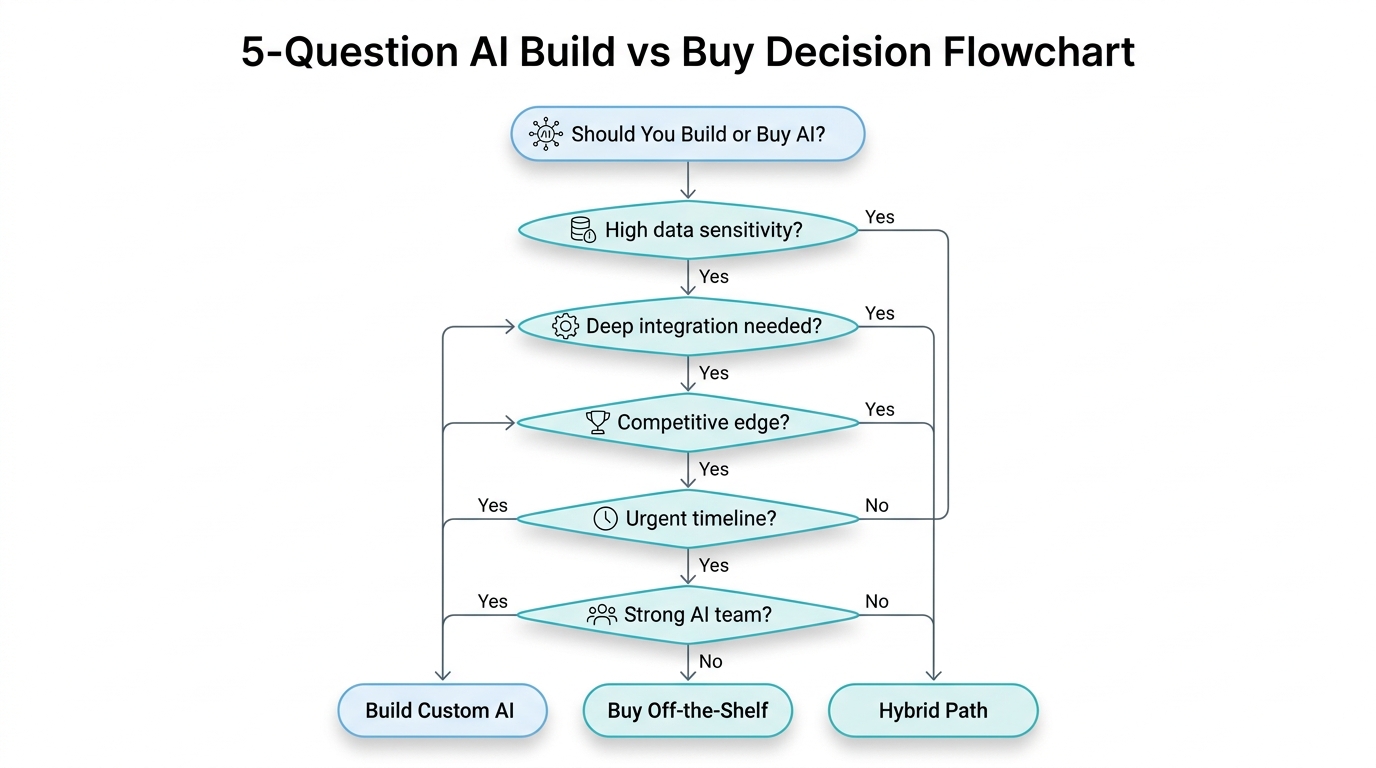
When starting a new AI project in a competitive market, answer these five questions honestly before committing. They cut through internal bias and anchor your decision in operational reality.
- How sensitive is your data? If it includes PII, trade secrets, or regulated information, lean toward custom AI solutions that keep data under your control.
- How deeply must this AI integrate with existing systems? Simple, standalone tasks (like a FAQ bot) favor off-the-shelf; complex workflows that span multiple backend systems argue for custom AI development.
- Will this AI give you a competitive edge? If the answer is yes, building creates an asset competitors cannot clone overnight. If it is a commodity function, buy it.
- What is your timeline to value? An urgent need (e.g., a seasonal customer support spike) may justify a quick off-the-shelf win. A strategic differentiator is worth the wait.
- Do you have internal AI expertise? Strong in-house teams can accelerate custom builds. Without them, an off-the-shelf start—potentially coupled with a consulting partner—reduces risk.
A healthcare startup we advised answered yes to questions 1–3 but had an urgent timeline (Q4). The prescription: begin with a compliant off-the-shelf NLP tool for immediate documentation needs, then transition to a custom model for diagnostic support within nine months. The hybrid path de-risked both compliance and budget. Custom AI solutions for diagnostics became their long-term goal.
How AI Agents Change the 2026 Calculus
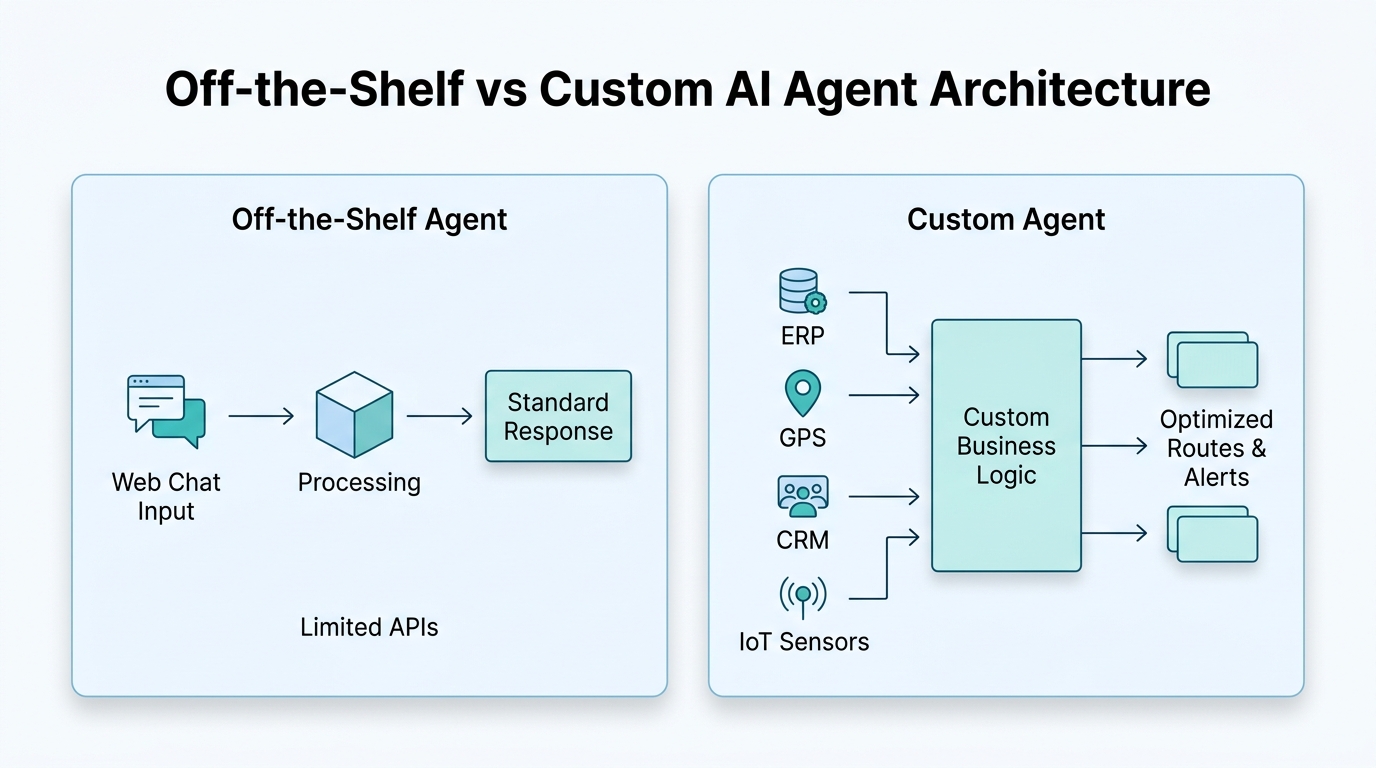
AI agents—autonomous software that plans and executes multi-step tasks—are raising the stakes. Off-the-shelf agent platforms (think no-code chatbot builders) can handle common customer service flows, but they struggle when actions require deep system integration or proprietary logic.
Custom AI agents, built on your workflows and APIs, are a different animal. A logistics company might buy an off-the-shelf agent for tracking updates, then build a custom agent that optimizes routes across its ERP and GPS data—automating a process that previously consumed three full-time dispatchers. These custom AI solutions for agent development integrate tightly with existing systems.
For agents that touch core IP or orchestrate critical workflows, custom development is the only way to ensure reliability and differentiation. custom AI agent development services focus on exactly this: embedding agents that understand your business rules, not someone else’s template.
A simple rule of thumb: if the agent is a standalone information provider, buy it. If it must act on your systems, build it. The decision often hinges on whether you need custom AI solutions or a generic app.
The Hybrid Path: Start Smart, Scale Custom
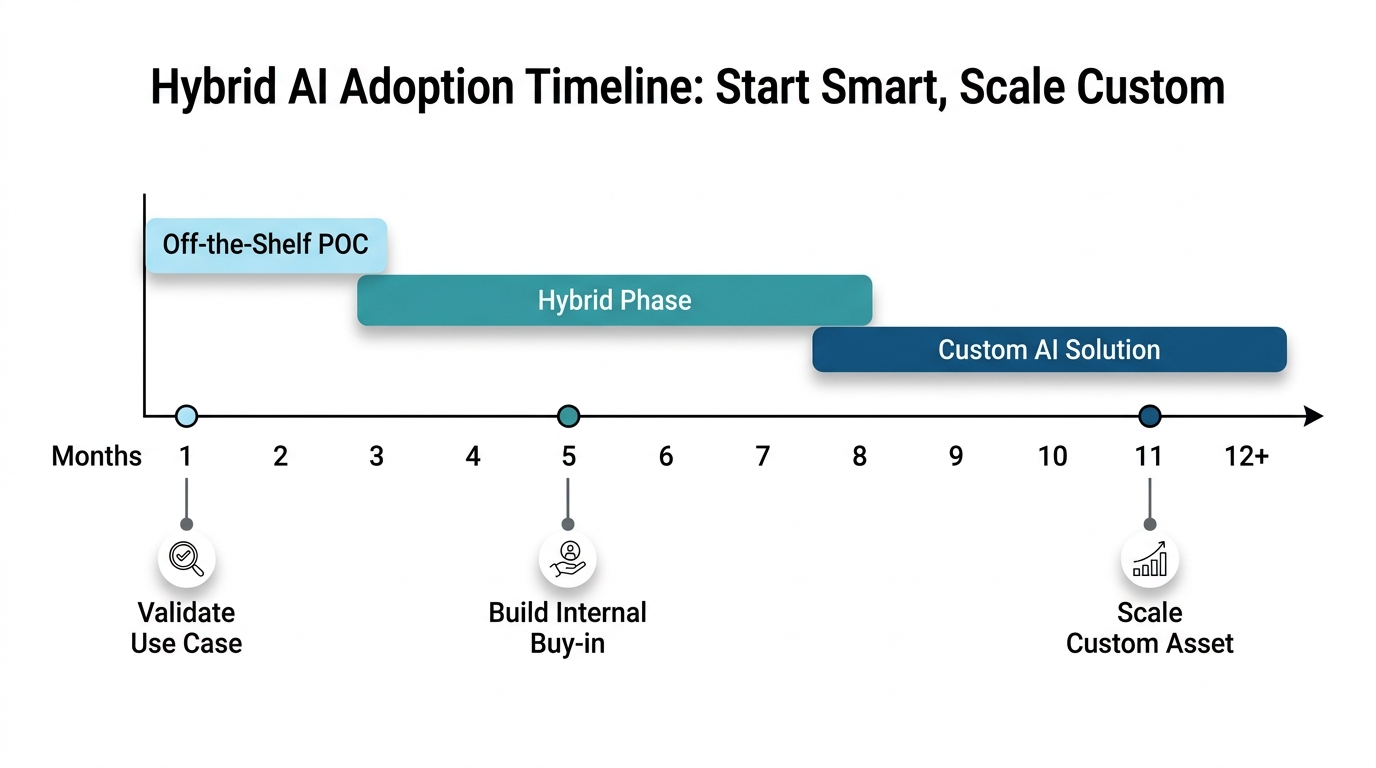
The most practical path is not an either/or choice—it is a phased evolution. Start with an off-the-shelf proof of concept to validate the use case, learn user behavior, and build internal buy-in. Then, with real-world requirements in hand, invest in custom AI solutions where differentiation and data ownership matter most.
Many companies first engage with generative AI solutions via off-the-shelf content tools, then later fine-tune custom models on their own brand voice and audience data. That progression turns a commodity purchase into a proprietary asset.
The key is to avoid locking yourself into a platform that cannot accommodate your ambition. A financial advisory firm we worked with started with a generic robo-advisor, learned what clients valued, then built a custom AI for personalized portfolio advice that integrated directly with their back-office systems. The result was a service their competitors could not replicate. Custom AI solutions, when executed well, become a lasting competitive asset.
The Framework That Saves You From Costly Mistakes
The build vs. buy decision is not about ideology—it is about alignment. Custom AI solutions win when data control, integration depth, or differentiation are at stake. Off-the-shelf tools win when speed, simplicity, and commoditized capabilities are sufficient.
But the most durable strategy is hybrid: buy for speed, build for scale. Use the 5-question test and the decision matrix above to pressure-test your next AI investment. The companies that get this right are not the ones that always build or always buy—they are the ones that make the right choice at each stage of growth.
If you are weighing a custom AI solution for the first time, an architecture-level conversation can save months of misdirection. AI consulting services start with an AI use-case identification framework that turns your business priorities into a clear roadmap—no jargon, no vendor lock-in, just a pragmatic plan. Investing in custom AI solutions early can pay dividends through competitive differentiation.
Frequently Asked Questions
When is off-the-shelf AI the better choice over custom AI development?
Off-the-shelf AI is ideal when you need a quick, low-cost solution for a non-differentiating task—such as a standard customer service chatbot or basic email categorization—and your data sensitivity and integration requirements are minimal. Custom AI solutions are better when those needs are non-negotiable.
What are the hidden costs of off-the-shelf AI software?
Hidden costs include growing per-seat fees as you scale, the engineering effort to build workarounds for integration, lost accuracy when using generic models on your data, and potential compliance risks if the vendor cannot meet your data residency or privacy standards. Custom AI solutions help mitigate these costs over time.
How do AI agents affect the build vs. buy decision?
AI agents that perform simple, standalone tasks (like answering FAQs) can be bought off the shelf. But agents that must orchestrate complex workflows across your proprietary systems require custom AI development to ensure reliability, security, and competitive advantage.
Is a hybrid approach possible when adopting AI?
Yes. Many organizations start with an off-the-shelf proof of concept to validate the use case and learn, then gradually replace or augment components with custom AI solutions in areas that drive differentiation and need deeper integration.
What questions should I ask before choosing between custom and off-the-shelf AI?
A practical 5-question self-assessment covers data sensitivity, integration depth, competitive differentiation, timeline to value, and internal AI expertise. These factors together indicate whether a buy, build, or hybrid path is most suitable. Custom AI solutions often score high on data and integration needs.

Loading...