

Salesforce Commerce Cloud in 2026: When It’s the Right Choice (And When It’s Not)
Salesforce Commerce Cloud is not just a software decision—it's a strategic foundation for enterprise ecommerce. Understanding its strengths and limitations is critical.
Picture a CTO staring at a decision matrix at 11 p.m. The columns compare Shopify Plus, Salesforce Commerce Cloud, and Adobe Commerce. The demos were impressive. The promises of AI-driven growth are tantalizing. But beneath the excitement lies a quiet terror: one wrong move will strand the business on an ill-fitting platform for the next five years.
The decision is real. Choosing Salesforce Commerce Cloud is not a software purchase—it’s a foundation poured for a skyscraper. Once the concrete sets, changing it is slow, expensive, and business-disrupting. Yet the market offers little clarity. Every vendor claims to handle scale, personalization, and headless commerce. Features blur together. Even careful evaluation feels like guesswork.
Here is the truth we’ve learned from over a decade of guiding commerce transformations: Salesforce Commerce Cloud is an exceptional, AI-powered platform built for complex, large-scale digital businesses. But it is not a one-size-fits-all solution. In fact, the most valuable insight for many brands is recognizing when it is the wrong choice.
As Webuters’ digital commerce services team has seen firsthand, the real risk is not missing features—it’s adopting Salesforce Commerce Cloud when your current capabilities are not ready. This guide assesses the concrete benefits, examines its current capabilities including Agentforce agents and Einstein-driven personalization, explores the ecosystem of apps and APIs, then offers an honest fit assessment. By the end, you’ll have a framework for your own evaluation, not just another vendor pitch.
Core Benefits of Salesforce Commerce Cloud
Before assessing fit, let’s answer the question buyers ask first: what actually makes this platform stand out? These five benefits consistently top the list.
Unified system across B2C and B2B. The platform lets you run both models from a single instance. A sporting goods brand can sell directly to consumers online while offering a wholesale portal for retailers—sharing customers, orders, and inventory. This eliminates data silos and duplicate processes.
Engineered for peak scale. It is built for traffic surges. The B2C Commerce Developer Guide outlines auto-scaling mechanisms that provision resources during high demand. The platform reliably processes thousands of orders per minute during events like Black Friday. That means no frantic DevOps calls when a promotion goes viral.
Einstein’s AI baked into the platform. AI isn’t a bolt-on. Einstein analyzes real-time behavior to power product suggestions, predictive search, and personalized offers. According to Salesforce’s State of the AI Connected Customer, 75% of customers expect companies to use new technologies to create better experiences. Einstein can recommend a winter coat to a customer who just bought ski gloves, helping increase average order values.
Ecosystem depth. The Salesforce AppExchange hosts hundreds of commerce-specific extensions—payment gateways, shipping, loyalty programs. You rarely build from scratch; instead, you configure. And a global network of Salesforce Commerce Cloud development services partners ensures expert help for complex integrations.
Continuous innovation. Quarterly releases deliver new features without major upgrades. You stay current automatically—critical when AI capabilities evolve this fast. These benefits are compelling, but what makes the platform stand out in 2026? The answer lies in AI-powered capabilities: Agentforce and Einstein.
2026 Capabilities: Agentforce and Einstein AI Take Center Stage
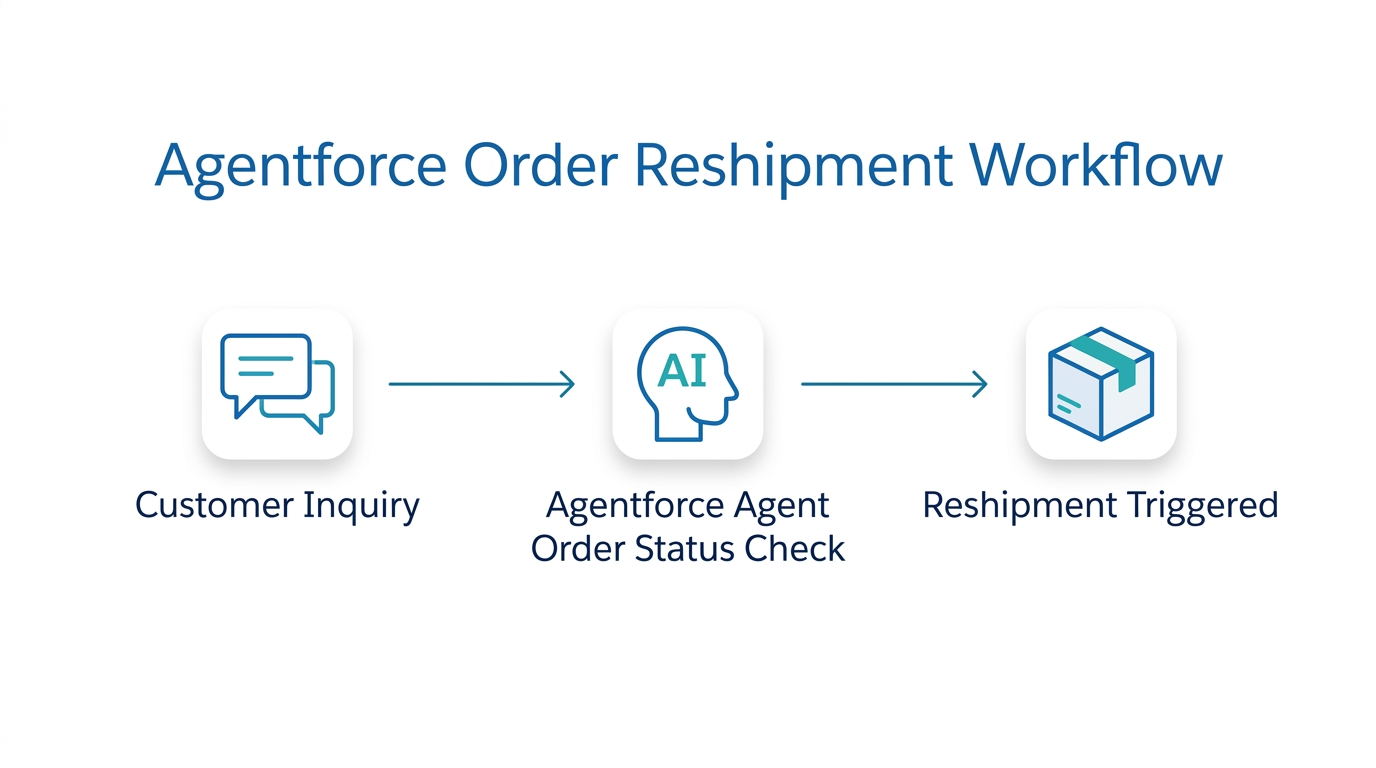
Many businesses are now moving beyond generative AI experiments to embed intelligence directly into customer journeys. Salesforce Commerce Cloud does that through two integrated systems: Agentforce agents for autonomous action and Einstein for personalization.
Agentforce commerce agents are autonomous AI assistants that operate within the commerce flow. They can handle customer service inquiries, manage orders, and even drive sales. For example, an Agentforce bot embedded on a product page can answer “where is my order?” in real time, track the shipment, and—if the package is lost—automatically trigger a reshipment through the built-in order management system. No human needed. It reduces support costs and improves resolution speed.
Einstein personalization uses real-time data to tailor every interaction. It segments customers based on behavior, predicts intent, and adjusts product suggestions, search results, and promotions on the fly. A merchandiser can set a rule that dynamically discounts overstocked items for high-lifetime-value customers, and Einstein will execute it across web, email, and paid ads without manual campaign setup. Predictive intelligence extends into the supply chain: Einstein can forecast demand for specific SKUs, helping merchants optimize inventory allocation.
These capabilities shift the platform from a transactional system into an autonomous commerce engine—one that doesn’t just facilitate sales but actively works to maximize them. But AI doesn’t operate in isolation. It needs data, and data comes from a connected ecosystem.
The Ecosystem: Apps, Partners, and Headless Flexibility
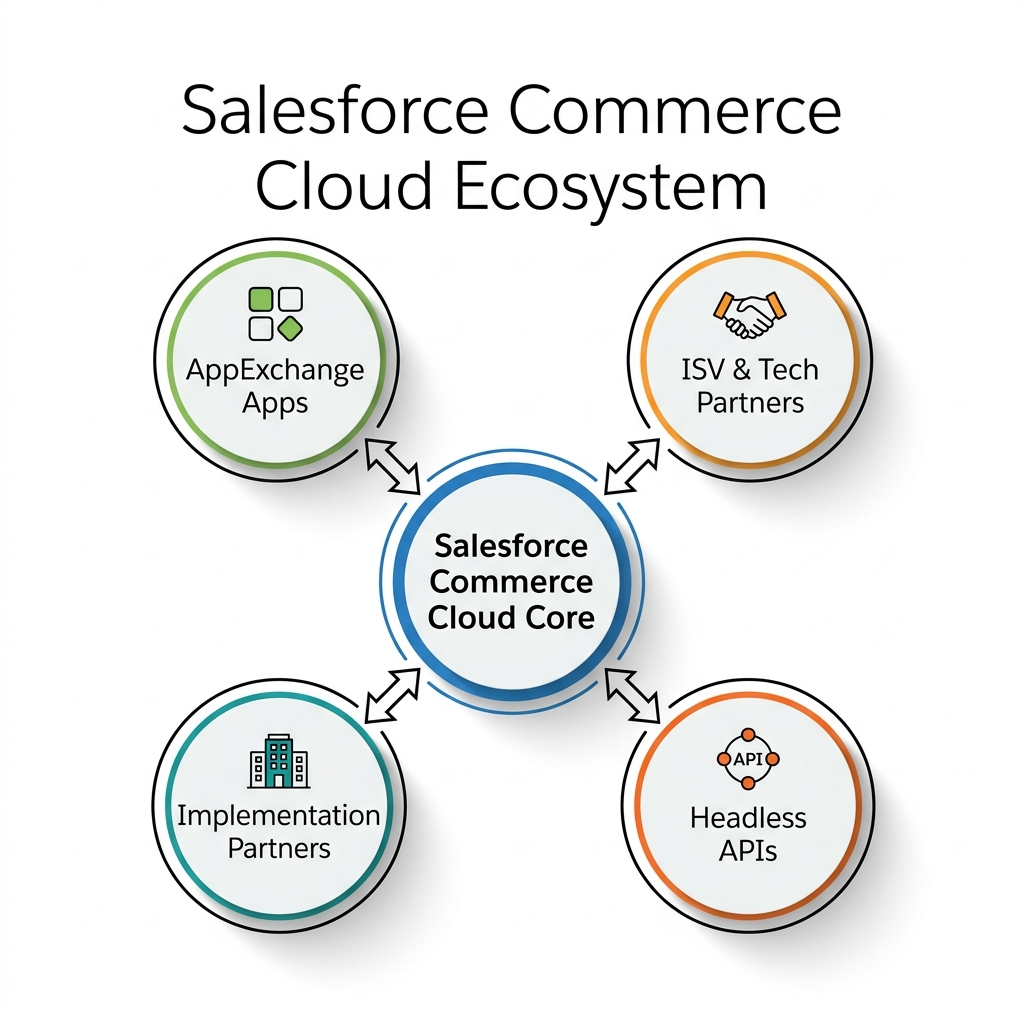
The power of Salesforce Commerce Cloud is amplified by its ecosystem. The AppExchange offers thousands of pre-built integrations covering payments, shipping, loyalty, and more. A retailer can add a loyalty program like LoyaltyPlus or a payment gateway like Stripe with minimal custom code. For unique needs, a network of implementation partners—including Webuters’ Salesforce development services—provides deep technical expertise.
Headless commerce APIs enable front-end flexibility. The platform exposes REST and GraphQL APIs that decouple the presentation layer from the back-end engine. This allows brands to build custom mobile apps or progressive web apps using modern frameworks like React, while the back-end manages transactions, promotions, and inventory. For instance, a fashion retailer can launch a high-performance iOS app with a custom design system, yet reuse the same catalog and cart logic as the web store. The flexibility is immense, but it also requires skilled development resources.
A trade-off is complexity. A merchant might integrate a third-party fulfillment system, a headless front-end, and an Agentforce agent—each requiring configuration and maintenance. A partner ecosystem eases this, but success usually hinges on an implementation partner who understands the architecture.
Unified Commerce Across B2C, B2B, and Order Management
Beyond AI and apps, Salesforce Commerce Cloud is fundamentally a commerce engine. It natively supports both B2C and B2B models on the same platform. B2C features include multi-site management, localized storefronts, and personalized catalogs. B2B adds account hierarchies, negotiated pricing, quote-to-cash workflows, and buyer roles. A hybrid brand can serve consumers through a direct-to-consumer site while running a wholesale portal for distributors—sharing customers, orders, and inventory in one system.
Unified fulfillment is also built in, centralizing order processing, shipping, and returns across all channels. Combined with real-time inventory visibility across retail locations, this enables buy online, pick up in store (BOPIS) and ship-from-store scenarios. The result is a consistent customer experience whether the transaction happens online, in-store, or through a sales rep.
This breadth is a key differentiator from lighter platforms that require third-party add-ons for B2B or fulfillment. But it also begs the question: who needs all this capability?
When Salesforce Commerce Cloud Is the Right Fit (And When It’s Not)
The answer depends on your business reality. The following table cuts through the demos.
| Criteria | Salesforce Commerce Cloud | Shopify Plus | BigCommerce Enterprise |
|---|---|---|---|
| Catalog Complexity | High (thousands of SKUs, variants) | Medium | Medium |
| Annual Revenue | $50M+ | $10M+ | $10M+ |
| Technical Team | Dedicated developers and admins | Small team or agency | Small team or agency |
| Integration Depth | Heavy CRM, ERP, OMS, custom logic | Moderate with apps | Moderate with apps |
| AI Capabilities | Built-in (Einstein, Agentforce) | Limited, via apps | Limited, via apps |
| Headless Support | Full via REST/GraphQL APIs | Partial (Storefront API) | Partial (APIs available) |
| Time-to-Market | 3-6 months (with partner) | 1-3 months | 1-3 months |
| Total Cost of Ownership | High (license + services) | Medium | Medium |
Salesforce Commerce Cloud shines for mid-market and enterprise brands with complex catalogs, multi-channel operations, and the internal technical muscle—or the partner budget—to manage it. If your annual revenue exceeds $50 million, you operate in multiple geographies, or you need deep CRM and OMS integration, the capabilities justify the investment.
But here is the honest truth: many businesses should not choose Salesforce Commerce Cloud. If your catalog is under 500 SKUs, your team is lean (no dedicated developers), and your budget is tight, a lighter platform like Shopify Plus or BigCommerce will likely deliver faster time-to-market at a lower total cost of ownership. Adopting this enterprise ecommerce platform in those conditions is like using a spaceship to drive to the grocery store—impressive, but impractical.
"The best platform isn't the one with the most features; it's the one that aligns with where you're going, not where you've been." – Webuters perspective
Making the Decision: A Framework for Evaluating Platform Fit
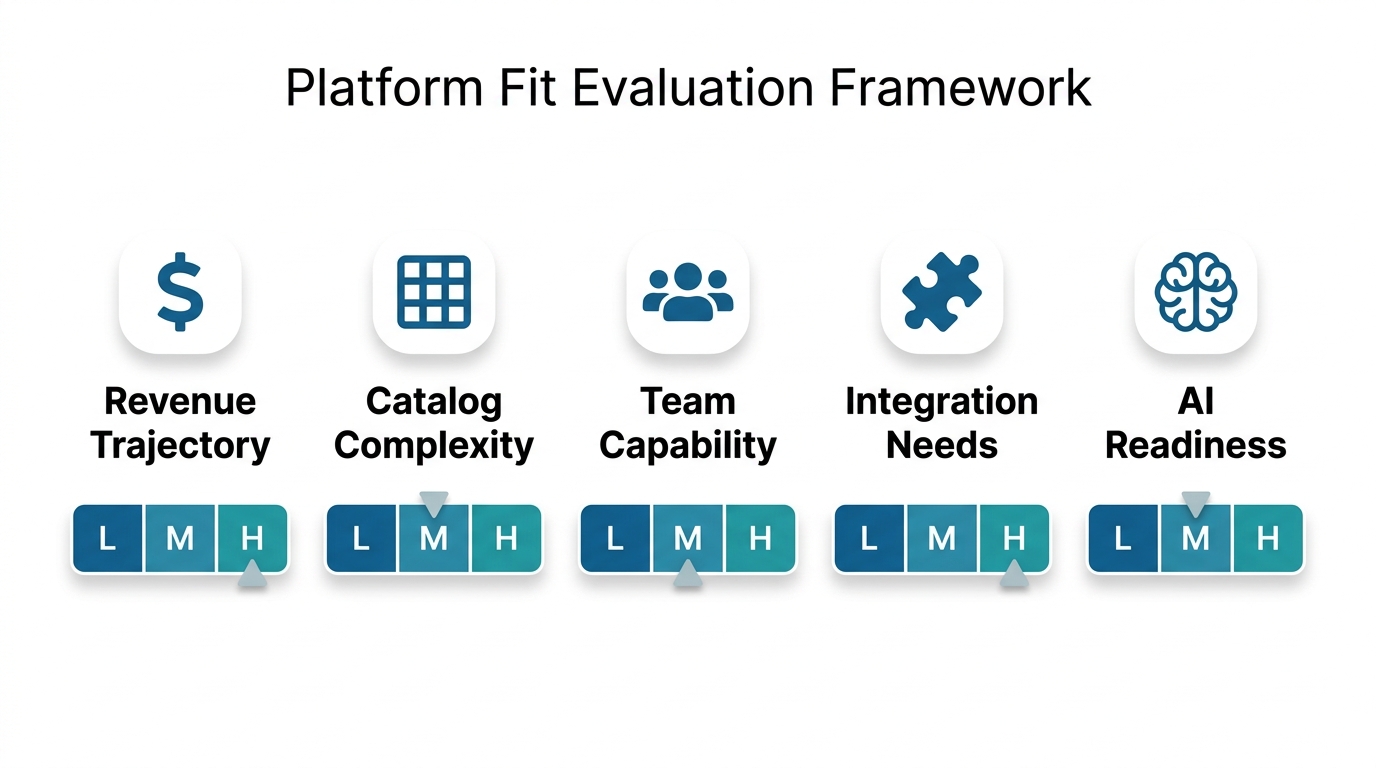
Return to the skyscraper analogy. Salesforce Commerce Cloud is architectural-grade concrete, engineered for towering ambitions. If you’re building a house, it’s overengineered and expensive. The right evaluation framework focuses on five factors: (1) revenue trajectory, (2) catalog complexity, (3) team capability, (4) integration needs, and (5) AI readiness. If you score high on most, this platform is a candidate worth exploring deeply—perhaps through a proof of concept on a specific use case, like testing Einstein recommendations on a segment of traffic to measure conversion uplift.
For the right business, the payoff is substantial: a unified, AI-driven commerce engine that can scale and innovate continuously. For others, the cost and complexity outweigh the benefits. That distinction matters because platform decisions lock in your roadmap for years.
If you’re weighing this decision, Webuters can help. Our team brings real-world implementation experience to assess your fit, not push a product. A no-obligation architecture discussion can clarify the trade-offs specific to your business.
Frequently Asked Questions
What is Salesforce Commerce Cloud?
It’s an enterprise ecommerce platform that supports B2C, B2B, and order orchestration. It offers AI-driven personalization, headless commerce APIs, and a vast app ecosystem. Mid-market and large brands use it for complex digital commerce.
What are the main benefits of Salesforce Commerce Cloud?
Key benefits include unified B2C/B2B commerce, high scalability for peak traffic, built-in Einstein AI personalization, a deep partner ecosystem, and continuous innovation through quarterly releases.
Is Salesforce Commerce Cloud suitable for small businesses?
Generally, no. Small businesses with fewer than 500 SKUs, lean teams, and limited budgets are better served by lighter platforms like Shopify Plus or BigCommerce, which offer faster time-to-market and lower overall cost.
What are Agentforce commerce agents?
They are AI assistants embedded in the platform that can autonomously handle customer service, order handling, and sales tasks—like answering queries or reshipping orders without human help.
How does Einstein personalization work?
Einstein uses real-time customer data to tailor product suggestions, search results, and promotions. It adapts to individual behavior to boost relevance and conversion rates.
What technical team is needed?
Brands typically need dedicated developers familiar with the Salesforce ecosystem, or they engage a certified implementation partner like Webuters to manage development and optimization.

Loading...