
Payment Gateway Providers in 2026: How to Choose and Integrate
You’ve spent an evening scrolling through “10 best payment gateway” posts, each crowning a different #1. One swears by Stripe; another insists Square is unbeatable; a third champions Adyen. You close the tabs more confused than when you started. Hidden fees, payout delays, integration headaches—the risk of choosing wrong feels personal.
That’s the real problem: not a shortage of providers, but a shortage of decision frameworks built around your business. The direct answer is simple but not simplistic: to choose the right payment gateway, match cost, methods, geography, payout speed, fraud tooling, and developer effort to your business. The leading providers—Stripe, PayPal, Adyen, Square, Braintree, and regional players like Razorpay—each solve different problems. No single gateway is “best” for everyone.
That’s the thesis of this playbook. A payment gateway isn’t just plumbing. In today’s commerce landscape, it’s a conversion surface, a trust signal, and a compliance boundary. The gateway you pick shapes checkout conversion, fraud exposure, and your PCI burden. Choose well, and payments fade into the background; choose poorly, and they become a constant source of friction.
In the sections ahead, we’ll clarify the payment ecosystem, walk through seven selection criteria, compare the leading providers in a practical table, and dive into integration best practices. Finally, we’ll look at what’s changing on the horizon: AI fraud scoring, wallet one-click, localized methods, and agentic checkout. Your next step is to turn this framework into a working, secure integration—and we’ll close with how Webuters can help you do exactly that.
Payments Are the Last Mile of Trust
Imagine selecting a logistics partner solely on shipping cost, ignoring route coverage, delivery speed, or package handling. It’s the same with payment gateway choices. The cheapest processor can cost you more in lost sales, fraud, and engineering hours than you save in fees.
A payment gateway isn't a checkout tool; it's the last mile of your customer's trust journey. That insight matters because a gateway does much more than authorize transactions. It frames the final interaction before purchase, collects sensitive data, and either reinforces or erodes confidence. A clunky, unfamiliar checkout increases cart abandonment. A security breach destroys trust. Conversely, a smooth, localized, one-click experience signals that you respect the customer’s time and preferences.
In 2026, gateways are intelligence layers. They apply AI to detect fraud, adapt to local payment methods automatically, and support wallet-based one-click flows. Picking a gateway isn’t about finding the best tech; it’s about choosing a partner that aligns with your commercial model and customer experience. Consider a SaaS startup that might lean on Stripe’s developer-friendly API and ecosystem, while a global retailer might need Adyen’s broad local method coverage. The mismatch costs are real: a subscription business without intelligent retry logic sees churn spike; a cross-border shop without local methods struggles to convert.
To avoid those missteps, you first need to understand the ecosystem’s components. Let’s clarify the roles.
The Payment Ecosystem: Clearing Up the Gatekeeper’s Role
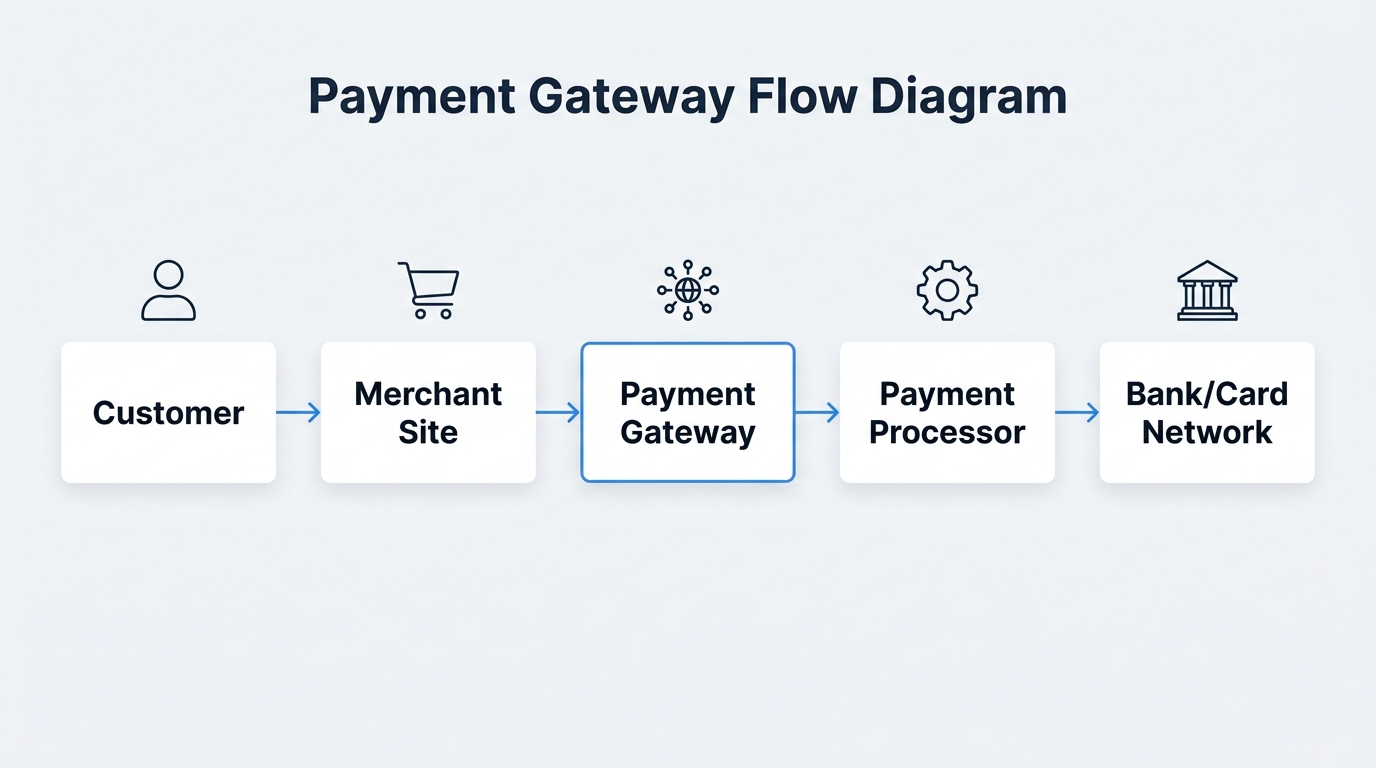
Many teams confuse the payment gateway with the processor and merchant account. Here’s the straightforward breakdown:
- Payment gateway: the front-end technology that captures and transmits transaction data securely. It’s the digital equivalent of a point-of-sale terminal for online payments.
- Payment processor: the back-end service that communicates with card networks and banks to authorize and settle funds.
- Merchant account: a holding account where settled funds sit until they’re paid out to your business bank account.
A payment gateway provider like Stripe bundles all three into one service, which simplifies contracting and reconciliation. Others, like older setups, require separate relationships. Understanding this distinction helps you evaluate whether a provider offers a full stack or only part of the puzzle. If you’re building a custom integration, product engineering services can help wire these pieces together without building from scratch.
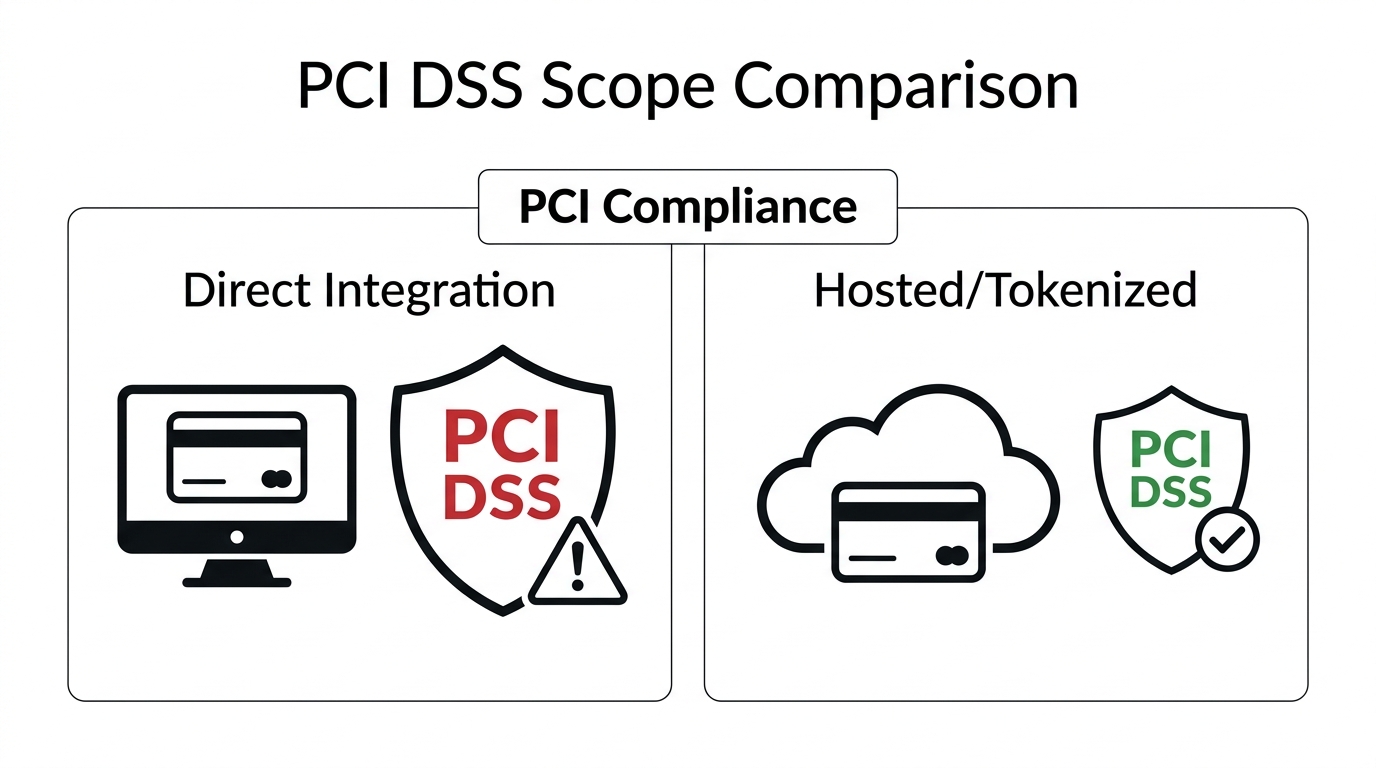
The distinction matters because your compliance and operational overhead are shaped by who handles what. For instance, if you use a hosted gateway that tokenizes cards, you offload PCI DSS scope to the provider. That’s a strategy we’ll explore later. Now, with roles clear, let’s apply a structured framework to choose the right payment gateway.
How to Choose the Right Payment Gateway: 7 Decision Criteria
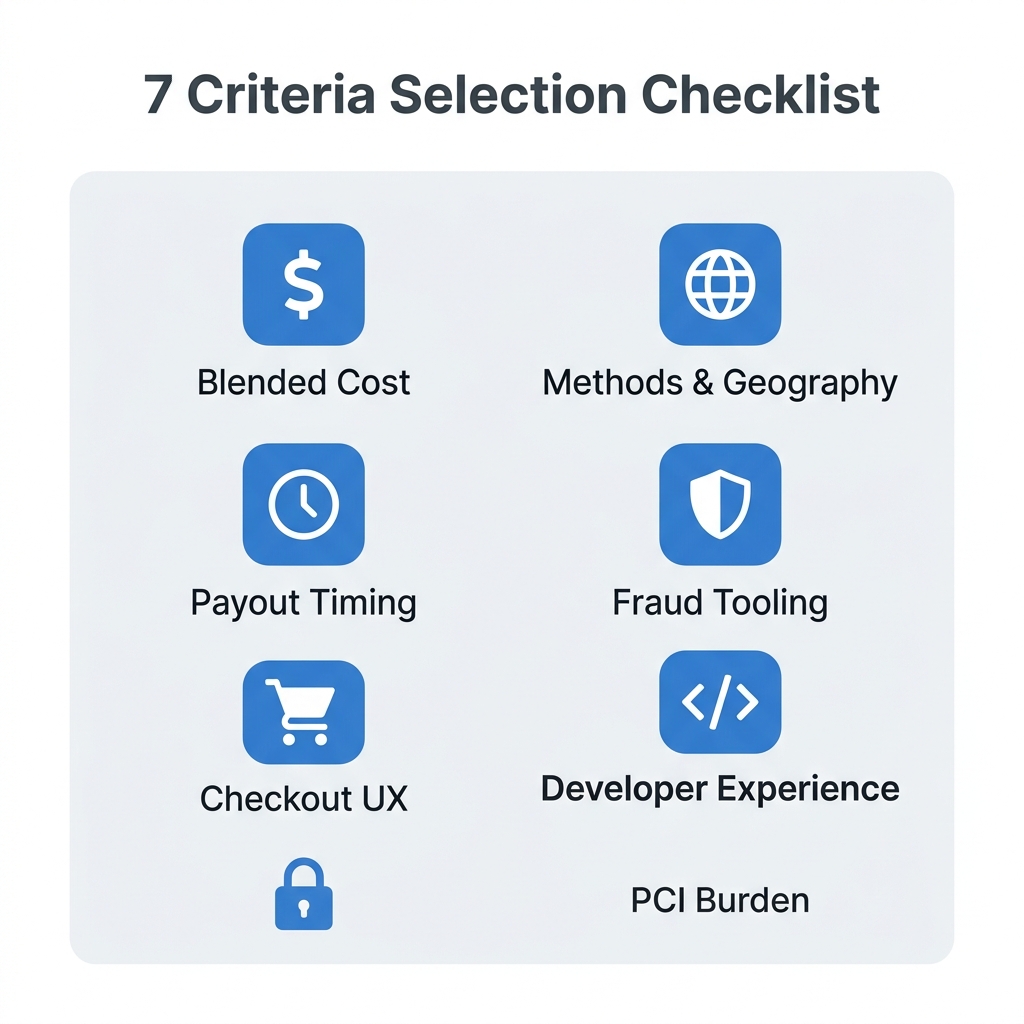
Selecting a gateway without criteria is like buying a car based on color. These seven dimensions will frame a business-first evaluation. A well-chosen payment gateway should align with your specific operational model, not just your budget.
Blended cost and fees
Look beyond the advertised transaction rate. Calculate the total cost: setup fees, monthly fees, chargeback fees, international surcharges, and currency conversion markups. Gateways often publish pricing models; verify them directly. The cheapest per-transaction rate can hide a higher chargeback fee that erodes your margin.
Supported payment methods and geographies
Assess whether the gateway supports the cards, digital wallets (Apple Pay, Google Pay), buy-now-pay-later options, and local methods (like iDEAL in the Netherlands or UPI in India) that your customers expect. A gateway strong in one region may be weak in another. For example, Adyen’s strength is its breadth of local methods; Razorpay dominates India’s UPI ecosystem. Missing a preferred method can tank conversion in that market.
Payout and settlement timing
Cash flow matters. Compare daily vs. batch payouts and the hold period before funds become available. Some gateways offer next-day settlement; others hold for several days. If you run a high-volume business, daily payouts can smooth operations.
Chargeback and fraud tooling
Fraud scoring, 3-D Secure (adaptive or static), and custom rules are now table stakes. Gateways like Stripe Radar and Adyen’s RevenueProtect use machine learning to block fraud while approving legitimate transactions. Choose a gateway whose fraud tools match your risk profile. A high-risk industry needs stronger defaults and real-time alerts.
Checkout UX and conversion impact
Your checkout flow directly influences cart abandonment. Hosted payment pages (where the customer is redirected to the gateway’s domain) can reduce friction if well-designed, but they may feel disjointed. Embedded or direct integrations keep customers on your site but increase PCI scope. In the current landscape, wallet one-click and express checkouts (like PayPal’s) are widely seen as a key lever to shorten time-to-completion. The gateway’s mobile optimization, autofill support, and speed all affect conversion. The best payment gateway for website traffic will optimize these elements seamlessly.
Developer experience and API quality
Have your engineering team evaluate the documentation, SDKs, sandbox environment, and webhook reliability. A gateway with a clean API, well-maintained client libraries, and responsive support can dramatically reduce development time and frustration. For example, some teams find Stripe’s API particularly clean, while others prefer Braintree for its flexibility. A poorly documented gateway leads to brittle code and delayed go-lives.
PCI/security burden
Any system that handles card data must comply with PCI DSS. The burden can vary wildly. Gateways that offer tokenization and hosted payment fields (like Stripe Elements or Adyen’s Drop-in) shrink your scope significantly. Instead of building a secure card data environment, you only need to complete a simpler self-assessment questionnaire. If you must handle raw card data directly, your security obligations—and audit costs—escalate. Look for a payment gateway service provider that prioritizes security certifications.
Use these seven criteria as your guide, but remember they are a lens, not a prescription. How you weight them depends on what drives your business—there is no universal ranking that fits every company. A B2B invoicing platform will prioritize invoice-based methods and recurring billing APIs; a consumer marketplace will emphasize instant payouts and multi-currency support. The exact weighting is a strategic choice you make, not a universal rule.
With this criteria in hand, you can now compare the leading players objectively.
2026’s Leading Payment Gateway Providers Compared
No rankings, just mapped fit. The table below highlights what each provider does best, so you can align strengths with your needs. Each of these providers has carved a niche.
| Provider | Best For | Methods & Geography Strength | Integration Model | Standout 2026 Capability |
|---|---|---|---|---|
| Stripe | Developers, SaaS, platforms | Global cards, wallets, broad method support | Hosted/API | Advanced AI fraud scoring (Radar) |
| PayPal | Brand trust, small businesses | Global cards, PayPal wallet, Venmo | Hosted/API | One-click with PayPal/Venmo wallet |
| Adyen | Global enterprise, local methods | Broad local method coverage | API/embedded | Broad local method coverage |
| Square | Omnichannel retail | Cards, contactless, POS | Hosted/POS | Seamless in-person + online integration |
| Braintree | Customization + PayPal | Global cards, PayPal, digital wallets | API/embedded | Flexible customization and PayPal integration |
| Razorpay | India-focused businesses | UPI, cards, netbanking, wallets | Hosted/API | Deep India-specific method support |
Note: Provider capabilities evolve. Verify current offerings and pricing on their websites.
Take Stripe: its programmatic API and extensive documentation make it the default for many SaaS teams. But if you’re a brick-and-mortar retailer expanding online, Square’s unified POS and e-commerce play might save you operational headaches. This is not about picking the one with the most features; it’s about eliminating those that don’t fit your prioritized criteria.
Choosing is step one. The more overlooked step—and the one that determines whether you lose money to downtime or compliance missteps—is integration.
Integrating It Right: Security, Tokenization, and Conversion
A poorly integrated payment gateway is worse than a poor choice. Here’s how to integrate it securely and for conversion. The underlying payment gateway architecture must be sound.
Shrink your PCI DSS scope first
PCI DSS compliance can be sprawling if you store or touch raw card numbers. Choose a hosted or tokenized integration model. With hosted payment pages (like Stripe Checkout or PayPal Standard), the card data never enters your server. Tokenization—where the gateway replaces the PAN with a token—lets you process recurring payments without storing sensitive data. According to the PCI Security Standards Council, scoping guidance emphasizes that eliminating the storage, processing, or transmission of cardholder data can dramatically reduce the assessment effort. Stripe’s integration security guide also notes that tokenization is a recommended approach to limit exposure.
Hosted vs. embedded: pick your trade-off
Hosted checkouts redirect customers away from your site, which can hurt conversion if the experience feels disjointed. However, they carry minimal PCI scope. Embedded integrations (using inline frames or SDK components) keep the customer on your domain, which can preserve branding and flow, but they elevate your security responsibilities. A middle ground: use a gateway’s embeddable hosted fields that tokenize on the frontend—Stripe Elements and Braintree’s Drop-in are common examples. They keep the look native while still keeping raw data off your server.
Webhooks: your reconciliation backbone
Webhooks notify your system of payment events—success, failure, chargeback, refund—in real time. Relying on them, rather than polling, ensures timely order fulfillment and accurate reporting. Test each webhook endpoint thoroughly in the sandbox and implement idempotency to avoid duplicates.
Sandbox and testing
Before going live, run end-to-end transactions in the gateway’s sandbox. Test edge cases: declined cards, expired cards, 3-D Secure challenges, partial refunds. Simulate network timeouts and verify your error-handling logic. A single unhandled failure can block the checkout flow entirely.
Integrating this way turns the gateway into a conversion lever, not a compliance liability. For many teams, this is where working with e-commerce development services experience accelerates delivery. When we migrated a leading apparel store from Magento to Shopify, the payment gateway integration had to be flawless—no lost orders, no downtime, and a checkout that converted better than the old one. That’s the standard worth aiming for.
What’s Changing on the Horizon: AI, Wallets, and the Next Wave of Checkout
The gateways you evaluate today are already evolving. These shifts aren’t speculations; they’re capabilities that should appear on your evaluation checklist.
- AI-based fraud scoring and adaptive 3-D Secure: Static rule engines are giving way to machine learning models that reduce false declines in some implementations. Gateways are now applying AI to assess risk in real time and only challenging transactions that genuinely look suspicious. This directly lifts conversion for legitimate customers. The best payment gateway providers are investing heavily in these capabilities.
- Wallets and one-click express checkout: Digital wallet adoption continues to climb. Apple Pay, Google Pay, and PayPal one-click offer customers a frictionless path. Gateways that don’t support these natively fall behind in conversion.
- Localized payment methods as a growth lever: For global businesses, supporting methods like UPI in India, iDEAL in the Netherlands, and Klarna’s BNPL in Europe isn’t optional. Gateways like Adyen and Razorpay differentiate on local method coverage.
- Emerging agentic and one-click checkout: We’re on the cusp of agentic payments—autonomous software agents that can complete purchases on a customer’s behalf within predefined parameters. Early examples include expressive wallet APIs and AI assistants that handle subscriptions. This area is still nascent, and in our view, as it matures, a gateway’s ability to expose fine-grained, secure API endpoints could become a meaningful differentiator.
These trends reinforce the idea that your online payment gateway is a strategic conversion surface. If your evaluation ignores them, the choice you make today may feel outdated within 12 months.
Your Next Step: Making the Right Payment Gateway Invisible
The right payment gateway, integrated well, becomes invisible. It works quietly while you focus on growth. The wrong one forces you into a cycle of patches, chargebacks, and missed sales. The playbook above gives you a framework to choose and integrate with confidence. A well-chosen payment gateway can be the difference between a thriving online business and a struggling one.
At Webuters, we’ve helped businesses engineer payment flows that secure transactions and improve conversion. Whether you need help evaluating providers, architecting a tokenized integration, or rebuilding your checkout for wallets and local methods, our product engineering services and e-commerce development services can de-risk the process. You can see how we handled a full-stack migration, including payments, in our Magento to Shopify migration case study.
Which payment gateway will you choose for your business? If the answer isn’t clear yet, a practical conversation can sharpen it. Reach out, and let’s turn the playbook into a plan.
Frequently Asked Questions
How does a payment gateway differ from a payment processor?
A payment gateway is the front-end technology that captures and encrypts customer payment data for transmission. A payment processor handles the backend communication with banks and card networks to authorize and settle the transaction. Many modern providers bundle both functions.
What is the most important factor when choosing a payment gateway?
There is no single most important factor; the right gateway depends on your business model. Prioritize a fit across cost, supported methods, geographies, payout timing, fraud tools, checkout UI, developer experience, and PCI burden. A global e-commerce store will value local payment method support and foreign exchange rates more than a domestic subscription SaaS. The best payment gateway for website operations balances all these factors.
Can I integrate a payment gateway myself?
Yes, many gateways offer well-documented APIs, SDKs, and sandbox environments. For simple implementations, a frontend developer can add a hosted checkout. However, for custom checkout flows, complex recurring logic, or deep integration with an existing platform, product engineering expertise ensures a secure, high-converting result.
How can I reduce PCI DSS compliance burden with my gateway?
Use a hosted payment page or tokenized embedded fields that keep raw card data off your server. These models transfer most security responsibility to the gateway provider and significantly reduce your PCI DSS scope, often allowing a simpler self-assessment questionnaire.
Are newer payment methods like wallets and BNPL worth supporting?
Yes. Digital wallets (Apple Pay, Google Pay) and buy-now-pay-later services reduce checkout friction and can increase conversion, especially on mobile. Gateways that natively support these methods, and keep up with regional preferences, give you a competitive edge.
What is the role of AI in modern payment gateways?
AI is used primarily for fraud detection and prevention. Gateways like Stripe Radar and Adyen’s RevenueProtect analyze transaction patterns in real time, reducing false declines and improving accuracy. This protects revenue while minimizing customer friction.

Loading...