
Hotel Fleet AI Is Not About Vehicles. It’s About Guest Experience You Can Actually See.
hotel fleet AI becomes relevant the moment a guest is standing at the airport, the concierge is checking three different channels for an update, the driver says he never received the latest timing, and nobody is fully sure which version of the trip is the real one. Transport feels invisible right up to the point where it fails in public.
That is the real problem. In many hotels, guest transport still runs through a patchwork of calls, spreadsheets, chat messages, paper slips, and late bill collection. One team logs the request, another assigns a vehicle, the driver gets the update somewhere else, and finance tries to reconstruct the story later from receipts and memory.
The case for hotel fleet AI is not that hotels need more software for the sake of it. The case is that transport needs to become a visible guest-service workflow. When assignment, status updates, trip tracking, slip generation, bill upload, and reporting live in one operating layer, the hotel gains clarity without removing people from the process.
That is the shift this article explores. We will look at why fleet management is really part of guest experience, where manual gaps appear in transport operations, how hotel fleet AI supports drivers and duty slips, how OCR improves trip records and bill handling, what real-time dashboards should show leadership teams, and what hotel leaders should check before they automate anything.
Why hotel fleet AI is part of guest experience
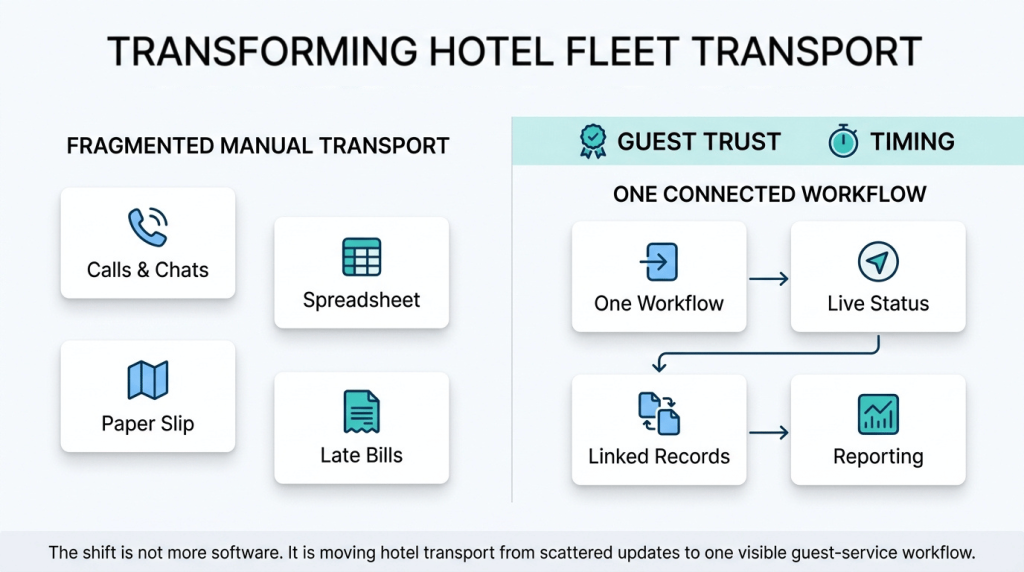
A guest does not experience hotel transport as an internal department. They experience it as arrival confidence, pickup reliability, timing, and trust. Airport pickup management, guest drop management, and chauffeur coordination are not back-office moments from the guest’s point of view. They are part of the stay.
That is why the usual framing of hotel fleet AI is too narrow. A delayed pickup does not stay inside transport operations. It spills into the concierge desk, the front office, guest sentiment, and later into billing and review workflows. One missed update can create service friction at the front end and administrative friction at the back end.
Hospitality technology platforms often treat operations as connected workflows. Oracle Hospitality and Oracle Hospitality documentation illustrate structured operational software and workflow context for hotels, while OpenTravel publishes standards that can support interoperability across travel systems. The practical takeaway is simple: transport should not remain the one important guest-facing workflow that still depends on scattered status messages.
A hotel vehicle is not just moving a guest from one place to another. It is moving trust, timing, and money through the operation.
A helpful analogy is this: many hotel transport workflows still behave like a paper relay race. One person takes the request, another relays it, someone updates a note later, and finance gathers the pieces afterward. hotel fleet AI works more like an air-traffic-control layer for guest movement, where every trip has a status, an owner, a document trail, and a next action.
For that reason, hotel fleet AI is really about making hotel fleet visibility part of the service promise, not an after-hours admin problem.
Where hotel fleet AI breaks down in manual transport workflows
The hidden cost in hotel fleet AI adoption is not only delay. It is fragmentation. Assignment may sit in a spreadsheet, status handling may happen over calls or messaging apps, and duty slips may be completed after the guest has already reached the destination.
This makes simple questions surprisingly hard to answer. Which vehicle was assigned to the airport pickup? Did the driver start on time? Was the guest boarded? Did the guest departure happen as planned? Has the parking receipt been attached? Is the toll image available? When those answers live in different places, hotel transport management becomes reactive by design.
The same problem shows up in compliance and finance. Driver document management and vehicle document expiry often sit outside the daily workflow, even though they affect service continuity. Expense capture and toll bill OCR may happen late, partially, or not at all, which leaves finance controllers reviewing transport costs without a clean operational trail.
Concierge teams usually feel this pain early. They are often asked for live answers by guests, but they do not always have a single source of truth for assignment, driver trip updates, or completion status. The result is more chasing, more uncertainty, and less confidence in the service promise.
| Workflow area | Manual approach | AI-enabled approach | Business impact |
|---|---|---|---|
| Airport pickup management | Booking passed through calls or chats | Request enters one workflow with status and ownership | Clearer arrival coordination |
| Guest drop management | Timing changes shared informally | Trip state reflects the live booking | Fewer missed handoffs |
| Driver updates | Driver calls or messages dispatcher manually | Status captured as start, en route, boarded, completed | Better service coordination |
| Slip creation | Slip created later from memory | Slip creation starts from trip assignment and completion events | Cleaner records and easier review |
| Expense tracking | Receipts collected at day end or later | Expense linked to the exact trip, vehicle, and driver | Better transport cost control |
| Toll receipt handling | Receipt image sits in chat threads | OCR extracts details into the trip record | Faster finance verification |
| Document expiry tracking | Separate manual reminder process | Alerts surface driver documents and vehicle expiry | Lower risk of missed renewals |
| Fleet reporting dashboard | Leaders assemble updates manually | Dashboard shows trips, exceptions, bills, and pending actions | Faster operational oversight |
How hotel fleet AI improves driver and duty slip visibility
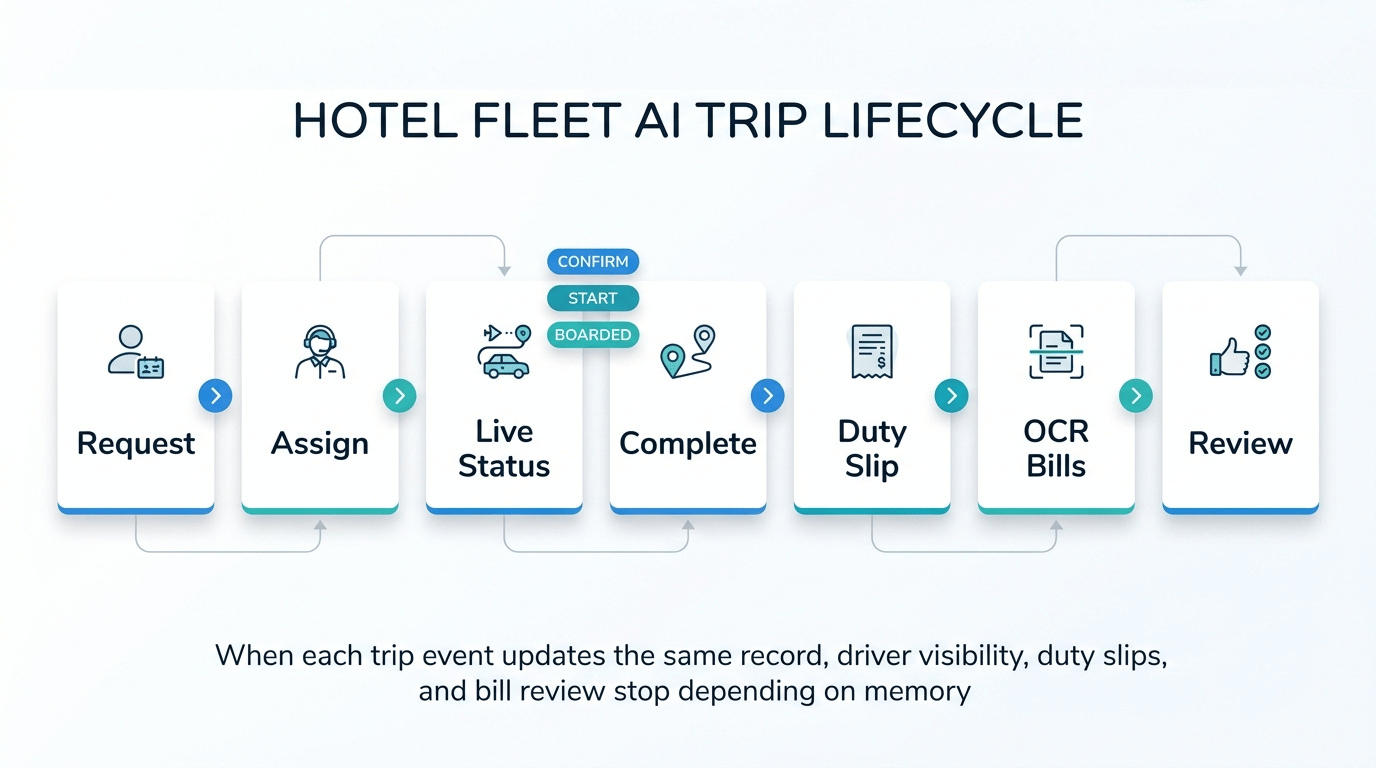
hotel fleet AI is best understood as a visibility layer for hotel transport operations. It does not replace the transport manager, concierge desk, or driver. It helps the hotel connect request intake, vehicle assignment, chauffeur coordination for hotels, trip state changes, and guest trip management in one workflow.
This is where hotel fleet AI becomes useful in very practical ways. A system can route a request to the right vehicle category, suggest or confirm vehicle assignment based on availability rules, capture driver trip updates, flag missing trip start status, and pre-fill trip details into a duty slip as events happen. Instead of asking staff to re-enter the same information in multiple places, the workflow carries it forward.
Responsible implementation matters here. The NIST AI Risk Management Framework provides guidance for managing AI risks, and Microsoft’s AI adoption guidance in the Cloud Adoption Framework covers planning, governance, and adoption. In simple words, hotel fleet AI should be governed, explainable, and tied to a real process rather than added as a black box.
A practical use case for hotels is the blend of structured workflow and selective intelligence. Structured steps handle trip creation, assignment, and duty slip generation. Intelligence helps normalize messy inputs such as guest notes, driver messages, or bill images. This is also where well-designed generative AI solutions can support unstructured transport communication without turning the whole operation into a complicated technical project.
A concrete workflow example makes this easier to see.
A guest requests an airport pickup through the concierge or reservation desk. The request captures guest details, arrival timing, terminal information, vehicle preference, and any service notes.
The hotel transport management system then assigns a vehicle and shares the trip with the selected driver. The driver receives the assignment, confirms availability, and the trip appears with a live status for concierge and transport teams.
When the driver starts, the system records trip start status. When the guest boards, the status updates again. When the guest reaches the hotel, the trip closes, and the duty slip is created or updated from the actual journey data rather than from memory.
After the trip, the driver uploads fuel, parking, or toll documents. Those documents attach to the trip, vehicle, and driver record. Finance sees one review trail instead of a pile of disconnected updates.
That is the real answer to the question, “How can hotel fleet AI help hotel transport operations?” It gives every trip a visible path from request to review.
Why OCR matters for transport bills and trip records
Trips are only half the story. The paperwork around them is usually where cost control breaks down. Receipts and supporting notes often arrive late because they depend on drivers sending images, staff renaming files, and finance figuring out which trip the expense belongs to.
OCR changes that by converting transport receipts into usable records. A parking bill can be uploaded after hotel fleet AI handles the trip closeout and linked to the exact duty slip. A toll document can be read, tagged, and attached to the airport pickup record before finance starts its review. The point is not to remove finance judgment. The point is to stop wasting finance time on basic reconstruction.
Hotel duty slip Automation also becomes stronger when trip and document workflows are connected. If the system already knows the guest, assignment, driver, route type, start and end status, and uploaded bills, the slip becomes a living record rather than a separate paper artifact completed later.
The same logic applies to document governance. Driver document management and vehicle document expiry should sit inside the same visibility layer because they directly affect dispatch decisions. If a license, permit, or vehicle document is approaching expiry, the operations team should see that before the assignment happens, not after a problem appears.
A driver finishes a transfer, uploads a parking receipt, and the image is tied to that guest trip automatically. A toll receipt is read through OCR and attached to the same record. Finance reviews a complete trip file instead of searching messages and folders.
For repetitive follow-up tasks, workflow automation can also sit alongside human review. This is where targeted RPA development can help with reminders, document collection steps, or exception routing after the trip is done.
What real-time fleet reporting should show hotel leaders
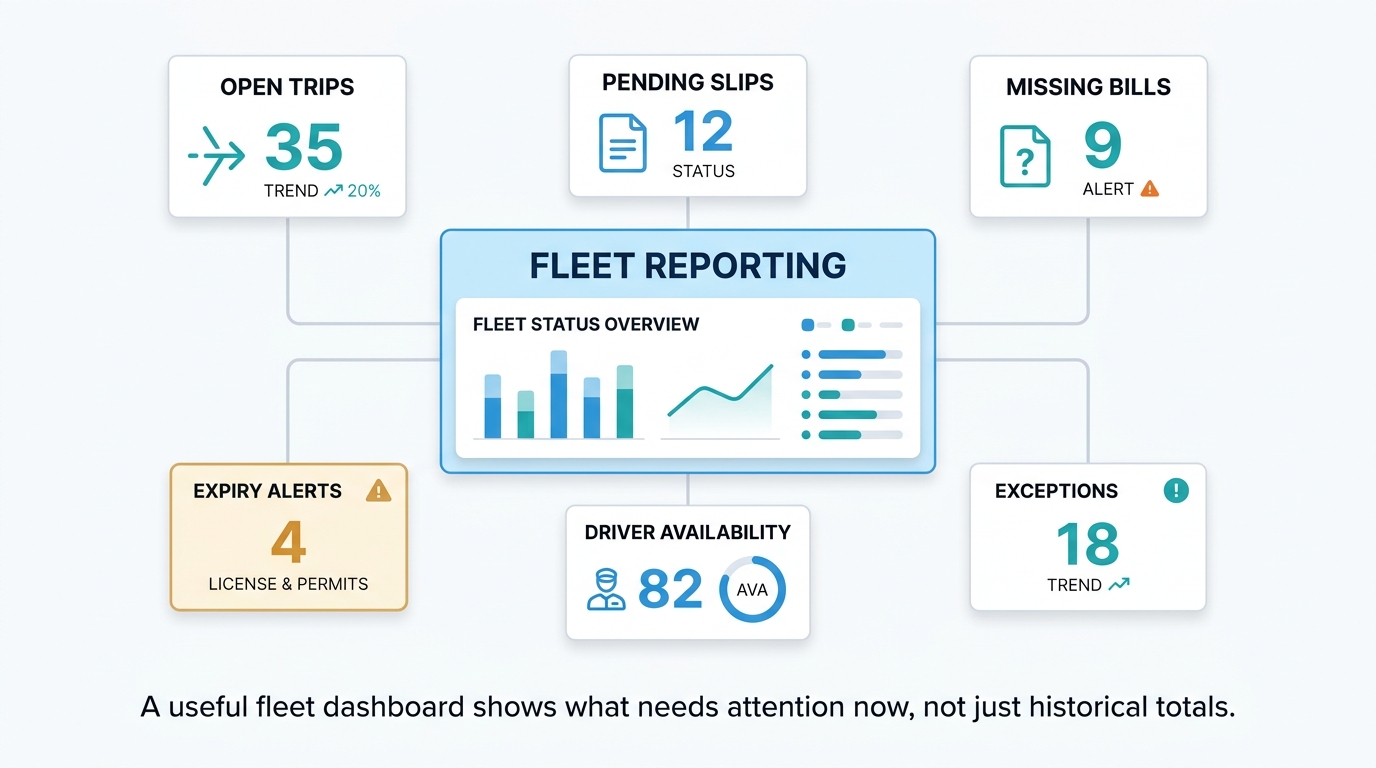
Leaders do not need another dashboard full of vanity metrics. They need an operational view they can trust. A useful fleet reporting dashboard should show open trips, completed trips, pending slips, missing bill uploads, document expiry alerts, driver availability, assignment patterns, and exception cases that still need action.
This matters because transport problems usually appear as patterns before they appear as crises. One property may have repeated gaps in status updates. One vehicle type may show delayed bill uploads. One driver pool may require extra document follow-up. Without reporting, those issues stay trapped inside daily firefighting.
Connected cloud architecture is relevant here because reporting only works when the workflow data is brought together. AWS travel and hospitality guidance is useful context for connected cloud capabilities in travel and hospitality environments. For hotel leaders, the implication is practical rather than technical: if trip, driver, bill, and document data can be unified, transport oversight becomes much easier.
A good hotel vehicle management system should also be understandable to non-technical managers. Operations leaders should be able to see where concierge transport coordination is stalling. Finance controllers should be able to review transport cost control without asking for manual reconciliations. Owners should be able to spot whether service reliability is improving because the workflow is visible, not because someone produced a nicer spreadsheet.
That is where hotel fleet AI stops being a back-office improvement and starts becoming an executive visibility layer. The dashboard is not just a reporting surface. It is the operating summary of guest transport.
FAQ: hotel fleet AI for hospitality teams
What is AI fleet management for hotels?
hotel fleet AI is a workflow-based way to manage guest transport with better visibility. It connects requests, vehicles, drivers, slips, expenses, and reporting so transport can be managed as part of guest service, not as a disconnected admin task.
How can AI help hotel transport operations?
hotel fleet AI can help by keeping transport data updated across the full trip lifecycle. It can support request routing, assignment, status tracking, slip creation, exception alerts, and document capture while hotel staff remain in control.
How can hotels automate duty slips?
Hotels can automate slips by generating or pre-filling them from live trip data such as guest details, assigned driver, assigned vehicle, timestamps, and uploaded bills. That reduces after-the-fact manual entry and improves record quality.
How can hotels track drivers and guest trips?
Hotels can track drivers and guest trips by using one transport workflow with visible statuses for assignment, dispatch, trip start, guest boarding, completion, and linked documents. This gives concierge, transport, and finance teams a shared view.
How can AI improve hotel transport operations?
hotel fleet AI improves hotel transport operations by reducing blind spots across concierge coordination, driver communication, slip handling, bill capture, and reporting. The main benefit is clearer visibility and accountability from request to review.
Before you automate, make the workflow visible
Before any hotel adopts hotel fleet AI, the first step is not a platform decision. It is workflow clarity. A practical starting point is to trace one real guest trip from request to billing review and document every handoff.
Ask a few direct questions. Where do trip requests originate today? Who confirms assignment? How are updates recorded? When is slip generation triggered? Where do fuel, toll, and parking bills go? Who reviews exceptions when something is missing?
If the answers sit across multiple tools, people, or channels, that does not mean the hotel is behind. It means the workflow needs to be mapped before it is automated. This is often where AI consulting services help hospitality teams separate real automation opportunities from process noise.
For many groups, the next requirement is not a brand-new stack but better system connection. If transport data needs to connect with PMS, ERP, finance tools, or property-level workflows, then integration and migration becomes part of the operating design rather than an afterthought.
A good hotel fleet AI pilot should define the pilot scope, the transport roles involved, approval points, exception rules, and the integrations required before any automation goes live. Start with one route type, such as airport pickup, then confirm how requests, driver assignment, guest boarding, duty slip creation, receipt upload, and finance review will move from one owner to the next.
Hotel fleet AI also needs role-based visibility. Concierge teams may need guest-facing trip status, drivers may need only their assigned trips, transport managers may need exception and document views, and finance teams may need bill evidence without unnecessary guest details. That governance layer keeps hotel fleet AI practical, auditable, and respectful of guest data.
A short fleet-readiness checklist for hotel leaders can help keep the work grounded:
- Identify where airport pickup and guest drop requests originate.
- Confirm who owns assignment and backup assignment decisions.
- Check how status updates and completion status are recorded.
- Map when and how duty slip generation happens.
- Verify how fuel tracking, parking receipt upload, and toll receipt OCR should flow into finance review.
- List all driver documents and vehicle expiry items that need alerts.
- Decide which exceptions require human approval and which repetitive steps can be automated.
Hotel fleet AI works when the trip stays visible from request to review
The real value of hotel fleet AI is not that it makes transport look more advanced. It is that it makes transport accountable. When one workflow connects guest trip management, driver coordination, slips, bills, and reporting, the hotel can serve guests with more confidence and manage transport with more discipline.
That shift matters across teams. Concierge gains clearer service coordination. Drivers receive better assignment visibility. Transport managers see exceptions earlier. Finance gets cleaner records for review. Leadership gets a more reliable picture of service and cost without waiting for manual reconciliation.
Hotels do not need AI to replace dispatchers, drivers, concierge staff, or finance reviewers. They need hotel fleet AI to give every trip a visible path from request to review.
When transport is visible, guest service becomes easier to trust and easier to manage. The executive takeaway is simple: hotel fleet AI works only when every trip stays visible from request to review.
If your hotel transport workflow still depends on memory, chat threads, and end-of-day reconstruction, this is the right moment to rethink it. Webuters can help you design practical hotel fleet AI automation for fleet operations, driver coordination, and guest transport visibility without turning the operation into a technology project for its own sake.

Loading...