
The Personalization Gap in Hospitality: Why Hotels Fail to Know Their Guests (And How AI and Unified Data Close It)
AI guest personalization starts with fixing the data architecture that keeps guest insights locked in silos. That is the real problem. For all the talk of guest-centricity, most hotels still treat repeat visitors like strangers, offering generic communications and standard amenities that ignore everything the property already knows about them. It’s a familiar friction, one that slowly erodes loyalty and leaves revenue on the table.
The root of this gap isn’t a lack of desire to personalize. It’s that guest data sits trapped in silos: the property management system, the CRM, the booking engine, the POS, and WiFi logs. These systems rarely speak to each other, so the data never combines into a full, actionable picture of the guest. As a result, even the best-intentioned personalization efforts hit a wall.
If you think AI guest personalization is only about flashy tech, you are wrong! It is about unifying data so that AI has something meaningful to work with. When you create a single dynamic identity for each guest and apply AI across the journey, you can deliver the tailored experiences that travelers now expect. In practice, this means honoring room preferences, offering upsells that feel helpful, and following up in ways that show you remember the person, not just the transaction.
In this article, we’ll examine exactly what guests expect versus what hotels actually deliver, why fragmented data blocks personalization, how to move from static profiles to dynamic identity models, and how to operationalize AI guest personalization across pre-arrival, in-stay, and post-stay moments. We’ll also cover measurement and a practical roadmap to close your own gap.
What Guests Expect vs. What Hotels Deliver
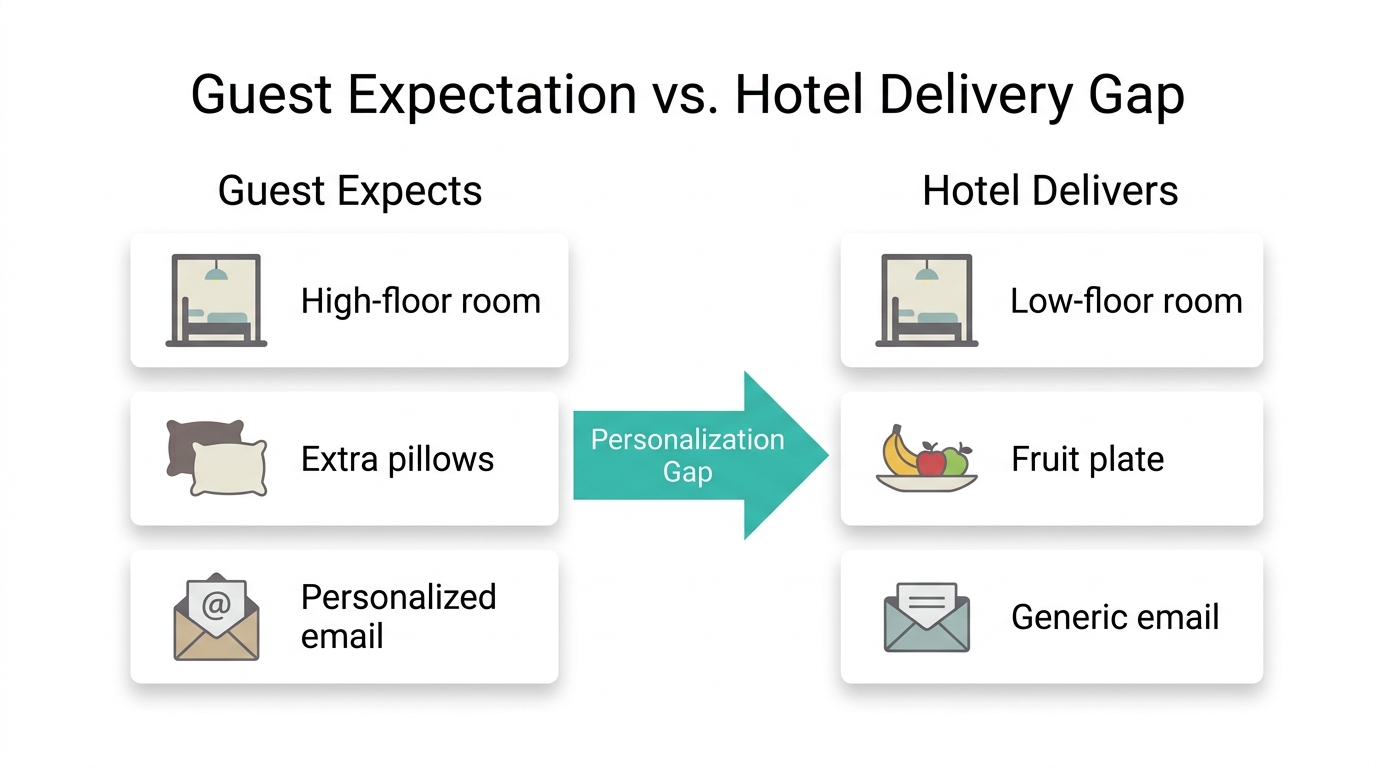
Guests are voting with their wallets. McKinsey found that 71% of consumers expect companies to deliver personalized interactions, and 76% get frustrated when this doesn’t happen. Meanwhile, companies that excel at personalization generate 40% more of their revenue from personalization than slower-growing counterparts. Yet the experience on the ground often falls flat. This is where AI guest personalization can make a real difference, it helps hotels meet those rising expectations.
Consider a returning business traveler who always books a high-floor room, requests extra pillows, and never touches the minibar. She arrives to find a standard low-floor room with a fruit plate and a minibar key on the desk. The GM may honestly believe they’re delivering a “welcome gift,” but the guest feels like a stranger. Worse, she then receives a generic pre-arrival email for her next stay offering a breakfast package, ignoring her history of skipping breakfast entirely. These aren’t hypotheticals. They represent the daily reality for most hotels.
The gap persists because the data needed for effective personalization is scattered and incomplete. When the PMS says one thing and the CRM says another, the front desk has no way to know what this guest actually values. The result is wasted offers, lower repeat rates, and a loyalty that’s built on points rather than genuine recognition. To bridge this gap, AI guest personalization must first solve the data fragmentation beneath it.
Why Fragmented Data Blocks Personalization
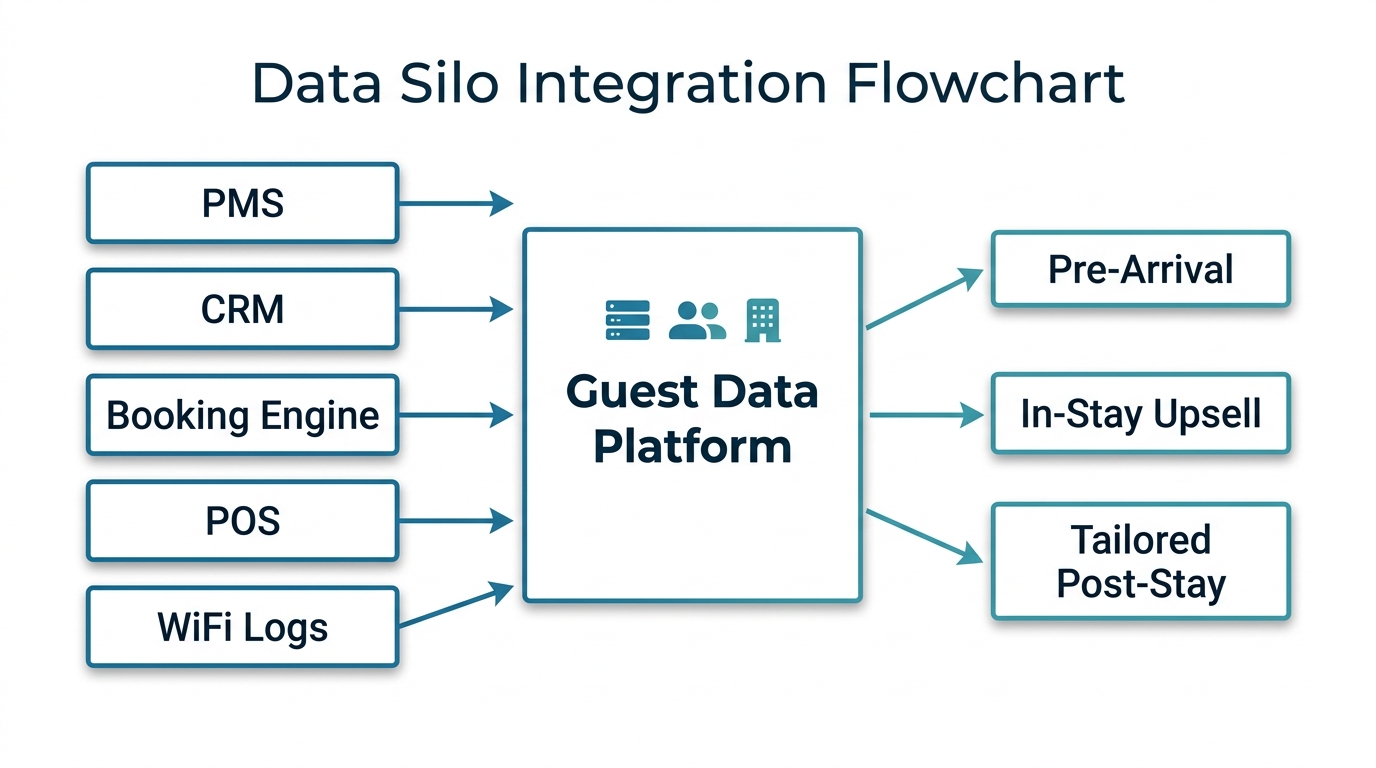
The guest data platform hotels need is a centralized repository that unifies all guest data from disparate systems into a single, actionable profile. Without it, a hotel’s tech stack works in isolation: the PMS knows room history, the CRM tracks loyalty points, the booking engine captures search behavior, the POS records on-site spending, and WiFi logs session data. These systems rarely talk to each other, creating a fractured view of each guest.
For instance, the PMS might show a guest booked a suite, but the CRM reveals they only redeem points for standard rooms. The booking engine may indicate a preference for quiet rooms, while the spa POS shows frequent deep-tissue massages—patterns that never get connected. This fragmentation leads to missed opportunities: room preferences ignored, upsells that feel random, and follow-up offers that have nothing to do with the guest’s actual behavior. AI guest personalization cannot work with siloed data; it needs a unified foundation.
The fix isn’t just collecting more data; it’s connecting the data you already have. When you integrate your systems unifying PMS, CRM, and booking data,you create a single source of truth that becomes the foundation for AI guest personalization. That’s where the real transformation begins.
From Static Profiles to Dynamic Guest Identity
Most hotels maintain static profiles that are manually updated and quickly stale. A dynamic identity model, powered by AI, is continuously refreshed from every interaction: bookings, stays, upsell acceptances, spa appointments, feedback, and even social media signals. Machine learning then enables behavioral segmentation not by generic demographics or loyalty tiers, but by predicted needs and propensities.
How does AI personalize the guest experience? It analyzes this stream of data to predict what a guest will want next. For example, a couple who always books a romantic package on their anniversary can automatically receive a champagne-and-roses setup on their next special date. A business traveler who skips breakfast but hits the gym can receive a pre-arrival email highlighting gym hours and a towel service offer. These are not one-off campaigns; they happen at scale, for thousands of guests, without manual intervention. This is the essence of AI guest personalization: delivering relevance at scale.
This shift from static to dynamic identity is what makes personalization operational. The AI continuously learns, so the profile gets smarter with every stay. The result is repeat guest recognition that feels genuine because it’s based on actual behavior, not just a loyalty number. The AI personalization thrives on dynamic profiles that evolve with each touchpoint.
Personalizing Pre-Arrival, In-Stay, and Post-Stay
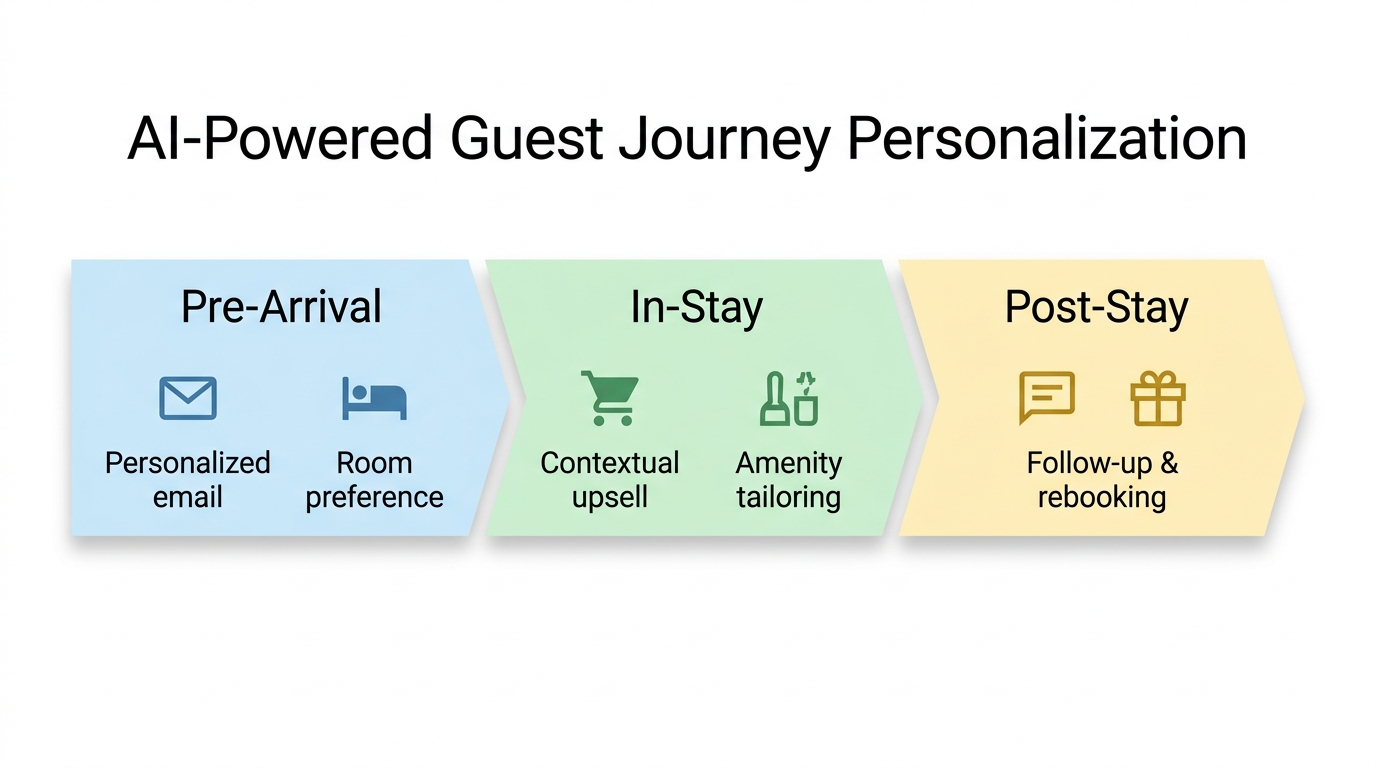
With a unified guest identity, hotel personalization at scale becomes a reality. AI guest personalization can flow across the entire journey, making every touchpoint feel intentional.
Pre-arrival: AI triggers personalized pre-arrival messaging based on room preferences and past spending. A family with young children, for example, might receive an email offering a kid’s activity pack and baby-proofing amenities. Effective preference capture here sets the stage for a tailored stay. AI guest personalization begins before the guest arrives.
In-stay: Context-aware upsell becomes possible. Real-time data: guest location, time of day, past behavior, inform what and when to offer. AI upsell recommendations hotels use analyze propensity to spend and channel timing to suggest relevant add-ons. After a long day, a guest might receive a push notification for a spa discount; if they lingered at the pool, a poolside cocktail offer appears. These aren’t generic blasts but timely, helpful nudges driven by real-time personalization hospitality. This approach directly boosts ancillary revenue. AI guest personalization during the stay drives immediate value.
Post-stay: The relationship doesn’t end at checkout. Tailored follow-ups reference specific experiences: “We hope you enjoyed the golf course, and we’ve saved your preferred tee time for your next visit.” Loyalty personalization AI powers offers, feedback prompts, and rebooking incentives that all reflect the guest’s history. End-to-end, generative AI for personalized guest journeys can craft messages that sound human and context-aware across email, SMS, app notifications, or in-room tablets. AI guest personalization extends beyond checkout to build lasting loyalty.
Measuring the Impact: What Happens When You Close the Gap
Do guests pay more for personalized stays? Research suggests they often value experiences that feel tailored. Moreover, personalization at scale drives performance: companies that grow faster derive 40% more of their revenue from personalization than slower-growing peers.
In practice, hotels that implement AI personalization for guests often see upsell take-up rates rise, repeat booking rates climb, and NPS scores improve. A midscale chain, for example, introduced AI-driven room-upgrade offers and saw a noticeable increase in acceptance for personalized recommendations over blanket promotions. A luxury resort that used dynamic profiles to tailor in-room amenities saw a lift in repeat business within a year. These outcomes validate the importance of personalization measurement.
To measure your own progress, track conversion rate by offer, incremental revenue per guest, repeat booking rate, and satisfaction trends. Use A/B testing to compare personalized versus generic groups, then feed results back into the AI models to continuously improve recommendation relevance. AI guest personalization is not a one-time project; it’s an optimization loop.
| Static Profile | Dynamic Identity Model |
|---|---|
| Manual updates, often outdated | Continuously updated from every guest interaction |
| Demographic and tier-based segmentation | Behavioral and propensity-based micro-segments |
| Generic offers for all guests in same segment | Personalized offers based on real-time context and prediction |
| One-size-fits-all communication across channels | Channel, timing, and preference-optimized messaging |
| Limited ability to adapt to changing guest needs | Real-time adaptation to in-stay behavior and preferences |
Your Roadmap to Closing the Personalization Gap
The personalization gap is not a mystery. It’s a data architecture problem with a clear fix. Start by auditing your data silos: map every guest data source and identify where the gaps are. Next, consider a guest data platform to unify everything into a single identity. Then, pilot AI guest personalization on one journey phase: pre-arrival is a good starting point and measure the lift over your baseline. Expand from there, and continuously refine based on outcomes.
This is where AI consulting for guest experience can give you a head start. Instead of building from scratch, you can partner with experts who have navigated the complexities of integration, AI modeling, and journey orchestration. A boutique hotel group that took this path with Webuters integrated their PMS and CRM and launched personalized pre-arrival emails. The result? They saw a meaningful lift in spa bookings within the first quarter.
The technology exists. The strategy is proven. The only question is whether you’ll move before your competitors do. If you’re ready to close your own personalization gap with AI guest personalization, talk to our AI team about personalization.

Loading...