
The End of Headcount-Driven Software Development: Why SDLC Intelligence Will Rule the AI Era
For years, software development followed a familiar pattern: when a project became bigger, companies added more people.
More developers. More testers. More business analysts. More project managers. More meetings. More handoffs. More status calls. More coordination.
The assumption was simple: if you want to move faster, increase the team size.
That assumption is now breaking.
Artificial intelligence is changing software development at the root. Not only by generating code, but by transforming the entire Software Development Life Cycle (SDLC).
The next generation of software delivery will not be won by the company with the largest engineering team. It will be won by the company with the strongest SDLC intelligence.
The future belongs to people who understand software deeply, think imaginatively, break problems into clear workflows, and use AI to move from idea to architecture, from architecture to design, from design to code, from code to testing, and from testing to production at a speed that traditional teams cannot match.
In simple words: the era of headcount-led software development is giving way to intelligence-led software development.
AI consulting is no longer optional. It is becoming a core capability for companies that want to modernize delivery, reduce operational friction, accelerate engineering velocity, and build smarter digital products.
The companies that adapt early will not just build software faster. They will redefine how software itself is created.
SDLC Was Never Just a Process. It Was Always a Thinking System
The Software Development Life Cycle is often misunderstood as documentation, project management, or a sequence of technical steps. In reality, SDLC is the thinking structure behind successful software.
IBM defines SDLC as a structured and iterative methodology used by development teams to build, deliver, deploy, and maintain software systems. Common SDLC phases include planning, analysis, design, coding, testing, deployment, and maintenance.
AWS describes SDLC as a cost-effective and time-efficient process that helps teams design and build high-quality software while minimizing project risks through forward planning.
This is important because AI does not remove the need for SDLC. It increases the value of SDLC.
AI can write code, but it does not automatically understand your business goal. AI can generate test cases, but it does not automatically know what failure means for your customer. AI can create a UI, but it does not automatically know which workflow will create the least friction for a real user. AI can suggest architecture, but it does not automatically understand your compliance, scalability, operational, and commercial constraints.
That is why the person who understands SDLC becomes more powerful in the AI era, not less.
A weak SDLC with AI creates fast chaos. A strong SDLC with AI creates record-speed delivery.
The future of software development will belong to teams that combine strong engineering fundamentals with intelligent automation, Gen AI services, cloud integration, legacy system migration, and AI-assisted delivery workflows.
AI consulting is becoming a strategic capability for organizations that want to modernize software delivery, reduce operational complexity, accelerate digital transformation, and build scalable products faster than traditional development models allow.
AI Is Not Just Entering Coding. It Is Entering Every Stage of SDLC.
Most companies first experience AI as a coding assistant. That is understandable. Code generation is visible, exciting, and easy to demonstrate.
But the real transformation is bigger.
AI can support requirement discovery, user story creation, workflow mapping, data-flow diagrams, architecture options, UI wireframes, API design, database modeling, test planning, documentation, DevOps scripts, release notes, monitoring plans, and production support.
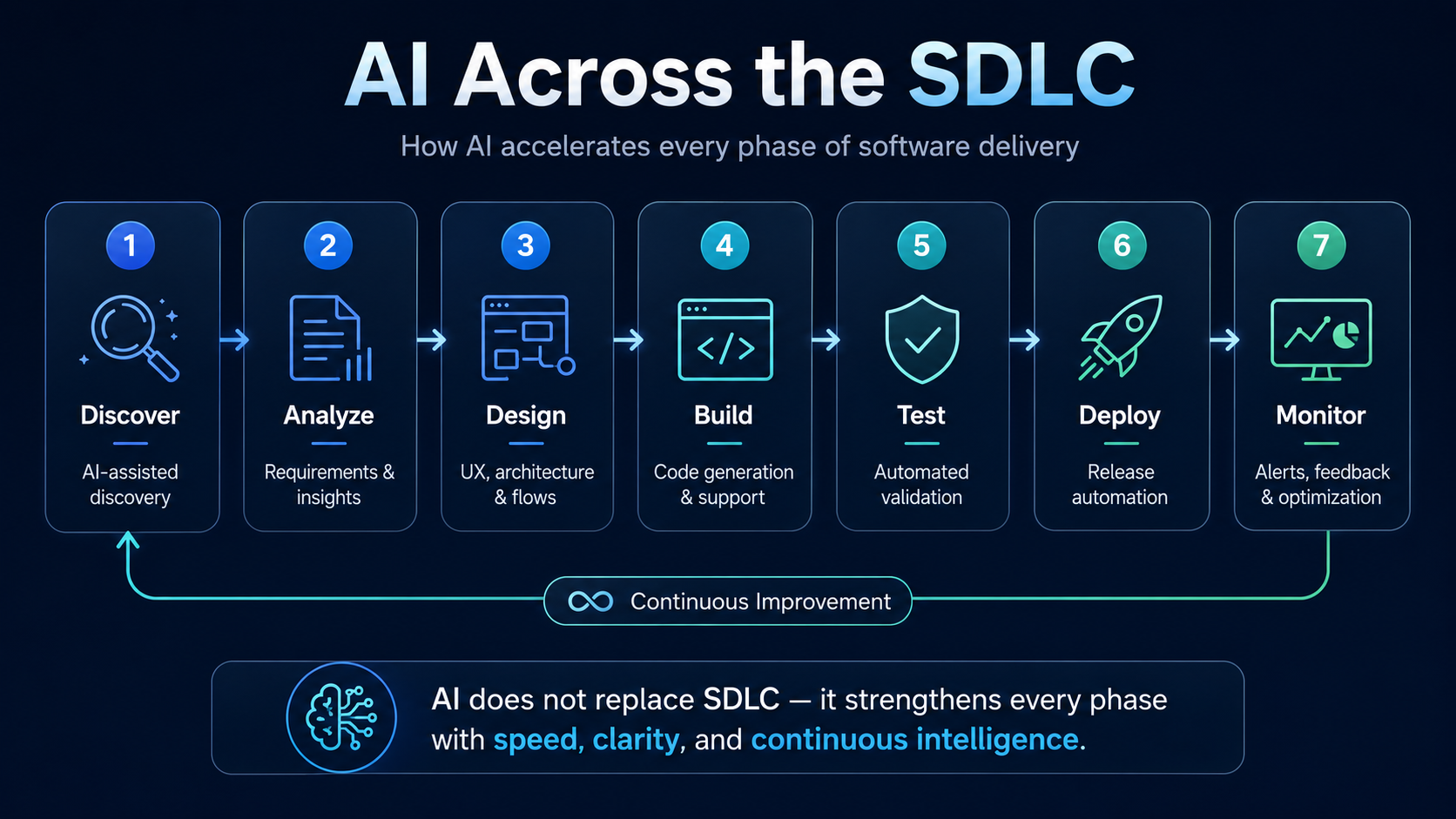
This is where the real shift begins.
The traditional SDLC had many handoffs: a business person explains the idea; a business analyst converts it into requirements; a designer creates screens; an architect creates a system design; developers write code; QA tests it; DevOps deploys it; support maintains it.
In the AI-first SDLC, one highly capable owner can orchestrate much of this flow with AI.
That does not mean every large enterprise project should be delivered by one person. It means one person with deep SDLC understanding, strong imagination, and the right AI workflow can now do what previously required multiple fragmented roles for many types of software: prototypes, MVPs, internal tools, automation systems, dashboards, workflow applications, integrations, and full product modules.
This is the rise of the AI-powered full-cycle builder.
From Headcount to Intelligence: The New Software Development Metric
In the past, companies often measured delivery capacity by team size.
How many developers do we have? How many testers are assigned? How many resources are on the project?
That language will slowly become outdated.
The better question is: how much SDLC intelligence does this team have?
SDLC intelligence is the ability to understand the full journey of software delivery, including business requirements, user workflows, architecture, data, security, engineering, testing, deployment, and continuous improvement.
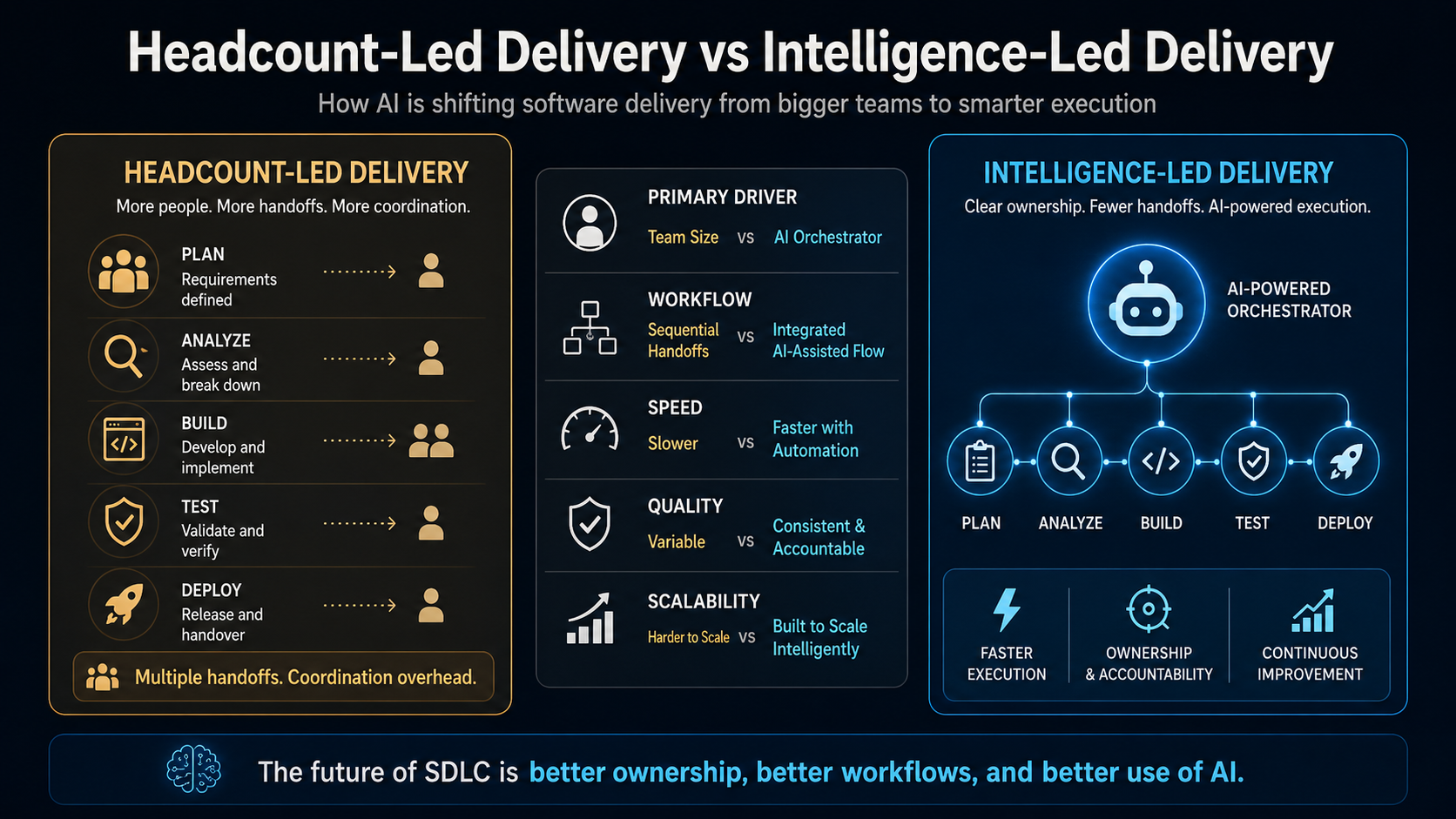
It is not enough to know how to code. It is not enough to know how to prompt. It is not enough to use AI tools.
The winning person will be someone who can imagine the complete system.
Someone who can ask: What problem are we solving? Who is the user? What is the workflow? What data is needed? What can go wrong? What should be automated? What should be reviewed by a human? What should be tested? What should be logged? What should be measured after release?
This is the person who will rule AI development, because AI rewards clarity.
When requirements are vague, AI produces vague output. When workflows are confused, AI produces confused systems. When architecture is weak, AI scales the weakness. When testing is shallow, AI helps ship bugs faster.
But when the human has strong SDLC intelligence, AI becomes a multiplier.
Google Cloud’s DORA research makes a similar point: AI acts as an amplifier, magnifying an organization’s existing strengths and weaknesses. The biggest returns come not just from tools, but from improving the underlying organizational system. [3]
That is the key lesson. AI does not save a broken SDLC. AI exposes it.
The Big Team Era Is Not Over. But the Blind Headcount Era Is.
Let us be clear: large teams will still exist. Complex enterprise platforms, regulated systems, core banking products, healthcare platforms, large-scale SaaS products, and mission-critical systems will continue to need specialized teams.
But the old habit of adding people to compensate for unclear thinking will decline.
A large team without clarity is slower than a small team with intelligence.
The future will favor smaller, sharper, more accountable teams. In many cases, it will favor one responsible builder supported by AI agents, automation, reusable components, cloud platforms, and review systems.
This is not a fantasy. It is already happening.
Stack Overflow’s 2025 Developer Survey found that 84% of respondents are using or planning to use AI tools in their development process, and 51% of professional developers use AI tools daily.
GitHub and Microsoft research found that developers using GitHub Copilot completed a controlled development task 55.8% faster than developers who did not use it.
McKinsey found that generative AI could allow developers to complete certain coding tasks up to twice as fast, and its broader analysis estimated a 20% to 45% direct productivity impact on software engineering spending from activities such as initial code drafts, code correction, refactoring, root-cause analysis, and system design generation.
Gartner predicts that by 2028, 90% of enterprise software engineers will use AI code assistants. Gartner also notes that the developer role will shift from implementation toward orchestration, problem-solving, system design, and ensuring AI-generated work meets quality expectations.
This is the future of software development: not fewer brains, but better-leveraged brains.
The One-Person Delivery Model: Possible, But Only With Discipline
A single person using AI can now move through SDLC in a way that was almost impossible a few years ago.
One person can interview stakeholders and use AI to summarize requirements. One person can convert rough ideas into user stories. One person can generate workflow diagrams and data-flow diagrams. One person can create UI concepts and design files. One person can generate backend code, frontend code, API contracts, and database schemas. One person can produce test cases and automate testing. One person can deploy using cloud infrastructure and CI/CD pipelines. One person can monitor, iterate, and improve.
But there is a condition.
That person must understand the full SDLC.
Without SDLC knowledge, the same person becomes dangerous. They may generate code quickly but miss edge cases, security risks, performance problems, data integrity issues, and user experience gaps.
This is why vibe coding alone is not enough. The future is not random prompting. The future is structured AI-assisted SDLC.
The strongest AI builders will not simply ask AI to build an app. They will guide AI through a disciplined sequence: business goal, user personas, process workflow, functional requirements, non-functional requirements, data model, integration points, architecture, design system, API contracts, security model, test cases, deployment plan, monitoring plan, and feedback loop.
That is how one person can become a complete delivery engine.
At Webuters, We Have Already Seen This Future With Webly
At Webuters, this is not just a theory.
We have seen how a single responsible builder, equipped with AI and strong SDLC thinking, can move with extraordinary speed. Webly was developed with a one-person ownership model, using AI not as a shortcut, but as a force multiplier across the development journey.
The key was not only AI. The key was clarity.
Clear workflows. Clear product thinking. Clear design direction. Clear responsibility. Clear testing. Clear iteration.
That is the real lesson. AI did not replace SDLC. AI made disciplined SDLC dramatically more powerful.
This same philosophy is visible in Webuters’ broader AI-first direction. Webuters launched AI Studio under OfficeIQ to help users create responsive single-page websites from a simple prompt, reducing cost and publishing timelines while removing technical friction for people with ideas.
This is where software development is going: from long cycles to rapid creation, from fragmented handoffs to intelligent workflows, from large execution-heavy teams to smaller teams with deeper ownership.
Companies Must Train People Differently Now
The biggest mistake companies can make is buying AI tools without training people in SDLC intelligence.
AI transformation is not a tool rollout. It is a capability shift.
Companies should train their people to understand the core concepts of SDLC deeply. Every developer, tester, analyst, product manager, and delivery lead should understand how software moves from idea to production.
Training should include requirement thinking, workflow mapping, user story writing, data-flow diagrams, system design basics, API and integration thinking, testing strategy, security and privacy fundamentals, DevOps and deployment basics, AI prompting and AI review, code quality validation, documentation discipline, production monitoring, and business outcome measurement.
This is how companies create AI-ready people.
The goal should not be to turn everyone into a coder. The goal should be to turn more people into full-cycle thinkers.
A business analyst with SDLC intelligence and AI can create better requirement documents, wireframes, test cases, and acceptance criteria.
A developer with SDLC intelligence and AI can design better systems, write better code, generate better tests, and understand business impact.
A QA engineer with SDLC intelligence and AI can move upstream, identify risks earlier, create automated test coverage, and improve product quality before code reaches production.
A project manager with SDLC intelligence and AI can stop being only a status tracker and become a delivery architect.
This is the new training model: not only learn AI tools. Learn SDLC. Learn imagination. Learn ownership. Then use AI.
Simple Workflows Will Become the New Superpower
AI works best when the human can explain the process clearly.
That is why simple workflows will become a major competitive advantage.
Before asking AI to build anything, companies should define: What triggers the workflow? Who performs each step? What data is captured? What decisions are made? What approvals are needed? What systems are involved? What exceptions can happen? What is the final outcome?
Once this is clear, AI can help convert workflows into design files, data-flow diagrams, user stories, API definitions, test scenarios, and working software.
This is where companies will gain massive speed.
A well-defined workflow can become a prompt. A prompt can become a prototype. A prototype can become a product. A product can become a platform.
The companies that learn to describe work clearly will build software faster than companies that only hire more people.
But AI Speed Without Governance Creates Risk
The AI-first SDLC must be fast, but it must not be careless.
Research already shows the risk of focusing only on code generation. Harness reported that AI adoption is creating a productivity paradox: engineering leaders report productivity gains, but developers are also spending more time on manual work such as reviewing AI-generated code, fixing bugs, and context switching. Harness estimated that about 31% of developer time is now consumed by this kind of invisible work.
Harness also found that while 63% of organizations reported shipping code faster after adopting AI, downstream processes such as testing, deployment, security, and compliance have not matured at the same pace.
Stack Overflow’s 2025 survey also shows a gap between AI adoption and trust, which reinforces the need for human verification and engineering accountability.
This is why AI software delivery needs guardrails.
Companies need code review. They need automated testing. They need security checks. They need deployment controls. They need observability. They need rollback strategies. They need human accountability.
Microsoft’s Security Development Lifecycle emphasizes integrating security into DevOps processes, and its AI-focused SDL guidance highlights new risks such as prompt injection, data poisoning, malicious tool interactions, agent identity, AI memory protection, AI observability, misuse, overreliance, and failure modes in probabilistic systems.
The future is not AI writes, humans trust. The future is AI accelerates, humans design, verify, govern, and own.
The New Role: AI SDLC Owner
Every company will soon need a new kind of person: the AI SDLC Owner.
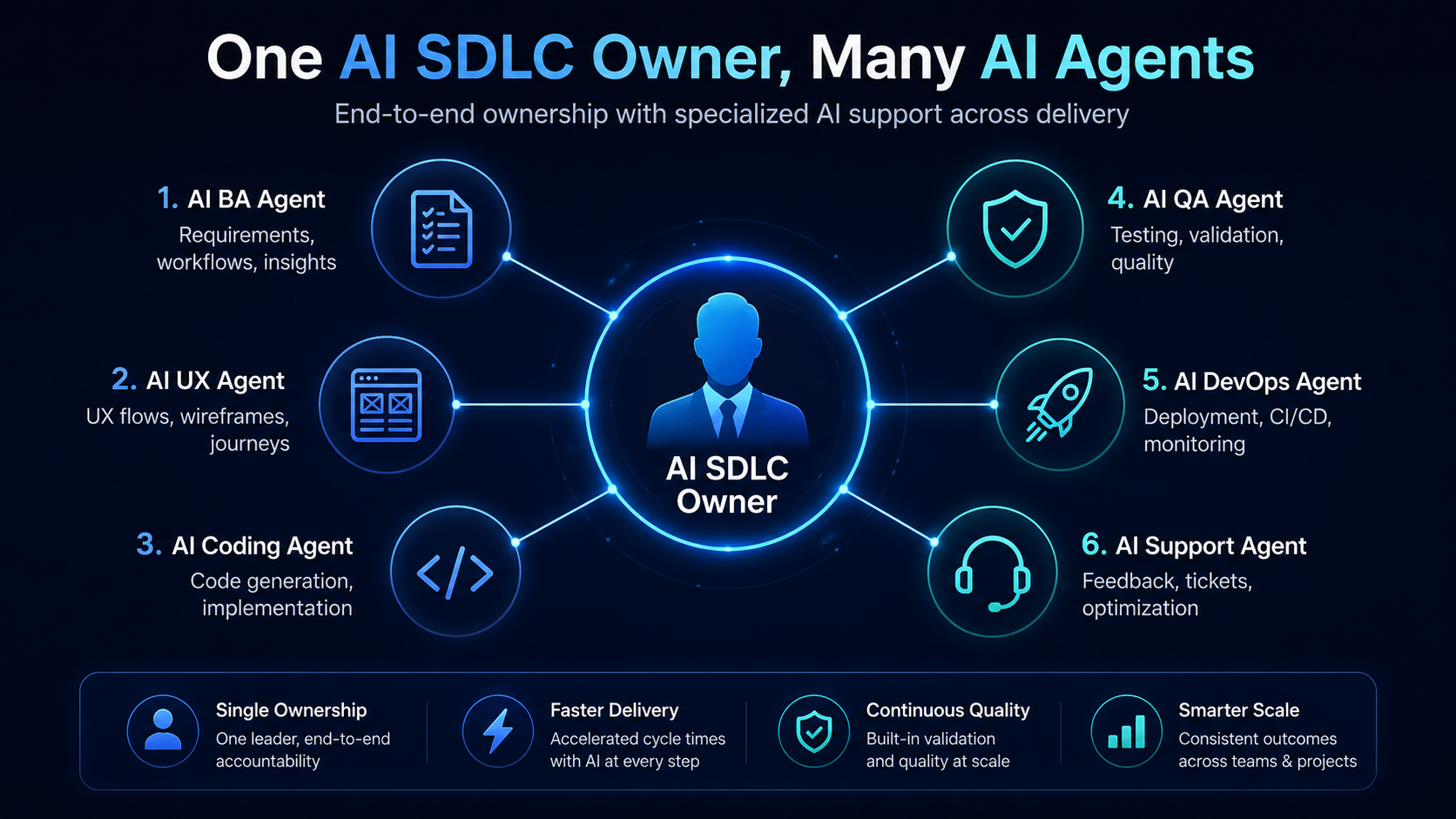
This person may come from development, product, QA, architecture, business analysis, or project management. Their background matters less than their ability to own the full journey.
An AI SDLC Owner understands the business problem, defines the workflow, creates the requirement structure, guides AI tools, validates outputs, coordinates reviews, ensures quality, and drives the product to production.
They are not just a prompt engineer. They are not just a developer. They are not just a manager.
They are an end-to-end software delivery thinker.
In traditional development, responsibility was distributed across roles. In AI-first development, responsibility becomes more concentrated. The person who can carry that responsibility will become extremely valuable.
This is why imagination matters.
AI can generate many answers. But imagination decides which answer is worth building. AI can create many screens. But imagination decides the right user experience. AI can suggest many architectures. But SDLC intelligence decides what is scalable, secure, and maintainable. AI can produce code. But ownership decides whether that code should go live.
The Future of Software Development Is Smaller, Faster, and Smarter
The software industry is entering a new phase.
The winning companies will not simply ask: how many people do we need?
They will ask: How clearly can we define the problem? How intelligently can we design the workflow? How much can we automate? How safely can we use AI? How quickly can we validate? How deeply can one person or a small team own the outcome?
This is the shift from headcount to intelligence.
Bigger teams will not disappear. But bigger teams without clarity will struggle. Smaller teams with strong SDLC intelligence, AI tools, reusable workflows, and end-to-end ownership will move faster than ever.
The future of software development will belong to people who understand the complete life cycle of software and can imagine what AI should build.
Not people who only write code. Not people who only manage tasks. Not people who only use tools.
The future belongs to builders who can think from idea to impact.
Final Thought
AI is not killing software development. AI is killing careless software development.
It is killing unclear requirements, unnecessary handoffs, bloated teams, slow documentation, repetitive coding, manual testing, and disconnected delivery processes.
But it is making strong SDLC more valuable than ever.
At Webuters, we believe the next era of software will be built by intelligent, AI-empowered teams that understand the full SDLC and take end-to-end responsibility for outcomes. Webly is one example of what becomes possible when a single responsible builder combines imagination, SDLC discipline, and AI-powered execution.
The companies that train their people this way will move faster. The companies that redesign their workflows this way will deliver better. The companies that adopt AI with SDLC discipline will lead.
And the companies that still believe software delivery is only about adding more people will slowly fall behind.
If your organization is exploring AI transformation, AI-powered software delivery, or SDLC modernization, Webuters can help you move from experimentation to execution.
Let us build the future of software – intelligently, responsibly, and faster than ever.
FAQ
What is AI in SDLC?
AI in SDLC means using artificial intelligence across the Software Development Life Cycle, including requirements, design, coding, testing, deployment, documentation, monitoring, and maintenance. The biggest value comes when AI is used across the full lifecycle, not only for code generation.
Will AI replace software developers?
AI will not replace all software developers, but it will change what great developers do. Developers will spend more time on problem-solving, system design, AI orchestration, code review, quality validation, and business impact.
Can one person build software with AI?
Yes, one skilled person can now build many types of software products, prototypes, MVPs, internal tools, and workflow applications with AI. However, this requires strong SDLC knowledge, product thinking, testing discipline, and clear ownership.
Why is SDLC more important in the AI era?
SDLC is more important because AI amplifies both clarity and confusion. A strong SDLC helps teams guide AI with better requirements, workflows, architecture, testing, security, and deployment practices.
How should companies train employees for AI-powered software development?
Companies should train employees in SDLC fundamentals, workflow design, requirement writing, system thinking, AI prompting, code review, testing, DevOps, security, and end-to-end product ownership. The goal is to create full-cycle thinkers, not just AI tool users.

Loading...