Why the Next Hospitality Advantage Will Come From Connected Intelligence
Learn why connected intelligence is becoming the next competitive advantage in hospitality, helping hotels connect systems, teams, guest data, and operations…

Connected hotel intelligence starts to matter the moment a guest arrives early, the room is almost ready, the preference data exists somewhere in the CRM, and yet the hotel still cannot act like one business.
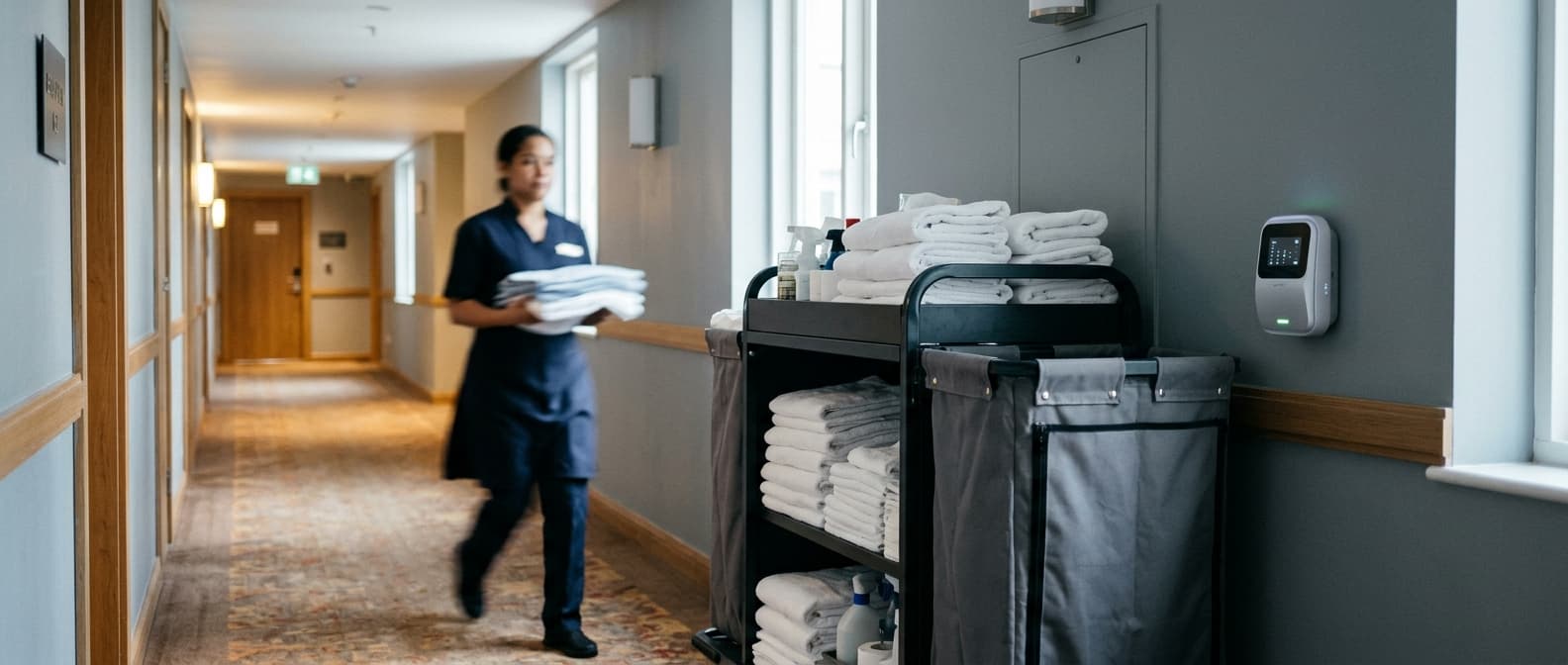
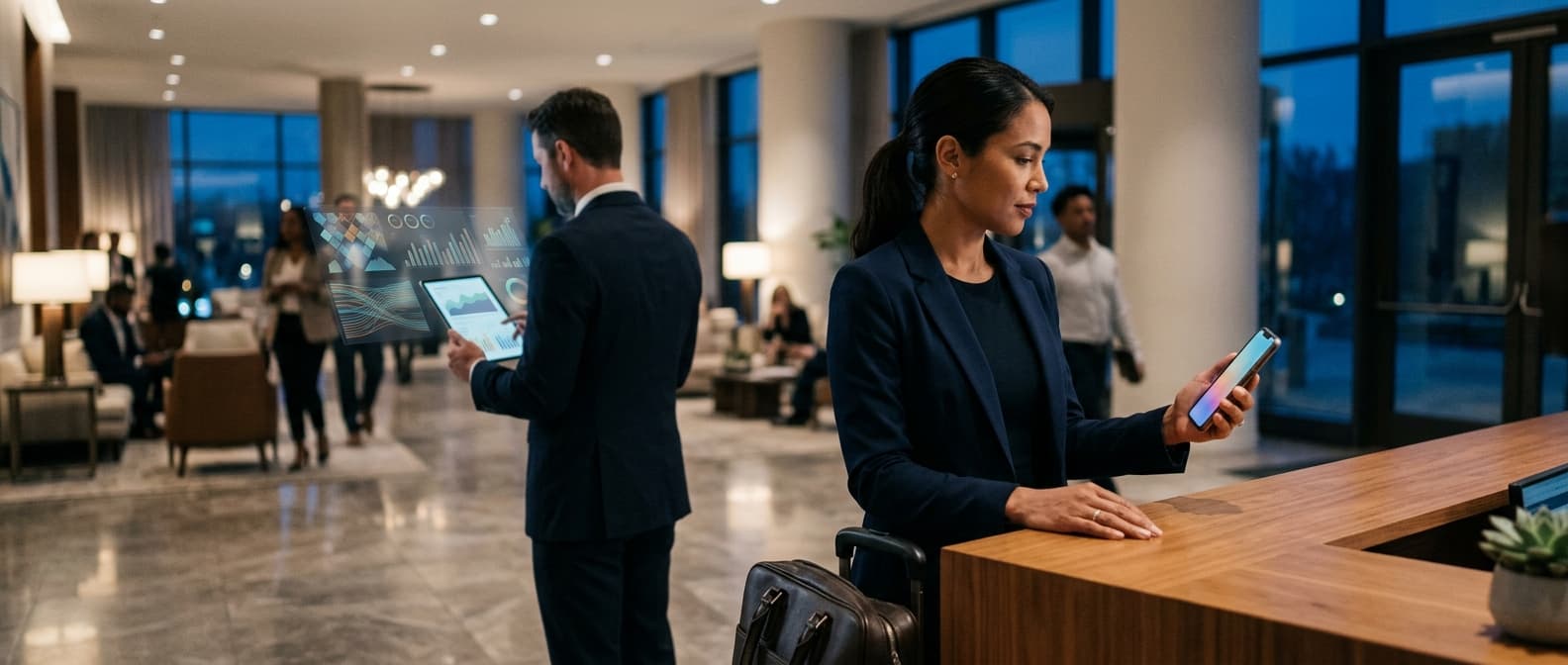
That is the real pressure point in hospitality. The front desk wants to help. Housekeeping is working the room board. Revenue is watching inventory. Guest services may already know something useful about the arrival. Leadership wants a live picture of the day. But each team is looking at a different slice of reality, and the guest feels the gap between those slices.
The problem is not a lack of software. Most hotels already run on a mix of PMS, CRM, guest communication tools, service workflows, dashboards, and partner systems. The problem is that those tools often stop at the edge of their own function, so decisions slow down exactly when coordination matters most.
That is why the next hospitality advantage will not come from adding one more isolated tool. It will come from connected hotel intelligence: a shared AI-enabled operating layer that helps PMS, CRM, guest systems, service teams, arrival logistics, revenue insight, and leadership decisions work from the same context.
This article explains:
- what connected hotel intelligence means in hospitality,
- why the advantage is shifting from standalone tools to connected systems,
- how connected hotel operations work across departments, and
- where AI fits as the intelligence layer.
It ends with a practical roadmap for leaders building a future-ready hotel technology strategy.
What connected intelligence means for hotels
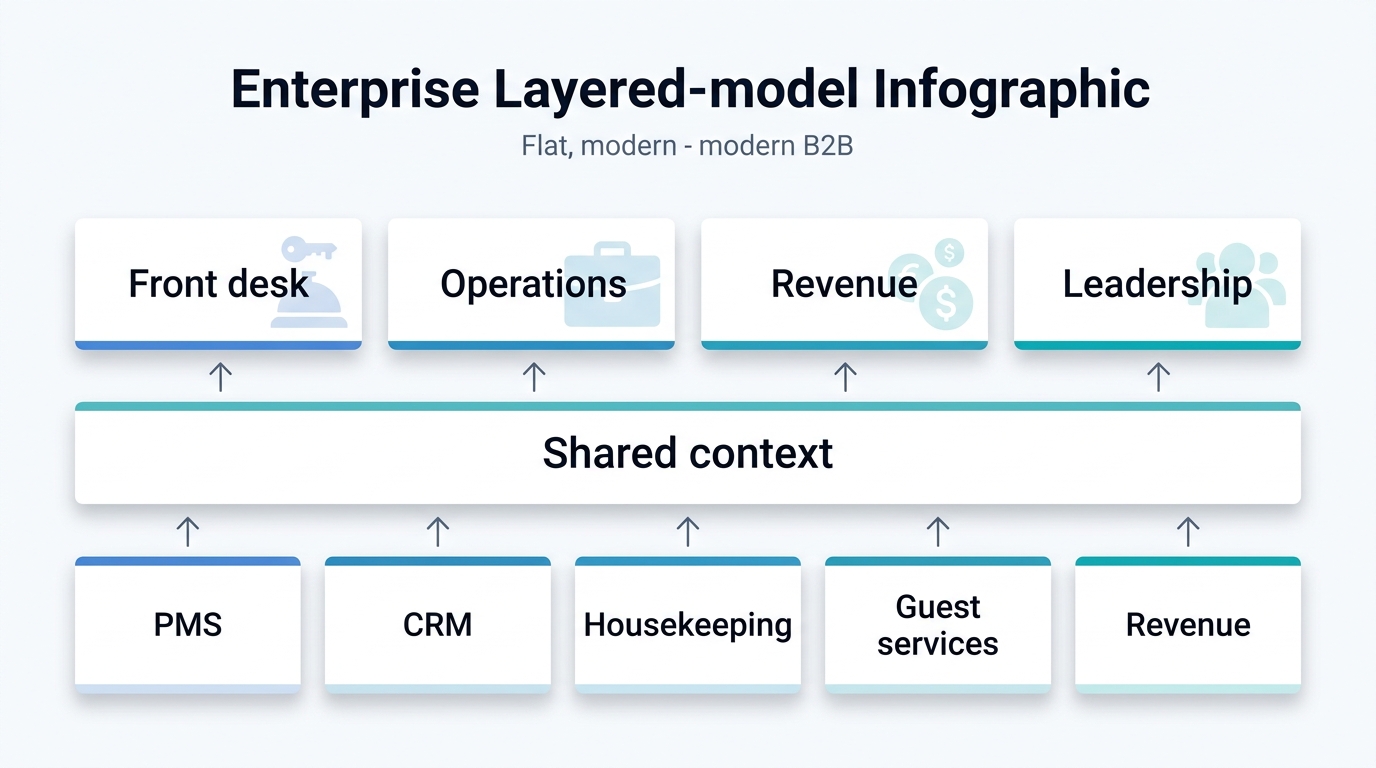
Connected hotel intelligence in hospitality means linking hotel systems, teams, and data so the property can act on one shared operational picture instead of many disconnected ones. In a connected hotel intelligence model, the hotel does not wait for each department to reconcile its own version of the day.
That matters because hospitality is not experienced in departments. The guest does not experience a PMS, a CRM, housekeeping software, or a revenue dashboard. The guest experiences one journey. When that journey is powered by disconnected tools, service becomes reactive. When it is powered by connected hotel intelligence, service becomes more timely, more consistent, and easier to coordinate.
Hotels already operate across layered systems and integrations. That is visible in Oracle’s hospitality solutions overview and Oracle Hospitality documentation. Interoperability also matters across the broader travel ecosystem, as shown by OpenTravel interoperability standards.
So connected hotel intelligence is not a rip-and-replace idea. It is a design decision. You keep the systems that matter, but you create a hotel intelligence layer above them so useful context can move across functions. For leaders mapping that change, AI strategy and consulting can help define priorities before more tools are added.
The hidden cost of fragmentation is not only technical. It is operational. It shows up in missed handoffs, delayed room-readiness decisions, partial guest experience signals, and leadership teams making decisions from reports that arrive after the moment has passed.
Why hospitality advantage is shifting
Hotels rarely lose advantage because they are missing a feature. They lose advantage because each tool optimizes one part of the journey while the guest experiences the whole journey. That gap between local optimization and end-to-end execution is where friction lives.
A standalone tool can improve a task. It can make one team faster or automate one step. But hospitality performance is created across handoffs: pre-arrival to arrival, arrival to room readiness, stay experience to service response, service response to loyalty, and occupancy decisions to revenue action. When those handoffs are disconnected, the hotel carries extra coordination cost even when nobody names it.
Hospitality technology environments already reflect this complexity across property systems, operations, and cloud modernization choices. You can see that in Oracle Hospitality’s platform perspective and AWS cloud solutions for travel and hospitality. What this really means is that the unit of value is no longer the app by itself. It is the flow of action the app can support across the business.
Why do hotels need connected AI systems?
Hotels need connected AI systems because AI becomes useful when it can interpret shared context, not just automate a single isolated task. If AI sees only one channel, one queue, or one department, it can optimize locally and still miss what matters operationally. If AI sees connected hotel systems, it can help prioritize arrivals, surface exceptions, route service actions, and support live decisions with more relevance.
That is why connected hotel intelligence matters before advanced automation matters. Closing the gap usually starts with integration and migration, not another standalone app. The strategic advantage shifts when the hotel can coordinate faster than the friction appears.
Connecting systems, teams, and data
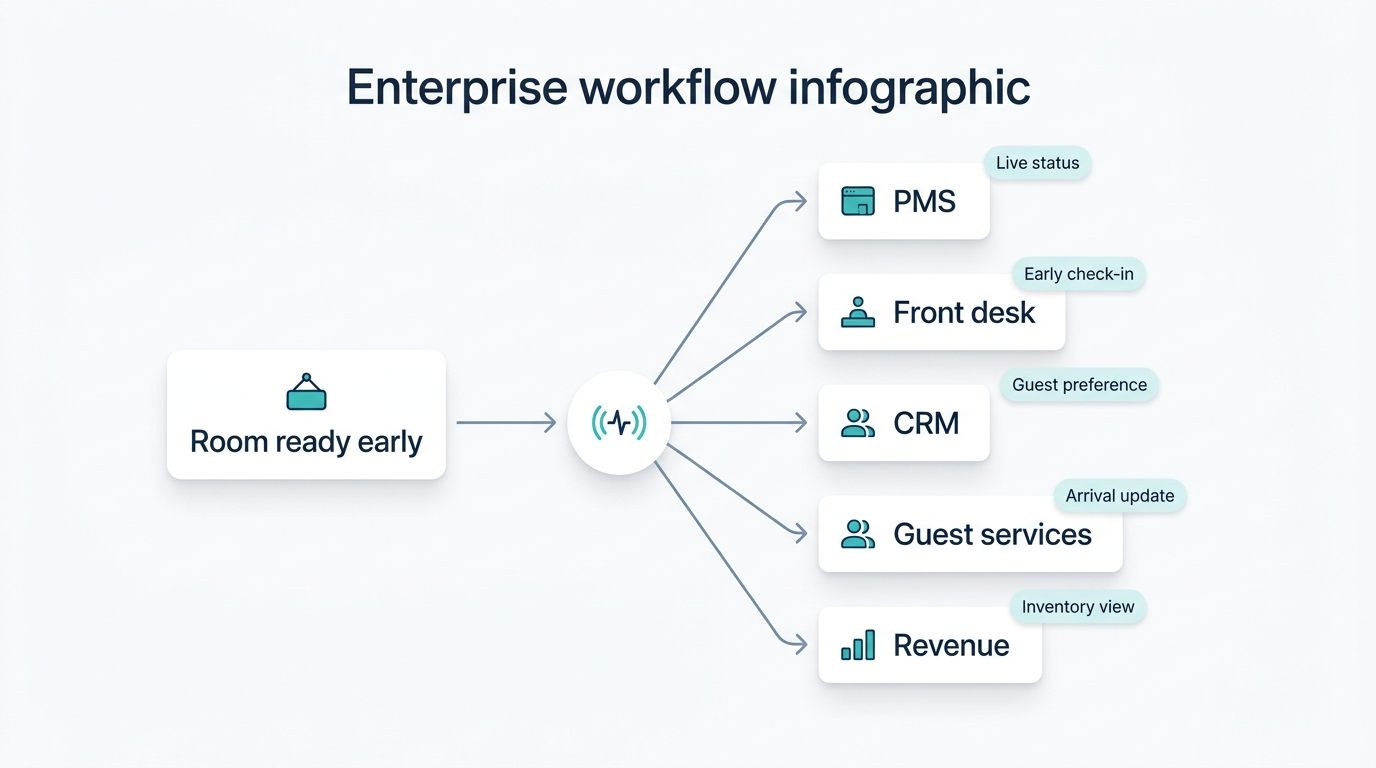
connected hotel intelligence works when three layers move together: systems, data, and people. Systems need to exchange information reliably. Data needs to be usable in context, not trapped in separate records. And people need to see the right operational signal at the right moment, inside the workflow where they actually work.
In practical terms, that means connecting PMS integration, CRM integration, guest system integration, front desk intelligence, housekeeping coordination, arrival logistics, revenue optimization, and leadership visibility. The goal is not to create one giant app that replaces everything. The goal is to make connected hotel systems behave like one operating model.
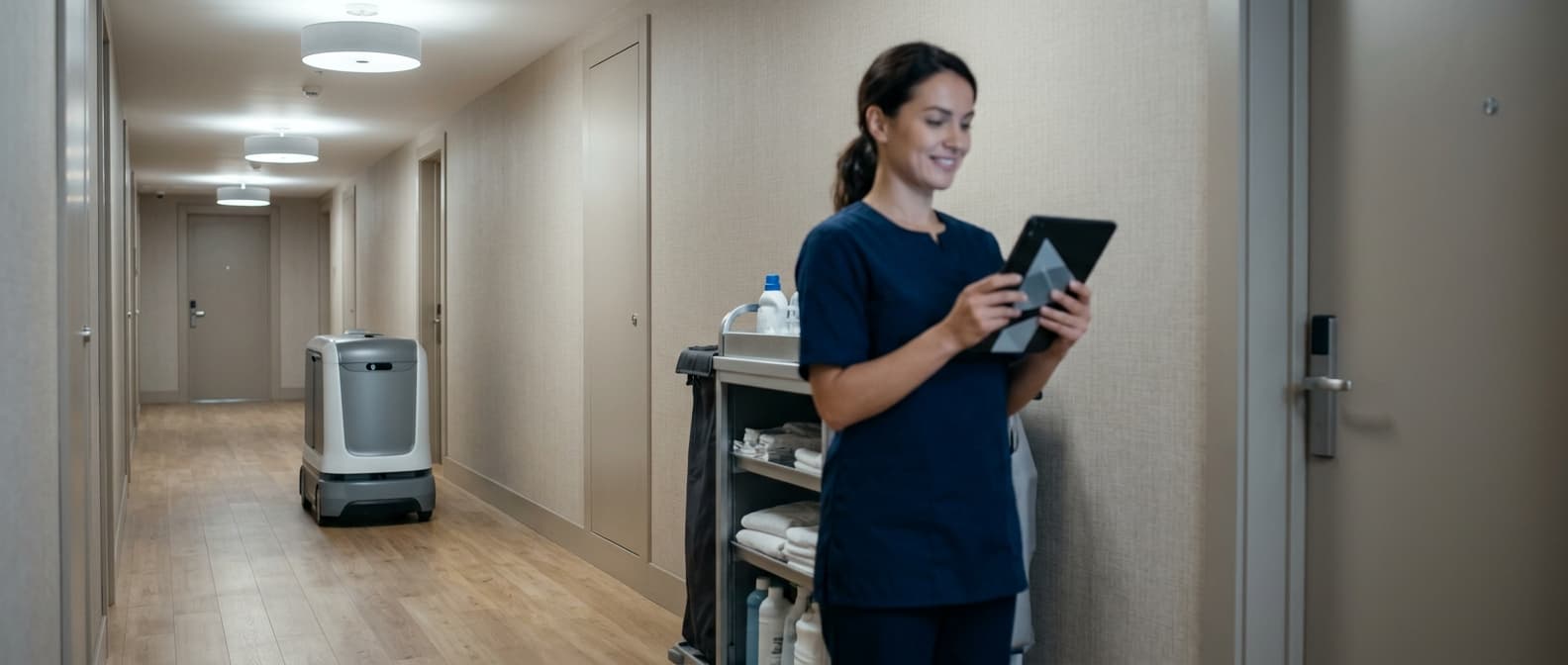
Here is a concrete example. A room becomes available earlier than expected because housekeeping finishes ahead of schedule and updates the room status. That single operational signal should update the PMS immediately, appear at the front desk so the arriving guest can be checked in sooner, trigger CRM context so the team can see the guest prefers high-floor quiet rooms, inform guest services if arrival timing has changed, and give revenue a live view of inventory movement for the day. Front desk, housekeeping, PMS, CRM, and revenue are all seeing the same signal, but each team sees the version of that signal that matters to its role.
That is what connected hotel intelligence looks like in action. It is not flashy. It is coordinated. And in hospitality, coordinated beats impressive when the guest is waiting in the lobby.
How can hotels connect guest data and operations?
Hotels can connect guest data and operations by building reliable integrations and shared workflows so guest context informs service, operations, and revenue decisions at the right moment. That usually means mapping where key signals originate, how they should move, and who needs them next. Open interoperability resources exist across the travel ecosystem, reflected in OpenTravel’s industry interoperability resource, while cloud adoption guidance also emphasizes readiness, architecture, and use-case planning for AI initiatives, as described in Microsoft’s AI adoption guidance and AWS travel and hospitality cloud guidance.
Below is a simple way to see the difference between disconnected tools and connected hotel intelligence.
Disconnected tools vs connected hotel intelligence
| Operational area | Disconnected model | Connected intelligence model | Business effect |
|---|---|---|---|
| Front desk | Waits for manual updates from housekeeping or service teams | Sees live room status, guest notes, and exception alerts in context | Faster check-in decisions and fewer avoidable guest delays |
| Housekeeping | Works from separate task boards with limited demand visibility | Receives priority cues tied to arrivals, VIP status, and room readiness | Better housekeeping coordination and less last-minute scrambling |
| CRM and guest data | Stores preferences and history that do not reach the moment of service | Pushes relevant personalized service into arrival and service workflows | More useful personalization, not just better records |
| Revenue management | Reads reports after operational changes have already started | Sees live inventory and operational constraints tied to room availability | Stronger yield decisions grounded in operational reality |
| Transport and guest services | Handles changes in separate channels | Shares arrival, delay, and readiness signals across teams | Better guest flow and fewer broken handoffs |
| Leadership visibility | Relies on siloed dashboards and retrospective reports | Views one cross-team picture of the day as it evolves | Better live decisions and clearer accountability |
The difference is simple but powerful. In the disconnected model, each department is correct inside its own system. In the connected model, the hotel is correct as a business.
AI as the hotel intelligence layer
Hospitality’s next advantage will not come from buying more software. It will come from turning disconnected systems into one shared intelligence layer.
AI in hospitality becomes valuable when it sits above connected systems as an interpretation layer. It should help the hotel detect patterns, surface priorities, recommend next actions, and summarize what matters across departments. It should not be positioned as a replacement for hotel staff. The role of AI-powered hospitality is to make people more informed, more coordinated, and more responsive.
This is where the conversation often goes wrong. One chatbot, one pricing model, or one workflow automation can absolutely help. But those tools do not automatically create connected hotel intelligence. They improve points. They do not necessarily improve flow. The hotel intelligence layer is different because it works across connected hotel operations and turns shared context into coordinated action.
A useful way to think about it is this: the AI layer should not invent the operating picture. It should read the operating picture created by connected hotel intelligence and help the right person act on it faster. That distinction matters for adoption, because teams trust systems that support their work rather than systems that pretend to replace them.
How can AI create competitive advantage for hotels?
AI can create competitive advantage for hotels when it improves decision speed, service coordination, guest personalization, and operational resilience on top of shared context. A manager can receive a live operations digest instead of collecting updates from separate teams. A front desk lead can see which arrivals need intervention first. A service coordinator can get the next best action based on guest profile, room state, and current workload. Where connected data is already in place, Generative AI services and solutions can help surface summaries, draft responses, and reduce manual coordination effort.
Responsible deployment matters here. Governance, oversight, and human review are not optional extras in AI-enabled operations. That is explicit in NIST’s AI Risk Management Framework and the AI RMF Core guidance. Implementation readiness and role clarity also matter when organizations adopt AI in cloud environments, as described in Microsoft’s AI adoption guidance for cloud environments.
So the real competitive edge is not an algorithm by itself. It is architecture plus governance plus workflow fit. That is why the real AI advantage in hospitality is architectural before it is algorithmic.
Building a future-ready hospitality technology roadmap
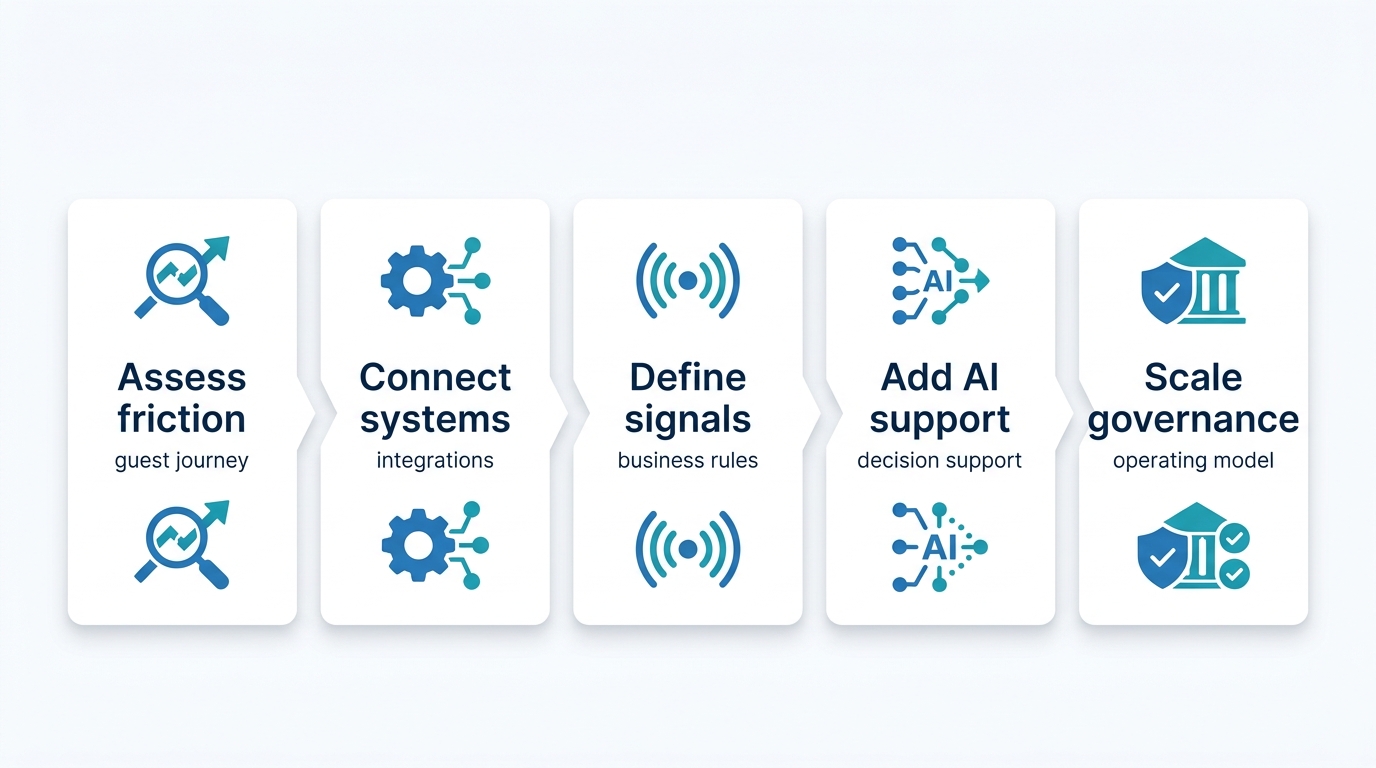
The best hospitality digital transformation roadmap does not begin with a list of AI features. It begins with data flow, system integration, and use-case prioritization. If the hotel cannot move the right signal from one system to the next, no intelligence layer will fully solve the problem.
A practical starting point is to assess where information breaks down across the guest journey. Look at pre-arrival, check-in, room readiness, service requests, arrival logistics, upsell moments, and revenue-aware operations. Then identify which systems hold the relevant signals, where those signals stall, and which workflows deserve to be connected first.
From there, the roadmap becomes clearer. Establish the integration layer. Define shared events and business rules. Decide what each role needs to see. Introduce AI only where it can improve prioritization, visibility, or decision support. This sequencing is consistent with cloud AI adoption guidance that emphasizes readiness, planning, and business alignment, as described in Microsoft’s cloud adoption framework for AI and AWS cloud solutions for travel and hospitality.
A strong roadmap also protects the hotel from trying to solve everything at once. Connected hotel intelligence usually starts with one high-friction workflow, proves value there, and then expands into the next. That pacing matters because operational trust grows when teams can see the difference in a familiar process. This is where connected hotel intelligence becomes a change program, not a technology purchase.
What is the future of AI in hospitality?
The future of AI in hospitality is practical orchestration. Not isolated automation in disconnected pockets, but better shared visibility, smarter workflow coordination, and more adaptive operations. Interoperability choices remain important in that future, reflected in OpenTravel’s standards resource, and hospitality platforms will still need clear integration patterns, as shown in Oracle Hospitality documentation.
In other words, smart hotel operations will be built one connected workflow at a time. A property might start with room readiness and guest-request handling. Then it might extend that model into loyalty, service recovery, transport coordination, and revenue-sensitive operating decisions. For leadership teams defining scope and sequence, our consulting support can help turn a broad ambition into a practical roadmap.
The future-ready move is not to buy the loudest tool. It is to build the hotel data layer, process layer, and intelligence layer in the right order so connected hotel intelligence can scale without chaos.
FAQ: Connected Hotel Intelligence
What is connected intelligence in hospitality?
Connected hotel intelligence in hospitality is a model where hotel systems, teams, and data work from shared context instead of isolated records. It helps the hotel act as one coordinated operation across service, guest experience, and revenue decisions.
Why do hotels need connected AI systems?
Hotels need connected AI systems because guest experience is created across handoffs, not inside one tool. AI is most useful when it can interpret shared context across room status, guest preferences, service workload, and business priorities, which is exactly where connected hotel intelligence adds value.
How can AI create competitive advantage for hotels?
AI creates advantage when it improves decision speed, service coordination, personalization, and operational resilience on top of connected systems and reliable workflows. That is where connected hotel intelligence becomes a business capability, not just a technology project.
What is the future of AI in hospitality?
The future of AI in hospitality is practical orchestration: better shared visibility, smarter workflows, and more adaptive operations rather than isolated automation projects. In that model, connected hotel intelligence is the operating foundation.
How can hotels connect guest data and operations?
Hotels can connect guest data and operations by identifying high-friction moments, integrating the systems involved, defining shared events, and routing relevant context into live workflows for front desk, housekeeping, service, and revenue teams. Done well, that becomes connected hotel intelligence in everyday practice.
The hospitality winners will build one shared operating layer
The next hospitality advantage will not come from a longer software stack. It will come from connected hotel intelligence that turns PMS signals, CRM insight, service workflows, arrival logistics, and revenue awareness into one shared flow of action.
That is the business implication. When systems, teams, and data are connected, the hotel reduces friction before the guest notices it. Decisions get faster. Service becomes more consistent. Leadership gets multi-department visibility. And AI in hospitality starts delivering value because it is working on top of connected reality instead of fragmented data.
The practical takeaway is simple. Hotels do not need more technology for its own sake. They need a better operating layer that helps every team act from the same context. That is what connected hotel intelligence is really about: not another dashboard, but a more coherent business.
If your hospitality team is ready to move from scattered systems toward a clearer operating model, Webuters Technologies can help with AI consulting, integration, and custom automation solutions built for real operational use, not just another layer of software. That is where connected hotel intelligence turns from an idea into a working advantage.
AI adoption and workflow automation
Start with one workflow, prove it in production, then scale what works.
See AI services
Krishna is the Founder and CEO of Webuters, a technology leader specializing in Generative AI, intelligent automation, enterprise software, and digital transformation. He helps organizations leverage emerging technologies to drive innovation, operational efficiency, and business growth. Through his writing, Krishna shares insights on AI adoption, technology leadership, product innovation, and the future of work, helping leaders navigate change and build future-ready organizations.
Follow Krishna on LinkedIn