
Hotel AI Operations: Blind Spots Hotels Must See Before Guests Feel Them
Hotel AI operations matters most before anything looks obviously broken. Hotels rarely lose control in one dramatic moment; they lose visibility through a chain of small handoffs that no single report captures on time.
Picture a busy arrival window. The lobby is full, the front desk is trying to keep the line moving, housekeeping is still clearing a few priority rooms, and guest requests are coming in faster than teams can close them. Nothing looks catastrophic. But pressure is building in several places at once, and leaders can feel it before the numbers ever make it obvious.
That is the real operating problem. The hardest hotel issues rarely begin as clear failures. They begin as room release delays, check-in bottlenecks, workflow gaps, unresolved guest requests, uneven staff load, and recovery work that depends too much on individual heroics. By the time those signals show up as complaints, refunds, bad reviews, or margin pressure, the business has already absorbed the cost. Two of the biggest hidden cost centers are food, beverage, and energy—see how AI turns them into margin protectors.
This is where Hotel AI operations changes the conversation. Not as a replacement for staff. Not as a shiny dashboard. But as an early-warning layer that helps hotel leaders see operational friction while there is still time to act. In simple terms, Hotel AI operations is most useful when it detects weak signals early enough to prevent business problems.
In other words, Hotel AI operations is not about adding another report. It is about helping leaders see which pattern matters first.
In practice, Hotel AI operations helps teams connect the moment a room slips, a request stalls, or a shift gets overloaded. That is where the business cost usually starts.
In the sections below, we will look at the hidden blind spots inside Hotel AI operations, why traditional reports miss early warning signals, how hotel AI operations can connect risk across departments, where service gaps turn into revenue leakage, and what a practical move from reactive management to predictive operating discipline actually looks like.
Hidden blind spots in hotel AI operations
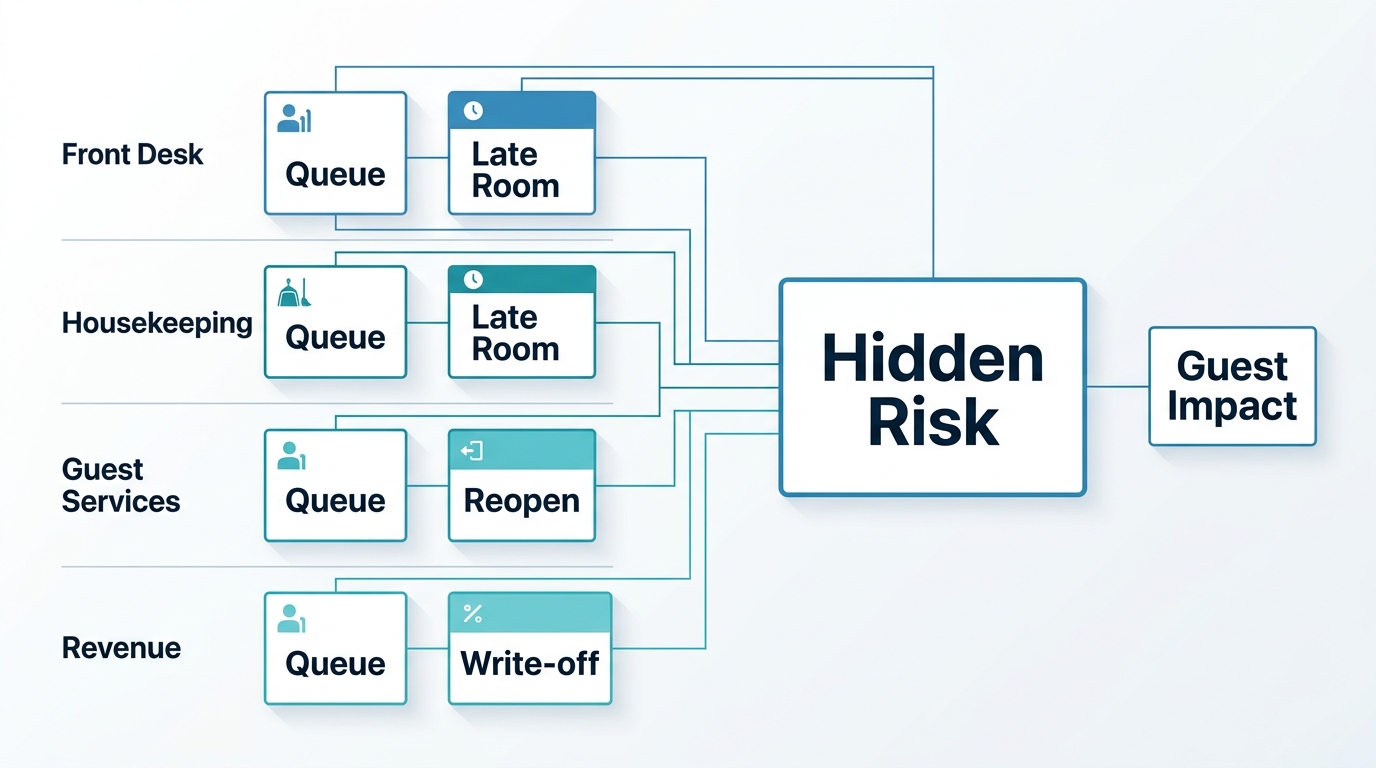
A hotel rarely breaks down like a switch turning off. It breaks down like a slow leak behind the wall. At first, the signs are small enough to explain away: one room that is still not released, one guest who has to ask twice, one team carrying more of the shift than the others, one service recovery case that gets closed without fixing the cause.
The real problem is not that these events happen. Hotels deal with exceptions every day. The problem is that the same exceptions repeat across departments, shifts, and guest journeys until they become a pattern leadership can feel but cannot fully see.
What a blind spot actually looks like
A blind spot in hotel operations is not just missing data. It is missing context. The front desk may know which arrivals are blocked by late room status. Housekeeping may know which floors are slipping. Guest services may know which requests keep coming back unresolved. Finance may see compensation, write-offs, or missed package opportunities later. But few leaders get all of those signals connected in one operational view.
That is why hotel operational blind spots are so expensive. They stay fragmented long enough to look manageable inside each department, even when they are harming the whole property.
In hotel operations, the biggest problems are rarely the loudest at the start. They begin as weak signals—until the guest turns them into a verdict.
The blind spots worth auditing first are usually practical and familiar:
- check-in bottlenecks that are really room release or escalation problems
- cleaning flow gaps that create room readiness issues later in the shift
- unresolved guest requests that reopen as follow-up work
- inconsistent recovery that resolves the moment, but not the cause
- staff workload visibility gaps that overload one team while another has unused capacity
- hotel revenue leakage that begins as repeated exceptions, not dramatic financial events
This is the lens that matters for Hotel AI operations. For owners, the value is not strongest where the process is already obvious. It matters where the risk hides between teams. Hotel AI operations gives that hidden risk a management rhythm instead of leaving it as shift-by-shift instinct.
Why reports miss early warning signals
Many hotels operate through separate property, guest-service, and revenue workflows. Oracle Hospitality solutions illustrate the structured software layer many hotel teams rely on, and the related Oracle Hospitality documentation shows how operational workflows are documented. OpenTravel standards can support data exchange across travel and hospitality systems.
That matters because early warning signals usually live between systems, not neatly inside one of them. A housekeeping report may confirm that rooms were eventually turned. A front desk log may show guest wait time pressure. A service ticket system may show a normal closure rate. Each view can look acceptable on its own while the guest experience is already deteriorating in sequence.
Retrospective reporting creates operational hindsight
Many hotel operating reports are used to explain what happened. That is useful for accountability, but weak for prevention. A morning operations summary might show occupancy, arrivals, service volumes, and exceptions. What it often does not show is the chain reaction: the late status update that caused the desk to improvise, the improvised check-in that created an unhappy guest, and the recovery effort that pulled staff away from another issue.
That is why leaders often feel the strain before they can prove the pattern. They hear the same type of escalation from different managers. They notice one team always looks stretched. They see recovery activity climb without a clean root cause. The data exists, but the business is still operating in hindsight.
The signal problem is bigger than the data problem
A practical AI strategy is not just about collecting more information. It is about detecting which combinations of events actually signal risk. Guidance such as the NIST AI Risk Management Framework and the Microsoft Cloud Adoption Framework for AI emphasizes governance, risk awareness, and disciplined adoption rather than disconnected experimentation.
What this really means is simple: Hotel AI operations is only useful when it helps a manager intervene sooner, not when it creates one more report to review after the shift.
How hotel AI operations detects risks across departments
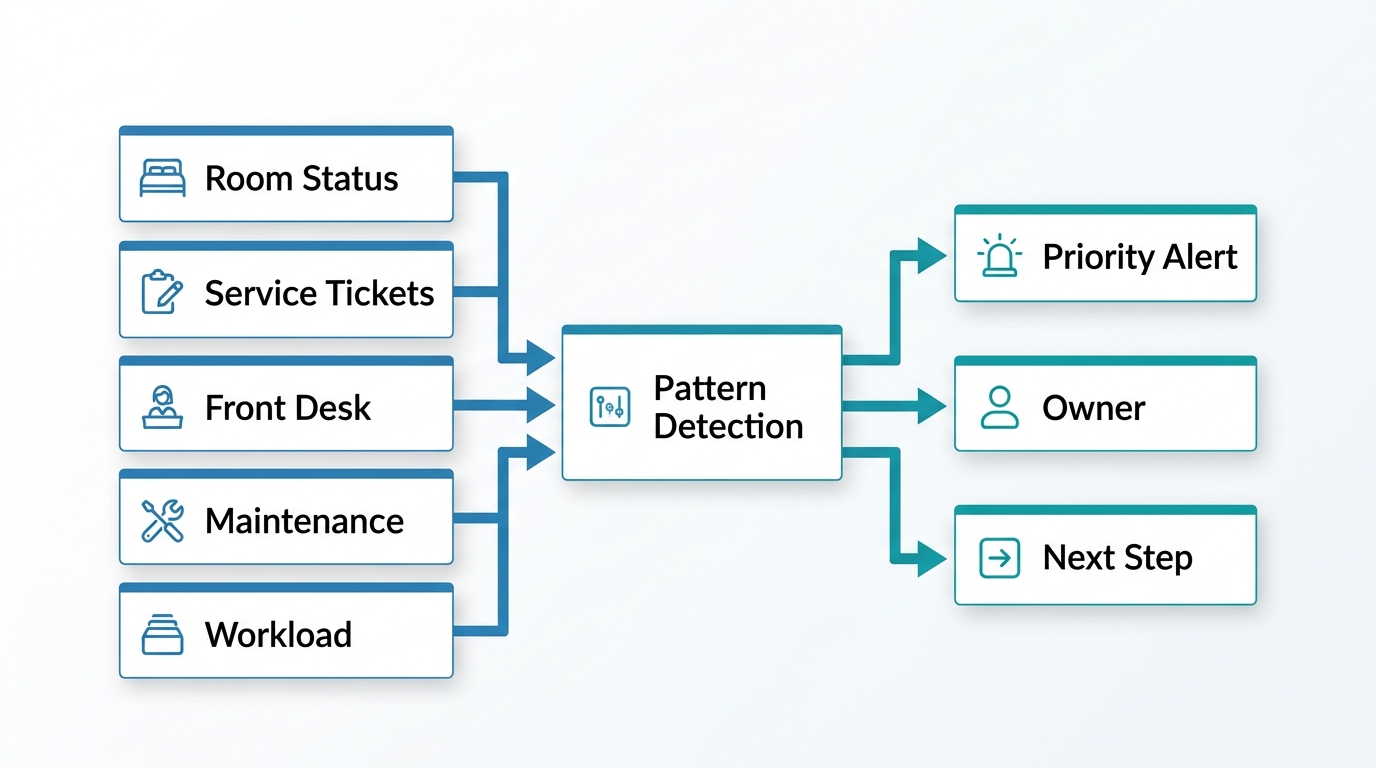
The strongest use of Hotel AI operations is not flashy automation. It is pattern detection across handoffs, delays, exceptions, and recurring service friction. AWS travel and hospitality guidance and the Microsoft guidance above are useful references for thinking about AI inside broader operational and cloud adoption decisions. For hotels, Hotel AI operations works best when it sits inside an actual operating model, not beside it.
In practice, Hotel AI operations can watch for weak signals across room status updates, guest service tickets, front desk activity, maintenance notes, escalation queues, and shift-level workload patterns. It does not need to replace the PMS, service platform, or manager. It needs to detect where separate signals start to form a business risk.
Three ways hotel AI operations finds what teams miss
First, Hotel AI operations spots repetition hidden inside normal activity. If readiness problems cluster around certain floors, shift changes, or arrival peaks, AI can surface that pattern before it becomes a daily firefight.
Second, Hotel AI operations connects events that departments usually see in isolation. A missed request, a delayed room release, and a manual compensation decision may look unrelated in separate tools. Hotel workflow intelligence can connect them as one service breakdown.
Third, Hotel AI operations helps prioritize action. Managers do not need alerts for everything. They need visibility into the few exceptions that are likely to create guest satisfaction risk, labor strain, or hotel revenue leakage.
If the underlying systems are fragmented, this usually starts with strong integration and migration so PMS, ticketing, service, and reporting data can be used together in a practical way.
| Hotel blind spot | What it looks like in daily operations | Likely business impact | What AI can detect early |
|---|---|---|---|
| Front desk delays | Check-in queues grow even when staffing looks adequate | Guest frustration, rushed service, higher escalation load | Repeated delay patterns tied to late room release, shift timing, or unresolved exceptions |
| Housekeeping gaps | Certain floors or room types lag behind expected turnover cadence | Room readiness issues, pressure on arrivals, staff strain | Floors, teams, or time windows where status updates and completion patterns consistently slip |
| Room readiness issues | Rooms are technically cleaned later than arrival pressure requires | Walk-in delays, compensation, missed upsell opportunities | Risk windows where arrival schedules and cleanup progress are likely to collide |
| Missed guest requests | Guests ask twice, or tickets close without true resolution | Lower satisfaction, more follow-up work, service recovery cost | Repeat request categories, reopened cases, and response gaps by shift or team |
| Service recovery failures | Problems are handled case by case with no root-cause pattern | Rising recovery workload, inconsistent experience | Complaint clusters linked to one recurring process failure |
| Staff workload imbalance | One team absorbs exception handling while others look stable | Burnout risk, slower service, uneven execution | Hidden workload concentration across roles, time blocks, or departments |
| Revenue leakage | Manual overrides, compensations, underused inventory moments | Margin erosion, missed value capture | Exception patterns that repeatedly precede write-offs, waived charges, or lost sellable time |
A practical starting point can be narrow. One property might begin with room readiness alerts. Another might focus on missed requests and recovery flow. The goal is not to boil the ocean. It is to make invisible operational risk visible soon enough to act. For owners, Hotel AI operations should begin where repeated friction has the clearest guest or revenue consequence.
Revenue leakage and service gaps
Hotel leaders often think of revenue leakage as a finance issue. In reality, it frequently begins as an operations issue. A room not released on time can trigger an avoidable upgrade, compensation, or lost ancillary sale. A missed request can turn into a recovery cost. A delayed response during a busy window can reduce the team’s ability to capture value from the next guest interaction.
This is why hospitality operational efficiency and service quality cannot be separated. Revenue leakage usually does not announce itself as one large event. It shows up as repeated exceptions, avoidable manual work, service inconsistency, and goodwill that has to be bought back.
Where the money slips out quietly
Consider a premium room that is still blocked near check-in because housekeeping status and front desk pressure were not reconciled early enough. The immediate problem looks operational. The financial consequence appears later through compensation, reallocation, or a lost opportunity to sell what the guest originally wanted.
Or take recovery work. If guest complaints prevention is weak, teams spend more time apologizing, re-routing, checking status manually, and making one-off decisions. Even when the guest is ultimately recovered, the property has paid in labor time, manager attention, and reduced consistency.
Hotel risk management AI helps by detecting the operating conditions that lead to leakage. Not just the outcome, but the pattern before the outcome: repeated unresolved requests, readiness issues during certain windows, delays linked to status lag, or overloaded teams handling too many exceptions.
That is the hidden cost of poor visibility. The property is not just fixing problems. It is financing preventable friction.
Moving from reactive to predictive hotel management
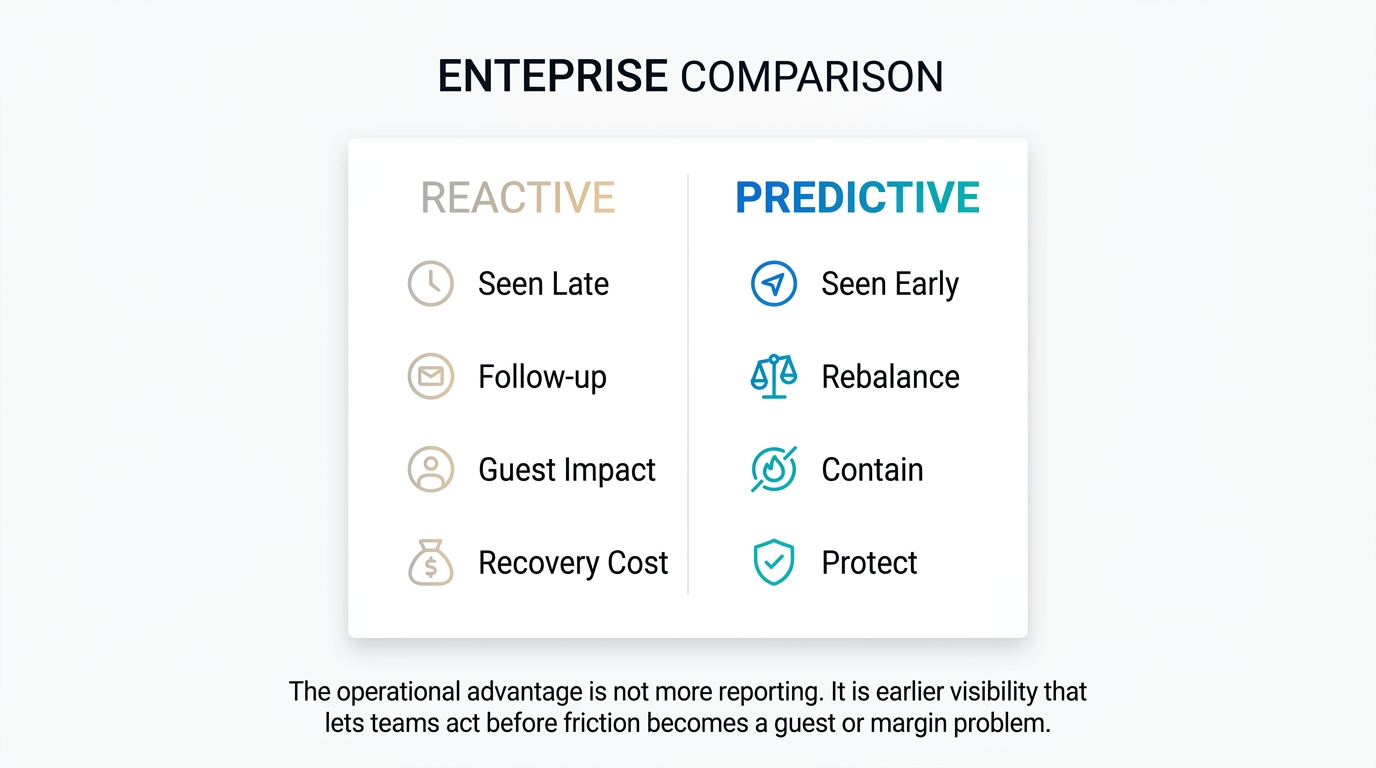
Reactive management waits for the pain to become visible. Predictive hotel management works earlier. It uses real-time hotel insights to intervene while the issue is still small, local, and recoverable.
This does not mean handing control to software. It means giving operators a better cadence for action. A GM can see that one wing is repeatedly missing targets before the next arrival wave. A rooms leader can rebalance work when cleaning bottlenecks begin to stack. A guest services manager can escalate a recurring complaint pattern before it becomes a weekend-long backlog.
What changes in the operating model
The shift from reactive to predictive starts with a different management question. Instead of asking, “What went wrong yesterday?” leaders begin asking, “What weak signals today are likely to become tomorrow’s guest problem?” That is a much stronger question for Hotel AI operations.
It also changes implementation priorities. The first win is usually not a complex model. It is an operating workflow that routes the right alert to the right person with enough context to act. That is where focused AI consulting services can help leadership teams define which blind spots matter, what systems need to connect, and which interventions are actually useful on the ground.
In some cases, teams also benefit from generative AI solutions that summarize shift handover issues, cluster recurring complaint themes, or help managers triage open service cases faster. The technology is helpful only when it reduces noise and supports better decisions.
For leaders who are still shaping their internal point of view, the AI and ML blog can be a useful place to keep building practical AI literacy around workflows, architecture, and adoption.
In that sense, Hotel AI operations becomes less about software and more about disciplined decision-making.
A practical checklist for hotel leaders evaluating AI visibility
Before investing in new tools, run a simple operational self-audit. If the hotel cannot see the pattern, it cannot manage the pattern. Hotel AI operations should answer the questions leaders already struggle to answer during busy shifts.
Ask these questions first
- Are room status, guest requests, service tickets, and escalation notes visible together, or only inside separate department views?
- Can managers see recurring exceptions by shift, room type, floor, or team, rather than only as one-off incidents?
- Do leaders learn about service gaps early enough to act, or only after the guest complains?
- Can the property trace repeated dissatisfaction to a workflow bottleneck such as cleaning flow gaps, front desk delays, or missed handoffs?
- Is staff workload visibility clear enough to spot when one team is carrying too much exception handling?
- Are compensation decisions, manual overrides, and recovery actions tracked as patterns, not just isolated approvals?
- Is there a named owner for operational exceptions, or do issues bounce informally between teams?
If two departments describe the same recurring problem differently, there is probably a visibility gap. If managers hear about issues only after complaint volume rises, the property is operating in hindsight. And if exception handling depends on memory, chat threads, or heroic follow-up, there is a strong case for Hotel AI operations that supports detection and escalation.
First-step implementation and data readiness
The first implementation step should be deliberately small. Start with one process that already creates friction, then confirm whether the needed data exists in usable form. That usually means checking data quality, event timestamps, handoff ownership, and whether systems can be connected without forcing teams into extra manual work.
This is where many hotel programs stall. The idea is sound, but the property is not ready to turn the signal into a workflow. Good hotel AI operations depends on practical data readiness, not just a software purchase. If the inputs are inconsistent, the output will be too.
FAQ
What blind spots can AI find in hotel operations?
Hotel AI operations can reveal front desk delays, housekeeping gaps, room readiness issues, missed guest requests, repeated recovery failures, staff workload imbalance, and hotel revenue leakage patterns by connecting events across systems and shifts.
How can AI help hotels prevent business problems?
In Hotel AI operations, AI helps prevent business problems by surfacing early warning signals while leaders still have time to intervene, reassign work, escalate unresolved issues, and reduce the guest impact of operational friction.
How does AI identify hotel service gaps before guests complain?
It looks for patterns such as repeated follow-ups, reopened tickets, late room status updates, unresolved requests, and exception-heavy shifts that suggest service quality is slipping before complaint volume rises. That is what makes Hotel AI operations useful for prevention rather than cleanup.
Why do hotel owners need AI visibility?
AI for hotel owners matters because financial and guest impact often appear after the underlying operational issue has already repeated multiple times. Better Hotel AI operations support service consistency, staffing decisions, and margin protection without forcing leaders to depend on after-the-fact reporting.
What are the hidden risks in hotel operations?
The hidden risks include room readiness delays, front desk bottlenecks, cleaning flow gaps, missed handoffs, inconsistent recovery, weak workload visibility, and quiet revenue leakage caused by repeated exceptions. If those patterns are connected early, the property has a much better chance of protecting guest satisfaction risk and avoiding avoidable cost.
The hotel advantage starts with earlier visibility
The next generation of well-run hotels will not win because they collect more operational data. They will win because they can recognize risk sooner, connect signals faster, and intervene before small misses become visible business damage.
That is the practical promise of Hotel AI operations. Not more noise. Not staff replacement. Not another dashboard that managers ignore. A better operating discipline that spots service friction earlier, protects teams from avoidable overload, and helps leaders act before guest satisfaction risk turns into revenue loss.
Better visibility is what turns Hotel AI operations from reactive firefighting into predictive leadership. That is the operating case for Hotel AI operations: see the risk early enough to protect both the guest and the margin.
If you are evaluating where AI can create the most practical value in a hotel environment, start with the places where teams already feel the strain but the reports still look fine. That is usually where the hidden cost lives.
If you want help identifying those blind spots, a focused conversation with Webuters through our AI consulting services is a practical first step. The goal is not to add more software for its own sake. The goal is to decide where Hotel AI operations can actually improve visibility, reduce friction, and protect revenue before the guest ever feels the problem.

Loading...