
What a Litify Implementation Actually Costs: The Scope-Driven Truth Behind the Quote
Litify implementation cost is the question every managing partner eventually asks, usually right after the licence quote lands on the table. The honest answer is "it depends." What nobody explains is what it depends on, and that gap is where budgets, trust, and projects quietly fall apart.
Here is the short version: Litify implementation cost depends mainly on the workflows in scope, the number and complexity of integrations, data migration volume and quality, custom development, testing, training and support, and it is separate from Litify and Salesforce licence fees. Most buyers blend those two layers, treating the licence as the budget and professional services as an afterthought. But a licence does not configure your workflows, move your records, or connect your systems.
In the sections that follow, we separate licence fees from services fees, walk through the eight cost components, examine three illustrative project scope profiles, list the inputs for a credible estimate, and compare commercial models. If you are new to the platform, start with our guide on what Salesforce Litify is.
Two Cost Layers Most Buyers Accidentally Blend Together
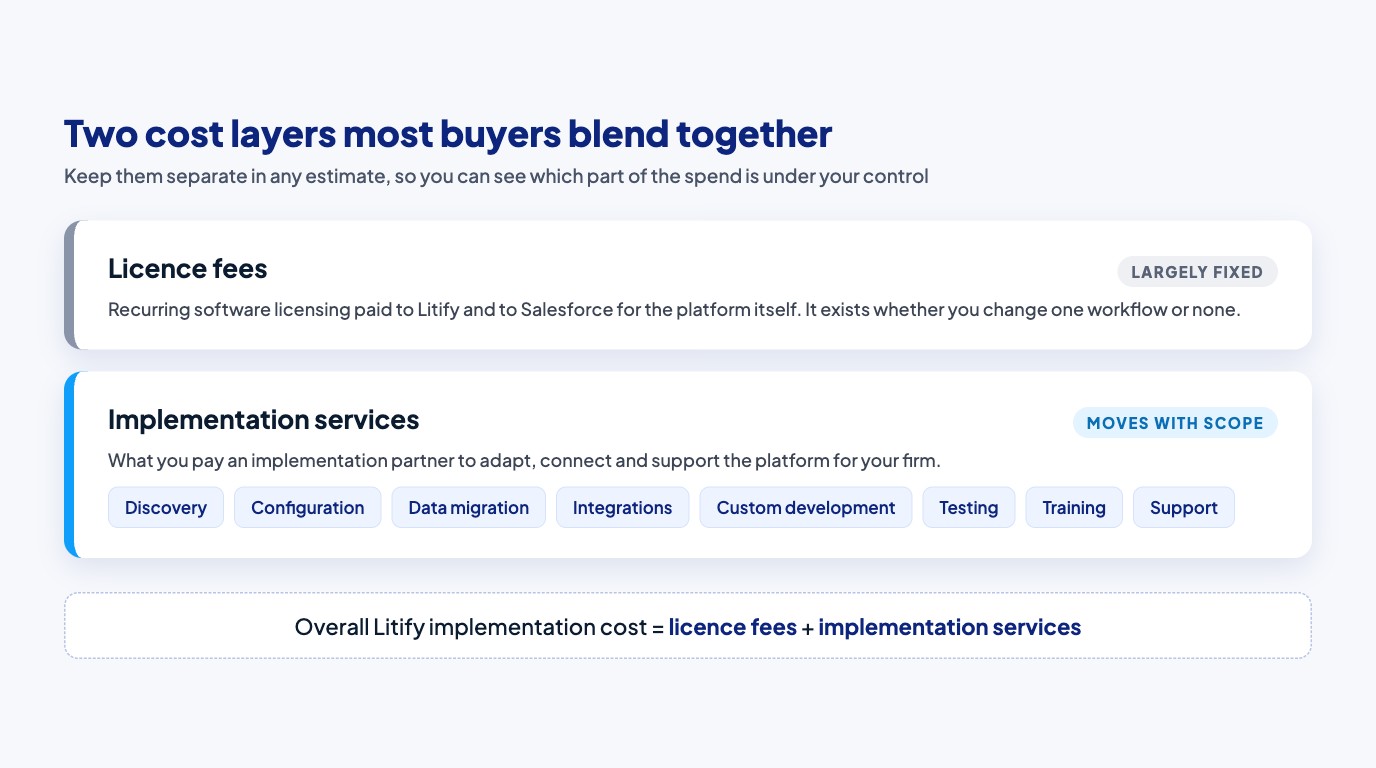
Litify runs on Salesforce, so your organisation pays recurring software licensing to Litify and to Salesforce for the platform itself. That licence layer is largely fixed for a given user count and edition, and it exists whether you change one workflow or none.
The second layer is the professional services you pay an implementation partner for discovery, migration, integration, custom development, testing, training, and post-launch support. This layer moves with scope. The overall Litify implementation cost is really the sum of these two very different kinds of money.
Think of it as building a house: the licence is the plot of land, and the build is where the variation lives. Two business units adopting the same product can have nearly identical licence exposure and very different services exposure, because their workflows and systems differ. That mismatch is the quiet driver behind most uncomfortable conversations about Litify cost.
Any estimate that blends the two layers into one number hides which part of the spend is under your control. Understanding total cost of ownership helps here, because the services layer is only the beginning; ongoing administration and incremental change belong in the same plan. Because Litify is built on Salesforce, you may also need Salesforce development services when configuration alone is not enough. The drivers behind Salesforce implementation cost will feel familiar (scope, data volume, integrations, and change tolerance), just with a legal-specific overlay.
The Eight Cost Components and What Moves Each One
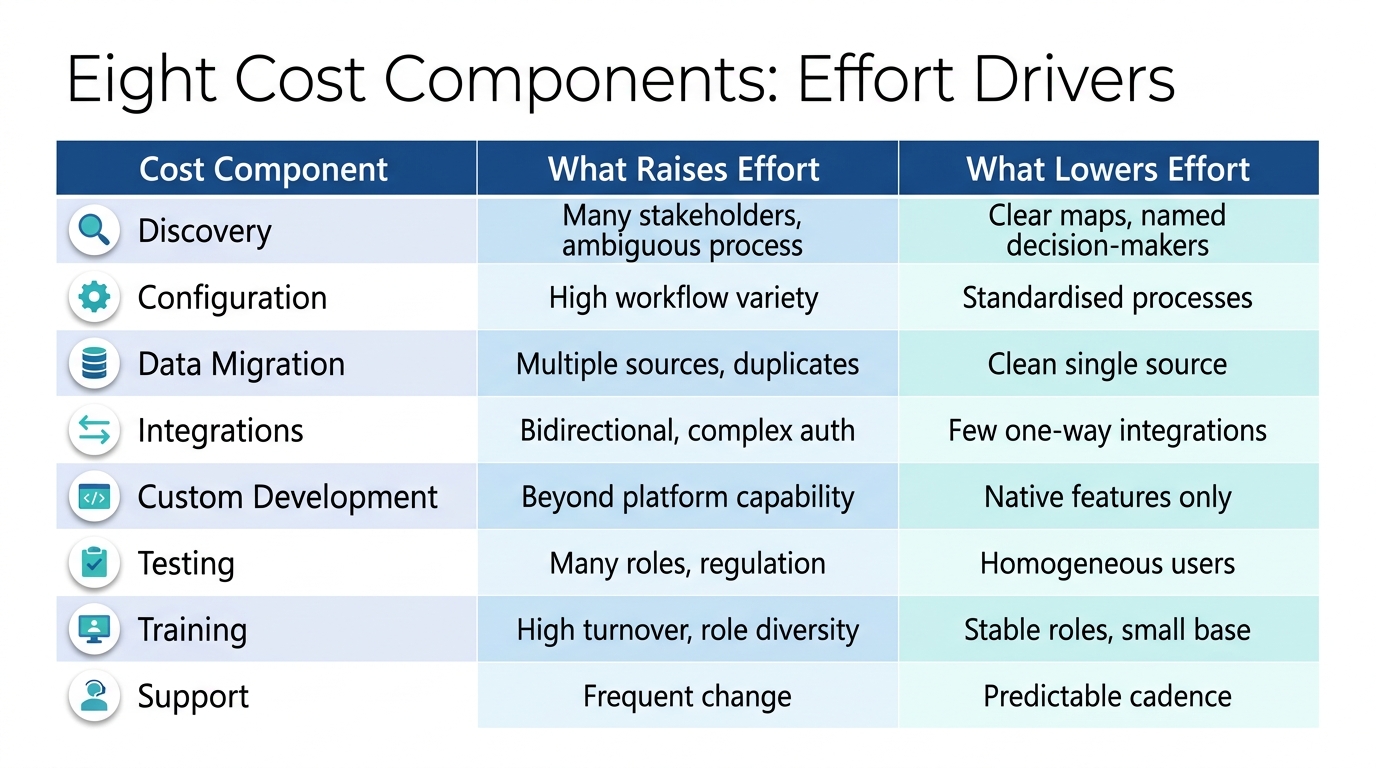
The services layer is not a single lump sum; it is a portfolio of eight effort drivers. Each responds to scope decisions you can influence early, and none operates in isolation, which is why an early Litify implementation cost figure is almost always provisional.
The discovery phase scales with stakeholder count, ambiguity about the future-state process, and how many decision-makers must agree before work can proceed. A firm that arrives with process maps and clear decisions shortens it. One that arrives with open questions extends it, because discovery becomes a series of meetings about what should have been decided internally, consuming senior partner time as well as consultant time.
Configuration scales with workflow variety: how many practice areas, matter types, intake paths, and approval chains differ in meaningful ways. The more exceptions your firm tolerates, the more configuration effort the platform requires to mirror them, because the work repeats for every process variation. An unchecked project scope here inflates your services spend before any code is written.
Data migration scales with record volume, number of source systems, relationship complexity, duplicate rates, field-level quality and how far the legacy schema diverges from the target model. Two firms with identical record volumes can still differ sharply if one source is clean and single while the other is a patchwork of spreadsheets and legacy tools. Follow our Salesforce migration best practices to reduce this effort before it compounds.
Integrations scale with the number of external systems, whether data flows one way or both, authentication complexity, error-handling expectations and reconciliation requirements. A one-way integration with simple authentication can be light; a bidirectional, near-real-time one with full reconciliation is not. For complex needs, consider Salesforce integration services.
Custom development scales with how far the requirement sits beyond what the platform provides out of the box. The official Litify platform page describes native capabilities; anything beyond those may require code, and that code must survive future platform releases. Custom code carries a maintenance obligation long after the build is done, which is why a forecast that ignores maintenance is an incomplete Litify implementation cost.
Testing scales with user count, role diversity, regulatory exposure, integration surface area and the impact of a defect reaching production. Trimming test cycles to save hours is a false economy, because defects found in production are harder and costlier to fix than defects found in test.
Training scales with user count, role variety, turnover and how much of the old way of working has to be unlearned. Adoption is where many rollouts quietly fail.
Support scales with how often the business changes, seasonal or practice-area variation, administration maturity and release cadence. A firm that treats Litify as a living system needs ongoing effort, and pretending otherwise is how post-go-live budgets get ambushed.
| Cost Component | What Raises Effort | What Lowers Effort |
|---|---|---|
| Discovery | Many stakeholders, ambiguous future-state process, delayed decisions | Clear process maps, named decision-makers, agreed scope boundaries |
| Configuration | High workflow variety across practice areas, many exception paths | Standardised processes, limited matter types, few approval chains |
| Data migration | High record volume, multiple legacy sources, duplicates, poor data quality | Clean single source, moderate volume, well-documented schema |
| Integrations | Many external systems, bidirectional sync, complex authentication, strict reconciliation | Few one-way integrations, simple authentication, clear ownership |
| Custom development | Requirements beyond platform capability, complex business rules, future-release risk | Configuration-only solutions, use of native features, minimal code |
| Testing | Many user roles, regulatory exposure, large integration surface, high defect cost | Homogeneous users, low compliance burden, simple data flow |
| Training | High user count, role diversity, high turnover, significant change from old processes | Small user base, stable roles, minimal process change |
| Support | Frequent business changes, seasonal variation, immature administration, frequent releases | Stable operations, dedicated admin, predictable change cadence |
Three Illustrative Project Shapes and Why Their Effort Differs
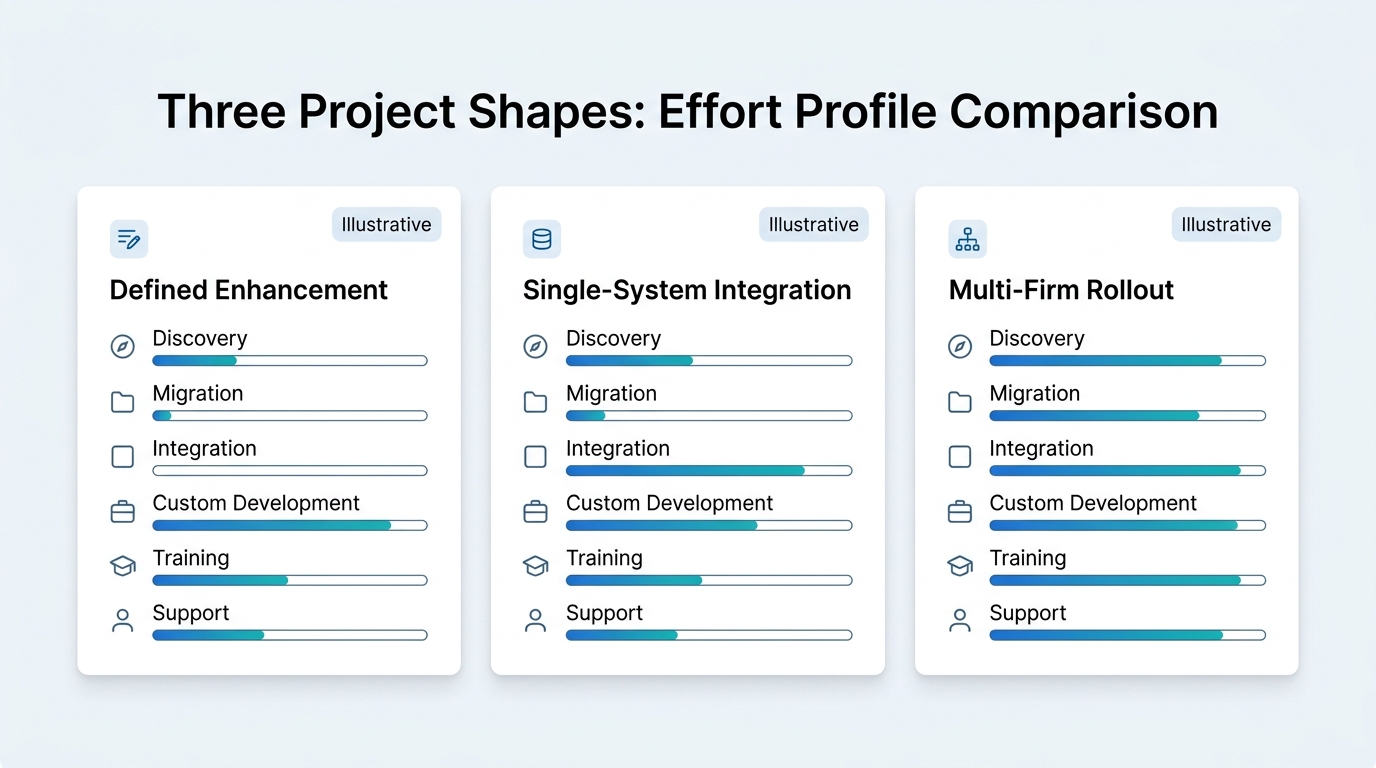
Two vendors can quote the same product and deliver very different numbers because the project shapes are different. The following three profiles are illustrative, not packages to buy, and they show how the eight components combine in practice. No numeric range is attached, because attaching one without a specific firm's inputs would be misleading; the only honest route to your own Litify implementation cost is a scope-first estimate.
Profile One: Defined Enhancement (Illustrative)
A firm already runs Litify in production and wants to add a new intake path and related reporting. Nothing has to migrate and no external system is touched, so the work is mostly configuration and regression testing. Discovery is short because stakeholders already know the current state, and custom development is unlikely. Training and support impact is low because the user base and roles are stable.
This profile suits a fixed-price engagement and is the easiest shape to estimate accurately, which is why a good partner can quote it with real confidence.
Profile Two: Single-System Integration (Illustrative)
A firm needs Litify to exchange data with an existing document or accounting system. The dominant effort is interface design, authentication, field mapping, error handling, and reconciliation testing, not configuration. Configuration is modest because the Litify org already exists, and migration is light because the system of record stays in place. Bidirectional sync or near-real-time requirements push the Litify implementation cost up, because every additional direction of data flow adds failure modes you must test. This profile often fits an effort-based model because endpoint behaviour is uncertain.
Profile Three: Multi-Firm Rollout (Illustrative)
Several firms or entities need a shared Litify model. Discovery is heavy because governance must be agreed across stakeholder groups, and migration is heavy because each firm may bring its own legacy systems. Integration density is high, and custom development may be required to enforce multi-entity security and reporting. Training and support scale with user count and role diversity, and coordination overhead can rival the technical work. Here, Litify pricing factors shift from configuration toward coordination.
This profile demands a phased approach. Working with a Litify consulting, customization and integration services partner experienced in multi-entity rollouts reduces risk. Until governance is settled, the estimate drifts for reasons that have nothing to do with technology, and the Litify implementation cost stays hard to forecast.
What to Prepare Before You Ask for a Credible Estimate
A credible estimate is a function of inputs the firm controls. The more you prepare, the less contingency a partner must add, and the more visible your own assumptions become. The following checklist shortens the discovery phase and sharpens the number.
- Process maps showing what happens today, who does it, and where handoffs occur.
- System inventory of every system that touches matter, party, document, time, or finance data, with the system of record for each.
- Sample data from each source system, revealing field structure, duplicate rates, and quality issues.
- User and role counts by practice area, office, and seniority, including expected growth.
- Reporting and analytics needs that leadership expects after go-live, not just build inputs.
- Integration endpoints and constraints for each external system, including ownership, authentication support, and data export permissions.
- Security, compliance, and regulatory constraints that shape access, retention, and auditability.
- Named decision-makers with authority to sign off on scope, so discovery does not stall waiting for consensus.
A firm that arrives with these inputs lets the partner spend discovery validating assumptions instead of uncovering them, which lowers both risk and contingency. Readiness, not the product alone, shapes the quoted Litify implementation cost.
Choosing Between Fixed Scope, Time and Materials, and Reserved Capacity
The right choice depends on how well the scope is known, how often it will change, and how much governance you want to run. Each model changes how the Litify implementation cost is shared between buyer and partner.
Fixed scope suits well-understood, bounded work where inputs are known and change tolerance is low. A defined enhancement is a good candidate. It trades flexibility for predictability, which is the right trade when requirements are genuinely stable.
Time and materials fits exploratory or evolving work. An integration with uncertain endpoint behaviour often runs better this way, with effort following reality rather than an early guess. Transparent governance is essential, because you pay for effort actually consumed and need to see where it went.
Reserved monthly capacity suits organisations with a steady, prioritised change backlog. Instead of opening a new statement of work for every small improvement, you buy a predictable block of hours.
| Commercial Model | Best Fit | Governance Needed |
|---|---|---|
| Fixed Scope | Well-understood, bounded work with stable requirements | Change control process, clear scope documentation |
| Time and Materials | Exploratory or evolving work with uncertainty | Time tracking, regular review meetings, transparent reporting |
| Reserved Capacity | Steady backlog of small improvements and continuous change | Prioritisation cadence, monthly review, capacity planning |
Remember that total cost of ownership does not stop at go-live. After launch, you will need administration, incremental change, seasonal variation, and platform release management. Those recurring costs belong in the same plan as the build. A well-scoped support retainer helps catch small issues while they are still cheap to fix and prevents emergency rework, which makes it one of the overlooked entries that shape the ongoing Litify implementation cost.
The Estimate You Shape, Not the Price You Receive
Scope (workflows, integrations, migration volume and quality, custom development, testing, training and post-go-live support) sets most of your figure, and it sits separate from Litify and Salesforce licence fees. Effort, not product, sets the number.
The biggest risk to your budget is not the software vendor; it is your firm's own unspoken assumptions about scope. Buyers who treat discovery as a formality end up paying for it later in change orders and delays. Buyers who invest in clarity before signing get a number they can defend to the board and a project that does not need rescuing after launch.
A scope-first estimate has almost nothing to do with the software licence and almost everything to do with the shape of the work. A vendor who quotes without discovery is quoting a placeholder, not a price.
If you are evaluating Litify on Salesforce and want a scope-first estimate built from the inputs we have outlined, our Litify consulting, customization and integration services are designed for exactly that. Request a scoped implementation estimate and we will work through your eight cost components one by one, so the Litify implementation cost you are quoted is one you can trace back to decisions you actually made.
Frequently Asked Questions
Does the Litify implementation cost include the licence fee?
No. The licence fee is paid directly to Litify and Salesforce and is separate from services fees. Implementation fees cover the professional services needed to configure, migrate, integrate, test, train, and support the system.
How do I know if my project is a defined enhancement or a multi-firm rollout?
Look at the number of workflows in scope, the systems that must connect, and the volume and quality of data to be migrated. A defined enhancement has few new workflows and no migration; a multi-firm rollout involves governance across entities, multiple source systems, and higher integration density.
What should I prepare before requesting an estimate?
Prepare process maps, a system inventory, sample data, user and role counts, reporting needs, integration endpoints, security constraints, and named decision-makers. This shortens discovery and keeps the resulting Litify implementation cost from creeping upward.
Can I get a fixed price for this work?
Yes, if the scope is well understood and unlikely to change. For exploratory work or uncertain integrations, an effort-based model may be more appropriate. For continuous change backlogs, reserved monthly capacity can be smoother. A fixed price works best when discovery has already removed most unknowns.
How does Litify implementation cost differ from total cost of ownership?
Implementation covers the build phase: configuration, migration, integration, testing and training. Ownership cost adds licence fees plus ongoing administration, incremental change and platform release management after go-live.
What is the biggest mistake buyers make when estimating Litify implementation cost?
The biggest mistake is asking for a price before defining scope. A number quoted without discovery is a placeholder. Map workflows and systems first, and the estimate becomes both more accurate and more controllable.

Loading...