
AI in Banking: The Three-Layer Map Every Leader Needs Before the Next Pilot
Where AI in banking is production-ready and where it is still a pilot — mapped across front, middle and back office, with a sequencing guide.

You have seen the polished demo. The boardroom screen glows with a model that predicts customer churn, flags suspicious transactions in milliseconds, and answers customer questions in a calm, synthetic voice. The promise: AI in banking will reshape everything from lending to risk. But the gap between demo and reality is not a technology failure, it is a leadership problem.
Walk back to the operations floor. The two-year-old pilot is still “about to scale.” The chatbot handles routine balance inquiries but escalates complex queries to humans. The credit model works in the lab but cannot explain itself to a regulator. The fraud system flags more alerts, but your analysts are drowning.
That disconnect comes from treating every use case as equally ready. In practical terms, AI in banking is the application of machine learning, natural language processing, and predictive analytics across a bank’s front, middle, and back offices to automate decisions and detect patterns applied selectively where production value is proven.
The biggest risk is not that AI fails. It is that you fund the loudest pilot while the quiet, production-ready wins go unfunded. In practice, the most proven value sits in back-office automation and fraud detection. Meanwhile, customer-facing personalisation gets the attention but remains pilot-stage. That mismatch creates pilot debt.
Here is the shift. Instead of asking “What can AI do?” ask “Which layer of our bank is ready for AI, and what decision does AI support?” That question leads to the three-layer map. This is not a single technology; it is a portfolio of capabilities for AI in banking.
The three-layer map is a mental model, not a product. It is a way to see the whole bank at a glance: front office, middle office, back office. Each floor has its own AI maturity, data readiness, and risk profile. The map is useful precisely because it prevents you from treating a chatbot demo as proof that the entire bank is AI-ready.
In this guide, we map that three-layer reality. We walk through six domains where AI actually lands, lending and credit, fraud and AML, customer service, risk and compliance reporting, operations automation, and personalisation and name for each what the technology does well, what it does badly, and the failure mode to watch. Then we give role-level decisions for the CIO/CTO, head of lending, risk and compliance officer, and COO. We close with why banking is structurally harder and how to sequence your next investment.
The Hype Gap: Why Your Pilots Haven’t Scaled
Pilots stall for a reason that has nothing to do with model quality: nobody owned the map. A bank funds the use case with the best demo rather than the one with the readiest data, and two years later the project is neither dead nor in production. It sits in the budget as a line nobody will defend and nobody will cancel.
A customer service chatbot that answers balance inquiries is not the same as an autonomous credit engine. The first is in production at many banks; the second is still experimental. IBM explains that banking AI spans multiple use cases, from customer experience to risk management, but production value is unevenly distributed.
When you consider AI in banking, production readiness varies sharply. Banks that have automated their core systems tend to see faster payback from automation. In the front office, chatbots are common, but personalisation lags. In the middle office, fraud detection and AML systems are mature, while credit decisioning is still human-led. Back-office automation is quietly delivering efficiency gains. For a deeper look at why back-office wins often go unnoticed, see how RPA contributes to the banking industry.
Mapping the Three Layers: Front, Middle, Back Office
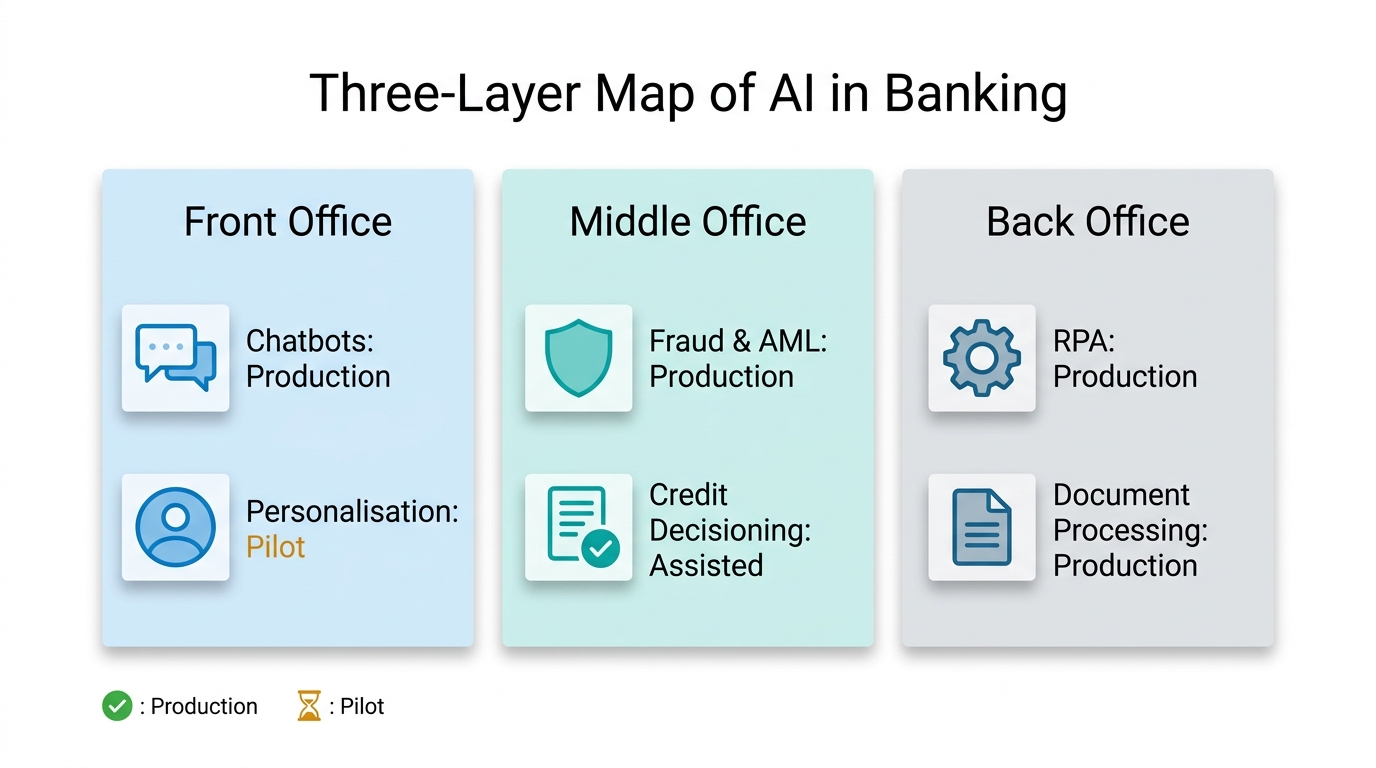
Think of a bank as a three-floor building. The front office is customer-facing, the middle office is risk and compliance, and the back office is operations and processing. Each floor has different wiring, maturity, and danger zones—which is why a single verdict on AI in banking is always wrong at the floor level. The same map holds for AI in financial services more broadly: insurers and asset managers stack the same three layers over different products.
In the front office, AI in banking shows up in chatbots and personalisation. Customer service chatbots are the most production-mature: they handle routine balance inquiries. Personalisation, however, is still pilot-stage because it depends on clean, connected customer data that many banks lack.
The middle office is where AI has its deepest production roots. Fraud detection and anti-money laundering systems have used machine learning for years. Credit decisioning models though not fully autonomous assist underwriters by scoring applications. These systems are mature because they operate on structured data and have clear success metrics.
The back office is quieter but proven. AI and RPA handle document processing, data entry, reconciliation, and report generation. Many institutions have seen real efficiency gains by automating account opening and loan document processing. The catch is that automation inherits whatever process it is pointed at, so the groundwork is process design rather than model selection.
Here is a simple map of the three layers with AI maturity:
| Layer | Primary AI Applications | Production Status |
|---|---|---|
| Front Office | Chatbots, virtual assistants, personalisation | Chatbots: production; personalisation: pilot |
| Middle Office | Fraud detection, AML, credit decisioning, risk reporting | Fraud and AML: mature production; credit decisioning: assisted |
| Back Office | RPA, document processing, reconciliation | Production in many institutions |
This map is not static, but it gives any AI strategy a starting point. Fund the floors that are ready, and do not force the others.
Six Domains Where AI Actually Lands: Strengths, Weaknesses, Failure Modes
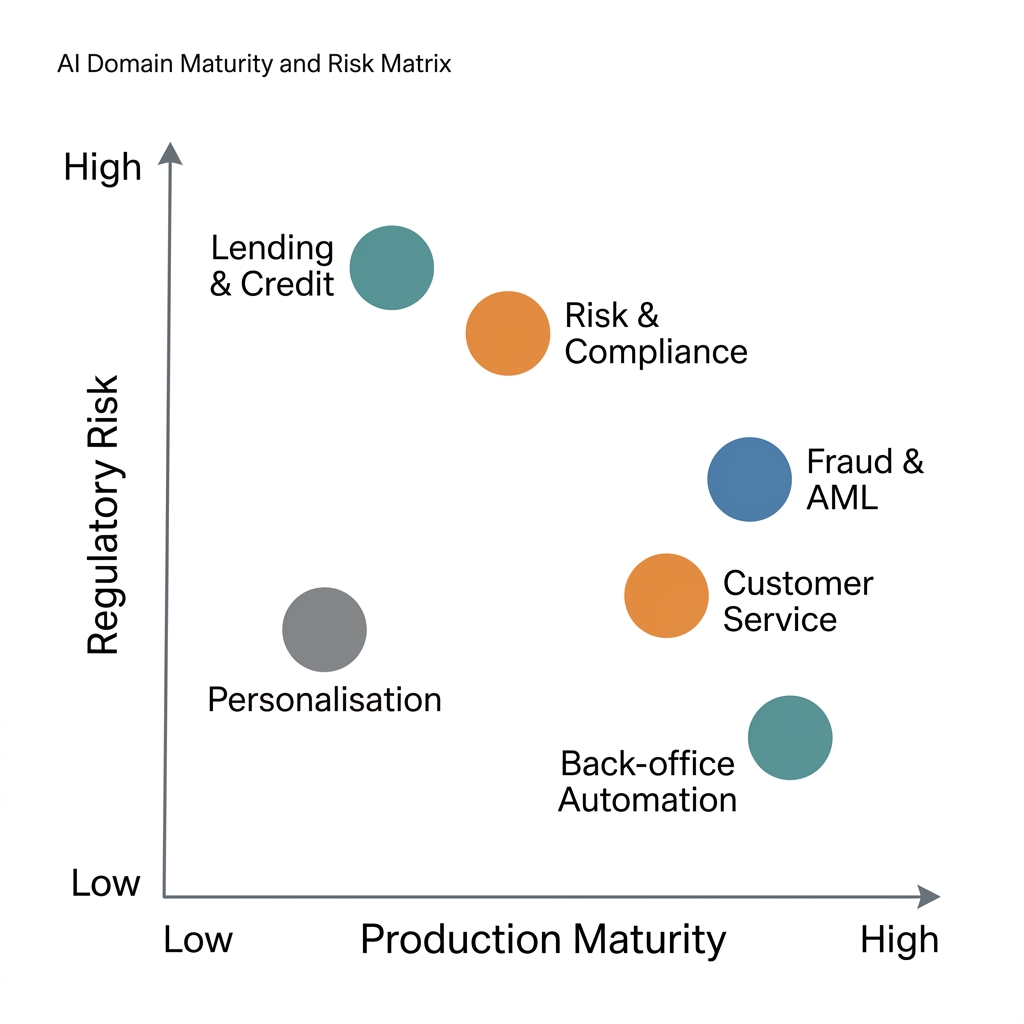
Now, let’s zoom into six specific domains. For each, we name what AI does well, what it does badly, and the specific failure mode.
Lending and Credit Decisioning
AI excels at pattern recognition across unstructured data, transaction history, cash flow, even social signals. It can speed up underwriting and reduce manual review, and in practice most of that gain arrives before the credit decision rather than at it: document intake, income verification, and the pre-screen that decides which files a human should read first. A commercial lender that cuts three days out of document handling has changed its economics without changing its credit policy at all.
Explainability and bias are the constraints. A model might decline an application on a combination of signals no underwriter can restate in a sentence, and an adverse-action notice has to say something specific. Proxy variables are the subtler trap postcode, device type, and thin-file history can reconstruct a protected characteristic the model was never given, and regulatory compliance turns on being able to prove they did not. Failure mode: over-reliance on black-box models without human override.
Fraud Detection and AML
This is the strongest production use case, and the reason is structural rather than technical: fraud has labelled outcomes. A transaction was disputed or it was not, so the model gets a clean training signal and a metric everyone already agrees on. Machine learning detects anomalies in real time, adapts to new patterns, and takes work off the queue in a way the business can count.
The weakness is adversarial. Fraudsters change tactics deliberately, so a model tuned on last quarter’s patterns decays in a way a churn model never does. AML carries a second problem: the false-positive rate is high enough that analysts triage by habit rather than by score, which is how a genuinely novel alert gets closed in eight seconds. Failure mode: alert fatigue and missed new fraud. Fraud detection is a prime example of where AI in banking delivers measurable ROI, provided someone owns model retraining as a standing job rather than a project. It is also the domain where AI in banking has the longest production history, which is worth remembering when a vendor presents anomaly detection as new.
Customer Service
Chatbots and virtual agents handle routine queries around the clock and take measurable volume out of the call centre—balance inquiries, transaction history, card freezes, branch hours. Customer service is usually the first place AI in banking touches an actual customer, which is exactly why it gets funded first and designed last.
The failure is rarely comprehension. It is the handoff. A customer who has already explained a disputed charge to a bot and has to explain it again to a human has been given a worse experience than if the bot had never answered. Complex, multi-step transactions—a mortgage query, a fraud claim, anything touching a joint account—need a route to a person that carries the context across. Failure mode: broken handoffs to human agents.
Risk and Compliance Reporting
AI can automate the mechanical half of reporting: pulling figures from source systems, reconciling them, and drafting the standing narrative sections that change little between quarters. That is genuine time back, because the aggregation work is where the hours actually go.
Interpretation is the half that does not automate. Regulatory language is deliberately judgement-laden, and a summary that is fluent and subtly wrong is more dangerous than one that is obviously incomplete—a reviewer catches the second and signs off the first. Generative AI in banking is useful here for drafting and never for filing. Keep a named human accountable for every submitted figure. Failure mode: inaccurate reporting that fails an audit.
Operations Automation
RPA and document processing are proven, unglamorous, and the reason operations automation is where AI in banking produces the most immediate cost savings. Account opening, loan document intake, reconciliation, and customer onboarding checks are high-volume, rule-bound, and measurable, everything a model needs and a personalisation project lacks.
Two things go wrong. Automate a broken process and you get a faster broken process, so the mapping work has to happen before the tooling. And screen-scraping bots are brittle by construction: a core system patch moves a field, the bot fails silently, and the exception queue fills for a week before anyone notices. Failure mode: workflows that break when underlying systems change. For many institutions the clarity of a documented workflow, not the automation layer, is what makes or breaks the deployment.
Personalisation
AI can deliver tailored offers, next-best-action prompts, and recommendations timed to a life event rather than a campaign calendar. This is the least mature domain, and the blocker is not the model. It is that a unified customer profile requires the mortgage system, the card system, and the current-account system to agree on who a customer is—which is a data-integration project wearing a marketing badge.
Trust makes the downside asymmetric. A retailer that recommends the wrong shoes is ignored; a bank that offers a consolidation loan to someone who has just been made redundant, or gets a life event visibly wrong, does lasting damage. Failure mode: bad recommendations that erode trust. Back-office wins are easier to measure and, for most banks, worth funding first.
Here is a table summarising the six domains:
| Domain | What AI Does Well | What AI Does Badly | Failure Mode |
|---|---|---|---|
| Lending & Credit | Pattern recognition in unstructured data | Explainability, bias risk | Over-reliance on black-box models |
| Fraud & AML | Real-time detection, reduces false positives | Adversarial adaptation, model drift | Alert fatigue, missed new fraud |
| Customer Service | Handles routine queries, 24/7 | Complex queries, escalation | Frustrated customers, broken handoffs |
| Risk & Compliance | Automates data aggregation | Regulatory nuance | Inaccurate reporting |
| Operations | RPA for back-office tasks | Legacy integration | Broken workflows |
| Personalisation | Tailored offerings | Data and model maturity | Bad recommendations erode trust |
Each domain has a different risk profile. The key is to match the layer with the right expectations for AI in banking.
Customer service is where most banks meet AI in banking first, and where the distance between a scripted bot and a genuinely useful one is widest — how chatbots are transforming the banking industry covers what separates the two.
What Each Leader Must Decide: CIO, Head of Lending, Risk Officer, COO
AI is not an IT project. It is an operating model change. Different roles own different decisions.
CIO/CTO: The Infrastructure Decision
You own the data architecture. AI models are only as good as the data they train on. Your decision: how to integrate AI with legacy core banking systems and ensure data quality. Do you build a data lake? Use vendor APIs? Core banking integration is often the biggest bottleneck, and no amount of model quality routes around a core that settles overnight. For many banks, the hardest part of any AI in banking initiative is not the model, it is the pipes.
Head of Lending: The Credit Policy Decision
You own the underwriting process. AI can recommend decisions, but you decide where human judgement is required. Set thresholds for auto-approval versus human review. That keeps AI in an assistive role and preserves explainability. Credit decisioning becomes a collaboration between model and underwriter.
Risk and Compliance Officer: The Governance Decision
You own model risk management. Regulators will ask how you validate, monitor, and audit AI models. Adopt a framework such as the NIST AI Risk Management Framework and build an inventory of all AI models. The Financial Stability Board has highlighted that AI models can amplify systemic risks if not governed properly. For any bank scaling this technology, governance cannot be an afterthought. Model risk management is a discipline that spans every AI model in the bank.
COO: The Operational Workflow Decision
You own the processes. AI can automate tasks, but you decide which processes are ready. Pick high-volume, rule-based workflows for automation first: account reconciliation, document processing, and customer onboarding. For a COO, the fastest wins usually come from back-office processes.
These roles must coordinate. A CIO who builds infrastructure without a risk officer’s governance will hit compliance walls.
Why Banking Is Structurally Harder: Explainability, Governance, and Legacy
Banking is not like retail. You cannot move fast and break things. You hold customer money and face regulators. This sector is harder for five structural reasons.
Explainability: When a bank denies a loan, the customer has a legal right to know why. Black-box models fail this test.
Model risk management: The NIST AI Risk Management Framework provides guidance. The Financial Stability Board’s 2024 report explores systemic risk. This discipline is not just a compliance box; it is a strategic capability.
Auditability: Every AI decision must be logged and reproducible. Every fraud detection model must be auditable.
Data residency: Customer data often must stay within a specific jurisdiction, limiting cloud options.
Legacy core integration: Your core banking system is likely decades old. AI models need clean, real-time data, but your core may batch-process overnight.
These constraints mean that deploying artificial intelligence in banking must be deliberate rather than fast. They are also why AI in banking demands a different operating rhythm than retail or media: the review step is not overhead bolted onto delivery, it is delivery.
These constraints are easier to judge against a platform built around them: what Salesforce nCino is sets out how a lending platform handles auditability and core integration, and reimagining financial services with Salesforce takes the same questions up to the platform layer.
Where an institution wants that assessed against its own systems rather than in the abstract, our insurance and finance industry solutions describe how we approach the work.
Sequencing Your Investments: What to Fund First, Second, Third
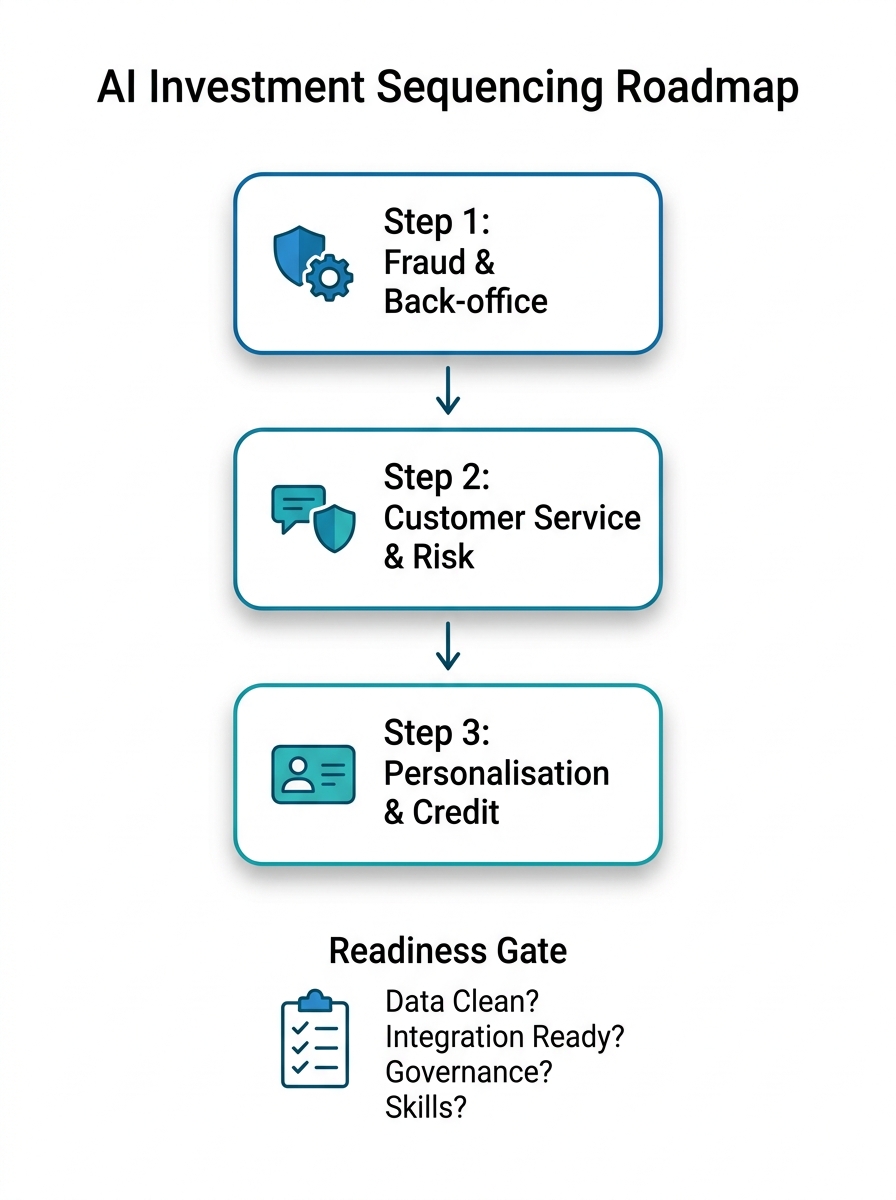
So where do you start? Not everywhere. A practical roadmap starts with the proven, boring stuff. It is a sequence based on production maturity, data readiness, and risk. The same logic applies to credit decisioning: do not automate what you cannot explain.
First: fraud detection and back-office automation. These have proven production value and low regulatory risk. For fraud, you already have data and a clear success metric. For the back office, banking automation applied to reconciliation and customer onboarding delivers quick wins that finance can verify without a new measurement framework.
Second: customer service and risk reporting. Chatbots reduce call volume, but you need an escalation path. Risk reporting automation saves time, but needs human validation.
Third: personalisation and advanced credit decisioning. These are the least mature and most risky. Fund these only after you have built data infrastructure and governance.
Before you start, ask these readiness questions, which are central to effective planning, because the failures of this technology almost always trace back to data or governance:
- Is the relevant data clean, labelled, and accessible?
- Can the AI model integrate with existing systems?
- Do you have a governance process for model validation?
- Do you have the in-house skills or a partner who understands both AI and banking?
If the answer to any is no, delay the start.
Frequently Asked Questions About AI in Banking
What is AI used for in banking?
AI is used across lending, fraud detection, customer onboarding, and personalisation. In AI in banking, the most production-ready applications are fraud detection and back-office automation, while personalisation and fully autonomous credit decisioning remain less mature.
Is generative AI safe to use in a bank?
Generative AI in banking is useful for drafting, summarisation, and internal knowledge retrieval, but it is not safe for final decisions without human review. It must be governed strictly to prevent hallucinations and data leakage. Always pair generative AI with a human in the loop.
How do banks handle AI model risk?
Banks typically maintain a model inventory, validate models before deployment, monitor performance, and conduct periodic reviews. Frameworks like the NIST AI Risk Management Framework offer structured guidance, but each bank must adapt it to its regulatory context. This is a core part of model risk management in banking.
What does AI in banking cost to get started?
Costs vary widely depending on data readiness, integration complexity, and talent. As a general industry estimate, a small RPA project may start in the tens of thousands of dollars, while a full AI platform with data lake and governance can require millions. Start with a focused pilot in a high-value, low-risk domain.
Where should a bank start with AI?
Start where data is clean and value is proven: fraud detection or back-office automation. These domains have clear success metrics and lower regulatory risk than customer-facing personalisation or autonomous credit decisioning. Banking automation is often the safest entry point. And no matter where you begin, keep the end goal clear: to make AI in banking a dependable part of daily operations.
The Winner Won’t Be the Fastest Adopter, but the Most Deliberate
Pilots do not fail because the AI is bad. They fail because nobody owned the map. AI in banking is a three-layer system, front office, middle office, back office. Fund the layer where production value is proven, and govern the one where risk lives.
Across AI in financial services generally, the institutions that win will not be the ones with the most models or the flashiest demos. They will be the ones that treat AI as an operational system and sequence investments deliberately. They will build governance before they build models.
If you are sitting on pilot debt and struggling to see which projects will actually scale, an AI readiness review can bring clarity. At Webuters, we help financial-services institutions map their current AI portfolio, identify quick wins in fraud and operations, and flag governance gaps before regulators do. We bring platform and delivery experience from our AI services, without pretending to be a compliance advisor.
The question is not whether AI will transform banking. It is whether your institution knows which floor to build next. If you would like a practical, no-hype assessment of where you stand, reach out for a readiness review. It is the first step from pilots to production.
AI adoption and workflow automation
Start with one workflow, prove it in production, then scale what works.
See AI services
Krishna is the Founder and CEO of Webuters, a technology leader specializing in Generative AI, intelligent automation, enterprise software, and digital transformation. He helps organizations leverage emerging technologies to drive innovation, operational efficiency, and business growth. Through his writing, Krishna shares insights on AI adoption, technology leadership, product innovation, and the future of work, helping leaders navigate change and build future-ready organizations.
Follow Krishna on LinkedIn