
The New Hospitality: Why AI Personalization Must Be Built on a Foundation of Data Trust
Discover how hotels can use AI personalization while maintaining GDPR compliance and guest trust. Learn consent management, data minimisation, and vendor due…

A robust AI data governance framework ensures that every data point touched by AI systems is managed responsibly. Picture a hotel lobby where a guest checks in via a mobile app, and by the time they reach their room, the temperature is set to their preference, the TV recommends their favorite shows, and the minibar is stocked with snacks they ordered last stay. That is the promise of AI-powered personalization in hospitality. But every data point an AI system touches carries risk, which is why ai data governance is essential for hotels.
Consider the 2018 Marriott data breach which is a stark reminder that personalization without governance is dangerous. Many hotel leaders now face a dilemma. Guests expect seamless, personalized experiences, yet they are increasingly aware of how their data is used. Regulations like the GDPR impose strict rules on consent, data minimization, and transparency. The common assumption is that personalization and privacy are at odds. But that assumption is wrong. The truth is that privacy is the foundation of lasting guest trust, and ai data governance is the tool that makes both possible.
In this article, we will walk through how hotels can deliver AI personalization that guests love without compromising compliance. We will start by mapping the full scope of data your AI stack touches, then cover the governance triad of consent, minimization, and retention. From there, we will walk you through how to vet AI vendors and show you why transparency is actually a massive competitive advantage. We will also tackle the five biggest questions hotel leaders are asking right now. By the end, you will see that strong AI data governance is far from a heavy burden. Instead, it is the absolute bedrock of modern hospitality.
The Collision Between Personalization and Privacy
A single lapse in data security can cost millions and erode guest confidence. The Marriott breach is a concrete example: attackers accessed personal data including passport numbers and credit card details. Deploying ai data governance early prevents such lapses from escalating. Regulators are tightening the rules too. The UK’s ICO has published guidance stating that AI systems must comply with data protection principles: fairness, transparency, and purpose limitation, just like any other processing. The GDPR imposes strict requirements on consent and data minimization. In the US, the AHLA maintains a hospitality law database that tracks an evolving patchwork of regulations. Strengthening ai data governance is no longer optional.
Hotel leaders often ask: Is AI personalization GDPR compliant? The answer is yes….provided you have a lawful basis and adhere to the principles. Many rush to deploy chatbots, recommendation engines, or dynamic pricing without a governance framework, believing that consent gathered at booking covers everything. But consent must be specific and granular; broad statements like “I agree to processing” are insufficient under GDPR Article. To achieve compliance, you first need to see exactly what data flows through an AI-powered hotel stack. Without that mapping, your AI data governance effort is incomplete.
What Data Your AI Stack Really Touches
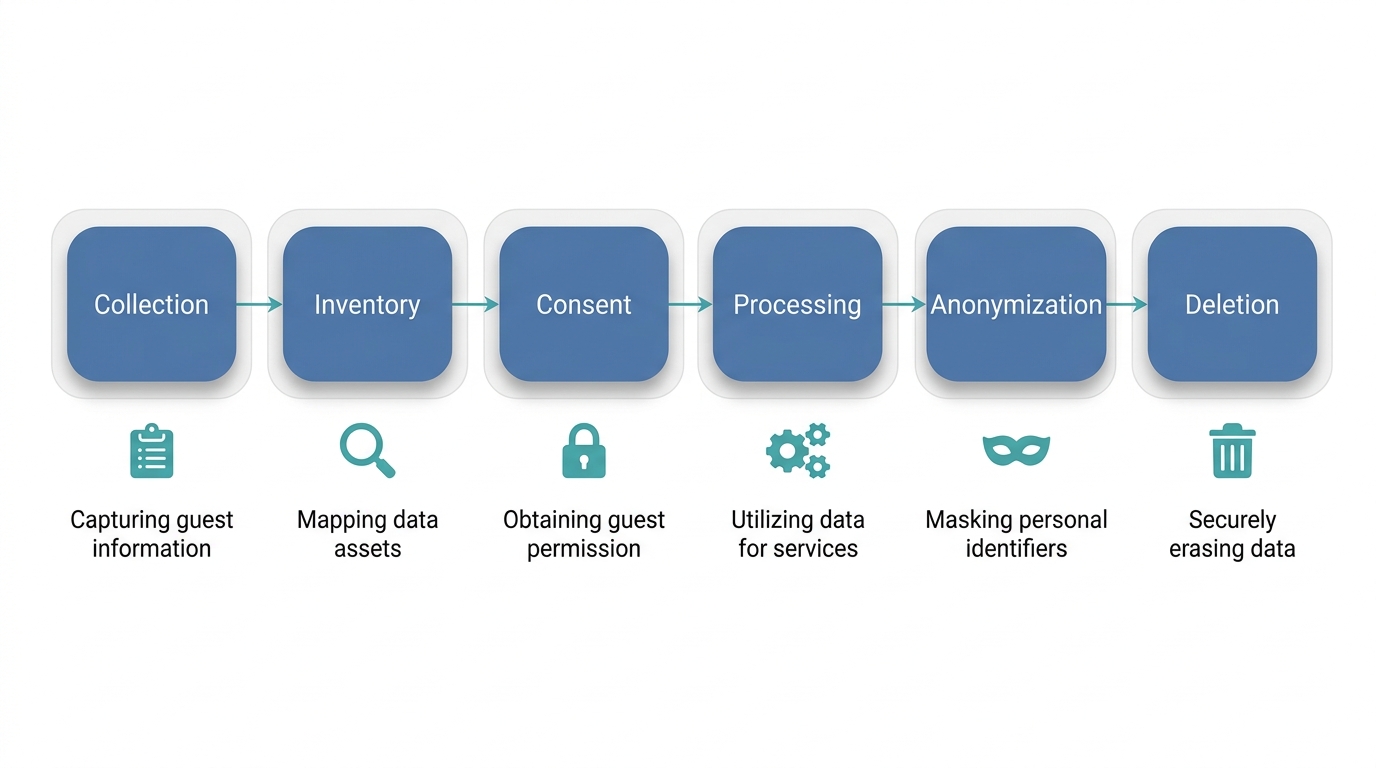
Picture a guest booking a room. At minimum, that reservation captures name, email, phone number, and payment details. But as that guest interacts with your hotel—through the mobile app, loyalty portal, front desk, restaurant, spa, and smart room devices—the AI stack ingests far more: dietary preferences, spa treatments (which may reveal health data), room temperature settings, and even voice recordings from assistants.
Few hotels design their data architecture with these overlapping streams in mind. Instead, systems are often stitched together through custom integrations, with data flowing unchecked between them. A recommendation engine that suggests restaurant options based on past orders might inadvertently draw from a connected spa system that holds medical information, creating a compliance risk. That is why a thorough data inventory is the first step in any ai data governance framework. Conducting a thorough data inventory helps you map every touchpoint where guest data enters your systems.
The GDPR’s data minimization principle is clear: collect only what is necessary for each purpose. If your AI only needs to know a guest’s room preference to adjust temperature, it should not have access to their loyalty tier or payment history. Achieving that requires a clear data inventory and strict access controls. Without them, your IT consulting for secure data architecture should start by mapping and segmenting these flows.
It also demands that you define what guest data AI systems can use for each type of personalization. A governance framework answers this by categorizing data into tiers: identity data (needed for booking), preference data (good for personalization), behavioral data (useful but risky), payment data (never for AI), and sensitive data (requires explicit, separate consent). Once you know what data is in play, the next step is to ensure you have lawful grounds to use it—starting with consent. A mature ai data governance program assigns ownership and audit rights for each data tier, ensuring that every category is managed consistently.
The Governance Triad: Consent, Minimisation, and Retention
The triad of consent, minimization, and retention is the bedrock of responsible ai data governance. When designed well, it turns privacy compliance into a system that guests trust.
Consent. Under GDPR, for personalization that is not strictly necessary for the service, you need explicit consent—opt-in, freely given, specific, informed, and unambiguous. Pre-ticked boxes are not valid. A practical approach is to implement a layered consent capture during check-in or app onboarding, offering separate toggles for “personalized offers based on my stay history” and “remember my room preferences.” Guests can then choose exactly what they are comfortable with. This answers the question: How do hotels get consent for personalization? It must be an active choice, and withdrawal should be just as easy. Proper guest consent management is key.
Data minimisation. Beyond the legal requirement, minimization forces your team to justify every data point. Before building an AI feature, ask: “Do we need this specific data field to make the recommendation?” If not, do not collect it. This reduces both privacy risk and data storage costs. AI systems should also be designed to anonymize or mask personal identifiers wherever possible, especially when training models. Data minimisation is a core pillar of ai data governance.
Retention. Data should never linger indefinitely. Establish retention schedules: for example, basic stay history might be kept for two years for marketing, but payment data is deleted 30 days after checkout (unless required by law). Automated deletion policies and regular audits ensure that old data does not become a liability. A clear data retention policy for hotels is essential. Enforcing retention schedules is a key output of any ai data governance program.
Integrating these three elements from the start transforms your AI stack into a privacy-respecting asset. But your responsibility does not stop at your own systems. You must also scrutinize the AI vendors you bring in.
Questions Every Hotel Must Ask AI Vendors About Data
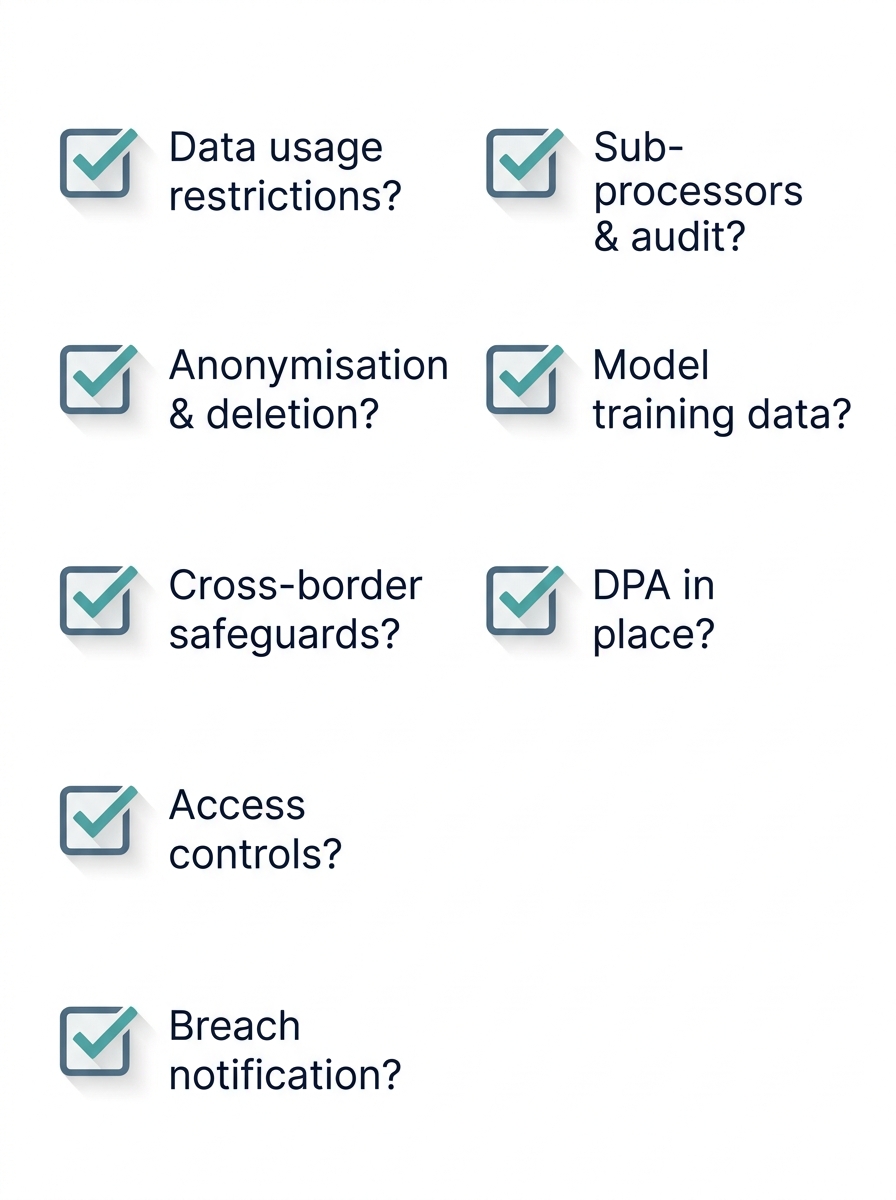
Third-party AI tools—chatbots, recommendation engines, dynamic pricing—often process guest data on your behalf. That makes them data processors under GDPR, and you remain the controller, responsible for ensuring they handle data lawfully. Before signing with any vendor, arm yourself with a thorough checklist. Your ai data governance strategy should extend to every vendor relationship.
Start with the contract. Vendor data processing agreements (DPAs) must explicitly state that the vendor will not use guest data for their own purposes, such as improving their models, without your permission. Clarify whether they aggregate data across clients, and if so, whether it is anonymized. AI consulting for governance and risk reviews can help. Many vendors claim they “anonymize” data, but true anonymization must be irreversible; pseudonymized data still falls under GDPR.
Cross-border transfers are another critical point. If your vendor processes data outside the European Economic Area or UK, you need safeguards like Standard Contractual Clauses (SCCs). Ensure the vendor has conducted a transfer impact assessment and that the clauses are properly implemented.
Technical questions matter too. Ask about their data retention and deletion practices: After the contract ends, is guest data immediately and securely deleted? Do they support secure integration across guest systems without granting full database access? What access controls do they have to prevent their employees from viewing guest data? And if a data breach occurs, what is their notification timeline? The answers reveal whether a vendor treats privacy as an afterthought or a design principle. Diligence on AI vendor data processing is non-negotiable, and it directly supports your ai data governance posture.
This vendor vetting process is an integral part of your overall ai data governance framework. By embedding these checks into procurement, you ensure that every AI tool you deploy is compliant from the start.
Transparency as a Competitive Advantage
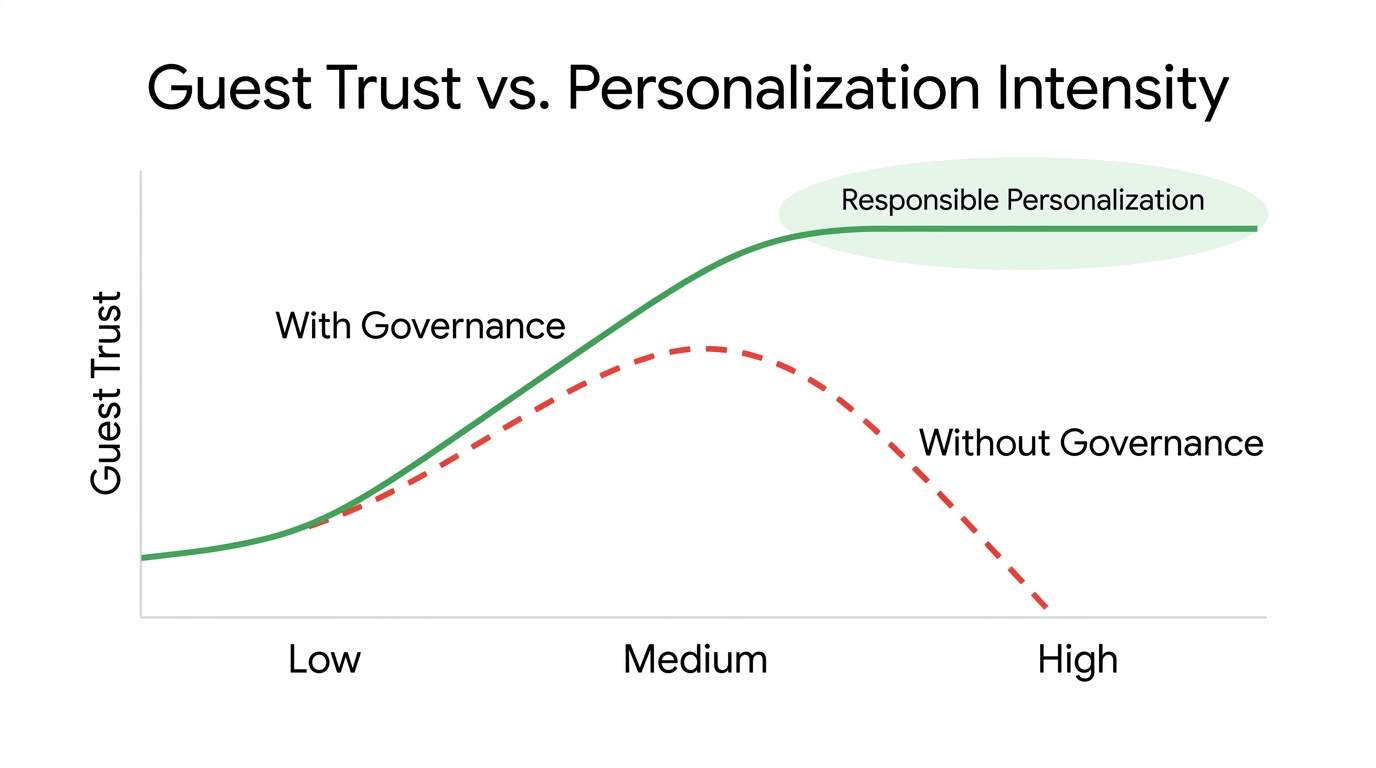
In a market where guests are increasingly privacy-conscious, transparency becomes a differentiator. When you clearly explain what data you use for AI personalization and give guests control, you build trust. That trust translates into loyalty. A transparent ai data governance approach signals that you value guest trust and transparency.
Practical steps include publishing a simple, layered privacy notice on your website and app that highlights the role of AI. Offer a “privacy dashboard” where guests can see which data categories are active and toggle preferences on or off at any time. Make withdrawal of consent as frictionless as booking a room. Transparency notices that are clear and accessible reinforce your ai data governance framework.
Industry organizations like HSMAI and AHLA recognize the importance of responsible data use, and some are developing best-practice seals or certifications. Displaying a commitment to responsible AI can be a marketing asset, especially for corporate travel programs with strict vendor privacy requirements.
The table below offers a quick-reference governance framework that you can adapt to your own property, mapping common data categories to AI permissibility, consent needs, and retention periods.
| Data Category | Examples | AI Permissibility | Consent Requirement | Retention Period |
|---|---|---|---|---|
| Basic Identity | Name, email, phone | Yes, for booking and service communications | Implicit (contractual) | 5 years after last stay (tax law) |
| Preferences | Room type, dietary needs | Yes, for personalization | Explicit opt-in | 2 years after last stay |
| Behavioral | On-property purchases, app interactions | Limited (anonymized preferred) | Explicit opt-in | 12 months or until withdrawal |
| Payment | Credit card details | Not for AI personalization | Never shared with AI system | Deleted 30 days post-checkout |
| Health/Sensitive | Medical conditions, disabilities | Only with explicit consent | Explicit opt-in + DPIA | Immediately after stay, unless consented otherwise |
“Privacy is not the enemy of personalization; it’s the foundation upon which lasting guest relationships are built.”
This table and the principles behind it answer many of the pressing questions that hotel leaders face daily. Let us address the most common ones head-on.
The Five Questions Every Hotel Leader Is Asking Right Now
Here are concise, actionable answers to the top concerns we hear from executives like you.
How should hotels handle guest data with AI?
Implement a governance framework that starts with a data inventory. Classify data, apply strict access controls, enforce data minimization, capture explicit consent for each AI use case, and regularly audit AI outputs for unintended data exposure. This approach turns compliance into a system, not a scramble. A comprehensive ai data governance plan covers each of these steps.
Is AI personalization GDPR compliant?
Yes, if you have a valid lawful basis. For most personalization beyond the essential service, explicit consent is the safest route. Legitimate interest might apply in very limited cases, but it requires a balancing test and clear notification. Always adhere to data minimization, transparency, and data subject rights. Integrating ai data governance ensures you meet these standards consistently.
What guest data can AI systems use?
Only data that is necessary and proportional for the specific personalization purpose. For example, a room-temperature preference can be used, but not the guest’s full booking history unless that is separately consented. Never use payment data, and treat health data with extra safeguards. The table above provides a starting taxonomy. A strong ai data governance policy defines these boundaries clearly.
How do hotels get consent for personalization?
Through granular, opt-in mechanisms. Use digital forms at check-in, in-app prompts, or preference centers where guests actively select which personalization they want. Consent must be freely given; do not bundle it with general terms. Pre-ticked boxes are not valid. Provide an easy way to withdraw consent at any time. Ai data governance includes managing the full consent lifecycle, which is part of responsible personalization.
What are the privacy risks of hotel AI tools?
The biggest risks include shadow AI tools used without governance, prompt leaks in large language models that expose guest data, weak access controls, inadequate anonymization, vendor training models on your data, and inadequate deletion after contract termination. Proactive ai data governance minimizes these risks.
Putting It All Together: Your Next Step
The thesis of this article is that privacy is not an obstacle to personalization—it is the very foundation that makes personalization trustworthy and sustainable. When you embed ai data governance into your AI strategy, you create a system where guest data is respected, regulators are satisfied, and your brand stands out as a leader in responsible hospitality. Adopting ai data governance is the single most important move you can make to protect guest trust and unlock AI’s full potential.
Webuters has over a decade of experience helping businesses move from digital transformation to intelligent automation, with a specific focus on AI consulting for governance and risk. We help hospitality leaders map their data flows, implement consent management, vet AI vendors, and create transparent guest-facing controls—all while accelerating time-to-value.
The question is not whether you can afford to do this, but whether you can afford not to. The next step is to have a practical conversation with someone who has done it before. If you’re ready to define your AI governance roadmap, speak with our AI advisory team for a no-obligation consultation.
Take the first step toward responsible AI personalization. Speak with our AI advisory team to define your governance framework.
AI adoption and workflow automation
Start with one workflow, prove it in production, then scale what works.
See AI services
Krishna is the Founder and CEO of Webuters, a technology leader specializing in Generative AI, intelligent automation, enterprise software, and digital transformation. He helps organizations leverage emerging technologies to drive innovation, operational efficiency, and business growth. Through his writing, Krishna shares insights on AI adoption, technology leadership, product innovation, and the future of work, helping leaders navigate change and build future-ready organizations.
Follow Krishna on LinkedIn