Loan Origination System: Why Projects Fail and How to Choose
A vendor-neutral guide to loan origination systems: what an LOS actually covers, where these projects really fail, when not to buy one, and the questions to…

You are sitting in a lending operations review meeting, staring at a dashboard from your current loan origination system that shows another month of delays. Loan officers say the system is too slow, underwriters complain about missing data, and the CFO asks why the cost per closed loan keeps climbing. A lineup of vendor demos promises dashboards, workflows, and AI, but every screen looks about the same.
The problem is rarely the software itself. In most loan origination system projects I have observed, the new platform becomes a faster version of the old chaos. The real issues sit underneath the surface: who owns the process, how clean the data is, how well the integrations hold up, and whether your team will embrace the new workflow. That is the central argument of this guide. A loan origination system is not just a tool; it is an operating model. When you ignore those underlying factors, you end up buying an expensive way to document existing problems. But understanding the true cost of your current process is possible only when you have a clear view of the entire lending lifecycle.
In the sections that follow, I will define what a loan origination system does and where it sits in the broader reimagining financial services with Salesforce landscape. Then I will expose the four hidden failure points that most vendor sales teams don’t mention, give you an honest answer on whether you need a new system at all, share the questions that matter during evaluation, and finally show where AI genuinely helps. By the end, you will know what to buy and what to fix before you sign.
What Is a Loan Origination System, Really?
A loan origination system is software that manages the end-to-end process of turning a loan application into a funded loan. It coordinates application intake, credit analysis, approval, documentation, closing, and booking into the core system. Unlike a loan management system, which handles servicing and payments after funding, an LOS focuses on the pre-funding journey. The typical stages and functional owners in a mid-market lending institution look something like this:
| Stage | Who Owns It | Key Activities |
|---|---|---|
| Application Intake | Loan Officer / Front Office | Collect borrower info, validate completeness |
| Credit Analysis | Underwriter | Assess creditworthiness, risk rating |
| Approval | Credit Committee / Authority | Decision making, conditions |
| Documentation | Operations / Legal | Prepare closing docs, disclosures |
| Closing | Operations | Signing, funding |
| Booking | Operations / Back Office | Set up loan in core system |
The table looks clean, but in reality each handoff between owners is a point of failure. For example, if the credit analysis stage relies on data entered manually by loan officers, the underwriter spends time correcting rather than deciding. That is why process ownership becomes critical. Platforms like Salesforce nCino, have emerged to unify these stages on a single cloud platform. But even a modern platform can fail if the surrounding process and data are broken.
When evaluating loan origination software, many commercial lending teams start with a feature checklist. However, the stages above reveal that the system is only half the story. The other half is the operating model you build around it. A commercial loan origination software solution might have beautiful dashboards, but if the handoff between the loan officer and the underwriter is still an email with a spreadsheet attached, you have not fixed the friction.
The best commercial lending leaders think beyond features. They ask how the tool will reduce friction in the loan origination process, not just what screens it shows. That line of thinking often leads to a more practical loan origination automation roadmap, where automation is applied to the bottlenecks that matter.
Why LOS Projects Fail: The Four Hidden Failure Points
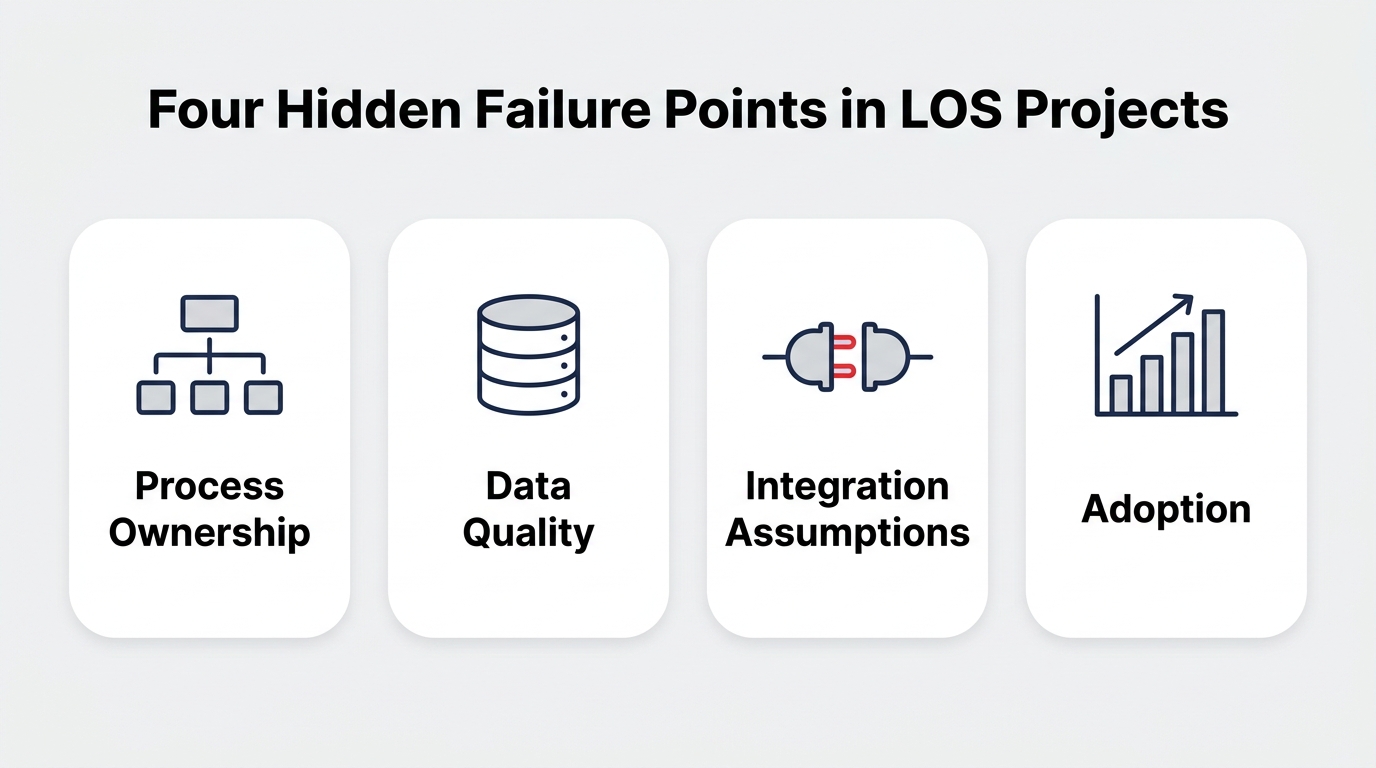
Feature checklists miss the real risks. I have seen lending teams spend months comparing product capabilities, only to sign with a vendor and then struggle during implementation. The failures rarely come from missing features. They come from four areas that live outside the demo script. Each one is a trap that can derail an otherwise sound purchase decision.
The most expensive feature in any loan origination system is the one you buy to avoid fixing your process.
Process Ownership: The Missing Single Owner
Every loan origination system needs one person who owns the entire process from application to booking. Without that owner, the new system inherits the old chaos. For example, a mid-market bank might have a loan officer who owns intake, an underwriter who owns credit analysis, and an operations manager who owns closing. If no one is accountable for the handoffs between them, the system becomes a record of the gaps, not a solution to them.
In practice, this means that before you buy, you should map your current loan origination process and identify every handoff. Ask who currently owns each transition. If the answer is “it depends” or “we all do,” that is a red flag. The new software will not clarify ownership; it will just make the ambiguity faster.
Data Quality: The Dirty Data You Carry Forward
Data migration is usually treated as an IT task, not a business problem. But the data in your legacy system has years of inconsistencies: duplicate customer records, outdated guarantor information, inconsistent industry codes. When you migrate that data into a new LOS, you carry forward the problems. The new system might have excellent reporting, but the reports will be garbage if the underlying data is bad.
For example, a credit union’s legacy loan data might have customer names formatted differently across branches. After migration, the new loan origination system misroutes applications because it cannot match borrowers correctly. The result is not just bad reporting; it is broken automation. Before you sign, ask the vendor who is responsible for data cleaning and what is included in the migration scope. If the answer is vague, expect problems later.
Integration Assumptions: The Core Banking Boundary
The boundary between the loan origination system and your core banking platform is where many projects meet reality. Credit bureaus, document management, e-signature, and CRM systems all need to talk to the LOS. Many buyers assume the vendor has pre-built connectors for everything, but those connectors often require custom work. For example, if your core banking integration uses a legacy API that the vendor has never seen, the integration effort can double the project timeline.
This is where you need to involve your technical team early. Ask for a live integration demo, not a slide deck. Also consider how changes to your CRM and ERP transformation services might affect the LOS integration later. A system that cannot easily exchange data with your core is not a digital lending platform; it is an island.
Adoption: Configuration That Recreates the Old Workflow
When a new system is configured to mirror the old manual steps, users see no benefit and go back to workarounds. For example, if your old approval matrix had five levels and you configure the new system to require the same five levels with the same manual touchpoints, you have not improved anything. Underwriters will still wait for emails, and loan officers will still chase signatures. Training becomes an afterthought, and the new system is blamed for being hard to use.
The goal of configuration is not to digitize the current process; it is to simplify it. During evaluation, ask the vendor to demonstrate how they handle exception routing and approval workflows. If the answer is “we can configure it however you want,” push back: you want better, not the same.
The best configurations streamline the underwriting workflow, reducing steps and automating handoffs. When the tool supports better credit decisioning with fewer manual touches, adoption becomes easier and the investment pays off faster. That is the real test of a digital lending platform: it should make the right thing easy.
These four failure points are not always visible in a product demo. The next question is: do you even need a new system, or are you addressing the wrong problem?
Do You Actually Need a New Loan Origination System?
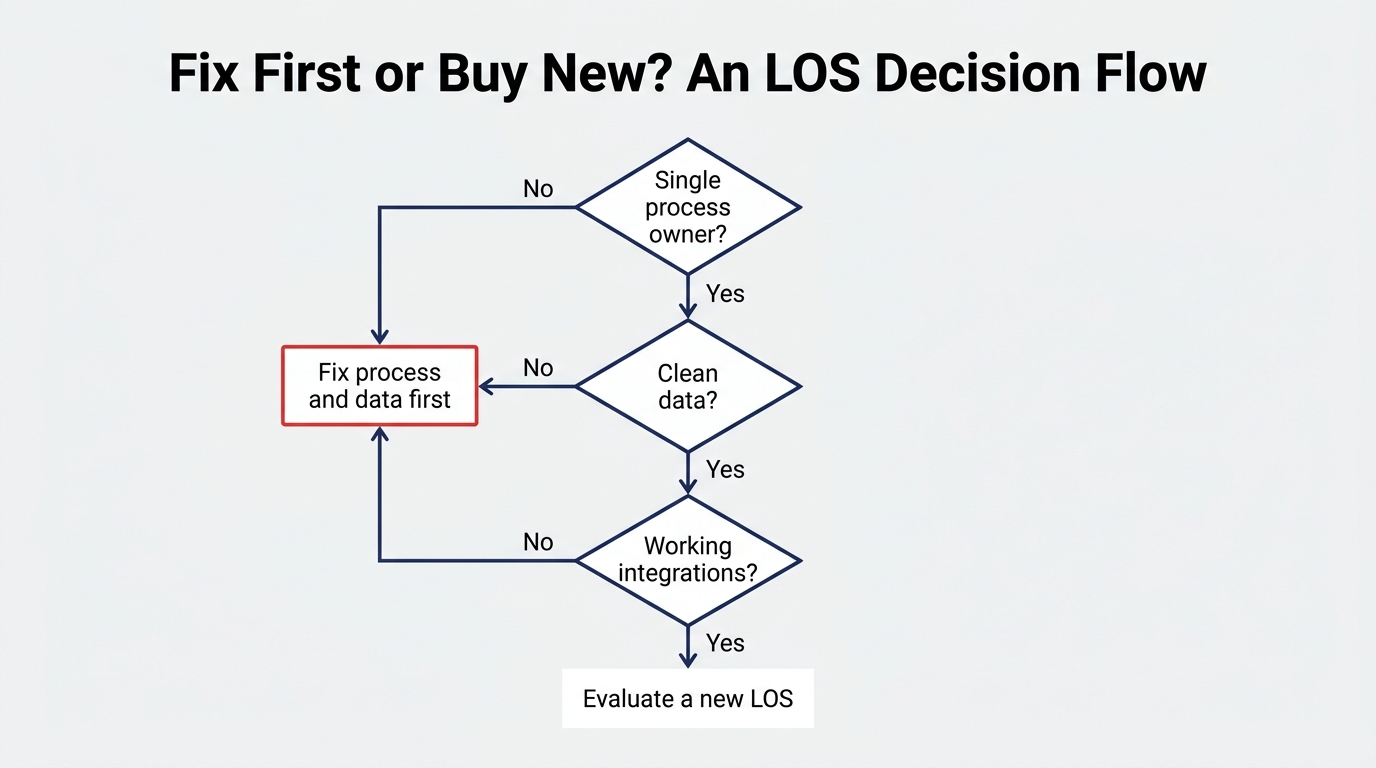
Sometimes the right answer is not to buy a loan origination system at all. If your core problems are unclear processes, manual handoffs, or dirty data, new software will simply automate the chaos. In fact, buying a new LOS can be an expensive way to preserve existing inefficiencies in the loan origination process.
For example, a lender might discover that it takes 30 days to approve a commercial loan because the approval authority is ambiguous. Underwriters don’t know which credit committee member can sign off on a particular loan amount, so loan applications sit in limbo. Buying a new system with a fancier workflow engine won’t clarify that authority; it will just put a timer on the confusion. In that case, the better investment is process redesign and a clear delegation of authority.
Similarly, if the real bottleneck is data quality….say, your customer information is scattered across spreadsheets, and your loan application requires manual re-entry into three systems, then a new LOS might not help until you clean the data and establish a single source of truth. Loan origination automation sounds appealing, but automation with bad data is just faster mistakes.
So how do you know? Start with a simple exercise: map your current loan origination process from application to booking, including every handoff and decision point. Identify where delays occur. Ask three questions: Do we have a single owner for the end-to-end process? Is the data entering our current system clean and consistent? Are our integrations with core banking and other systems working smoothly? Are our people following the current process, or are they working around it?
If the answers reveal that the main problems are process or data, then fix those first. A new system may still be needed later, but it will be far more likely to succeed if the foundation is solid. Conversely, if your current system cannot support the types of loans you want to offer….say, you need better digital application capture or automated credit decisioning, then a new LOS might be justified.
The decision is not just about features; it is about business outcomes. If you decide a new system is warranted, the real work begins: asking the right questions during evaluation to avoid the traps we’ve described.
The Right Way to Evaluate an LOS: Questions That Matter
Evaluation should be a structured interrogation, not a beauty contest. Instead of comparing feature lists, ask the following questions. They cut to the issues that cause projects to fail.
- How does the system integrate with core banking and credit bureaus? Ask for live API documentation, not marketing slides. Who has done a similar integration? Can they provide a reference?
- What is configuration versus customization? Clarify what can be changed through settings without custom code. Customization is where long-term maintenance costs hide.
- Who owns data migration? A vague answer is a red flag. Data migration is a shared responsibility, but you need a named lead from the vendor and a clear scope of what data cleaning is included.
- Who exactly will be on the implementation team? You need to meet the technical leads, not just the sales director. Ask about their experience with institutions of your size and complexity.
- How are change requests priced after go-live? Ask for a sample change order and typical turnaround times. Many buyers underestimate the cost of post-launch changes.
While you are evaluating, also consider how the system fits into your broader digital lending platform strategy. For example, if you are already using Salesforce for CRM, you might prefer a LOS that natively extends Salesforce rather than a standalone system. That is why understanding what Salesforce nCino is can be useful, even if you don’t buy it. The key is to avoid a system that becomes a silo. The right loan origination software should integrate with your existing ecosystem, not force you to rebuild it.
One more thing: ask for references from institutions that have been live for at least 12 months. Ask them about integration pain points, data migration surprises, and how the vendor handled change requests. The answers will tell you more than any demo.
Where AI Actually Helps in Loan Origination (and Where It Shouldn’t)
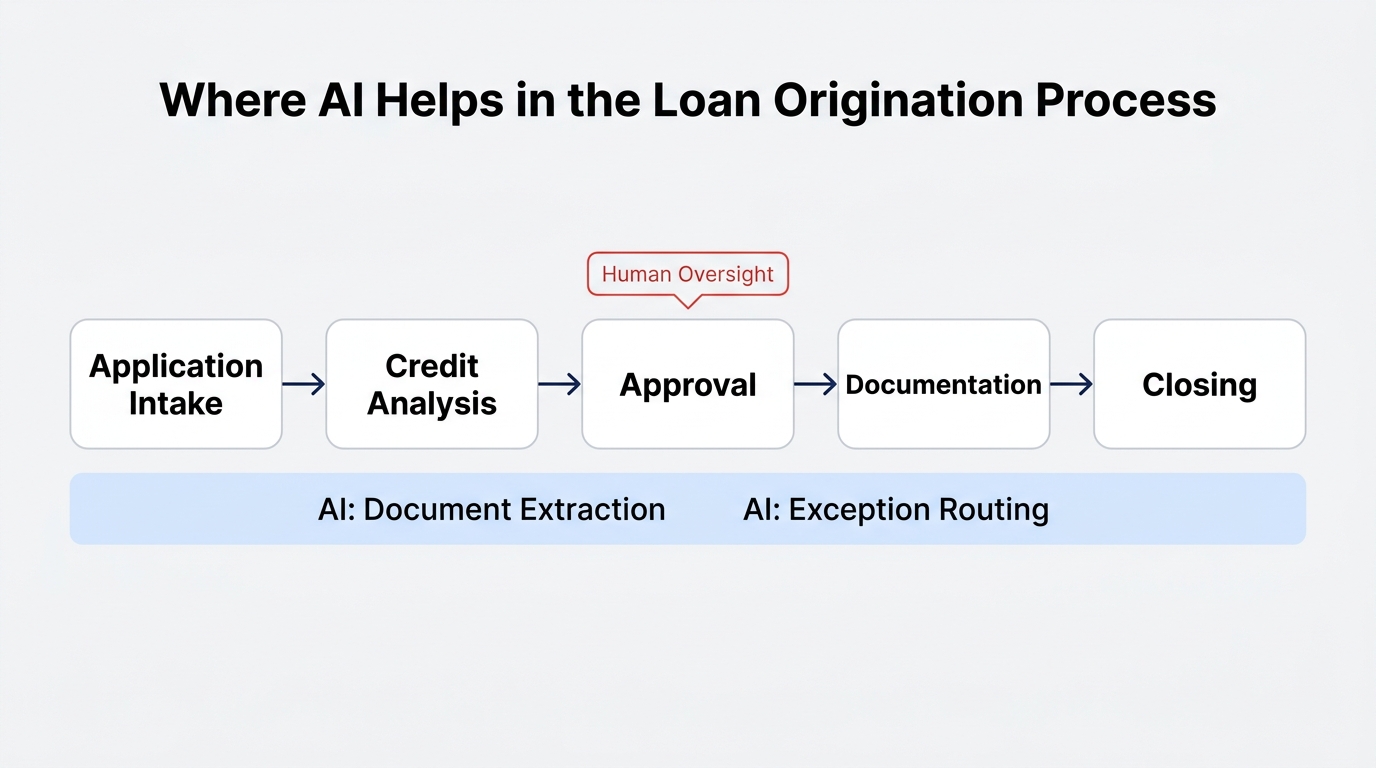
AI in banking is not about replacing underwriters; it is about removing friction from the parts of the loan application and underwriting workflow that are repetitive and error-prone. IBM’s overview of AI in banking provides a practical baseline for separating hype from operational value. In loan origination, the most immediate wins are in document extraction, application pre-fill, exception routing, and monitoring.
For example, an AI model can extract data from tax returns and bank statements, pre-filling the loan application and flagging discrepancies for underwriters. That reduces manual data entry and improves accuracy. Exception routing is another strong use case: an AI agent can automatically route a commercial loan application to the right credit analyst based on borrower risk, but a human must approve any exception. Monitoring is also valuable: AI can detect unusual patterns in application flow or credit decisioning, alerting managers to potential bottlenecks or policy gaps.
However, AI agents must operate inside existing permissions, approval gates, and audit trails, never beside them. The NIST AI Risk Management Framework makes clear that governance must be part of deployment, not an afterthought. This means defining clear roles for human oversight, ensuring that every AI decision can be traced and explained, and keeping audit logs intact. That is especially important as AI agents move into LOS platforms. For example, nCino’s Mortgage MCP for AI agent integration shows how quickly these capabilities are entering the market. As that integration surface expands, data governance becomes non-negotiable.
If you are considering adding AI to your loan origination workflow, partner with experts who understand both the lending domain and the governance requirements. Webuters offers AI agent development services that can help you build agents that respect your existing permissions and audit trails. We approach AI as a way to augment your team, not replace it.
Now that you know where AI fits, let’s address some common questions about LOS selection and implementation.
FAQ: Loan Origination Systems
What is a loan origination system?
A loan origination system is a software platform that manages the end-to-end process of turning a loan application into a funded loan. It handles application intake, credit analysis, approval, documentation, closing, and booking. Unlike a loan management system, which focuses on servicing after funding, an LOS focuses on the pre-funding journey.
What is the difference between a loan origination system and a loan management system?
A loan origination system handles the front-end of the lending lifecycle: applying, underwriting, approving, and closing. A loan management system handles the back-end: servicing, payments, collections, and reporting after the loan is funded. Many institutions integrate the two or choose a platform that offers both capabilities.
How long does a loan origination system implementation take?
Implementation timelines vary based on scope, data readiness, and integration complexity. A typical mid-market implementation can take anywhere from six to eighteen months. However, the key factors are not technical; they are process clarity and data quality. A well-prepared client with clean data and clear process ownership will move faster than one that has to redesign everything mid-project.
Should we build or buy a loan origination system?
Buying a commercial loan origination software is usually cheaper and faster than building from scratch. However, buying only makes sense if you have addressed the failure points we discussed: process ownership, data quality, integration reality, and adoption. If your current processes are broken, building will not fix them either. Sometimes the right first step is process redesign, then a system purchase.
What integrations does a loan origination system need?
At minimum, a loan origination system needs integration with your core banking platform, credit bureaus, and document management system. Many also integrate with CRM systems like Salesforce, e-signature providers, and accounting software. The quality and ease of these integrations should be a primary evaluation criterion, not an afterthought. A successful loan origination system is one that works with your existing technology stack.
The Real Investment: Your Operating Model, Not Just Software
Buying a loan origination system is not the finish line; it is the starting gun. The success of the project depends on what you do before and after signing the contract. Process ownership, data quality, integration reality, and adoption will determine whether the system delivers value or becomes another expensive shelfware.
That is why a vendor-neutral approach matters. As a Salesforce and AI implementation partner, Webuters is not tied to any lending platform. We are paid to make the chosen system work, which means we have no incentive to sell you a particular product. Our experience in financial services, including insurance and finance industry solutions, has taught us that the real problem is usually not the software; it is the operating model around it.
If you are evaluating a loan origination system—or wondering whether you need one at all—the best first step is a vendor-neutral review of your current lending workflow. We can help you map the process, identify the four hidden failure points, and decide whether a new system is the right answer. No hard sell, just a practical assessment of what is really causing friction. The question is not whether you will modernize your lending operations; it is whether you will fix the foundation before you build on it. The most expensive feature in any loan origination system is the one you buy to avoid fixing your process—so fix the process first, and then reach out to Webuters for a lending workflow assessment.
CRM and ERP transformation
Pick the right platform, clean the data and connect it to the rest of the business.
See CRM and ERP services
Krishna is the Founder and CEO of Webuters, a technology leader specializing in Generative AI, intelligent automation, enterprise software, and digital transformation. He helps organizations leverage emerging technologies to drive innovation, operational efficiency, and business growth. Through his writing, Krishna shares insights on AI adoption, technology leadership, product innovation, and the future of work, helping leaders navigate change and build future-ready organizations.
Follow Krishna on LinkedIn