AI Guest Experience in Hospitality: How Hotels Can Catch Service Failures Before Guests Complain
Explore how AI helps hotels detect service delays, missed guest requests, housekeeping gaps, and operational issues before they turn into guest complaints.

AI guest experience is not really about a chatbot answering faster. It is about helping hotel teams see service failures while they are still small enough to fix.
That is the real shift. Instead of waiting for frustration to surface at the front desk, hotels can catch the early signs first: an unanswered request, a delayed handoff, a room that looks ready on paper but is not ready in practice.
A guest usually does not become unhappy because of one dramatic moment. Frustration builds quietly. A request was acknowledged but not assigned. A room looked ready in one system but not in reality. A promise made at the front desk slipped between shifts, and by the time anyone notices, the guest has already repeated the issue twice.
That is why AI guest experience matters as an operational early-warning layer. It should help people spot the friction underneath a complaint, not replace the people who solve it.
This is an important distinction. Guest complaint prevention is not only a training problem. It is also a visibility problem, an ownership problem, and a follow-through problem. When teams cannot see what is late, unresolved, or at risk, even good staff can deliver an inconsistent experience.
In the sections below, we will look at where complaints actually begin, the service delays AI can detect early, how AI guest experience supports front desk and housekeeping teams, what connected implementation looks like, and how hotel leaders should measure success once the workflow is live.
Why AI guest experience matters when operational gaps stay hidden
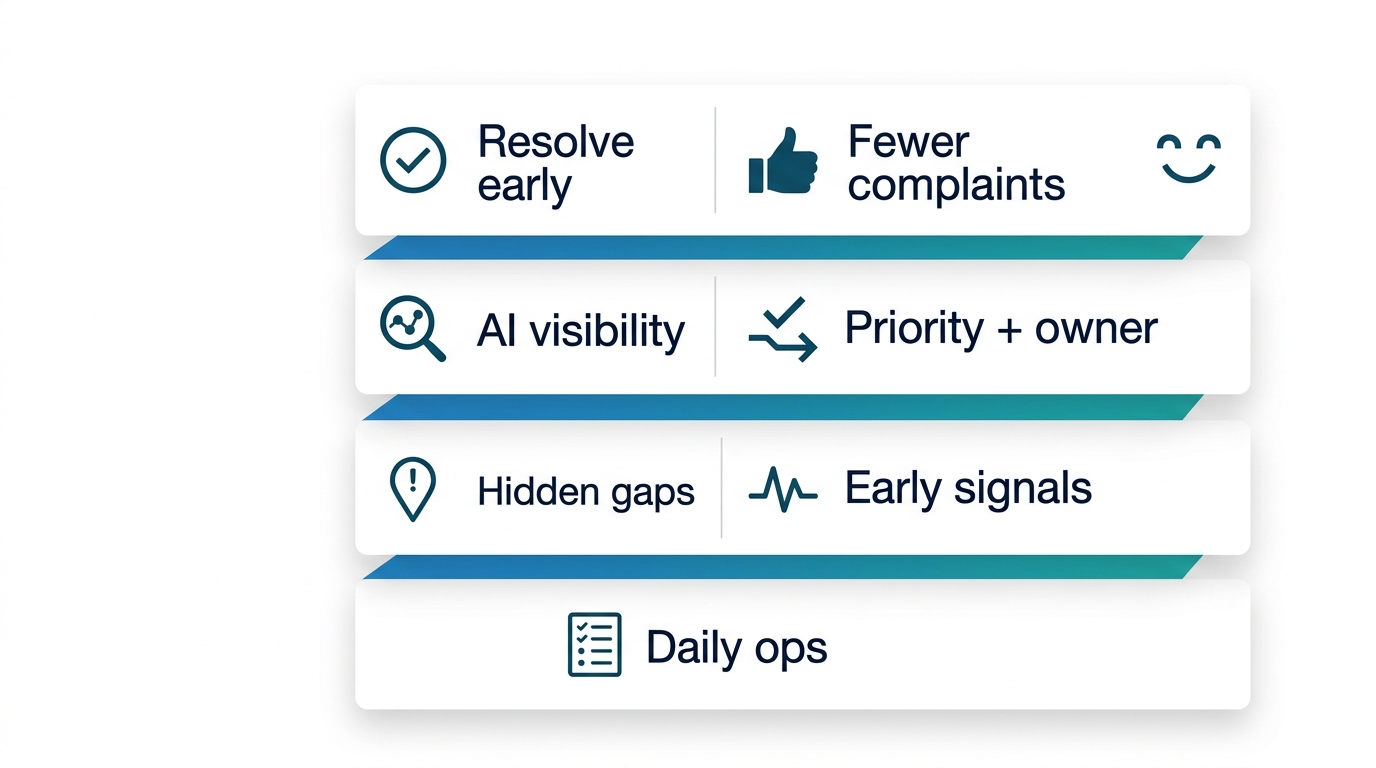
The complaint itself is not the real problem. The real problem is the hidden operational gap that had time to grow before anyone treated it as urgent.
In hotels, that gap often shows up in ordinary places: a housekeeping task that never got picked up, a delayed room service order, weak front office follow-through, or a service recovery promise with no clear owner. None of those looks dramatic on its own. But when they stack up, the guest starts feeling ignored even if every team member believes they are helping.
Hotels already depend on multiple systems to run daily workflows. Oracle Hospitality platform overview describes technology built for hotel operations. Oracle Hospitality documentation shows how broad those workflows can be across hospitality environments. OpenTravel publishes interoperability standards intended to support travel system data exchange. The practical takeaway is simple: the guest journey crosses tools, teams, and handoffs, and that is where friction hides.
A guest asking for extra towels through messaging may receive a polite acknowledgment, but if the task is not routed to the right person before shift change, courtesy does not become service. A room can appear ready from the front desk perspective while housekeeping still has one unresolved status update. A late-night promise to fix an issue can disappear by morning if no one is tracking closure.
The most valuable complaint is often the one your team never has to hear.
That is why AI guest experience works best as a smoke detector for service delivery. It does not replace the person at the desk, the supervisor on the floor, or the manager handling hotel service recovery. It helps them see the first signs of trouble before the guest turns those signs into a complaint.
Service delays AI can detect before they become complaints
Once complaints are understood as delayed signals, the question becomes practical: what can AI actually see?
The useful answer is not “everything.” It is specific operational patterns. AI guest experience can flag repeat guest messages, identify requests that stay open too long, notice when expected status changes do not happen, and surface service delay alerts when a promise has no clear closure. In this context, complaint prediction is not mind-reading. It is structured pattern recognition around delay, silence, repetition, and incomplete follow-through.
That makes AI guest experience especially useful for delayed room service, unresolved housekeeping tasks, front desk follow-up gaps, and unanswered guest messages. If a guest sends the same message twice, that is a signal. If a task stays open past the expected service window, that is a signal. If one department marks something complete but the guest-facing workflow still shows no closure, that is a signal.
The point is not only detection. The point is action. Good hotel automation should move from signal to priority, then to ownership, then to escalation, and finally to closure.
| Operational gap | Early warning signal | AI action | Human follow-up | Guest-facing outcome |
|---|---|---|---|---|
| Delayed room service | Delivery window is exceeded or the guest sends a repeat message | Flags delay, raises priority, alerts supervisor | Team checks order status and resolves delivery or apologizes proactively | Guest feels informed rather than ignored |
| Missed housekeeping request | Pillow, linen, or cleaning request remains open beyond expected time | Detects overdue task and escalates to shift lead | Housekeeping lead assigns or reassigns the task | Issue is handled before the guest calls again |
| Front office follow-up gap | A promise made during check-in or service recovery has no closed task | Converts the note into a tracked action and sends a reminder | Front office owner confirms completion across shifts | Better continuity and fewer repeated complaints |
| Unresolved guest messaging | Multiple messages from the same room with no confirmed resolution | Detects repeat contact and marks complaint risk | Staff responds with a status update and closes the loop | Faster reassurance and lower frustration |
This is also where hotel reputation management starts long before a public review. A guest who has to ask twice about the same issue is not only experiencing delay. They are learning that the hotel may not remember, coordinate, or recover quickly. AI in hospitality guest experience can surface that risk while it is still internal.
How AI guest experience supports front desk and housekeeping teams
AI guest experience should make work clearer, not colder. When it is designed well, it acts as a coordination layer that helps teams know what matters now, who owns it, and what needs attention before the next shift inherits the problem.
For front desk teams, the value is visibility. Follow-up no longer has to live in memory, sticky notes, or fragmented inboxes. A service promise can become a tracked task with a due window, a status, and an escalation path. Staff do not need to search three systems to learn whether engineering responded, housekeeping completed a request, or the guest has already sent a second message.
For housekeeping teams, the benefit is just as practical. Missed housekeeping requests often happen because timing, urgency, and ownership are unclear. AI guest experience can prioritize requests based on guest context, arrival timing, room status, and escalation rules so the team sees what needs action first instead of treating every message like a separate manual interruption.
The human side matters here too. A loyalty guest recognition signal can help the front desk see that a returning guest prefers extra water, a specific pillow setup, or faster room readiness. That does not make service robotic. It gives staff better context so a personalized guest experience feels intentional rather than improvised.
A connected digital touchpoint can help here as well. Our next generation mobile app for hospitality is a useful example of how guest-facing convenience becomes more valuable when the operational follow-through behind it is connected.
Improving response times without adding workload
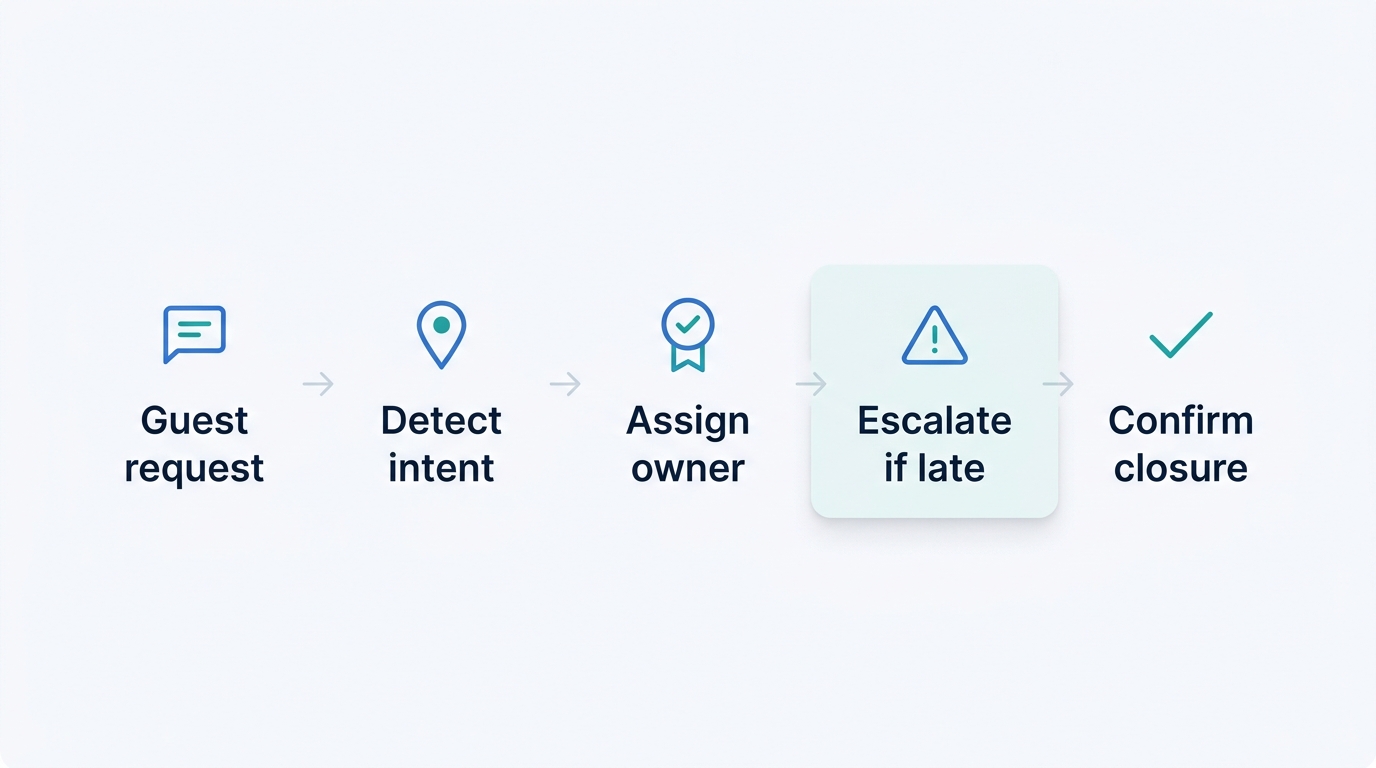
A practical starting point for hotels is to stop treating response-time improvement as a staffing-only problem. The hidden cost is often manual triage.
When every request enters a general inbox, gets copied into another tool, or waits for someone to interpret urgency, the delay is built into the workflow. AI guest experience improves response times by reducing that decision lag. It can categorize requests, detect service intent, route work to the right team, and trigger alerts when the response path slows down.
This matters most during busy periods and shift changes. That is when guest request management usually breaks down, not because people do not care, but because the operating model makes follow-through fragile. AI guest experience helps by making request status visible, so teams do not waste time asking whether something was assigned, started, or finished.
A guest request workflow in practice
Imagine a guest sends a message through the hotel app at 8:10 p.m.: “The room is missing extra blankets, and my child is already asleep.”
First, the system recognizes a housekeeping-related request with urgency because it affects immediate guest comfort. Next, the task is routed to housekeeping with a named owner instead of sitting in a general guest messaging queue. If the request is not accepted within the defined service window, the shift lead receives a service delay alert. Once the blankets are delivered, staff mark completion, and the front desk can confirm the request was resolved. If similar requests keep appearing for the same room type or shift pattern, the hotel can review whether stocking or handoff practices need to change.
That sequence matters because it turns guest messaging automation into accountable service action. Without that structure, a message can look handled when it has only been acknowledged. With that structure, AI guest experience supports response-time improvement without asking staff to manage yet another disconnected dashboard.
How connected workflows make AI guest experience useful
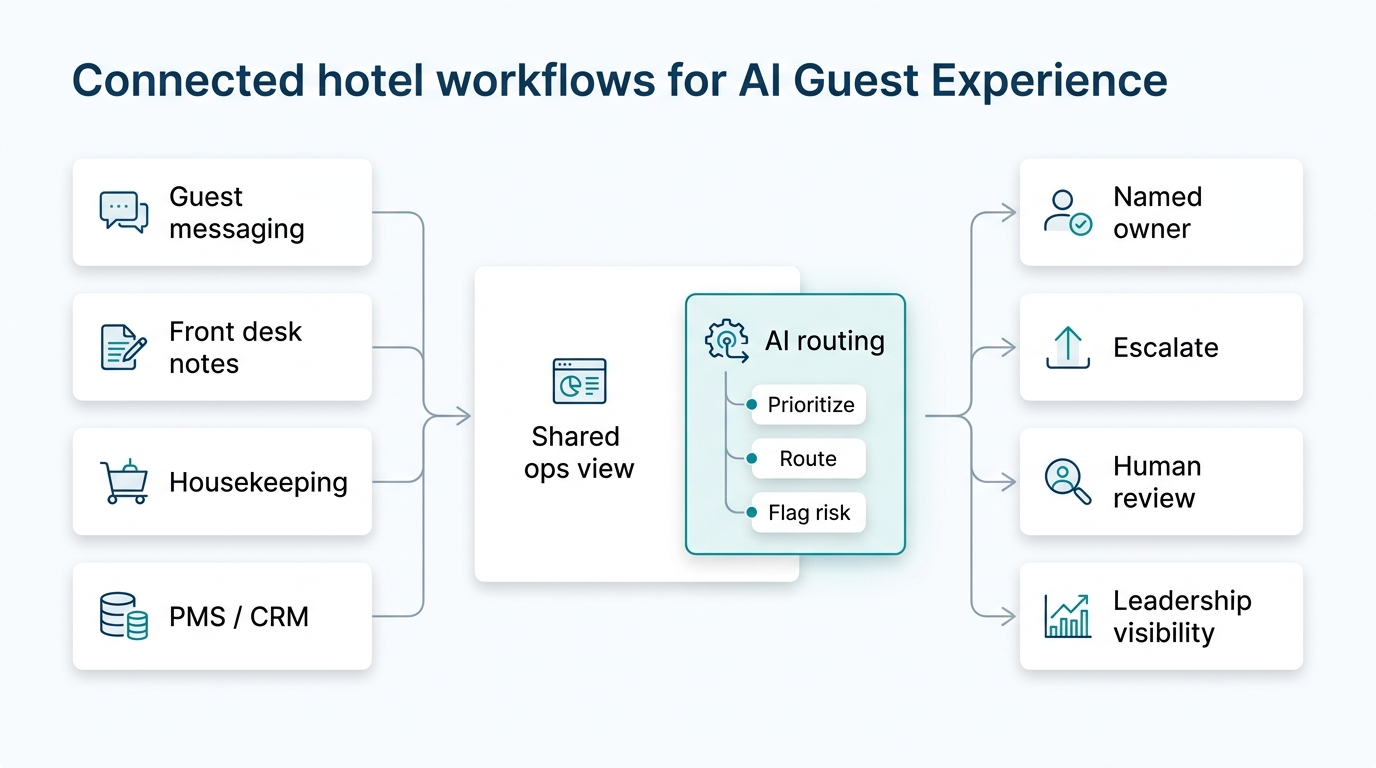
This is where the conversation shifts from tools to architecture. The next step is not simply adding an AI concierge for hotels or another message channel. It is building hospitality workflow automation that connects signals, decisions, and task closure across the systems teams already use.
In practice, that means guest messages, front desk notes, housekeeping status, service recovery tasks, and loyalty recognition should feed one operational view of what is at risk. AI can summarize, prioritize, and route. But the real value appears only when the workflow includes business rules, owners, and escalation logic.
For enterprise buyers, implementation fit matters as much as feature fit. The AI layer should sit cleanly alongside PMS, CRM, housekeeping, and guest messaging systems so teams are not forced to re-enter data or manage a second source of truth. If the workflow is fragmented, the AI will only accelerate confusion. If the workflow is connected, the AI can help the hotel act sooner with less manual effort.
Hotels do not need isolated intelligence. They need connected intelligence. Microsoft’s Cloud Adoption Framework for AI emphasizes aligning AI adoption with strategy, governance, and operating model. NIST’s AI Risk Management Framework provides guidance for governing AI risks and human oversight. AWS travel and hospitality guidance outlines cloud solution patterns for travel and hospitality use cases. The lesson for hotel leaders is straightforward: AI works better when it is governed, connected, and tied to operations.
That is also why backstage workflow design matters more than chatbot novelty. At Webuters, this is where generative AI solutions start to matter, but only when they are paired with clear process design and grounded in AI consulting services. A useful model is not “let the AI talk to the guest and hope for the best.” A useful model is “let the system detect friction early, route the work correctly, keep people in control, and close the loop.”
One governance point matters especially in hospitality: guest communications should still have human oversight for sensitive cases, exceptions, and tone-sensitive recovery. AI can recommend action, but people should remain accountable for the final guest-facing response when the situation requires judgment.
When that happens, guest satisfaction tracking becomes more meaningful. Leaders can see which request types stall, which handoffs fail most often, where service delay alerts cluster, and which service recovery steps need redesign. That is how AI guest experience moves from isolated automation to a genuine operating capability.
Practical readiness checklist for hotel leaders planning AI guest experience
Before investing in hospitality AI tools, it helps to ask a simpler question: are your service workflows ready to become proactive?
A strong AI guest experience setup should make those answers easier to see.
Use this short checklist:
- Are guest requests from messaging, front desk, and housekeeping visible in one operational view?
- Does every common request type have a defined owner and an escalation path?
- Can your teams track open tasks across shifts, not just inside one department?
- Is guest messaging automation connected to task management, not just acknowledgment?
- Can loyalty recognition and preference context be used appropriately to improve service timing?
- Do managers have visibility into overdue tasks, repeat contacts, and slow service recovery cases?
- Can staff close the loop on a request before the guest has to ask again?
If several of those answers are no, AI guest experience is not the problem; the service model is.
A practical way to measure success after implementation is to watch whether repeat contacts go down, whether task closure happens faster, and whether fewer requests remain unresolved at the end of a shift. Those are not vanity metrics. They tell you whether the workflow is actually reducing friction instead of just recording it.
Questions hotel teams should ask before they automate AI guest experience
How can AI prevent guest complaints in hotels?
AI guest experience can prevent complaints in hotels by detecting early warning signs such as repeated guest messages, overdue service tasks, missed housekeeping requests, and unresolved follow-up, then routing and escalating them before frustration builds.
How does AI improve hotel guest experience?
It improves hotel guest experience by helping teams respond faster, keep context visible, and close the loop on requests before guests need to repeat themselves. It also supports a more personalized guest experience when preferences, service status, and team ownership are visible at the right moment.
Can AI detect hotel service issues early?
Yes. AI guest experience can detect hotel service issues early by recognizing patterns such as delayed room service, stalled task updates, repeat contacts, and gaps between promised and completed service. It is best understood as complaint prediction through workflow signals, not guesswork.
What operational gaps affect hotel guests?
Common gaps include missed housekeeping requests, weak shift handoffs, slow service recovery, front desk follow-up failures, unclear ownership, and disconnected guest messaging workflows. Guests may experience these as slow service, repeated explanations, or the feeling that nobody is fully accountable.
How can hotels respond to guest requests faster?
Hotels can respond faster when AI guest experience connects request channels to task ownership, status tracking, and escalation rules so staff act on prioritized work instead of manually chasing updates.
Closing the gap between service intent and guest experience
Hospitality teams usually do not fail because they lack intent. They fail because intent gets lost inside fragmented workflows, delayed status updates, and unclear ownership. The shift from reactive complaint handling to proactive service intelligence is really the shift from guessing what is wrong to seeing it early.
That is why AI guest experience should be measured by the quality of follow-through it enables. If it helps a team catch a missed housekeeping request before the second reminder, rescue front office follow-up before morning shift, or resolve delayed room service before the guest posts about it, then it is doing the work that matters.
For hotel leaders, AI guest experience is less about automation theater and more about operational control. When hotels can see friction earlier, they can protect the guest experience before the complaint ever happens.
If you are rethinking how guest messaging, housekeeping, service recovery, and front office workflows should work together, talk to Webuters about workflow design and AI operating model planning. The real question is not whether AI guest experience can respond faster. It is whether your hotel is ready to catch service failures before the guest has to ask twice. With the right AI guest experience design, that shift becomes operational, not aspirational.
AI adoption and workflow automation
Start with one workflow, prove it in production, then scale what works.
See AI services
Krishna is the Founder and CEO of Webuters, a technology leader specializing in Generative AI, intelligent automation, enterprise software, and digital transformation. He helps organizations leverage emerging technologies to drive innovation, operational efficiency, and business growth. Through his writing, Krishna shares insights on AI adoption, technology leadership, product innovation, and the future of work, helping leaders navigate change and build future-ready organizations.
Follow Krishna on LinkedIn