The Rise of the AI SDLC Owner: How One Person Can Orchestrate AI Agents Across Software Delivery
The next big role in software delivery may not be another developer, project manager, tester, or business analyst. It may be…

The next big role in software delivery may not be another developer, project manager, tester, or business analyst. It may be one person who understands all of them.” Software development is entering a new leadership era.
For decades, the default answer to software complexity was team expansion. If requirements increased, companies added business analysts. If design work increased, they added UX designers. If delivery slowed, they added developers. If bugs increased, they added testers. If releases became risky, they added DevOps engineers. If users complained, they added support teams.
That model worked when software development depended almost entirely on human execution. But AI is changing the operating model.
The next big role in software delivery may not be another developer, project manager, tester, or business analyst. It may be one person who understands all of them.
This person is the AI SDLC Owner.
The AI SDLC Owner is not a traditional project manager. Not just a developer. Not simply a prompt engineer. Not only a product owner. This is a full-cycle software delivery thinker who can understand business goals, define workflows, orchestrate AI agents, validate outputs, manage risk, and drive software from idea to production with end-to-end accountability.
In the previous Webuters article on AI transforming SDLC from headcount-driven delivery to intelligence-led delivery, we argued that software development is moving away from the blind addition of people and toward stronger SDLC intelligence, smaller high-leverage teams, and AI-powered execution. This article goes deeper into the next logical question: if AI reduces handoffs and increases leverage, who owns the complete delivery system?
The answer is the AI SDLC Owner.
AI can produce artifacts, but someone still needs to know whether those artifacts are right.
Why This Role Is Emerging Now
The Software Development Life Cycle, or SDLC, has always been more than a process diagram. It is the operating structure that helps teams plan, design, build, test, deploy, and maintain software.
AWS describes SDLC as a cost-effective and time-efficient process used to design and build high-quality software while reducing project risk through forward planning.
AI does not remove the need for that structure. It increases it.
As AI enters software development, the ability to generate output is becoming abundant. Requirements can be summarized. User stories can be drafted. Wireframes can be generated. Code can be produced. Test cases can be written. Deployment scripts can be created. Support responses can be drafted.
But output is not the same as ownership.
AI can produce artifacts, but someone still needs to know whether those artifacts are right. Someone must decide whether the requirement captures the actual business need. Someone must judge whether the workflow makes sense. Someone must know whether the architecture will scale. Someone must check whether the code is secure. Someone must validate whether the test coverage is enough. Someone must decide whether the system is ready to go live.
That is why the AI SDLC Owner is becoming critical.
AI is making execution faster. But faster execution without strong ownership creates faster confusion.
AI Is Moving From Coding Assistant to SDLC Participant
Most organizations first see AI as a coding assistant. That is natural. Code generation is visible, measurable, and exciting.
But the real transformation is broader.
IBM notes that AI can now support the SDLC across planning, analysis, coding, testing, deployment, and maintenance, and that AI agents act as an intelligent layer that enhances productivity, reduces cognitive load, and improves decision-making.
AWS has also described an AI-driven development life cycle where AI creates plans, asks clarifying questions, implements solutions after human validation, and repeats that pattern rapidly across SDLC activities.
That is a very important shift.
AI is no longer only helping developers write code. It is starting to participate in the entire software delivery workflow.
This creates a new challenge: if AI is involved across requirements, design, build, test, deployment, and support, then the company needs someone who can orchestrate the entire flow.
That person is the AI SDLC Owner.
What Is an AI SDLC Owner?
An AI SDLC Owner is a person responsible for orchestrating AI-assisted software delivery from idea to production.
This person combines SDLC understanding, product thinking, workflow imagination, business context, technical judgment, AI orchestration, quality ownership, governance awareness, and delivery accountability.
The AI SDLC Owner does not have to personally perform every task. Instead, they coordinate the work of AI agents and human reviewers across the full lifecycle.
A traditional software team may look like this:
Business stakeholder → business analyst → UX designer → architect → developer → QA engineer → DevOps engineer → support team → project manager
An AI-first delivery model may look like this:
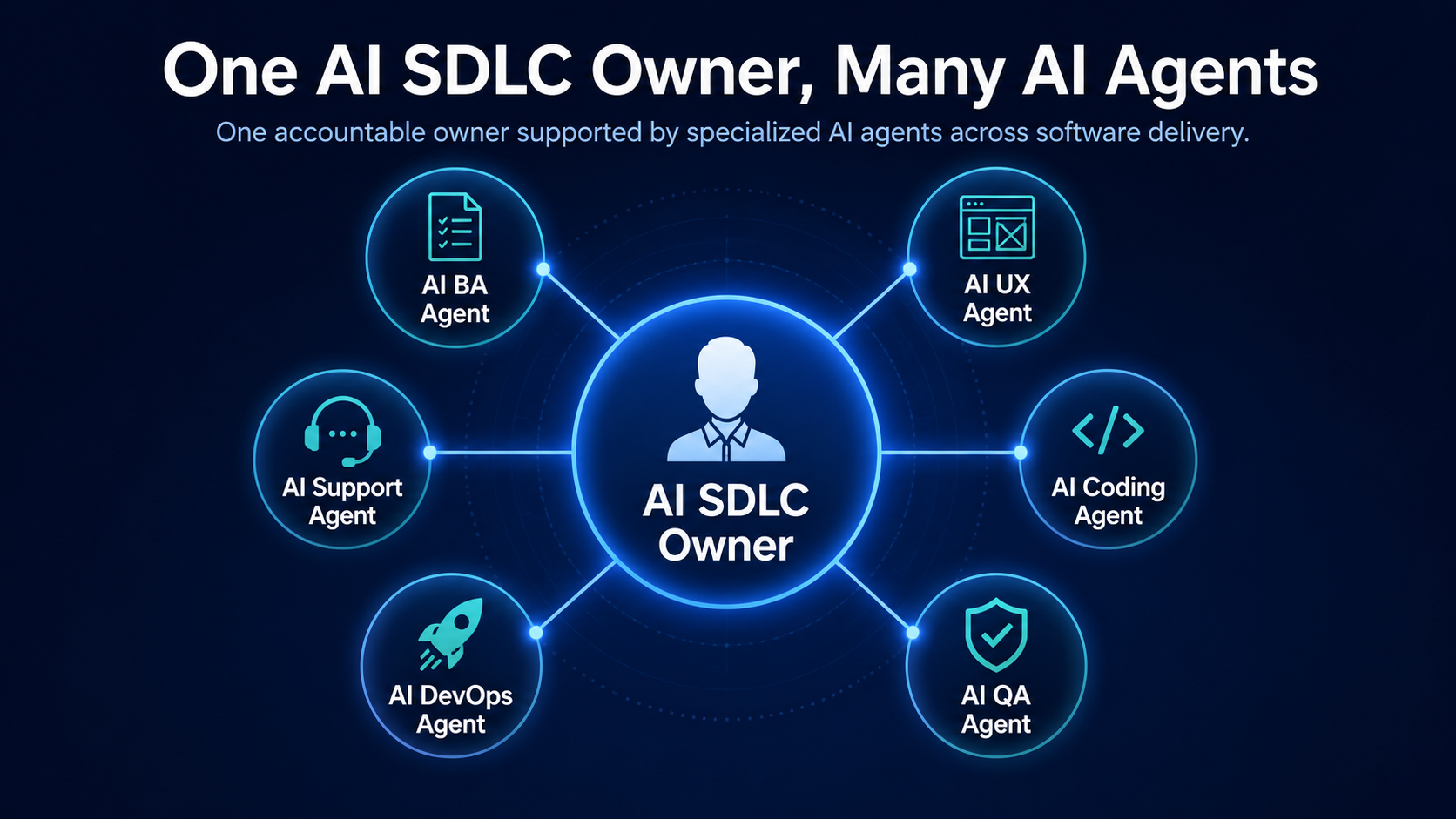
AI SDLC Owner → AI BA Agent → AI UX Agent → AI Coding Agent → AI QA Agent → AI DevOps Agent → AI Support Agent → human review and release governance
The difference is not that people disappear. The difference is that responsibility becomes clearer.
Instead of work moving through many disconnected handoffs, one accountable owner keeps the complete context alive.
Why the Old Handoff Model Breaks Down
Traditional SDLC often creates fragmented responsibility.
The business analyst understands the requirement but may not understand the technical implications. The designer understands the user interface but may not fully understand backend constraints. The developer understands implementation but may not understand the original business reason. QA understands test scenarios but may not know which risks matter most commercially. DevOps understands deployment but may not know how the feature should behave in production. Support understands user pain but may not influence the next design cycle quickly enough.
Every handoff loses context. Every delay creates interpretation. Every interpretation creates rework.
This is not because people are failing. It is because the operating model is fragmented.
AI gives companies a chance to redesign this model.
But AI alone does not solve fragmentation. In fact, without an accountable owner, AI can make fragmentation worse. Different teams may use different AI tools, generate conflicting artifacts, produce inconsistent documentation, and push partially validated code into production.
Harness calls this the AI Velocity Paradox: organizations may ship code faster with AI, but downstream bottlenecks in testing, deployment, security, and compliance can erase those gains.
That is why AI needs ownership.
Every handoff loses context. Every delay creates interpretation. Every interpretation creates rework.
The AI SDLC Owner as an Orchestrator
The AI SDLC Owner does not act like a task coordinator. They act like an orchestrator.
That means they do three things continuously.
First, they maintain context. They understand the business problem, the user, the workflow, the data, the constraints, the risks, and the desired outcome.
Second, they guide AI agents. They know what to ask, how to structure prompts, what context to provide, how to compare outputs, and when to reject AI-generated work.
Third, they validate the system. They check requirements, design, code, tests, security, deployment, and production behavior before the work is considered complete.
This is why the AI SDLC Owner is very different from a prompt engineer. A prompt engineer asks AI for output. An AI SDLC Owner designs the full delivery system.
A prompt engineer asks AI for output. An AI SDLC Owner designs the full delivery system.
The AI Agent Model Across SDLC
The strongest AI-first delivery model will not depend on one generic AI assistant. Enterprise work is too complex for that.
Webuters has already discussed this in the context of multi-agent systems, where specialized AI agents collaborate, divide work, check each other’s outputs, and interact with business systems. In enterprise workflows, specialization matters because real business processes require domain context, access control, auditability, and clear responsibility.
The same logic applies to software delivery.
A practical AI SDLC Owner model can use six specialized agent categories.
| SDLC Area | AI Agent | What the Agent Helps With | What the Human Owner Must Validate |
| Business analysis | AI BA Agent | Requirements, user stories, process maps, acceptance criteria | Business intent, scope, priorities, edge cases |
| UX and product design | AI UX Agent | User journeys, wireframes, interaction flows, design variations | User experience quality, simplicity, accessibility |
| Engineering | AI Coding Agent | Code generation, refactoring, API design, database scaffolding | Architecture, logic, maintainability, security |
| Quality assurance | AI QA Agent | Test cases, regression scenarios, automation scripts, bug triage | Risk coverage, test depth, release readiness |
| DevOps | AI DevOps Agent | CI/CD scripts, environment setup, release automation, monitoring configs | Deployment safety, rollback strategy, compliance |
| Support and feedback | AI Support Agent | Ticket summaries, issue patterns, user feedback, release notes | Priority, product impact, next iteration decisions |
This is the new software delivery system: one accountable owner, many specialized agents, and human judgment at the points that matter.
The Seven-Phase AI SDLC Owner Workflow
A strong AI SDLC Owner does not begin with code. They begin with clarity.
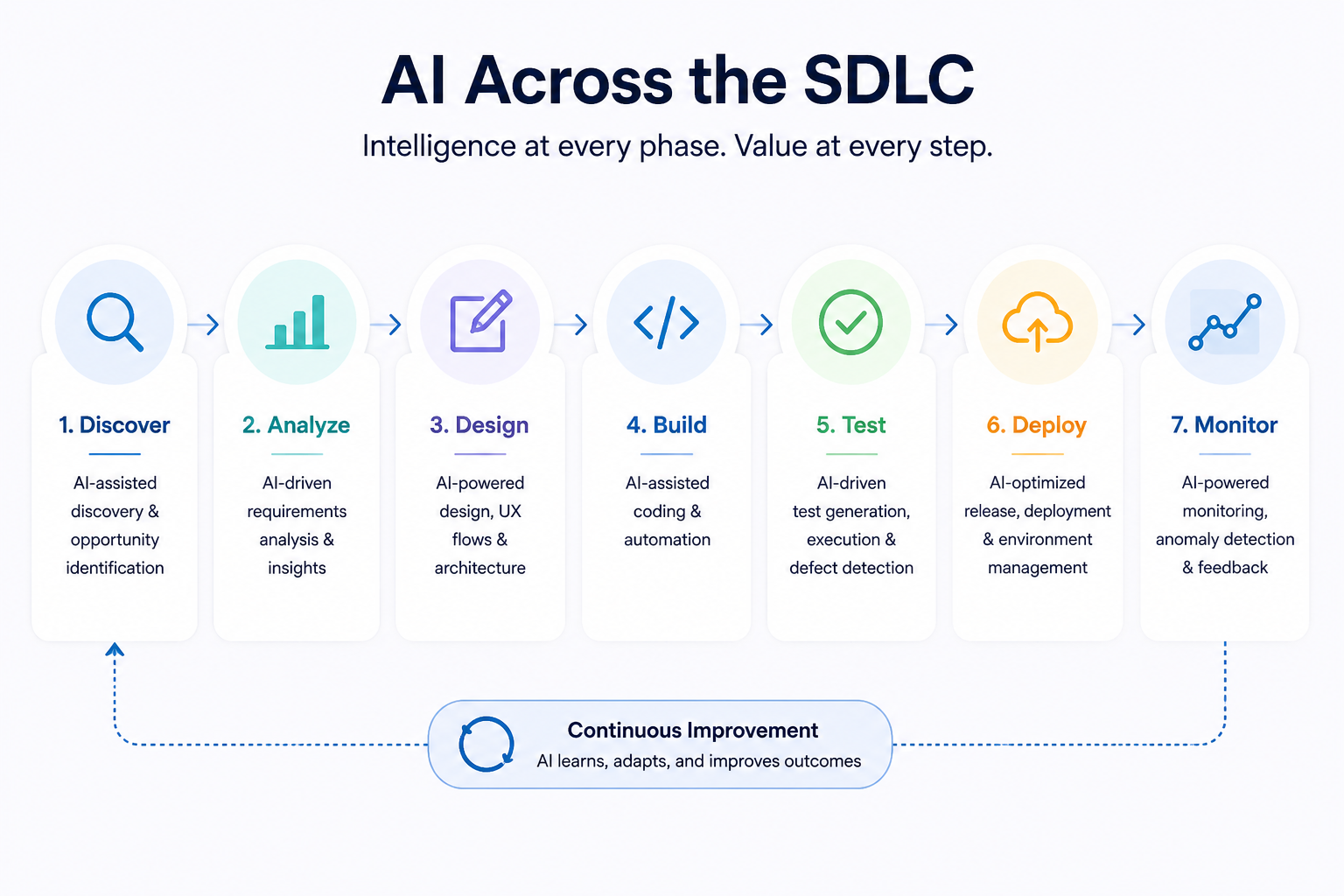
1. Discover: Convert the Business Problem Into a Clear Opportunity
The first responsibility of the AI SDLC Owner is to understand the problem. Not the feature request. The problem.
A stakeholder may say, ‘We need a dashboard.’ But the real problem may be that managers cannot see delayed approvals, sales teams cannot track customer status, or operations teams cannot detect process bottlenecks.
The AI SDLC Owner uses AI to accelerate discovery, but does not outsource judgment.
AI can help summarize stakeholder interviews, cluster pain points, analyze existing documents, compare workflows, and produce discovery questions. But the owner must determine what truly matters.
Good discovery asks: What business outcome are we trying to improve? Who is affected? What happens today? Where is time lost? What decisions are delayed? What data is missing? What errors repeat? What would success look like in measurable terms?
The output of this phase should be a clear problem statement, success metric, user profile, and process baseline.
2. Analyze: Turn Ambiguity Into Requirements
Once the problem is clear, the AI SDLC Owner guides the AI BA Agent to convert discovery inputs into structured requirements.
This includes functional requirements, non-functional requirements, user stories, acceptance criteria, workflow steps, business rules, data requirements, integration needs, and risk assumptions.
AI is very useful here because it can produce first drafts quickly. But requirements are one of the most dangerous places to be careless.
A wrong requirement creates the wrong product.
The owner must review whether the AI-generated requirements are complete, realistic, measurable, and aligned with business goals.
At this stage, the AI SDLC Owner should also build a simple definition of done. Not a vague definition. A real one.
3. Design: Create the Workflow Before the Interface
Many software projects fail because they jump from idea to screen.
The AI SDLC Owner should first design the workflow.
Before asking AI to generate UI concepts, they should define the entry point, user roles, step-by-step flow, decision points, data captured, system responses, exception paths, approvals, notifications, audit logs, and completion state.
Once this workflow is clear, the AI UX Agent can help generate wireframes, user journeys, screen layouts, and interaction flows.
This is where imagination matters.
The best AI SDLC Owner is not someone who accepts the first AI-generated wireframe. They ask better questions: Can this flow be simpler? Can we remove a step? Can the system infer something automatically? Can we reduce user typing? Can we show the right action at the right moment? Can we make failure states obvious? Can we design for the user who is tired, rushed, or not technical?
AI can generate many design options. The owner must choose the one that works.
4. Build: Use AI to Accelerate, Not Blindly Generate
This is where most people focus when they talk about AI in software development.
AI can now help with frontend components, backend APIs, database schemas, authentication flows, integration logic, unit tests, refactoring, documentation, bug fixes, code explanation, and legacy code understanding.
The productivity potential is real. McKinsey found that developers using generative AI tools can complete certain coding tasks up to two times faster, especially tasks such as code documentation, new code generation, and refactoring.
McKinsey also estimated that generative AI could have a 20% to 45% direct productivity impact on software engineering spending by reducing time spent on activities such as initial code drafts, code correction, refactoring, root-cause analysis, and generating system designs.
But McKinsey’s research also makes something else clear: human oversight remains crucial. AI tools can introduce errors, lack organizational context, and struggle when the big picture must be considered.
This is exactly why the AI SDLC Owner is important.
The owner must not treat AI-generated code as finished work. They must review architecture, data flow, maintainability, security, performance, and integration behavior.
AI can write code. The owner must ensure it belongs in the system.
5. Test: Make AI Prove the System Works
In traditional software delivery, testing often comes too late.
In AI-first delivery, testing must move earlier and become continuous.
The AI QA Agent can help generate unit test cases, integration test cases, edge case scenarios, regression test suites, negative test cases, security test prompts, load test ideas, user acceptance test scripts, and bug reproduction steps.
But the AI SDLC Owner must define what quality means.
Quality is not just ‘no visible bugs.’ Quality means the system works for the intended user, under expected and unexpected conditions, with the right level of reliability, security, performance, and maintainability.
This is where many AI-assisted teams will fail. They will generate code quickly, test lightly, and then spend more time fixing downstream issues.
Veracode’s 2025 GenAI Code Security Report tested over 100 large language models and found that 45% of code samples failed security tests and introduced OWASP Top 10 vulnerabilities.
That does not mean AI coding is bad. It means AI-generated code must be treated like junior code produced at high speed: useful, but requiring review, testing, and governance.
6. Deploy: Release With Controls, Not Hope
Deployment is where software becomes real.
The AI DevOps Agent can help generate CI/CD configurations, container files, infrastructure scripts, monitoring setup, rollback plans, and release notes.
But the AI SDLC Owner must control release risk.
Before deployment, they should verify: Has the code passed automated tests? Has security scanning been completed? Are environment variables and secrets handled safely? Is logging enabled? Is monitoring configured? Is rollback possible? Are release notes ready? Are stakeholders informed? Is there a support path if something breaks?
AWS notes that security should be integrated throughout SDLC through DevSecOps practices, including code review, architecture analysis, and penetration testing as part of the development effort rather than afterthought activities.
The AI SDLC Owner must make this practical. AI can accelerate deployment. But accountability must still be human.
7. Monitor: Convert Production Feedback Into the Next Cycle
The SDLC does not end at deployment. It becomes real after deployment.
The AI Support Agent can summarize tickets, detect user complaints, cluster bugs, identify recurring issues, analyze logs, and suggest improvements.
This is one of the biggest opportunities in AI-powered software delivery.
Traditional teams often lose production feedback. Support sees issues. Product hears complaints. Developers move to the next sprint. Leadership sees only dashboards. Nobody closes the loop quickly enough.
The AI SDLC Owner should make feedback part of the lifecycle.
Production monitoring should answer: Are users adopting the feature? Where are users dropping off? Which errors happen repeatedly? Which support tickets increased after release? Which workflows are slower than expected? What should be improved in the next iteration?
The real power of AI in SDLC is not just faster build time. It is faster learning.
The real power of AI in SDLC is not just faster build time. It is faster learning.
The AI SDLC Owner Is Not a Replacement for Expertise
This role is powerful, but it should not be misunderstood.
The AI SDLC Owner is not a fantasy role where one person magically replaces every expert on every project.
Large enterprise systems, regulated platforms, high-scale architectures, security-sensitive applications, healthcare systems, financial systems, and mission-critical platforms will still need specialists.
But the operating model changes.
Instead of a large team compensating for unclear ownership, companies can use smaller expert teams with stronger orchestration.
Instead of every task requiring a human specialist from the beginning, AI agents can prepare drafts, options, analysis, tests, documentation, and operational artifacts.
Instead of handoffs creating delays, the AI SDLC Owner can maintain continuity.
The best model is not ‘AI replaces the team.’ The best model is ‘AI gives one accountable owner and a smaller expert team much higher leverage.’
Why This Is Bigger Than Prompt Engineering
Prompt engineering is useful. But it is not enough.
A prompt engineer can ask AI to generate a user story. An AI SDLC Owner knows whether the user story solves the business problem.
A prompt engineer can ask AI to create a wireframe. An AI SDLC Owner knows whether the workflow is usable.
A prompt engineer can ask AI to write code. An AI SDLC Owner knows whether the code is secure, scalable, testable, and aligned with architecture.
A prompt engineer can ask AI to write test cases. An AI SDLC Owner knows whether those tests cover the real risks.
This is why the future role is not simply prompt engineer. The future role is AI delivery orchestrator with SDLC intelligence.
Gartner has described AI-native software engineering as embedding AI into every SDLC phase, with developer roles shifting from implementation toward orchestration, problem solving, system design, and ensuring AI tools deliver high-quality outcomes. Gartner also predicts that by 2028, 90% of enterprise software engineers will use AI code assistants.
That shift is exactly where the AI SDLC Owner fits.
The Skills Companies Should Train Now
Companies should not wait for this role to appear in the job market. They should build it internally.
The best candidates may come from different backgrounds: a senior developer who understands business workflows, a business analyst with strong system thinking, a QA lead who understands risk and quality, a product owner with technical depth, a project manager who understands delivery architecture, a solution architect who can communicate clearly, or a DevOps engineer who understands product outcomes.
The background matters less than the mindset.
The AI SDLC Owner needs these skills.
| Skill | Why It Matters |
| SDLC Fundamentals | Understand discovery, analysis, design, build, test, deploy, monitor, and maintain. |
| Workflow Thinking | Break messy business operations into steps, decisions, data flows, exceptions, and outcomes. |
| Requirement Discipline | Write requirements that are clear, testable, measurable, and connected to business value. |
| Product Imagination | Imagine better workflows, not simply automate old ones. |
| Technical Literacy | Understand architecture, APIs, databases, integrations, security, performance, and deployment basics. |
| AI Orchestration | Use AI agents for analysis, design, coding, testing, DevOps, support, and documentation. |
| Review and Validation | Challenge AI outputs, compare alternatives, detect gaps, and verify quality. |
| Governance Awareness | Understand data privacy, security risks, access controls, audit logs, and approval gates. |
| Communication | Explain the system to business leaders, developers, testers, users, and support teams. |
| Ownership | Take responsibility for the outcome; AI can assist work but cannot care about the result. |
AI can assist the work. It cannot care about the result.”
Governance: The Missing Piece in AI-Powered Delivery
AI-powered software delivery must be fast, but it must also be safe.
The more AI agents participate in software development, the more companies need governance.
OWASP’s 2025 Top 10 risks for LLM and generative AI applications include prompt injection, sensitive information disclosure, supply chain risk, data and model poisoning, improper output handling, excessive agency, system prompt leakage, vector and embedding weaknesses, misinformation, and unbounded consumption.
These risks matter directly to AI-assisted SDLC.
If an AI Coding Agent uses insecure dependencies, that is a supply chain risk. If an AI Support Agent exposes private customer data, that is sensitive information disclosure. If an AI DevOps Agent has too much permission, that is excessive agency. If an AI agent accepts malicious instructions from user input, that is prompt injection.
This is why the AI SDLC Owner must design guardrails.
A practical governance model should include role-based access for AI tools, approved data sources, prompt and output logging, human approval for high-risk actions, secure code review, automated security scanning, dependency checks, secrets management, test coverage requirements, release gates, rollback plans, production monitoring, and incident review.
The goal is not to slow AI down. The goal is to make AI safe enough to scale.
The goal is not to slow AI down. The goal is to make AI safe enough to scale.
A Practical Operating Model for Companies
Companies that want to adopt this model should not begin by telling everyone to use AI more. That creates tool sprawl.
A better approach is to define an AI SDLC operating model. Here is a simple five-step roadmap.
| Step | Action |
| 1. Pick One Software Workflow | Start with a clear use case such as an internal workflow application, dashboard, approval workflow, CRM/ERP extension, integration, or MVP prototype. |
| 2. Assign One AI SDLC Owner | Do not split ownership across five people. Assign one accountable owner to maintain continuity from discovery to feedback. |
| 3. Define the AI Agent Stack | Identify which AI tools or agents support BA, UX, coding, QA, DevOps, and support activities. |
| 4. Create Review Gates | Requirements, UX, code, tests, security, release, and production feedback should each have clear review checkpoints. |
| 5. Measure the Outcome | Measure cycle time, handoffs reduced, rework reduced, defects, incidents, adoption, deployment frequency, and business outcome achieved. |
What the AI SDLC Owner Means for Different Roles
| Role | How the Role Evolves |
| Business Analysts | Become AI workflow architects who use AI to model processes, generate user stories, simulate scenarios, and validate business rules. |
| UX Designers | Move faster from workflow to interaction design while preserving usability, accessibility, simplicity, and emotional experience. |
| Developers | Focus more on architecture, review, integration, performance, security, complex logic, and maintainability. |
| QA Engineers | Move upstream into risk coverage, quality strategy, release confidence, and AI-assisted automated validation. |
| DevOps Engineers | Use AI to accelerate deployment automation while ensuring reliability, observability, resilience, and compliance. |
| Project Managers | Evolve into delivery architects who design AI-supported workflows and remove bottlenecks instead of only tracking status. |
Why Smaller Teams Will Win
The future is not simply fewer people. It is better leverage.
A small team with strong SDLC intelligence, clean workflows, AI agents, and one accountable owner can move faster than a large team with unclear handoffs.
This is the shift from headcount to intelligence.
The old question was: How many people do we need? The new question is: How much clarity, context, intelligence, and ownership do we have?
AI adoption is no longer the differentiator. The differentiator is how well organizations redesign delivery around AI.
The Webuters Perspective
At Webuters, we believe the future of software delivery will not be won by companies that simply buy more AI tools.
It will be won by companies that redesign how work moves from idea to outcome.
That means combining AI consulting, generative AI services, custom AI solutions, workflow automation, cloud-native engineering, DevOps maturity, security and governance, and human ownership.
Webuters’ AI consulting services are focused on helping organizations automate workflows, gain insights, and improve business performance through scalable and responsible AI solutions.
Webuters’ Generative AI services are built around helping businesses innovate, automate, improve decision-making, and create AI-powered solutions that fit real business needs.
This is exactly where the AI SDLC Owner model becomes powerful.
A company does not need AI scattered everywhere. It needs AI structured around delivery.
The AI SDLC Owner is the human operating layer that connects business goals, AI agents, engineering discipline, and production accountability.
The Future: One Owner, Many Agents, Stronger Software
The future software team may not look like the past. It may be smaller. It may be more fluid. It may include human experts and AI agents working together. It may have fewer handoffs and more ownership.
But one thing will remain true: software still needs judgment.
AI can accelerate discovery. AI can generate requirements. AI can create designs. AI can write code. AI can produce tests. AI can support deployment. AI can monitor feedback.
But AI cannot replace the responsibility of deciding what should be built, why it matters, how it should work, when it is safe, and whether it delivers value.
That responsibility belongs to the AI SDLC Owner.
The companies that understand this role early will build faster, learn faster, and deliver better software with smaller, sharper, AI-empowered teams.
The companies that only add AI tools without changing ownership will create more noise, more risk, and more rework.
The next era of software delivery is not about replacing people with AI. It is about giving the right people the intelligence, agents, workflows, and ownership to deliver software at a level that was not possible before.
Final Thought
The AI SDLC Owner is not just a new title. It is a new way of thinking about software delivery.
It says that the future belongs to people who can see the full system.
People who understand the business problem. People who can imagine better workflows. People who can guide AI agents. People who can validate quality. People who can manage risk. People who can take an idea from conversation to production.
In the old model, software delivery was divided across roles. In the new model, AI will assist every role, but ownership must become clearer than ever.
That is why the AI SDLC Owner will become one of the most important roles in AI-powered software development.
If your organization wants to move from AI experimentation to AI-powered software delivery, Webuters can help you design the right AI SDLC model, train your teams, build intelligent workflows, and deliver software faster with responsible AI adoption.
Let’s build the future of software with clarity, intelligence, and ownership.
FAQ
What is an AI SDLC Owner?
An AI SDLC Owner is a full-cycle software delivery owner who uses AI agents to support requirements, design, coding, testing, deployment, monitoring, and support while maintaining end-to-end accountability for the outcome.
Is an AI SDLC Owner the same as a project manager?
No. A project manager usually tracks timelines, resources, status, and coordination. An AI SDLC Owner goes deeper into the software lifecycle by owning workflow clarity, requirement quality, AI orchestration, technical validation, testing, governance, and production outcomes.
Can one person really deliver software with AI agents?
One skilled person can deliver many types of software faster with AI agents, especially MVPs, internal tools, prototypes, workflow applications, dashboards, automations, and integrations. However, complex enterprise or regulated systems still need specialist review, security controls, architecture oversight, and governance.
Which AI agents support the AI SDLC Owner?
The most practical agent model includes an AI BA Agent for requirements, AI UX Agent for workflows and wireframes, AI Coding Agent for implementation, AI QA Agent for testing, AI DevOps Agent for deployment and monitoring, and AI Support Agent for feedback and tickets.
Does AI replace SDLC?
No. AI does not replace SDLC. It strengthens SDLC by accelerating discovery, analysis, design, build, test, deployment, and monitoring. Strong SDLC becomes even more important because AI can amplify both good structure and bad structure.
What skills does an AI SDLC Owner need?
An AI SDLC Owner needs SDLC fundamentals, workflow thinking, requirement writing, product imagination, technical literacy, AI prompting and orchestration, testing strategy, security awareness, communication skills, and strong ownership.
How should companies start building this role?
Companies should begin with one software workflow, assign one accountable AI SDLC Owner, define AI agent support across the SDLC, create review gates, measure delivery outcomes, and improve the model through real project experience.
Legacy application modernization
Move an ageing application forward one reviewed release at a time.
See modernization services
Krishna is the Founder and CEO of Webuters, a technology leader specializing in Generative AI, intelligent automation, enterprise software, and digital transformation. He helps organizations leverage emerging technologies to drive innovation, operational efficiency, and business growth. Through his writing, Krishna shares insights on AI adoption, technology leadership, product innovation, and the future of work, helping leaders navigate change and build future-ready organizations.
Follow Krishna on LinkedIn