What Hotel Owners Don’t See Until AI Connects Their Operations
Discover how AI in hospitality connects hotel systems, improves guest experience, reduces manual work, and gives hotel owners clearer operational decisions.

AI in hospitality is often introduced like a new feature you bolt onto the business. A chatbot here. A dashboard there. Maybe an AI concierge in the guest app. But anyone who has watched a hotel during a busy arrival window knows the real issue is usually not a lack of tools. It is that the hotel is running like several teams on separate walkie-talkies: everyone is moving, everyone is reacting, and almost no one can see the full picture.
A guest asks for early check-in. Housekeeping is still turning rooms. The front desk is managing arrivals. A VIP preference is sitting in the CRM. A maintenance issue is tracked somewhere else. Finance will eventually see the result, but not the chain of small misses that created it. In AI in hospitality, the hidden cost is not just delay. It is lost visibility.
That is where AI in hospitality becomes useful in a practical way. Not as flash. Not as a replacement for staff. As connected intelligence across front desk, housekeeping, guest requests, room service, CRM, PMS, and revenue workflows. When those signals finally meet in one operational layer, hotel leaders can see the blind spots they were already paying for: slower service, missed upsell moments, repeated complaints, staff overload, and revenue leakage that never showed up as one dramatic event.
This article looks at the gaps inside hotel operations, why more software does not automatically fix them, how AI in hospitality connects departments, what owners start seeing once the hotel becomes more legible to itself, and how to implement AI in hospitality in a way that respects both workflow reality and human judgment.
The hidden gaps inside hotel operations
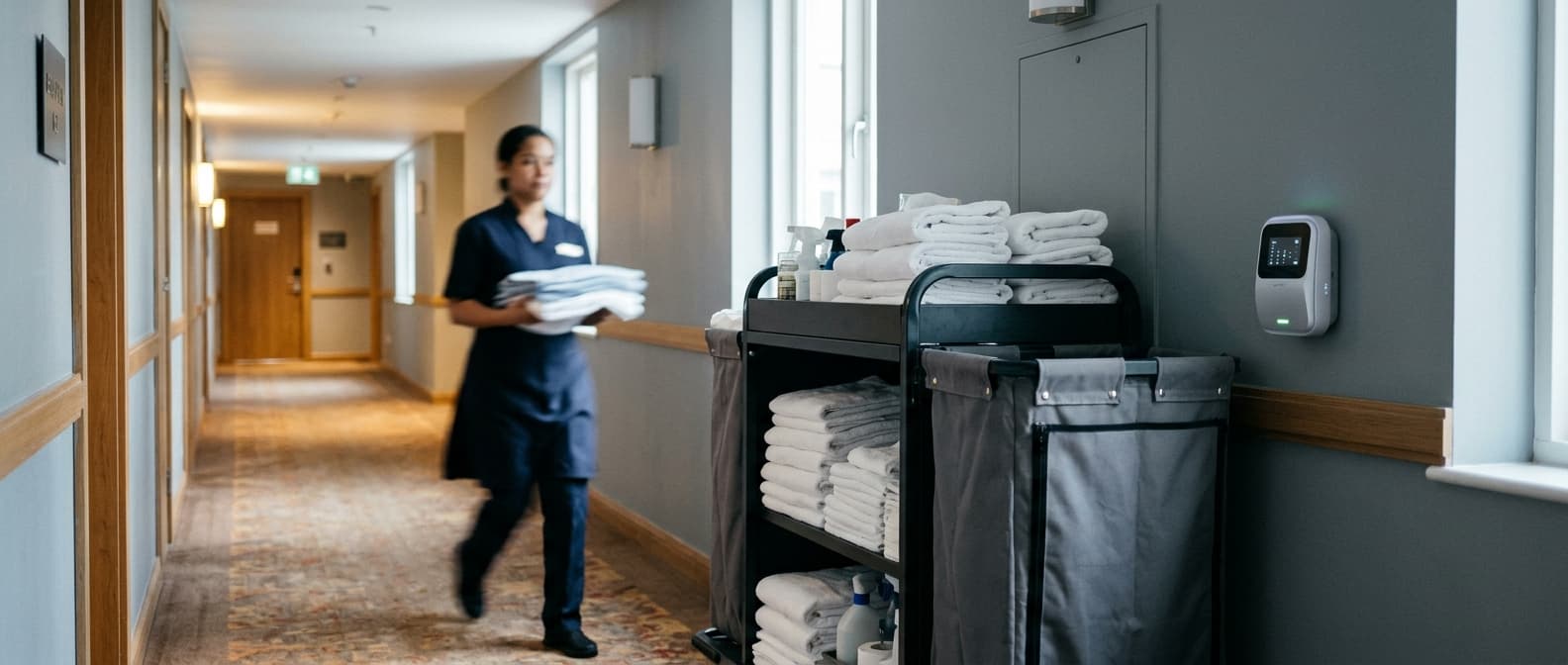
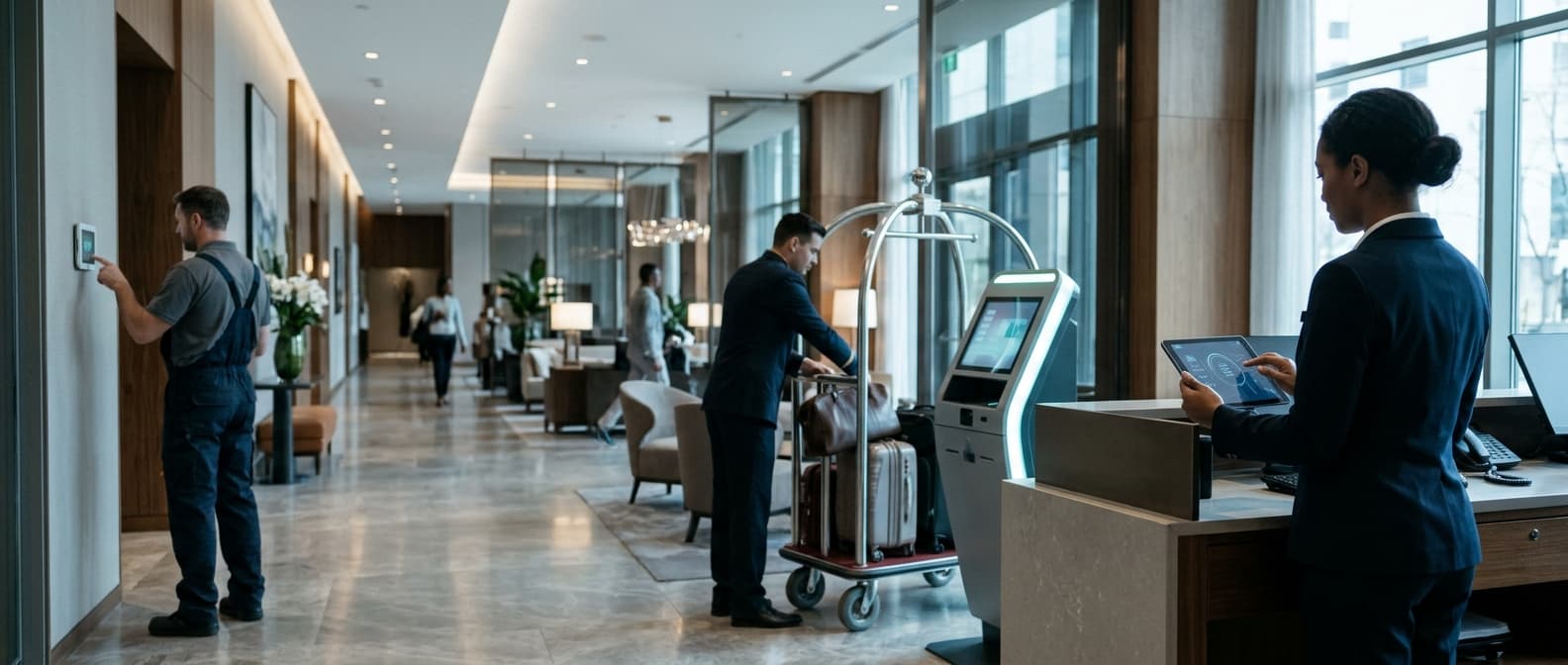
From the outside, a hotel can look like one business. Inside, it behaves more like a chain of handoffs. Front desk, housekeeping, room service, guest request management, maintenance, CRM, PMS, and revenue teams all make decisions that affect the same stay, but they often do it through different systems, different priorities, and different timing.
That creates an uncomfortable pattern. The guest experiences one journey, while the hotel manages that journey in fragments. A front desk associate may know a guest is arriving early, but housekeeping coordination may still live in a separate workflow. A repeat complaint might be captured in the CRM, but the team handling the live service moment never sees it. A room service delay may get resolved manually, yet no one spots that the same delay keeps happening on similar occupancy nights.
This is where AI in hospitality becomes less about speed and more about shared context. If teams spend their time asking each other for updates, repeating guest information, or discovering problems after the guest has already felt them, the issue is not effort. The issue is disconnected visibility.
One guest request, multiple blind spots
Imagine a returning guest arrives before check-in time and asks for an early room, extra towels, and a quiet-floor preference. The front desk logs one part of the request. Housekeeping sees another. The quiet-floor preference may already exist in the guest profile, but if the PMS and CRM are not aligned, that history does not reliably reach the team making room assignments. What the guest experiences as “the hotel” is actually a chain of manual interpretation.
Owners usually see the symptom later. Lower guest satisfaction. More staff stress. More exceptions. More service recovery. But the operational gap started much earlier, at the handoff.
Why more software does not always solve the problem
A common reaction to operational friction is to add another system. New guest messaging software. A new reporting tool. A new task app. A new bot. But connected hotel systems and disconnected hotel software are not the same thing.
Hotel technology stacks are already broad. The Oracle Hospitality platform overview shows how hospitality technology spans property operations and guest-facing capabilities, and the Oracle Hospitality documentation reflects how extensive those operational environments can become. OpenTravel supports interoperability standards across the travel ecosystem, which is a useful reminder that system connection is not a side issue in hospitality technology.
So the question is not whether a hotel has software. It is whether the software creates a shared operating picture. Another dashboard does not help if managers still cannot tell where a delay started. Another guest communication channel does not help if staff still need to copy requests manually into housekeeping queues or service workflows. AI in hospitality only becomes useful when it has operational context, not just more data points. In practice, AI in hospitality should reduce confusion, not add another layer of it.
| Operational Area | Disconnected Hotel Software | Connected Hotel Systems | Business Impact |
|---|---|---|---|
| Front desk automation | Check-in notes stay in one tool | Arrival status, guest preferences, and room readiness are visible together | Faster, clearer decisions at arrival |
| Housekeeping coordination | Teams chase updates manually | Room status updates trigger relevant front desk actions | Fewer avoidable delays and better room turnover visibility |
| Guest request management | Requests are passed by message or phone | Requests are routed with priority, owner, and escalation path | Better follow-through and less dropped work |
| CRM and PMS visibility | Guest history sits apart from live stay data | Preferences, issues, and value signals appear in the workflow | Stronger personalization and fewer repeat issues |
| Revenue workflow | Upgrade or recovery signals are missed | Service context and guest value are visible at the right moment | Fewer missed upsell and recovery moments |
| Staff workload | Managers see pressure only after complaints | Workload patterns and bottlenecks become visible earlier | Better staffing judgment and less reactive firefighting |
Here is why this matters: software can increase activity without increasing clarity. AI in hospitality becomes valuable when it reduces the distance between signal and action.
How AI in hospitality connects hotel departments
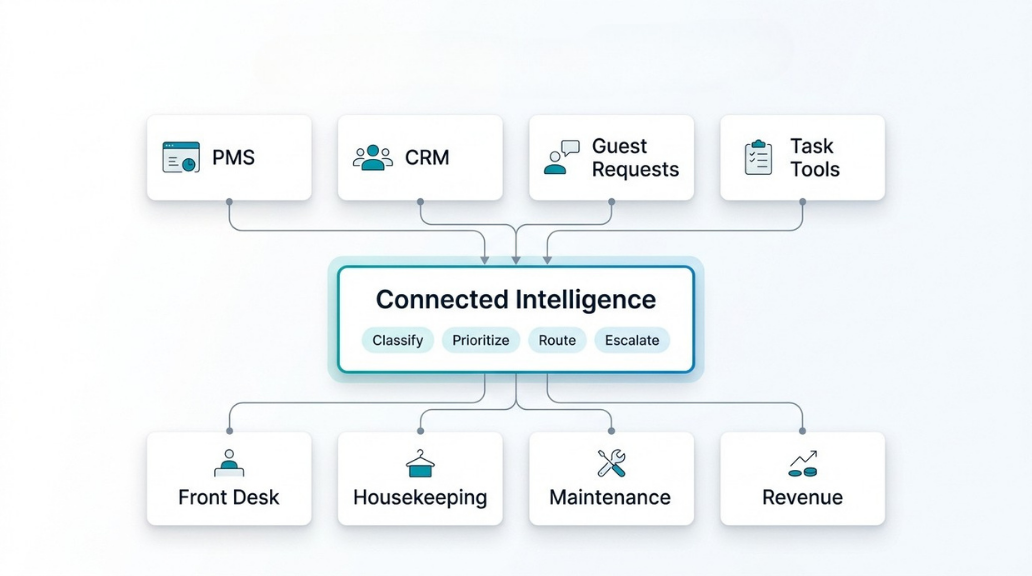
AI in hospitality becomes practical when hotel systems feed one shared operating layer that helps teams act with the same context.
The useful role of AI in hospitality is not to replace the PMS, the CRM, or the service tools. It is to act as a connective intelligence layer across them. That layer can read operational signals, surface context, prioritize tasks, route requests, and flag exceptions for human review.
A connected PMS matters because it tells the hotel what is happening in the stay right now. A connected CRM matters because it tells the hotel who the guest is, what has happened before, and what relationship or preference should shape the service decision. For many hotel groups, that foundation starts with reliable guest profiles, clean operational data, and disciplined CRM ERP integration.
Microsoft’s Cloud Adoption Framework for AI emphasizes a practical sequence: start with business scenarios, data readiness, platform choices, security, and governance rather than jumping straight to the tool layer.
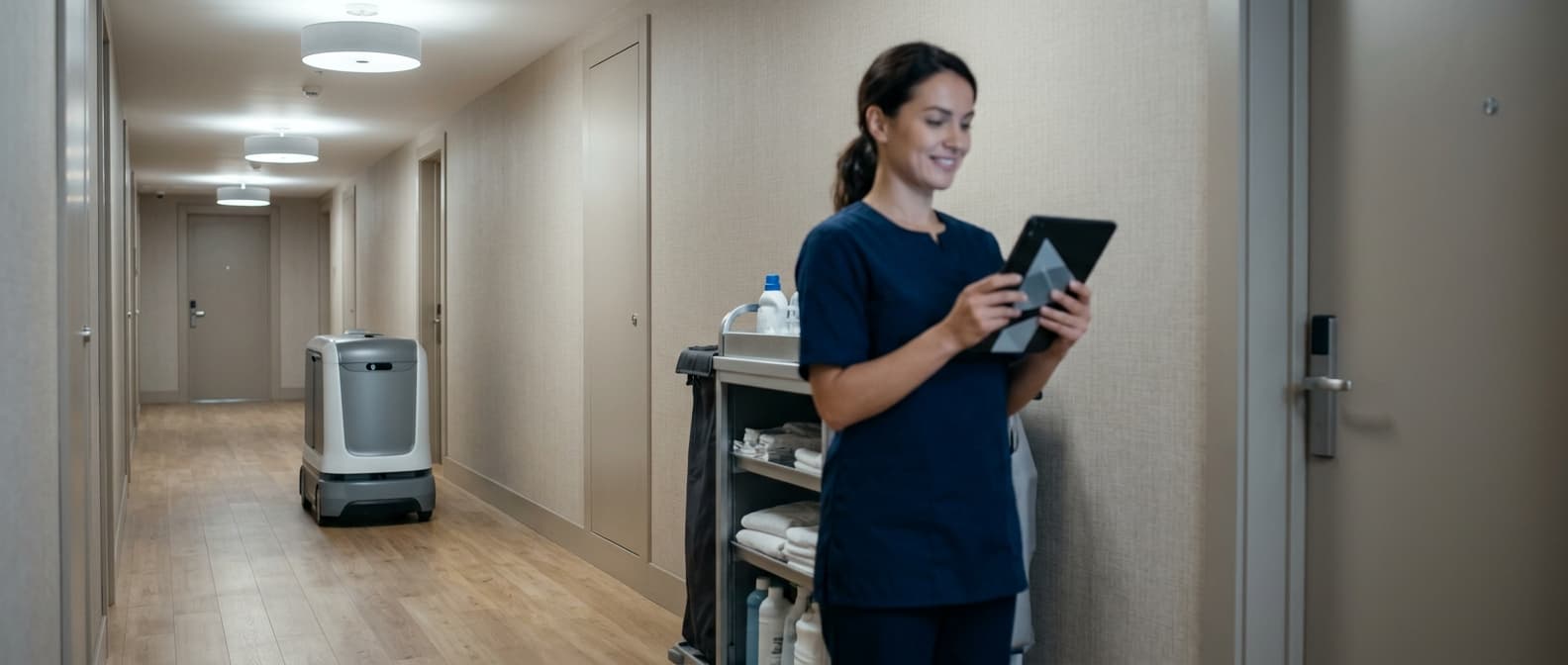
Once that foundation exists, AI in hospitality can do something practical. A guest request coming from messaging, app, or front desk can be classified by urgency, matched to stay context, and routed to the right operational owner. A VIP arrival note stored in the CRM can be surfaced to housekeeping and front desk before check-in pressure peaks. A service task that drifts too long can trigger escalation instead of waiting for a manager to notice it manually.
What this looks like in the flow of work
Think about a late-night room issue. In a disconnected setup, the guest explains the problem, the front desk logs it, someone calls housekeeping or maintenance, and the guest may repeat the issue twice more. In a connected workflow, AI in hospitality can attach room status, guest tier, prior issue history, and urgency to the ticket immediately. The staff still handle the service. The difference is that they start informed.
For example, when an early-arrival request comes in, AI in hospitality can combine the returning guest’s CRM preference, PMS arrival status, and housekeeping room-readiness signal before routing the task. The front desk still makes the service decision, but the team sees the context, owner, and escalation path in one place instead of reconstructing it through calls and messages.
That same principle is why guest-facing digital experiences only work when operations can respond behind the scenes. It is also why AI in hospitality, hotel operations automation, and hotel management automation only become truly useful when they are tied to the systems that execute the work.
In hospitality, AI is not most powerful when it talks to the guest. It is most powerful when it helps the hotel finally hear itself.
If your organization is planning the workflow layer behind that kind of change, Generative AI services and solutions can help teams design the connective logic without starting from isolated tools.
What hotel owners start seeing once AI in hospitality is connected
The first real win is not a futuristic guest interaction. It is visibility. When AI in hospitality is connected to daily workflows, owners and operators start seeing the business at the point where friction is created, not just at the point where it shows up in a report.
That means staff workload patterns become visible earlier. A housekeeping manager can see which floors or room types repeatedly create turnaround pressure. A general manager can spot that a specific handoff between front desk and maintenance is causing delayed service recovery. A guest experience leader can see repeated issues attached to the same guest profile before they become a pattern of frustration.
A useful way to think about this is through operational KPIs that a hotel can actually act on. Not just occupancy and ADR, but response time to guest requests, room readiness lag, escalation time for unresolved issues, repeat issue rate by guest profile, and the number of handoffs required before a service task is closed. When those signals are visible, management stops guessing where the problem is.
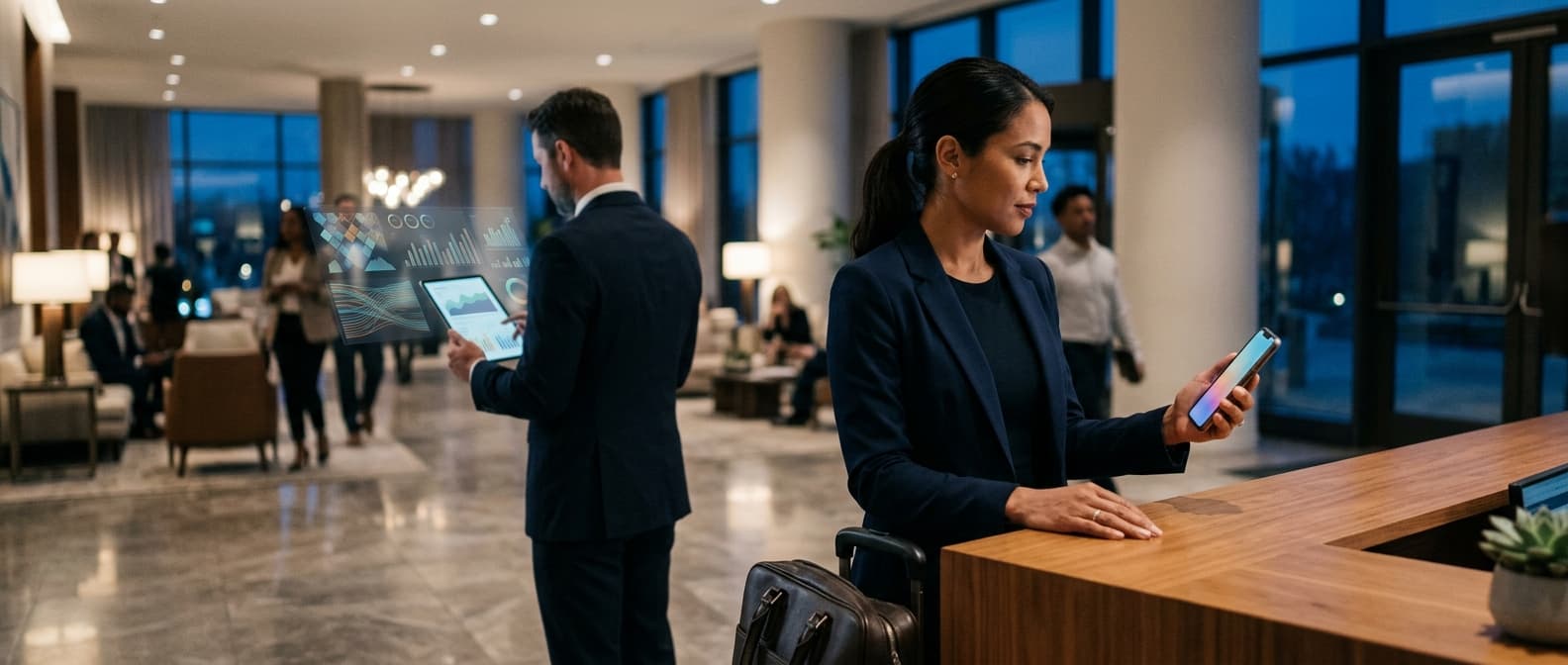
This is where hotel decision intelligence becomes useful. AI can highlight exceptions, summarize delays, and show where guest request management is drifting. It does not make the judgment for the team. It makes the judgment easier to make because the context is already assembled.
What implementation needs in practice
A useful rollout does not start with the whole property. It starts with ownership.
One team owns the workflow. One person owns escalation rules. One person owns the data handoff. That matters because connected operations fail when everyone assumes someone else is watching the handoff. If a room is not ready by a defined time, the system should trigger an escalation path. If a request sits too long, the responsible team should know whether it is waiting on housekeeping, maintenance, or front desk action. If a VIP profile conflicts with a live room assignment, someone should be accountable for the exception before the guest feels it.
That is the difference between automation as decoration and automation as operating discipline.
Where hotels lose revenue without connected intelligence
Hotels do not lose revenue only through pricing decisions. A meaningful share of hotel revenue leakage lives in small operational misses that compound quietly. A missed upgrade opportunity. A delayed response that turns into a negative review. A guest preference that was known by one department and invisible to the team that could have acted on it.
Consider the upgrade moment. The guest is eligible, the room inventory supports it, and the guest profile suggests a strong fit. But if the value signal lives in the CRM and the live stay context lives in the PMS, the opportunity can disappear during check-in pressure. The issue is not strategy. It is timing and visibility.
The same applies to service recovery. If a complaint is logged but no one clearly owns the next action, a solvable problem becomes a public one. If a returning guest repeats the same issue across stays because the history never reaches the live workflow, the hotel is not just losing guest satisfaction. It is losing trust, future spend, and the chance to turn a bad moment into a loyalty-building one.
That is why AI in hospitality should be framed carefully. The goal is not to automate warmth. The goal is to reduce the manual friction that blocks commercial and service opportunities from reaching the staff member who can act on them.
How AI improves guest experience without replacing staff
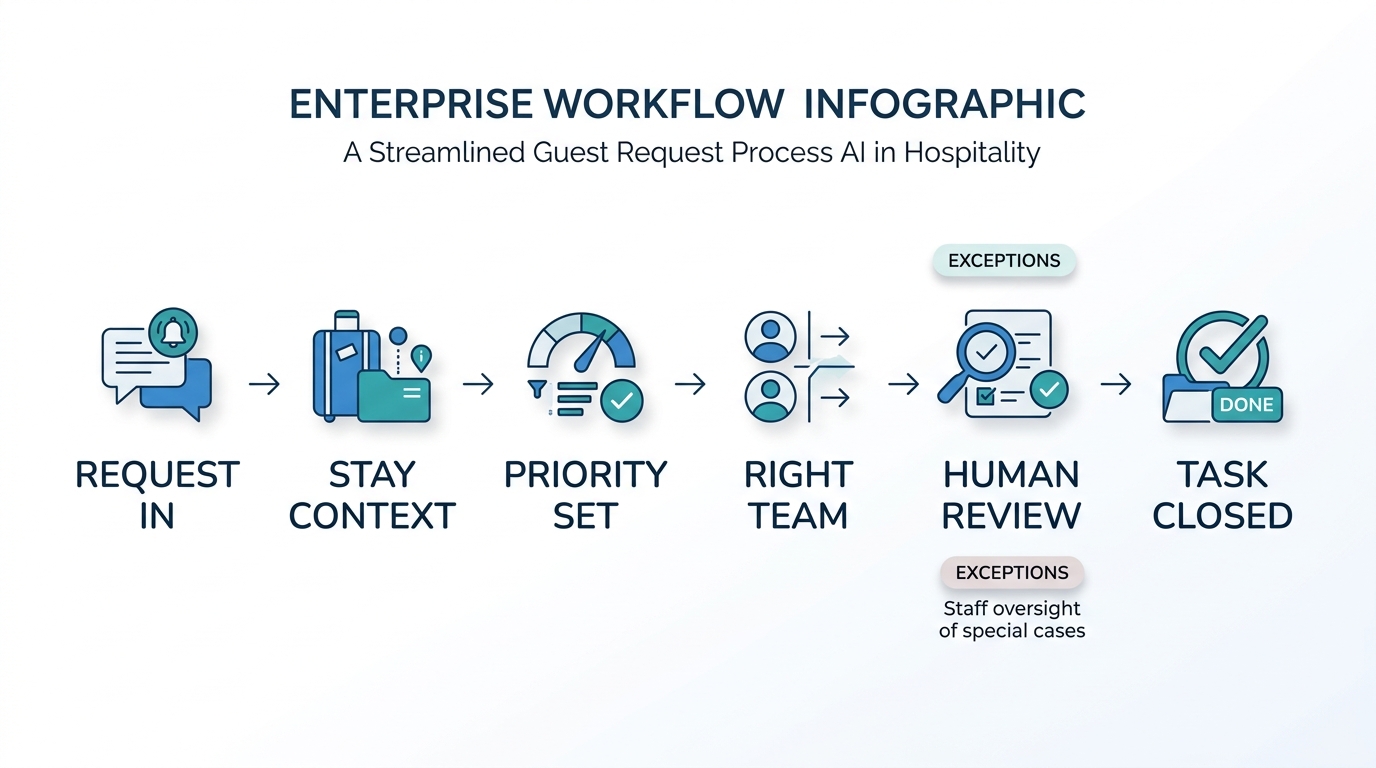
Hospitality is still human work. The welcome, the judgment, the recovery conversation, the thoughtful exception for a tired traveler—those moments are not problems to automate away. AI for hotel owners should support the team with prioritization, routing, summaries, and automation around the edges so staff can spend more time on the part that feels like hospitality.
A front desk associate does not need another screen full of alerts. They need a ranked sense of what matters now: which arrivals are waiting on room readiness, which guest request carries urgency, which repeat issue should be handled with care, and which task needs escalation. Housekeeping coordination improves when the team receives clearer task context instead of fragmented instructions. Guest experience automation works best when the guest does not have to repeat the story.
This human-centered approach is not just good operations; it aligns with responsible AI guidance. The NIST AI Risk Management Framework centers governance, risk mapping, measurement, and management, with clear attention to accountability and human oversight. In simple words: AI in hospitality can automate classification, routing, and alerts, while people retain control over exceptions, empathy, and final service judgment.
How hotels should implement AI in hospitality
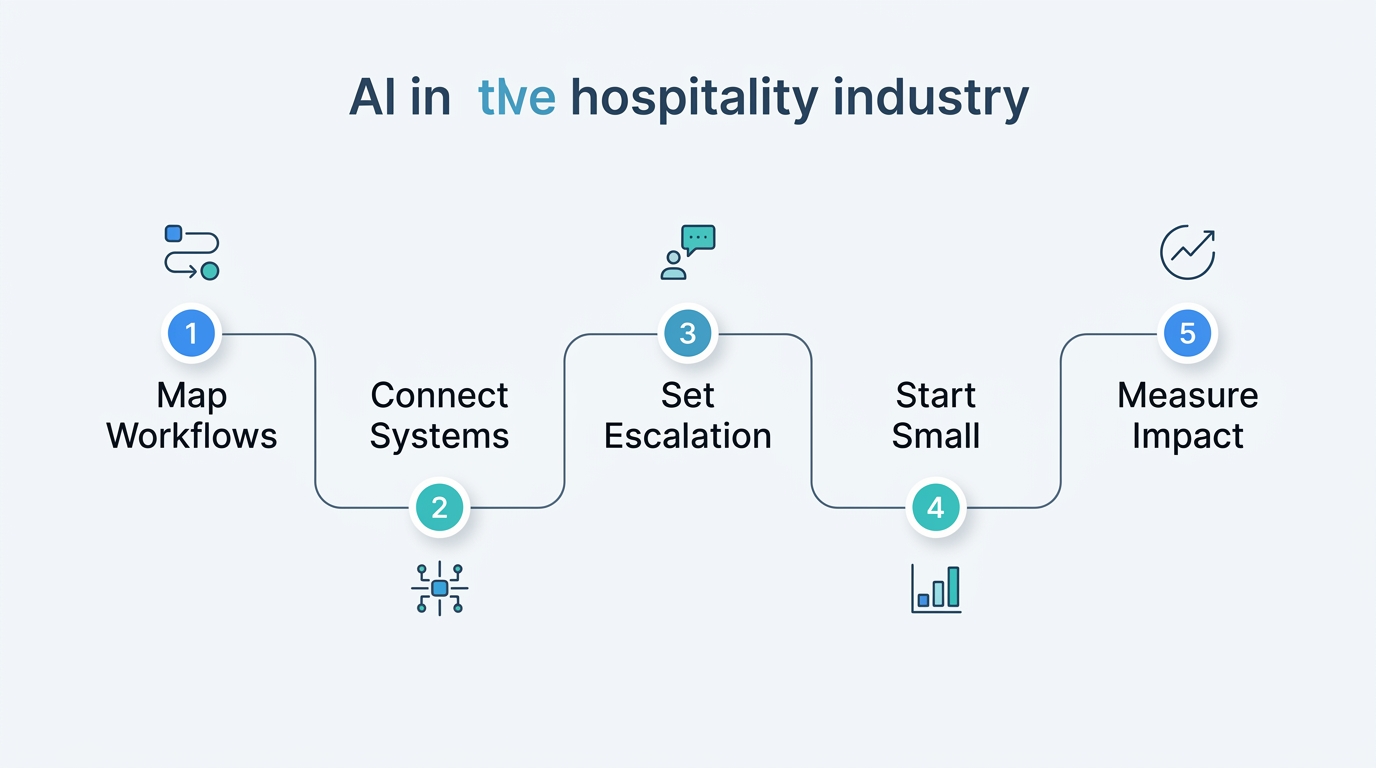
Implementing AI in hospitality is not complicated, but it does require discipline: map workflows, connect systems, define human escalation, automate narrow workflows, and measure operational impact. That order matters.
Start by mapping the workflows that already hurt
Begin with the friction you can already feel. Early check-in. Room readiness. Guest request routing. Service recovery. Missed upgrades. Draw the current path across front desk, housekeeping, room service, guest messaging, CRM, PMS, and finance where relevant. The goal is to find where context gets dropped, repeated, or delayed.
Connect the systems that hold the missing context
Once the workflow is clear, connect the systems that hold the required context. This is where connected PMS data, guest profile history, service logs, and operational task status need to meet. Hospitality platforms are already designed around operational systems that span the property, but the business value comes from making those systems usable together in the workflow.
Keep human escalation explicit
Not every decision should be automated. A practical starting point is to let AI classify, summarize, and route, while humans own exceptions, service recovery, approvals, and judgment calls. That balance is consistent with both Microsoft’s scenario-led AI adoption guidance and NIST’s emphasis on governance and oversight.
Automate one narrow workflow first
Do not start with the whole hotel. Start with one visible problem. Guest request management is often a clean entry point. Room readiness coordination between front desk and housekeeping is another. If guest-facing digital channels are part of the picture, make sure the experience is tied to real operational response, the same principle we emphasize in our next generation mobile app for hospitality work.
Measure whether the work became easier to run
Measure what improves legibility and execution. Faster routing. Fewer dropped handoffs. Better workload balance. Clearer follow-through. More consistent service recovery. This is how AI in hospitality earns trust inside the property: by making the work easier to run, not just easier to describe.
Frequently asked questions
Is AI in hospitality mainly about chatbots and AI concierge tools?
No. Those can be useful, but the bigger opportunity in AI in hospitality is connecting hotel systems so guest requests, stay status, preferences, and service actions move together instead of living in separate tools.
What should hotels automate first?
A strong starting point is a narrow workflow with visible friction, such as guest request management, room readiness coordination, or service escalation. The point is to prove value in a real operational path before expanding into broader hospitality automation.
Does AI in hospitality replace hotel staff?
It should not. The most practical use of AI in hospitality is to support staff with prioritization, routing, summaries, and alerts so they can spend more time on hospitality service and less time chasing context.
Why are PMS and CRM connections so important for AI-powered hotel operations?
The PMS shows what is happening in the current stay. The CRM shows who the guest is, what has happened before, and where value or risk may sit. Without both, AI sees only part of the picture, which limits real-time hotel insights.
Where does hotel revenue leakage usually show up?
Often in small operational breaks: missed upgrades, unresolved issues, slow follow-up, fragmented guest history, and weak ownership of service recovery. Connected intelligence helps those moments become visible earlier.
The practical takeaway for hotel owners
The next evolution of smart hotel technology will not be judged by how futuristic it looks in a demo. It will be judged by whether it helps the hotel run with clearer priorities, clearer handoffs, and clearer guest context. That is the shift from more software to connected intelligence.
The future belongs to hotel operations that are easier to see. A manager should be able to understand where work is piling up, where a guest issue is repeating, where staff need support, and where revenue opportunities are being missed without waiting for end-of-day reconstruction. That is what AI in hospitality can actually deliver when the PMS, CRM, and service workflow stop behaving like separate islands.
At Webuters, we see this as a business design question before it becomes a model question. If you are evaluating AI in hospitality, start with the parts of the hotel that still depend on invisible handoffs and manual translation. For most teams, AI in hospitality starts paying off when those handoffs are visible, owned, and connected. A practical next step is to work with our AI consulting services team to map the workflows, define the escalation rules, and design the connected operating layer that turns AI in hospitality into visibility, better handoffs, and better decisions.
AI adoption and workflow automation
Start with one workflow, prove it in production, then scale what works.
See AI services
Krishna is the Founder and CEO of Webuters, a technology leader specializing in Generative AI, intelligent automation, enterprise software, and digital transformation. He helps organizations leverage emerging technologies to drive innovation, operational efficiency, and business growth. Through his writing, Krishna shares insights on AI adoption, technology leadership, product innovation, and the future of work, helping leaders navigate change and build future-ready organizations.
Follow Krishna on LinkedIn