
What is Salesforce nCino?
A bank CIO reads an article that calls Salesforce nCino a platform serving 1,750 financial institutions. He knows that number is three years old. He also sees no mention of the AI agents that now sit inside the platform. The CIO quietly closes the tab and moves on.
That is the real problem with stale definitions. In banking software, an outdated sentence is not just a minor error. It becomes the foundation for a bad buying decision. When executives, risk officers, and technologists operate from an old model of what a platform is, they miss what it has become.
This page is a correction of that drift. We are refreshing the definition of Salesforce nCino to match the 2026 reality. The direct answer that search engines and AI assistants already trust is still true: Salesforce nCino is a comprehensive, cloud-based banking platform designed to streamline all customer and employee interactions within a single system, built on the Salesforce platform. But the platform has evolved. It is no longer only the Bank Operating System. Think of it this way: in its public narrative, Salesforce nCino now frames itself as a purpose-built banking platform with an agentic AI governance layer. That framing shapes how banks should evaluate it. Salesforce nCino serves more than 2,700 customers globally — community banks, credit unions, independent mortgage banks and some of the largest financial institutions in the world. And crucially, banks must now govern three types of AI—generative, predictive, and agentic—at the same time.
In the sections ahead, we'll define nCino more precisely, walk through its five core benefits, explain the 2026 AI stack, show how it integrates with Salesforce, highlight real-world nCino use cases from six financial institutions, and give role-level guidance for commercial lending, mortgage operations, and risk leadership. We'll end with the questions most banks ask before evaluating the platform.
What Exactly Is Salesforce nCino?
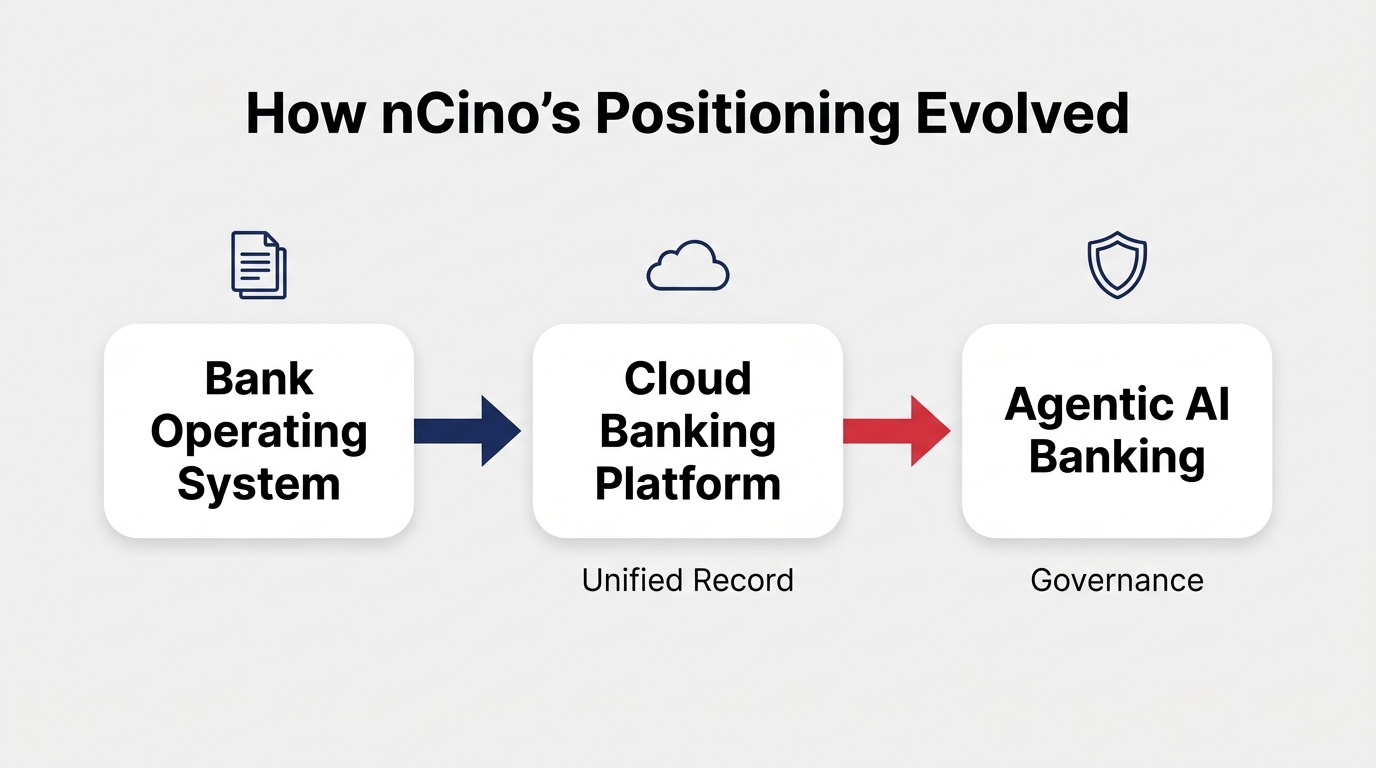
Let us start with the sentence that gets quoted everywhere. Salesforce nCino is a comprehensive, cloud-based banking platform designed to streamline all customer and employee interactions within a single system. It is built on the Salesforce platform. That means it inherits Salesforce's security model, data architecture, and ecosystem. But Salesforce nCino is not a Salesforce product. It is an independent solution crafted by bankers for bankers, and that distinction matters. Banks do not buy a generic CRM. They buy a banking-specific operating layer that understands loan origination, deposit onboarding, and treasury workflows out of the box.
The platform drives increased efficiency, transparency, profitability, and regulatory compliance across all lines of business, from commercial loan origination to digital account opening and treasury management. Those phrases are not marketing filler. They map to concrete capabilities. A commercial lender can originate a loan, collect documents, collaborate with credit analysts, and push the file through approval without leaving the system. A treasury management team can open a new account and attach it to the same customer record used by the lending side. That single view is the core value. This unified approach also supports smoother customer onboarding, reducing the time a new client waits before becoming fully operational.
For years, nCino was long known as the nCino Bank Operating System. That name still appears in analyst reports and old training decks. It is not wrong, but it is incomplete for 2026. Think of it as the platform's foundation. On top of that foundation, Salesforce nCino's public narrative now frames it as a purpose-built banking platform with an agentic AI governance layer—a shift from a system that records work to a system that can do some of the work under guardrails. That framing is central to how Salesforce nCino presents itself in 2026.
Customer count is another fact that needed correction. You might have seen the old figure of 1,750 customers from 2022. That number is stale. The current figure is more than 2,700 customers globally, as reported in August 2026. That scale gives the vendor enough data to harden its AI models against the edge cases that only show up in real bank workflows.
Now that we have a clear definition, let us look at the benefits that drew banks to the platform—and why those benefits deepen when the AI layer is added.
The Five Benefits That Made nCino a Banking Standard
Increased Efficiency
Manual workflows are the silent killer of bank profitability. Loan officers chase documents. Relationship managers re-enter data from one system to another. Operational staff copy and paste between spreadsheets. nCino eliminates most of that friction by putting every step of a process on one screen. When a borrower uploads a tax return, the credit analyst sees it instantly. When a loan moves from underwriting to closing, the next person in line has the full file without a handoff email. That is efficiency that shows up in time saved, not in a vendor's brochure.
Enhanced Transparency
In a siloed bank, no one has the same view of a customer. The relationship manager sees one balance. The credit team sees a different one. The compliance officer sees a third. Salesforce nCino creates a single system of record for customer and employee interactions. That means every stakeholder, from the front office to the back office, looks at the same data. When a regulator asks for a document, the bank does not need to assemble it from five systems. It is already in one place. Transparency reduces blind spots and lowers the chance of an embarrassing audit finding.
Improved Profitability
Efficiency and transparency feed profitability. Faster credit delivery means a bank can close more loans in the same calendar time without adding headcount. Lower operational costs come from fewer manual touches and less rework. Better risk assessments come from cleaner data and consistent processes. All of that flows to the bottom line. The platform synchronizes operations across the front, middle, and back-office, leading to faster credit delivery and improved risk assessments. That is not a future promise; it is the operating reality for banks that have already made the move.
Regulatory Compliance
Compliance is not a feature; it is a consequence of good architecture. nCino builds audit trails into every workflow. Every document upload, every approval click, every change to a risk rating is logged with a timestamp and user ID. When an examiner arrives, the bank can produce a complete, defensible record without staying up late the night before. That is why many banks, including the ones we will profile later, selected Salesforce nCino specifically for regulatory pressure.
Customer and Employee Satisfaction
Customers do not care about your internal systems until they fail. If a borrower must email the same document three times because no one can find it, satisfaction drops. If a banker must switch between five screens to answer a simple question, their job becomes a grind. Salesforce nCino reduces both types of friction. The platform improves account openings, shortens loan closing times, enhances operational efficiency, minimizes data entry chores, and helps to decrease delinquency rates. Those outcomes directly affect the people who matter most: the customer and the employee.
These benefits are real and well documented. But in 2026, the conversation has shifted. The next section explains the new layer on top of nCino—the AI stack that is changing what the platform can do.
Salesforce nCino and AI in 2026: Governing Three AIs at Once
Salesforce nCino did not bolt a chatbot onto the side of its platform. The company now positions itself as "the platform for agentic AI banking" — the emphasis being a governance layer with guardrails for deploying, managing, measuring, and governing AI, rather than a single assistant. Banks are already running three different types of AI at once, and each demands a different oversight framework. In nCino's AI in Banking Benchmark — a spring 2026 survey of 150 senior banking executives — banks reported running generative AI at 91%, predictive AI at 87%, and agentic AI at 81% adoption simultaneously. Those are not separate groups. The same institution often runs all three, sometimes in the same department.
Generative AI drafts documents and summarizes data. Predictive AI scores risk and forecasts defaults. Agentic AI takes actions, such as sending a follow-up email or updating a loan status. Generative AI needs accuracy checks to prevent hallucination. Predictive AI needs model validation and drift monitoring. Agentic AI needs approval controls and a complete audit log. The table below summarizes this.
| AI Type | Adoption Rate | Primary Use Case | Governance Focus |
|---|---|---|---|
| Generative AI | 91% | Drafting documents, summarizing data | Ensure factual accuracy, prevent hallucination |
| Predictive AI | 87% | Risk scoring, forecasting | Validate models, monitor drift |
| Agentic AI | 81% | Automated actions, process execution | Define approval controls, audit all actions |
That adoption reality is why the old “what is nCino” answer fails. 84% of US banks have adopted enterprise-level AI, so the pilot phase is over. You are not deciding whether to use AI; you are deciding how to govern what you already have. On the workforce side, 89% of banking executives expect staff to work alongside AI agents within five years, while 55% already invest in reskilling. The dual workforce of humans and AI agents is not a future scenario. It is next quarter's operating model.
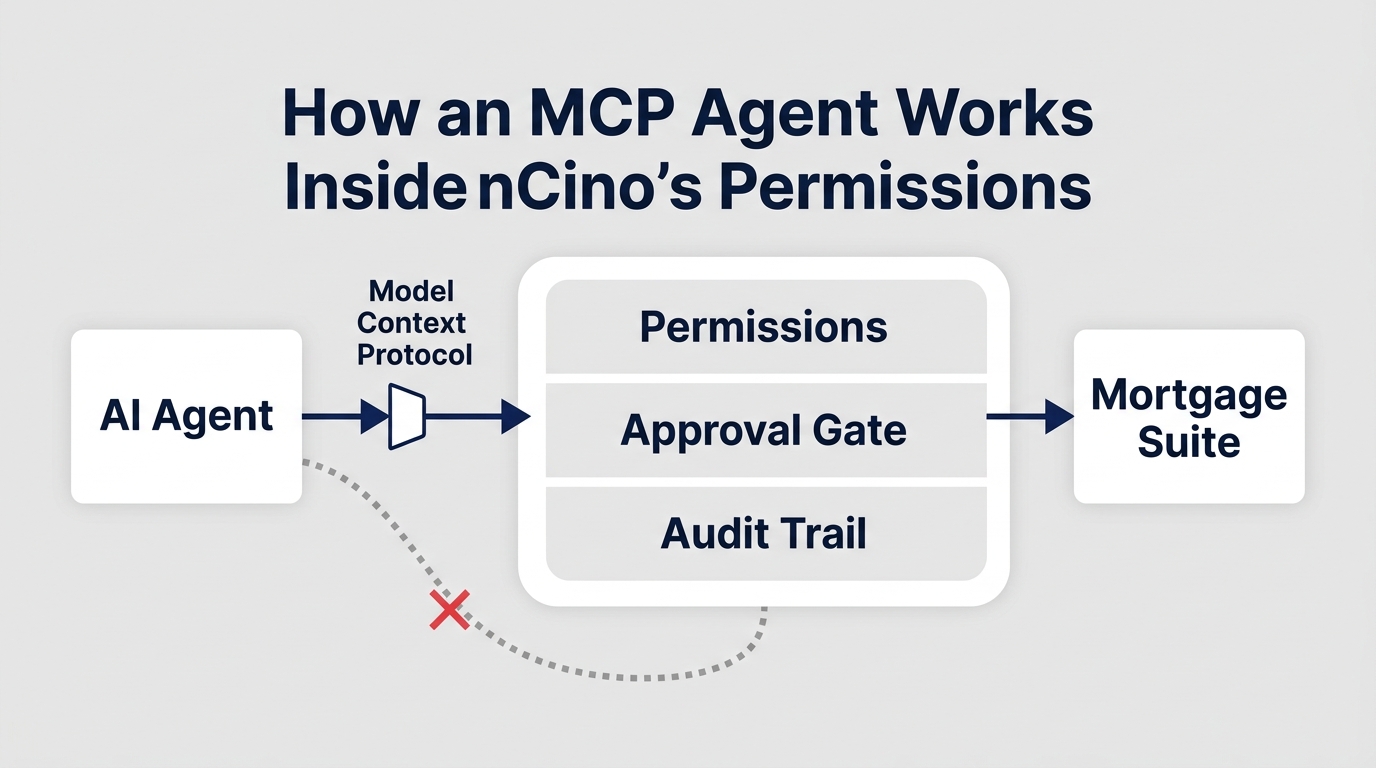
When it comes to nCino Salesforce integration, the clearest agentic move is Mortgage MCP, released in August 2026 for the nCino Mortgage Suite. It implements the Model Context Protocol — an open standard for connecting AI agents to external systems — so lenders can plug MCP-compatible agents directly into the mortgage platform. nCino ships two pre-built tools alongside it: Admin MCP and Loan Officer MCP.
The design choice underneath is the part worth copying. Agents act inside the platform's existing compliance and permission framework rather than beside it. The agent gets no private path to your data; it inherits the permissions, approval gates, and audit trail the platform already enforces. Whatever you deploy, that is the bar to hold: an agent should be no more privileged than the person whose work it is doing.
How nCino Integrates with Salesforce: Four Integration Benefits
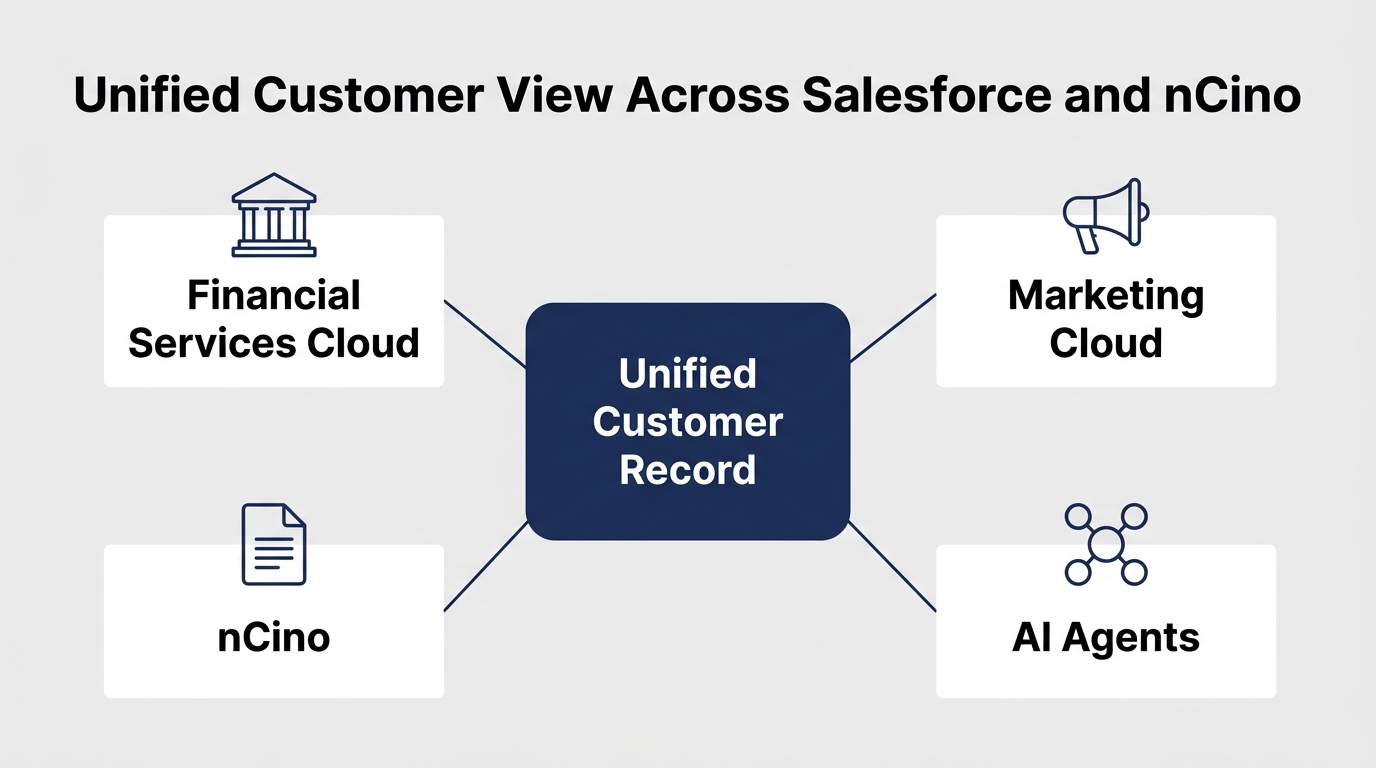
Salesforce nCino is built on the Salesforce platform, so integration with Salesforce products is native rather than bolted on. Salesforce Financial Services Cloud provides the customer relationship management layer for wealth management, insurance, and retail banking. Salesforce Marketing Cloud handles campaign execution. Salesforce nCino provides the banking operations layer. Together, they offer four clear integration benefits.
Unified Customer View
Financial Services Cloud and Salesforce nCino share one customer record. When a relationship manager updates a phone number in Financial Services Cloud, the change appears in Salesforce nCino immediately. When a loan officer files a new loan application in Salesforce nCino, Financial Services Cloud shows that activity in the customer timeline. This unified view eliminates the “left hand does not know what the right hand is doing” problem. The 2026 AI layer—including the MCP integrations—is designed to operate on this same unified record, enabling context-aware responses. Without it, AI agents would be making decisions on partial data.
Enhanced Marketing Capabilities
Marketing Cloud can pull data from the unified record to run targeted campaigns. For example, a bank can send a personalized home equity line of credit offer to customers who just opened a checking account in Salesforce nCino and have not applied for a mortgage. The campaign is not based on a third-party list; it is based on the bank's own real-time customer data. This is the kind of targeting that used to require a data warehouse and a team of analysts. With the integration, it can be a drag-and-drop marketing flow.
Improved Operational Efficiency
Data duplication is a tax on every department. When customer information lives in separate silos, someone must reconcile the records. Sales says one thing, operations says another, and the customer hears a third. The Salesforce nCino integration removes those silos. A single update propagates everywhere. Manual reconciliation drops, and the operations team stops being the cleanup crew for bad data. This efficiency also accelerates digital account opening, since new accounts created in Salesforce nCino instantly appear across the ecosystem.
Increased Customer Satisfaction and Loyalty
A seamless experience across sales, service, and lending builds trust. A customer who opened a deposit account online should not have to repeat their life story when they call about a loan. With the unified record, the service agent already knows who the customer is, what they have, and what they need. The loan officer has the same view. The result is faster service, fewer repetitive questions, and a customer who feels known rather than processed.
These integration benefits are real, but they are best illustrated by banks that have already deployed Salesforce nCino. The next section highlights six institutions and the outcomes they achieved.
If the governance questions above are the ones holding up your own rollout, that is the work our AI agent development services exist to de-risk.
What nCino Looks Like in Practice
Vendor case studies are a starting point, not proof. nCino publishes customer stories covering regulatory compliance, relationship visibility, paperless lending and processing efficiency — useful for understanding what the platform is used for, but vendor-reported and not independently audited. Read them as direction, not as benchmarks you should expect to reproduce.
An illustrative commercial lending workflow
Here is the shape of the problem, using a composite example rather than a named bank. Consider a mid-size commercial lender running roughly 400 loan applications a month. An application arrives; a relationship manager rekeys it into a spreadsheet; credit requests documents by email; underwriting waits; nobody can answer "where is this file?" without asking three people. The delay is not analytical — the credit decision itself takes hours. The delay is coordination.
A platform like nCino attacks that specific gap: one record every function works from, defined handoffs instead of email, and an audit trail that exists as a by-product of the work rather than as a reporting exercise. Whether that is worth the implementation cost depends entirely on how much of your cycle time is coordination versus analysis — which is worth measuring before you buy anything.
Related work we have delivered
We are a Salesforce and AI implementation partner rather than a reseller of any one banking platform, so the closest parallels from our own delivery are in adjacent financial-services workflows. Both examples below are anonymised at the client's request, and the figures are our own measured results:
- Insurance claims automation. For a leading insurance provider we automated claim validation, fraud detection and customer communication, cutting approval times by 62% and fraudulent payouts by 53%. The pattern is the same one nCino targets in lending: the bottleneck was handoffs, not judgement.
- Salesforce Einstein Analytics. For a client already running Sales Cloud, we implemented and customised Einstein Analytics so sales and marketing could act on predictions rather than retrospective reports — the same unified-record principle nCino relies on.
Should You Buy nCino? Role-Level Guidance for 2026
The decision to purchase Salesforce nCino is not made by one person. It involves at least three roles, each with a different set of worries. Here is what each should look for, and what to ask before buying.
Commercial Lending Lead
Your primary goal is to close more loans faster without loosening credit standards. nCino's workflow automation is your friend. For nCino commercial lending, the platform synchronizes operations across the front, middle, and back-office, leading to faster credit delivery and improved risk assessments. That means you can move a loan from application to approval in fewer days, with fewer manual touches. Ask the vendor: how does Salesforce nCino handle our specific commercial loan products? Can the AI layer draft credit memos from existing data? What is the approval workflow for an agent-assisted decision? You want to see a demo that includes your actual loan products, not a generic small business loan.
Mortgage Operations Manager
Your pain points are loan closing times, data entry, and delinquency rates. nCino's Mortgage MCP and Loan Officer MCP address the first two directly. The platform improves account openings, shortens loan closing times, enhances operational efficiency, minimizes data entry chores, and helps to decrease delinquency rates. Ask for a demo of the Loan Officer MCP's logging feature. Every AI action should be timestamped and attributable. Ask how the AI handles exceptions, such as a borrower who submits an incomplete document. You want to see the fallback path, not just the happy path.
Bank CIO or Risk Officer
Your concern is governance. You are not buying a loan system; you are buying a system that will run AI agents inside your bank. That agentic-governance layer is what you need to scrutinize. Ask these questions: How does the AI layer handle data privacy? What governance controls exist for agent actions? How does it integrate with our existing model risk management policies? What audit reports are available out of the box? You should also consult the NIST AI Risk Management Framework as a reference for your own evaluation. The platform's configurable approval controls and full action logging are the minimum bar. If a vendor cannot show you an audit trail, walk away.
These role-level checks will keep your bank from buying a demo that works only in the vendor's sandbox. The final section wraps up the core message and points to a practical next step.
The Future of Banking: You Can't Govern What You Can't Define
Salesforce nCino has moved from a Bank Operating System to what its public narrative frames as a purpose-built banking platform with an agentic AI governance layer. That shift is not cosmetic. It changes how banks must think about the platform. You are no longer just configuring workflows. You are configuring AI guardrails.
The 2026 reality includes three types of AI running simultaneously—generative, predictive, and agentic—each demanding a different oversight framework. If you treat them all the same, one of them will eventually surprise you. Generative AI might produce a persuasive but wrong credit summary. Predictive AI might silently drift from its validation baseline. Agentic AI might take an action no one approved. Governance is not a checkbox. It is the operating discipline that keeps these systems safe.
The bank that wins with Salesforce nCino in 2026 will not be the one that buys the most AI. It will be the one that governs the three AIs it already runs—and keeps its definitions as current as its platform. If your bank is ready to evaluate or implement Salesforce nCino, the practical next step is to assess your current AI governance posture. Our team has helped banks navigate exactly these decisions through CRM and ERP transformation services. Let us talk.
Frequently Asked Questions
What is Salesforce nCino?
Salesforce nCino is a comprehensive, cloud-based banking platform designed to streamline all customer and employee interactions within a single system, built on the Salesforce platform. It is crafted by bankers for bankers and covers commercial loan origination, digital account opening, and treasury management.
Is nCino owned by Salesforce?
No. nCino is an independent, publicly traded company (NASDAQ: NCNO), not a Salesforce subsidiary and not a Salesforce product. It builds its banking platform on the Salesforce platform, which is why the two names appear together so often — but you buy nCino from nCino, and its roadmap, pricing and support are its own. Salesforce licensing is a separate line item you should confirm during procurement.
Is nCino built on Salesforce?
Yes. nCino is built on the Salesforce platform. That means it uses Salesforce's underlying data model, security, and extension framework. However, nCino is an independent solution, not a Salesforce product.
What does nCino do?
Salesforce nCino gives banks a unified system for lending, deposit account opening, and treasury management. It automates workflows, provides a single customer view, and creates audit trails for compliance. In 2026, its public narrative centres on governing AI agents inside the platform.
Is nCino a CRM?
No. nCino is not a traditional CRM. It is a banking platform that uses Salesforce as its foundation. It includes CRM-like features for relationship management, but its core strength is banking operations such as loan origination and regulatory workflows.
What is nCino's Bank Operating System?
The Bank Operating System is the long-standing name for nCino's platform. It described nCino's role as the single system that runs a bank's daily operations. In 2026, Salesforce nCino frames itself as a purpose-built banking platform with an agentic-AI governance layer on top of that foundation.
Does nCino use AI?
Yes. Salesforce nCino's 2026 stack includes Mortgage MCP for the Mortgage Suite, with Admin MCP and Loan Officer MCP as pre-built agent tools. It supports generative, predictive, and agentic AI, each with its own governance controls. Banks running Salesforce nCino must manage all three types simultaneously.
If your institution is considering Salesforce nCino or needs help with the broader Salesforce ecosystem, our CRM and ERP transformation services can provide the strategic and technical guidance you need. Reach out to discuss your CRM and ERP transformation needs.
If you are mapping this against the wider picture, we have written on reimagining financial services with Salesforce, on chatbots in banking, and on our insurance and finance industry solutions.

Loading...