
The Hotel AI Layer: Why the Future of Hospitality Is Coordination, Not Replacement
The hotel AI layer is the missing conductor when a returning guest arrives and every department knows something important, but no one sees enough context soon enough to act.
That is the real story behind hotel technology today. The front desk can see VIP status in the property management system. Marketing knows past preferences in the CRM. Guest messaging holds the late-arrival note. Housekeeping knows whether the room is ready. Yet the guest still experiences four separate conversations instead of one coordinated stay.
This article is about what changes when hotels stop treating those systems as isolated tools and start treating the hotel AI layer as a coordination layer. I’ll show why hotel silos persist, what the hotel AI layer actually does, how PMS CRM integration AI works in practice, and how hotels can modernize without pretending every platform behaves the same way.
The thesis is simple. A hotel AI layer should not replace PMS, CRM, booking, loyalty, or guest messaging systems. It should connect them, interpret their signals, and help teams act on the right guest context at the right time.
Why hotel systems still create data silos
Hotels usually do not run short on software. They run short on coordination. A property management system is built to manage reservations, room inventory, folios, and core stay operations. A CRM is built to manage profiles, segmentation, campaigns, and relationship history. A booking engine captures intent. Loyalty tools track recognition and benefits. A guest messaging system manages live communication. Each tool is useful, but each one is optimized for its own lane rather than the full guest journey.
That separation is not accidental. Hospitality platforms cover multiple operational domains, and product behavior varies by module, deployment model, and implementation detail across broader hospitality technology solutions and product-level hospitality documentation. Cross-vendor exchange also depends on message structures and interoperability patterns described in OpenTravel resources. In practice, connected PMS CRM guest systems are not created by default just because the hotel owns the software.
The operational impact shows up in small moments that guests notice immediately. A late-arrival update reaches the front desk, but not housekeeping. A loyalty guest is marked as important in the CRM, but the live stay team does not see the same context in time. A service request is logged, but the staff member responding cannot tell whether the guest is already in the room, still en route, or speaking with another team.
This is where the hospitality technology stack starts behaving like a building with separate phone lines and separate logbooks. Information exists, but no one is conducting the property. And when teams try to patch that gap with manual checklists, copied notes, or ad hoc messages, the process becomes slower precisely when the guest expects it to feel seamless.
There is also a governance reason to solve this carefully. The point of AI for PMS and CRM is not blind automation. The AI risk management guidance from NIST emphasizes governance, measurement, and human oversight, which matters in hospitality because guest communication, service recovery, and loyalty recognition often require traceability and clear accountability.
What a hotel AI layer does
In simple terms, a hotel AI layer is not another system of record wearing an AI badge. It is a coordination layer that reads signals from hotel system integration points, assembles context, recommends or triggers the next action, and records what happened.
That distinction matters because the layer should sit above the PMS, CRM, booking, loyalty, messaging, and service tools already in place. It does not replace them. It connects them, interprets data across them, and decides what should happen next based on rules, context, and approved automation paths.
Hospitality does not have a data shortage. It has a coordination gap—and the hotel AI layer is how hotels close it.
A practical architecture hotels can actually use
A practical hotel AI layer architecture usually has five parts. First, the systems of record hold authoritative data such as reservations, guest profiles, room status, loyalty tiers, or service tickets. Second, a data and context layer normalizes that information into a usable operational event stream. Third, the AI orchestration layer evaluates patterns, priorities, and next best actions. Fourth, workflow actions send tasks, updates, or recommendations to the right system or team. Fifth, human escalation keeps exceptions and sensitive decisions with people.
This layered approach is consistent with enterprise adoption thinking that treats AI as architecture and operating model design, not just model deployment, in cloud AI adoption guidance. It also fits cloud implementation thinking for travel and hospitality workloads described in hospitality cloud architecture guidance. Where multiple vendors are involved, normalized message and profile structures also matter, which is why OpenTravel resources are relevant when designing cross-system coordination.
| Layer | Role | Example hotel data | What AI does | Human responsibility |
|---|---|---|---|---|
| Systems of record | Store authoritative transaction data | Reservation, folio, room status, loyalty tier, service case | Reads trusted inputs from source systems | Maintain data quality and ownership |
| Data/context layer | Unify and normalize signals | Guest identity, stay timeline, channel activity, preference history | Creates a usable operational view and event context | Define mapping, identity rules, and access controls |
| AI orchestration layer | Evaluate next best action | VIP arrival, late check-in, maintenance issue, room readiness | Prioritizes, recommends, routes, or triggers workflows | Set policies, thresholds, and escalation logic |
| Workflow actions | Execute approved tasks and communications | Housekeeping task, front-desk alert, guest message, case update | Sends actions to the right team or system | Approve templates, exceptions, and service rules |
| Human escalation | Handle edge cases and sensitive situations | Service recovery, billing dispute, special accommodation | Flags uncertainty or risk for review | Make final decisions where judgment matters |
The value of the hotel AI layer is not that it makes every decision automatically. The value is that it turns guest profile unification and real-time data sync into useful action while keeping humans in control where judgment matters.
How PMS, CRM, and guest systems work together
When people talk about PMS CRM integration AI, they often imagine a direct connector between two systems. In reality, hotel AI integration works better when you think in event flows, not simple data pipes.
The PMS remains the operational system of record for the stay. The CRM remains the relationship memory. Booking engines act as demand entry points. Loyalty systems capture recognition and benefits. Guest messaging platforms become the live communication channel. Service and operations tools capture delivery status. A successful hotel AI layer often begins with Integration and Migration work that maps each source system before orchestration starts.
A practical sequence looks like this: ingest, normalize, enrich, decide, trigger, and log. A reservation event enters from the booking engine. Identity logic matches it to an existing profile. The context layer enriches it with loyalty status, prior preferences, and current operational constraints. The hotel AI layer evaluates what matters right now. Then the workflow engine updates the right teams and systems, and the action is logged for visibility.
This is also why hotel system automation should not start with copying every field everywhere. It should start with deciding which events matter, which systems own the truth, and which actions need to happen in real time. In practice, teams often need to work through source-system mapping, event design, identity resolution, API integration patterns, and workflow rules before the hotel AI layer can be designed well. If guest identity is fragmented across brand, property, and partner platforms, the foundation often needs stronger CRM ERP alignment before a hotel AI layer can make trustworthy recommendations.
The vendor reality matters here. Hospitality platforms cover broad solution areas, but implementation patterns differ across products and deployments in the broader hospitality technology solutions and detailed hospitality documentation. And where travel data must move across multiple systems, OpenTravel resources help explain why consistent message structures are so important.
A concrete example makes the point clearer. A guest books through the hotel website, updates a preference in the CRM, sends a late-arrival note through messaging, and later requests extra pillows after mobile check-in. Without a hotel AI layer, those become separate records in separate systems. With a hotel AI layer, they become one coordinated operational story.
Turning a guest profile into action
A guest profile is often described as if it were just a better screen. That is too small a definition. In practice, it should be a living operational profile built from stay history, preference history, live stay data, room and housekeeping status, service interactions, channel activity, and current requests.
But visibility alone is not enough. A dashboard can still leave staff doing manual detective work. The real gain comes when the hotel AI layer turns that operational profile into intelligent workflows: prioritizing tasks, recommending next actions, routing requests, and escalating only the exceptions that truly need a person.
Consider a returning guest arriving for a two-night stay. The CRM shows that the guest prefers a quiet room and has previously requested early check-in. The PMS shows today’s reservation, current arrival window, and room assignment. Housekeeping status shows that the originally assigned room is not yet ready, while another suitable room is close to completion. The guest messaging system contains a live note that the guest will arrive earlier than planned.
In a disconnected environment, each team sees a fragment. In a connected one, the hotel AI layer reads the returning guest profile, live stay data, housekeeping status, and guest messaging signals as one operational event. It then marks room preparation as a priority, routes an updated task to housekeeping, alerts the front desk to hold assignment until the ready room clears, and sends the guest a proactive message with the revised readiness update.
That is not magic. It is workflow orchestration. And if the new room cannot be prepared in time, the human escalation path matters: a manager or front desk lead steps in to decide on an upgrade, offer, or service recovery option.
The same model applies to other workflows. A guest reports a Wi-Fi issue through messaging. The hotel AI layer checks whether the guest is currently in-room, whether a known outage already exists, and whether the request matches a recurring case pattern. It can open the right task, update the guest with an approved status message, and escalate only if the issue becomes an exception.
This is where responsible design matters. The AI governance and risk guidance supports traceability and oversight, while AI adoption planning guidance reinforces that enterprises need operating models around AI, not just isolated tools. In hospitality, that means the hotel AI layer should automate routine coordination but keep sensitive guest decisions in human hands.
Governance and change management for a hotel AI layer
The technical stack is only half the work. The other half is operational discipline.
A hotel AI layer touches real staff workflows, so governance has to be explicit. The team needs clarity on who can approve automations, who can override them, what gets logged, and which guest actions must always be reviewed by a person. Access control matters because different teams need different levels of visibility. Auditability matters because guest-facing actions should be explainable after the fact. And adoption matters because the best workflow still fails if staff do not trust it.
A simple checklist helps:
- Define which data sources are authoritative.
- Limit who can change workflow rules.
- Log every automated action and escalation.
- Review exception handling regularly.
- Train front-line teams on what the AI layer will and will not do.
- Start with one property or one workflow before expanding.
That is not bureaucracy. It is how the hotel AI layer stays useful after the pilot phase.
A practical roadmap for hotel AI integration
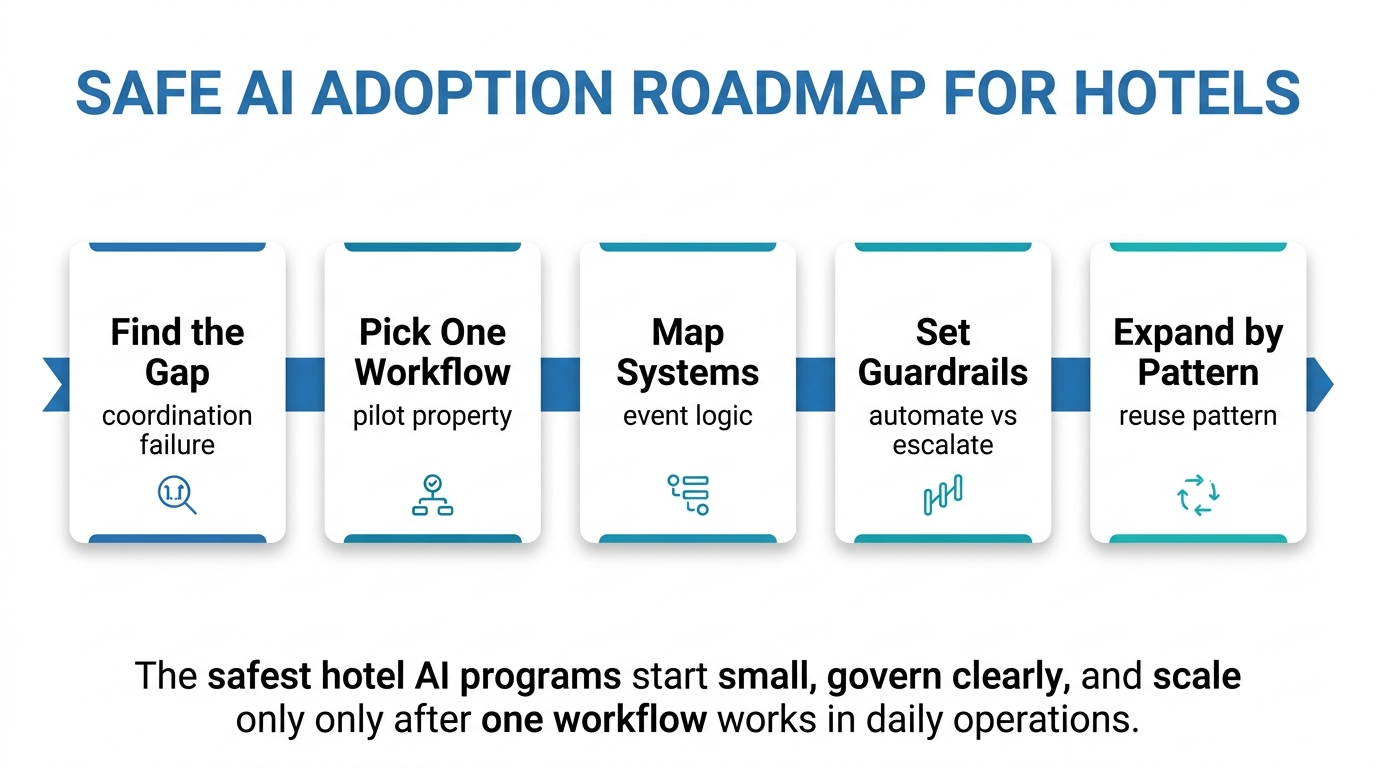
The fastest way to stall hotel technology modernization is to treat AI like a rip-and-replace project. A better path is staged, operational, and specific.
Start with the moments where coordination fails. Arrival readiness, service request routing, loyalty recognition, housekeeping prioritization, and case escalation are all good places to look. The goal is not to find every possible use case. It is to find where data already exists but does not become action in time.
Then pick one workflow, not ten. A practical starting point can be a single property and a single workflow, such as pre-arrival recognition or late check-out orchestration. This keeps the first hotel AI layer small enough to govern and useful enough to prove value through daily operations rather than slideware.
In practice, design work usually comes before model choice. The team needs to understand the system landscape, the event logic, and the decision points before selecting tools. That is where AI consulting services help leadership teams separate business need from tool noise. Enterprise guidance on AI transformation planning and travel and hospitality modernization supports this sequence because architecture, governance, and operating model shape whether AI can actually be used reliably.
Decide what should be automated, recommended, or escalated. Not every action needs the same level of autonomy. Some tasks are straightforward: route a housekeeping priority, send an approved guest update, or flag a likely duplicate request. Other tasks need judgment: service recovery, billing disputes, accessibility accommodations, or VIP exceptions. The implementation documentation reality across hospitality platforms is one more reason to define escalation rules early rather than assuming uniform behavior across systems.
Choose build patterns that fit the workflow. Some hotel AI integration use cases can work with rules and existing platform automation. Others need property-specific context, multi-system reasoning, or brand-specific decision logic. That is where custom AI systems can be the safer path than generic tools. And when the workflow includes guest-facing communication, generative AI solutions can help draft responses or summaries, but only within approved operational and brand guardrails.
Expand only after the operating model works. Once the workflow works at one property or for one use case, expand by pattern. Keep the PMS, CRM, booking, and messaging systems as systems of record. Add the hotel AI layer where coordination is needed most. That is how a hospitality AI platform becomes sustainable: not by replacing everything, but by making existing systems work together with clearer accountability.
FAQ
Why do hotel PMS and CRM systems need AI?
Hotel PMS and CRM systems need AI because they are built for different jobs. The PMS manages the live stay, while the CRM manages relationship context, and neither one automatically orchestrates cross-team action. A hotel AI layer helps connect those signals so staff can act on one shared view instead of switching between separate systems.
How can AI connect hotel systems?
AI connects hotel systems by sitting above them as a context and orchestration layer. It reads events from source systems, normalizes guest and operational data, evaluates the next best action, and triggers approved workflows across teams and platforms. Integration details vary by platform, which is why product-specific ecosystems and documentation matter in hospitality technology solutions and hospitality documentation.
What is an AI layer for hospitality technology?
An AI layer for hospitality technology is a layer that sits above PMS, CRM, booking, loyalty, messaging, and service tools without replacing them. It combines guest profile unification, workflow orchestration, and decision support so hotel teams can move from disconnected records to coordinated action. In practice, a hotel AI layer makes the connected PMS CRM guest systems usable, not just connected on paper.
How can hotels use AI with PMS and CRM data?
Hotels can use AI with PMS and CRM data to support guest recognition, arrival readiness, service routing, personalization, task prioritization, and exception handling across departments. In practice, the hotel AI layer should improve the single guest view while keeping humans in control of sensitive decisions.
Why are disconnected hotel systems a problem?
Because guests experience one journey while hotel data often lives in separate tools. That creates delays, inconsistent service, and missed opportunities to respond with the right action at the right time. A hotel AI layer reduces that coordination gap by making shared context available when it matters.
The hotel AI layer is a coordination strategy, not a replacement strategy
The real problem is not that hotels lack a PMS, a CRM, or another specialized platform. The real problem is that valuable guest and operational data stays trapped inside separate workflows. A hotel AI layer changes that by connecting systems of record, building live context, and turning signals into actions that teams can actually use.
That is why the best hotel technology modernization programs usually start with orchestration, not rip-and-replace. The goal is not to make the stack look futuristic. The goal is to make the guest experience feel coherent and make operations feel accountable.
When the same returning guest arrives again, the difference is visible. The front desk sees the right profile, housekeeping sees the right priority, guest messaging reflects the live situation, and managers step in only when judgment is needed. The hotel does not become more automated for its own sake. It becomes more coordinated, which is what the guest actually experiences.
If your hotel systems collect data but do not create action, Webuters can help you assess your PMS, CRM, and guest messaging stack and design a phased hotel AI layer roadmap that connects operations, guest experience, and decision-making. Two proven applications of that layer are turning reviews into a reputation flywheel and forecasting F&B and energy margins.

Loading...