
AI Customer Service Statistics 2025/2026: The Data That Matters for CX Leaders
AI customer service promises efficiency, but real data is what cuts through vendor hype. You’re in a conference room, staring at a vendor’s slide deck. The numbers flash by: “80% cost reduction,” “99% customer satisfaction.” You’ve heard these claims before, and something doesn’t add up. You need real data—not sales pitches—to build a business case for AI in your support operation. That’s the tension every CX leader faces. The promise of AI customer service is enormous, but the statistics can feel like a maze of inflated benchmarks and cherry-picked results.
This article is your compass. We’ve dug into verified sources—Zendesk, IBM, Salesforce, Plivo—to surface what the data actually says about AI adoption, ticket deflection, cost savings, and customer satisfaction in 2025 and beyond. Our thesis is clear: current AI customer service statistics show strong adoption and significant ROI, but only if you separate vendor anecdotes from independent research. By the end, you’ll have a framework to evaluate any AI claim and pinpoint where AI customer service can deliver real value. We’ll cover adoption benchmarks, deflection and ROI numbers, satisfaction effects, the shift toward agentic AI, and—most importantly—how to interpret the data honestly.
Adoption Hits Critical Mass: Over 70% of Organizations Now Use AI
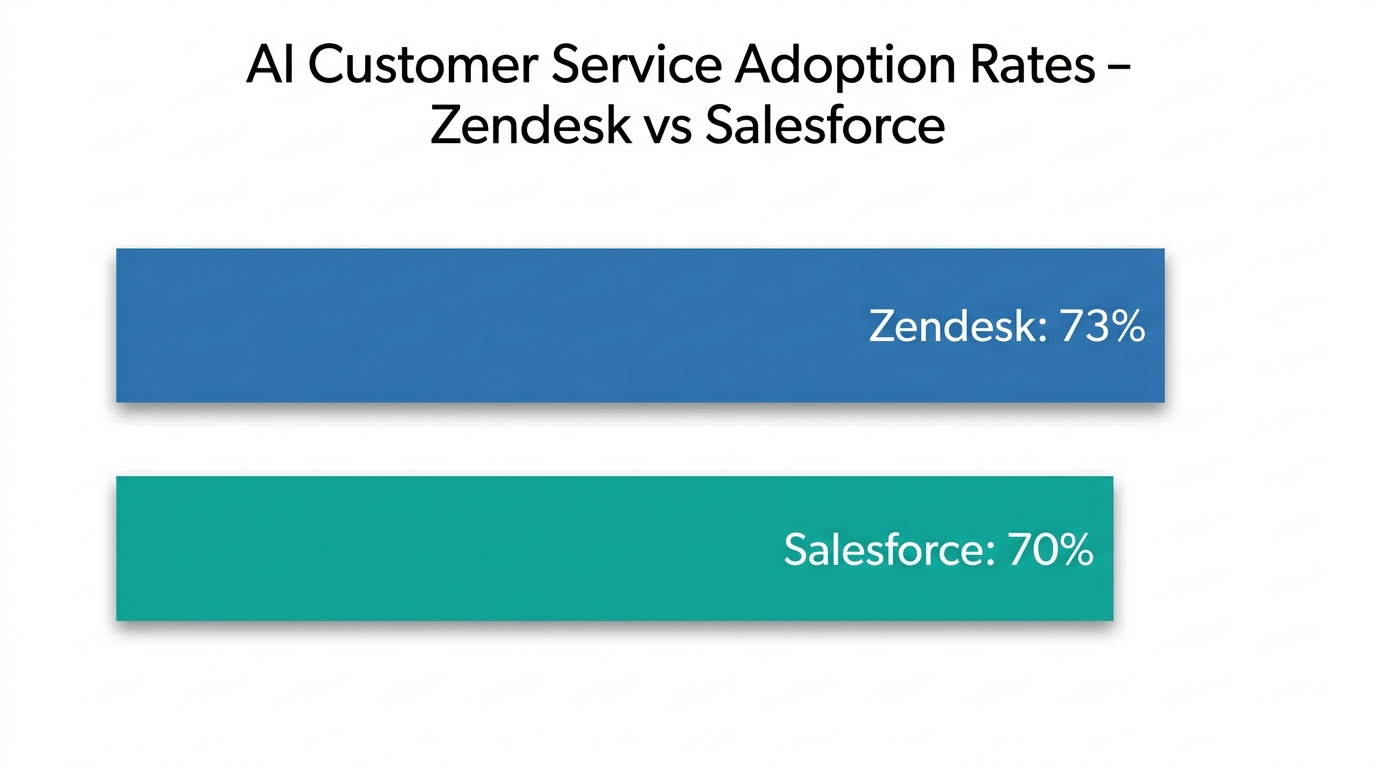
According to Zendesk’s latest report, 73% of CX leaders say AI is already integral to their strategy. Meanwhile, Salesforce data shows 70% of service organizations are actively using or piloting AI. This widespread customer service AI adoption isn’t a futuristic projection; it reflects where the market stands today. The implication is unambiguous: if AI isn’t part of your support strategy, you’re already behind the curve. But adoption alone doesn’t guarantee success. Many companies deploy basic chatbots only to find that customers still flood the phone lines. We’re past the tipping point where AI is a “nice to have”; it’s the baseline for competitive support ops. That’s why the next critical number is ticket deflection. The question isn’t whether to adopt AI customer service, but how to implement it in a way that actually moves the needle on ticket volume. For many organizations, a solid AI customer service implementation starts with a focused use case.
Ticket Deflection Rates: The Real Numbers Behind 30–50% Automation
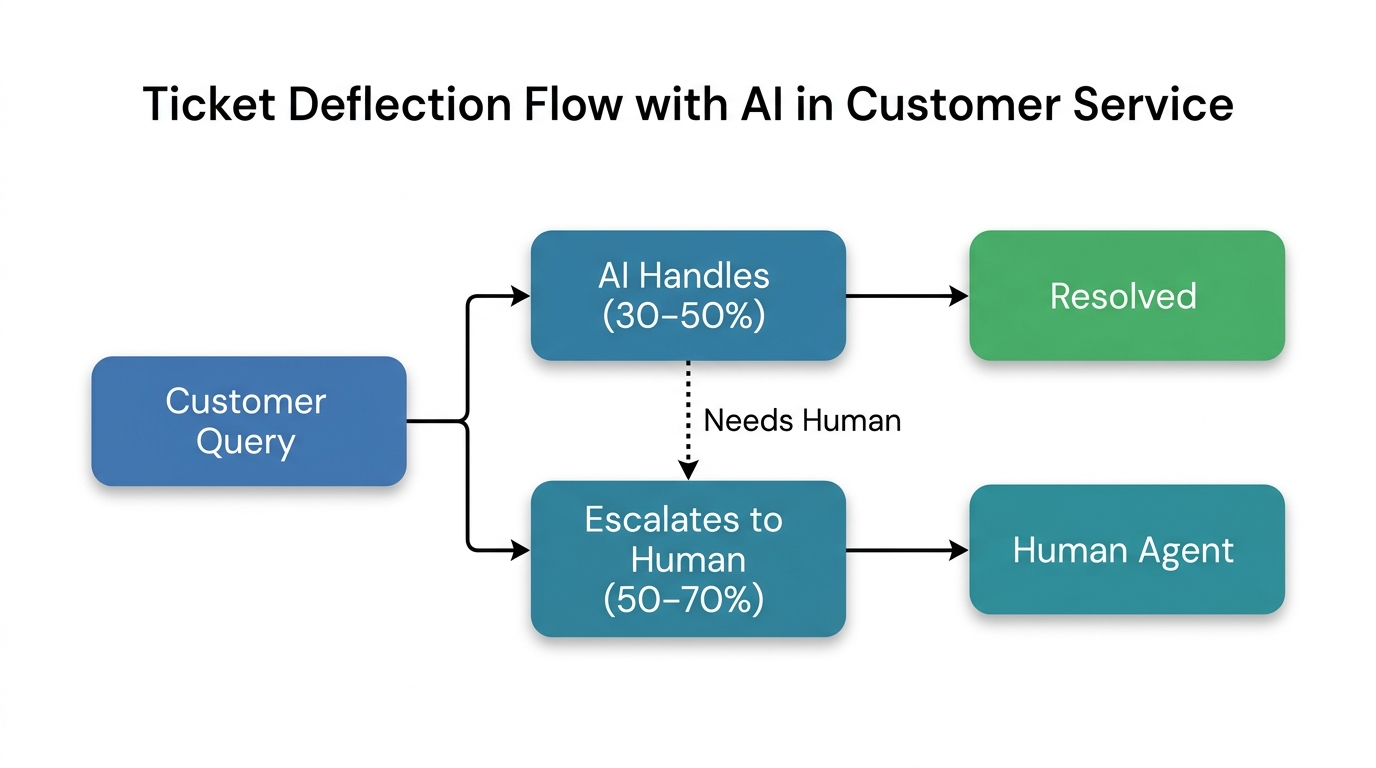
Plivo’s industry survey shows that companies using AI chatbots report a 30–50% reduction in support ticket volume. IBM’s research corroborates this range, noting that AI can automate up to 80% of routine inquiries but only 20–30% of complex issues. That makes the ticket deflection rate a key metric to track. Here’s the nuance: simple queries—password resets, order status, store hours—deflect easily. Anything that requires investigation, empathy, or multi-step logic still needs a human. That’s why a realistic deflection target isn’t 100%; it’s about handling what AI handles well and routing everything else smoothly. In practice, a well-designed AI customer service system resolves 70–80% of first-contact issues that fall within its knowledge domain, according to Salesforce’s aggregated customer data. But that number drops sharply when you step outside predefined scripts. To maximize deflection, you need to design an AI customer service system that can handle the most common queries autonomously.
Deflection is the tip of the iceberg. The real business case lives in cost savings and ROI. Next, we translate deflection percentages into dollar impact.
Cost Savings and ROI Benchmarks: From Deflection to Dollars
Zendesk reports that companies using AI see an average 25% reduction in cost per contact. Plivo’s data aligns, showing a 20–40% range across implementations. Meanwhile, IBM’s analysis indicates that AI can reduce average handle time by 40–50%, directly shrinking operational costs. The financial picture is compelling: for a support team handling 10,000 tickets a month at $5 per human interaction, a 30% shift to AI deflects 3,000 tickets—saving $15,000 monthly. Implementation cost varies. IBM notes that initial deployment for a mid-sized enterprise typically falls between $30,000 and $100,000, with ongoing maintenance at 15–30% of that annually. Most organizations achieve positive ROI within 6–12 months, with full payback in 12–18 months. These chatbot ROI metrics assume a focused use case. A scattershot approach—deploying AI everywhere without integration—can stretch timelines or even erode value. That’s why it’s critical to identify the right AI use case before you write a check. The difference between a 6-month and 18-month ROI is often just the clarity of your starting point. Support cost reduction is real, but it demands discipline. For a deeper understanding of how AI customer service directly impacts your bottom line, our AI consulting services can help you model the numbers.
Customer Satisfaction: Does AI Help or Hurt the Experience?
It’s the million-dollar question. Zendesk found that companies using AI maintain CSAT scores comparable to human-only support, provided the AI is transparent—customers know they’re interacting with a bot and the bot is helpful. Salesforce adds that 62% of customers say AI actually improves their service experience. A key metric in AI customer service is first response time, which sees a dramatic leap: AI responds in under one second on average, versus minutes for a human agent. That’s a clear first response time improvement. But there’s a catch. When AI fails—misunderstands intent, loops endlessly, or can’t escalate—CSAT plummets. A well-designed human handoff is non-negotiable. In fact, 68% of customers are willing to use AI if it resolves issues quickly. The takeaway: well-executed AI customer service doesn’t inherently harm satisfaction; poorly implemented AI does. The CSAT impact depends on execution. And that’s where expert guidance, such as AI consulting services, can preempt the pitfalls. A thoughtful AI customer service strategy balances automation with empathy.
The Agentic AI Shift: Moving from Deflection to Resolution
Up to now, most AI customer service has been reactive—answering FAQs, collecting data, and handing off to humans. But the next wave is agentic AI: systems that resolve multi-step issues autonomously, with human approval when needed. This concept of AI agents with human approval is gaining traction. IBM projects that by 2026, agentic customer service could reduce escalation rates by an additional 20%. Salesforce reports that 80% of service organizations plan to deploy AI agents for complex tasks within two years. What does this mean for your roadmap? Today’s chatbots handle maybe 30% of tickets. Agentic AI—capable of processing returns, troubleshooting account issues, or even negotiating billing adjustments—could expand that to 60–70%. The human agent’s role shifts from doing the work to supervising AI and handling emotional or highly novel cases. If you’re exploring custom AI agent development services, now is the time to architect for this transition, not after the fact. The future of AI customer service is increasingly autonomous, but the foundation you build today matters.
How to Read These Statistics: Separating Vendor Hype from Independent Truth
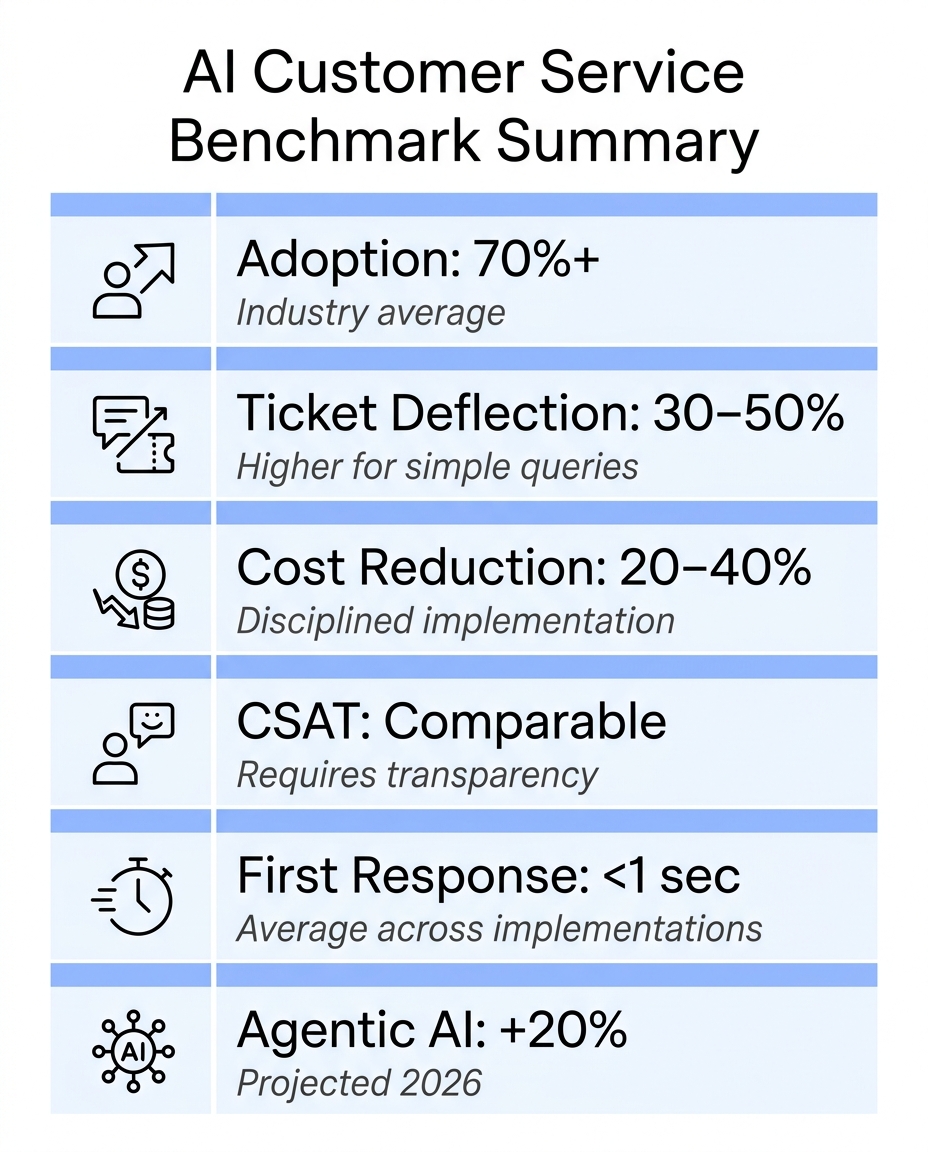
This is the section that could save you a six-figure mistake. Many AI customer service statistics in this space come from vendors who ran a narrow, optimized pilot and then generalized the results. For instance, an “80% deflection” claim might stem from a single use case in a controlled environment. In our experience analyzing the data, independent surveys—like Plivo’s cross-industry study or IBM’s broader research—tend to land in the 30–50% deflection range, which is a more realistic baseline for a fresh implementation. When you evaluate AI customer service statistics, ask: What was the sample size? Was it a self-selected group of customer-success stories? How long was the measurement window? As a rule of thumb, treat vendor-reported numbers as the upper bound of what’s possible under ideal conditions. Treat independent studies as your realistic baseline. Then run your own pilot—because your customers, agents, and systems are unique. The table below summarizes the key benchmarks, with sources and realistic notes to ground your expectations.
| Statistic | Value | Source | Notes |
|---|---|---|---|
| Adoption rate | 70%+ using or exploring AI | Zendesk, Salesforce | Cross-industry average |
| Ticket deflection | 30–50% | Plivo, IBM | Higher for simple queries, lower for complex |
| Cost per contact reduction | 20–40% | Zendesk, Plivo | Varies by automation level |
| CSAT with AI | Comparable to human-only | Zendesk | Requires transparency |
| First response time improvement | < 1 second vs. minutes | Salesforce | Averages across implementations |
| Agentic AI escalation reduction | 20% additional deflections | IBM | Projected for 2026 |
The Next Step: From Statistics to Strategy
You now have a clear, sourced picture of where AI customer service stands in 2025. Adoption is mainstream. Deflection rates of 30–50% are realistic based on independent surveys. Cost savings of 20–40% are achievable with disciplined implementation. Customer satisfaction can hold steady or even improve if you prioritize transparency and smooth handoffs. And the shift toward agentic AI means the scope of automation will only grow. But the most powerful statistic is the one you’ll generate from your own pilot. That’s where the conversation moves from “what if” to “what now.” If you’re ready to turn these benchmarks into a tailored plan—whether it’s a use case audit, a proof of concept, or a full-scale implementation—our team at Webuters is built for exactly that. A successful AI customer service strategy requires the right partners and a clear roadmap. Start by exploring how we help you identify the right AI use case, or reach out for a no-strings-attached discussion about the numbers that matter most to your operation.
Frequently Asked Questions
What is the average ticket deflection rate for AI in customer service?
Independent studies and surveys show that AI chatbots can deflect 30–50% of support tickets on average. Simple, repetitive queries (e.g., password resets, order status) see higher deflection, while complex issues still require human handling. The ticket deflection rate is a key benchmark for AI customer service.
How long does it take to see ROI from AI customer service?
Most organizations achieve positive ROI within 6–12 months, with full payback in 12–18 months. The exact implementation timeline depends on use case clarity, integration complexity, and the maturity of your AI implementation.
Does AI improve or hurt customer satisfaction?
When implemented transparently—customers know they are talking to a bot and it resolves issues quickly—AI maintains CSAT scores comparable to human-only support. Failures like misunderstanding intent or inability to hand off can lower satisfaction dramatically. The CSAT impact is positive when AI is done right.
What is agentic AI in customer service?
Agentic AI refers to artificial intelligence systems that can autonomously resolve multi-step, complex issues (returns, billing disputes) with human oversight or approval. It moves beyond simple FAQ deflection to handling end-to-end tasks.
How reliable are vendor-reported AI customer service statistics?
Vendor-reported statistics often come from controlled pilots or self-selected success stories, so they tend to be more optimistic. Independent surveys—such as those from Plivo and IBM—often show more conservative results, providing a realistic baseline for your planning.
If you’d like to turn these benchmarks into a tailored plan—whether it’s a use case audit, a proof of concept, or a full-scale implementation—our team at Webuters can help. Start by exploring how we help you identify the right AI use case, or reach out for a no-strings-attached discussion about the numbers that matter most to your operation.

Loading...