
From Reactive Rates to Predictive Pricing: How AI Is Rewriting Hotel Revenue Management
Hotel dynamic pricing is the new standard for revenue optimization, moving hotels away from reactive rate setting toward predictive, AI-driven strategies. Imagine a revenue manager on a Monday morning. Her coffee has gone cold. On the dashboard, she watches a competitor slash weekend rates. Her own rates were fixed last Thursday locked behind approval chains. By the time she gets authority to adjust, the competitor has already captured the bookings. This isn’t a hypothetical; it’s the daily reality for thousands of hotels still relying on manual, reactive pricing. And that slow response isn’t just inconvenient…it costs real money, every single week.
The conventional hotel dynamic pricing playbook is built on looking backward. Rate rules are set based on historical occupancy, perhaps with a glance at what competitors charged last week. But travel demand is more volatile than ever. When you price reactively, you’re always a step behind. You miss the premium you could have captured during a surge, and you end up discounting at the last minute to fill rooms that should have sold out at higher rates.
Here’s the problem, clear and simple: reactive pricing leaves money on the table because it can’t keep pace with real-time market shifts. The thesis of this article is that hotel dynamic pricing powered by AI uses continuous analysis of demand drivers, booking patterns, and competitor actions, but its real power emerges only when embedded in quality data, human intuition, and strategic governance. In the sections ahead, we’ll dissect why the old way breaks down, how AI-driven pricing actually works, what data you need to trust it, where humans still belong in the loop, and how to measure and start the shift toward a smarter revenue engine.
The High Cost of Looking Backward
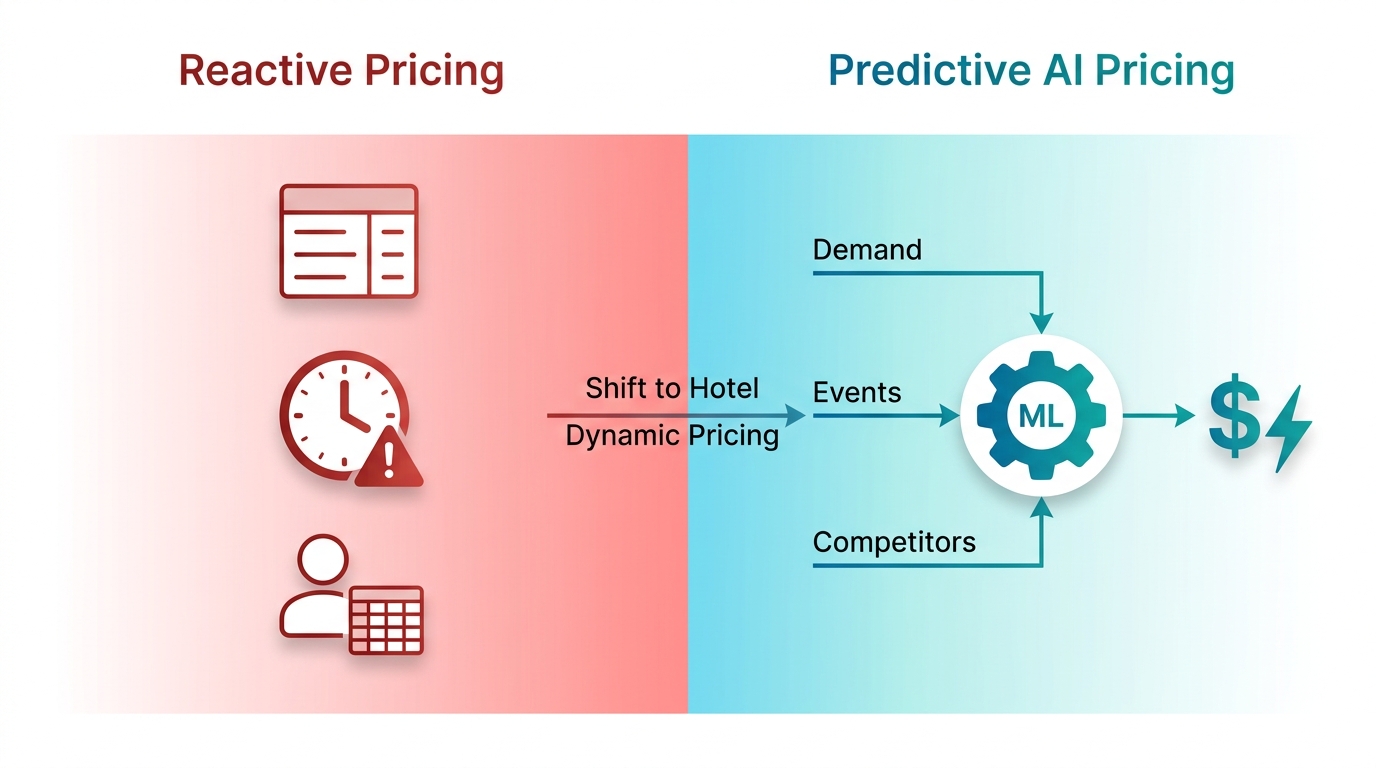
Reactive pricing is like sailing blindfolded: you adjust your sails only after you feel the wind change, but by then you’re already off course. This approach manifests in several costly ways.
First, rates are set using outdated demand signals. A revenue team might load rates for the next two weeks based on the booking pace from the prior week. But what if a local business conference gets announced three days before? Or a heatwave suddenly boosts last-minute weekend getaway demand? The static rate card won’t respond. Hotels often end up selling rooms at the same price regardless of real-time demand, leaving high-value bookings on the table.
Second, manual overrides are slow, inconsistent, and hard to scale. A revenue manager at a multi-property group might spend hours each morning cross-checking competitor rates across OTAs and making adjustments property by property. This creates bottlenecks, and two different managers may apply different judgments to similar scenarios. The result is erratic pricing that confuses both guests and algorithms.
Third, and perhaps most damaging, is the forced last-minute discounting. When occupancy dips a few days before arrival, the instinct is to slash rates to fill rooms. That fills the rooms, but at a steep cost to profitability. A better approach would have recognized low demand earlier and gently lowered rates over a few weeks, preserving revenue while nudging booking pace. According to Skift’s analysis of AI in hotel revenue management, “properties that adopt hotel dynamic pricing see a significant reduction in last-minute discounting and a healthier booking curve”.
The real kicker? Many hotels that believe they’re maximizing revenue are actually trapped in a cycle of high occupancy but flat ADR. That’s a classic sign of reactive discounting rather than strategic pricing. The rooms are full, but the average rate is lower than it should be because last-minute deals eroded the premium that early bookers were willing to pay.
So why do most hotels still rely on reactive methods? Because until recently, the alternative hotel dynamic pricing seemed complex, expensive, and risky. But that’s changing fast.
What Hotel Dynamic Pricing Actually Evaluates
Hotel dynamic pricing uses machine learning models to forecast granular demand by segment, by day, by length of stay and then recommend or automatically set optimal rates in near real time. Unlike a static rate sheet, it continuously ingests signals from inside and outside the property to answer one question: what price will maximize revenue right now, given everything we know?
The fundamental advantage of AI over traditional revenue management systems (RMS) is continuous optimization. Traditional RMS often operates on batch updates or rule-based logic. AI-driven hotel dynamic pricing refreshes its view of the market as often as new data arrives sometimes every few minutes. It evaluates a web of interconnected factors:
- Historical booking patterns and current booking pace (the pickup curve).
- Competitor rates, sourced from competitor rate shopping tools or public APIs.
- Local events, event-driven demand signals, weather forecasts, flight arrivals, and even social sentiment.
- Guest segment behavior: does the business traveler book last-minute at any price, while the leisure family books months out but is sensitive to a $10 difference?
- Length of stay and arrival day patterns: is a Thursday arrival much more valuable than a Friday, and how does that change with a holiday? Effective length of stay controls can help maximize revenue by optimizing for longer, higher-value stays.
- Shoulder periods: the days immediately before and after a peak event, which can be priced strategically to capture overflow demand.
Consider an example of predictive pricing: an AI system identifies that when a nearby concert venue announces a major act, search traffic for hotels in that area spikes 60% above normal within two hours. The model, having learned this correlation from past events, immediately nudges rates upward for the concert dates, well before human revenue managers have even heard about the show. Meanwhile, it might lower rates for the following Monday to capture the post-concert shoulder period [shoulder period strategy], balancing occupancy and rate. This is hotel dynamic pricing at its best.
This intelligence doesn’t emerge from nowhere. The models are only as good as the data they’re fed. Let’s look at what a reliable revenue engine actually needs.
Data: The Fuel Your Revenue Engine Needs
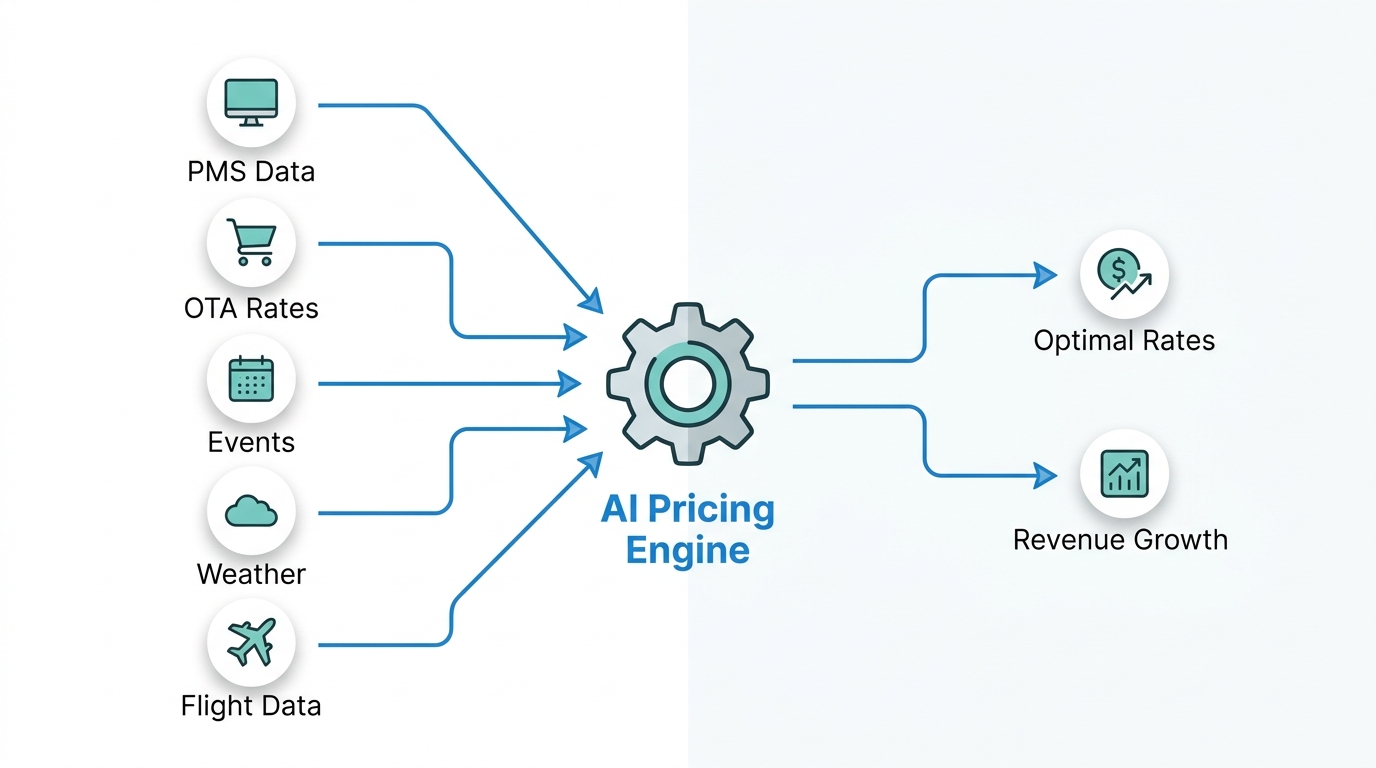
A hotel dynamic pricing model is nothing without clean, connected data. Many hotel groups sit on a goldmine of information but it’s scattered across disjointed systems. The core internal data sources include your property management system (PMS), which holds occupancy, ADR, RevPAR, and booking pace; the booking engine for direct channel data; and the channel manager for OTA performance metrics. External data is equally critical: competitor rate shopping feeds, event calendars, weather forecasts, flight schedules, and local demand indicators like convention center bookings.
Data quality matters more than model sophistication. A model trained on inaccurate or sparse data will produce unreliable recommendations. Before you invest in an AI tool, you need a data foundation. This is where many hotels hit a bottleneck: integrating PMS, booking, and market data across properties can be messy, especially if you’ve grown through acquisition and have multiple PMS versions. A chain with 50 properties might find that 15 of them use different systems, each generating data in subtly different formats.
Consider the impact of external data on hotel dynamic pricing. One resort we worked with integrated local flight arrival data into its forecasting model. It discovered that a spike in international flights on Thursday evenings was a leading indicator for weekend leisure demand. By adjusting rates in response to flight schedules, they captured a noticeable ADR uplift on those weekends. That’s the kind of granular insight that only comes when you connect the dots between siloed data sources.
A practical checklist for data readiness:
- Do you have at least 12 months of clean, property-level booking data (by day, room type, and segment)?
- Can you access real-time competitor rates via an API or rate shopper?
- Is your PMS data integrated with your CRM to capture guest value segments?
- Do you have a process to ingest and standardize external events and weather feeds?
Once the data pipeline is solid, the next question is: where does the revenue manager fit in? The answer might surprise you.
The Revenue Manager as AI Supervisor
The biggest fear around hotel dynamic pricing is that AI will replace revenue managers. But the evidence and the real-world experience of early adopters points in a different direction. The technology doesn’t eliminate the human; it elevates the role. The revenue manager becomes an AI supervisor: validating recommendations, tweaking model parameters for strategic reasons, and stepping in when context demands it. In this model, hotel dynamic pricing is not an automated decision but an augmented one.
There are clear scenarios where human override remains essential. When a natural disaster strikes, a political unrest emerges, or a new competitor opens next door, the model may not have enough historical data to respond appropriately. Similarly, during a property renovation or a rebranding, guest behavior may shift in ways the algorithm can’t anticipate. A skilled revenue manager can apply strategic intuition that hasn’t yet been encoded in data.
For example, a hotel launching a new loyalty program might see an unusual booking pattern. The AI, not having seen this member behavior before, might misinterpret it as organic demand and raise rates prematurely. The revenue manager, understanding the broader marketing plan, can override the rates for a defined period until the model learns. This is the human-in-the-loop partnership in practice, ensuring hotel dynamic pricing aligns with business strategy.
How should you build trust in the AI? Start with a recommendation-only mode. Let the system suggest rates for a few months while the team compares them to manual decisions. Use metrics like forecast accuracy and revenue capture to evaluate. Gradually increase the scope of automation; first for low-risk dates, then for shoulder periods, and eventually for peak demand always with guardrails. As BCG’s research on AI-first hotels highlights, “the most successful adopters pair AI tools with empowered revenue analysts who focus on strategy, not spreadsheets”.
The winning formula isn’t AI alone; it’s an AI-augmented revenue team. That partnership leads to better decisions, faster. Next, let’s look at how to measure the impact of hotel dynamic pricing.
Measuring What Matters: Forecast Accuracy, ADR, and RevPAR
When moving to hotel dynamic pricing, you can’t just trust gut feeling about whether it’s working. You need hard numbers. The key performance indicators fall into three buckets.
Forecast accuracy – How close are predicted room nights or revenue to actual results? The standard metric is Mean Absolute Percentage Error (MAPE). In manual processes, MAPE values for short-term forecasts can range from 20–30%. AI models for hotel dynamic pricing often reduce that to below 10%, and in some cases below 5% for the next seven days. Better forecasts mean you can price with confidence rather than hedging with discounts.
ADR improvement – By dynamically raising rates during high-demand windows and avoiding unnecessary discounting, hotels can achieve ADR uplifts in the range of 5–15% within the first year. This doesn’t mean gouging guests; it means capturing the true willingness-to-pay that static pricing leaves on the table.
RevPAR growth – Because RevPAR combines both rate and occupancy, it’s the ultimate gauge of revenue health. When you optimize both dimensions simultaneously, RevPAR gains of 8–20% are achievable. For many properties, the quickest RevPAR win comes from reducing last-minute discounting frequency by 30–50% preserving rate integrity while maintaining occupancy. Successful hotel dynamic pricing directly boosts these metrics.
| Metric | Manual Pricing | Predictive Pricing (AI) |
|---|---|---|
| Forecast accuracy (MAPE) | 20–30% | <10% |
| ADR lift | Baseline | 5–15% |
| RevPAR increase | Baseline | 8–20% |
| Last-minute discount frequency | High | Reduced by 30–50% |
| Time spent on rate updates (weekly hours) | 10–20 | 2–5 (oversight only) |
Composite ranges based on industry reports and Webuters client engagements.
It’s critical to isolate the effect of AI from other variables. The most reliable approach is to run a controlled A/B test: apply AI recommendations to a subset of properties or date ranges, and compare performance against a control group. Without this discipline, you might attribute a market upturn to your algorithm and be disappointed when it reverses.
These numbers are compelling, but they raise a natural question: How do you start? The path forward doesn’t require a complete overhaul just a deliberate first step toward hotel dynamic pricing.
For teams evaluating this next step, Webuters’ AI forecasting and pricing models can provide a practical reference point.
Your First Step Toward Hotel Dynamic Pricing
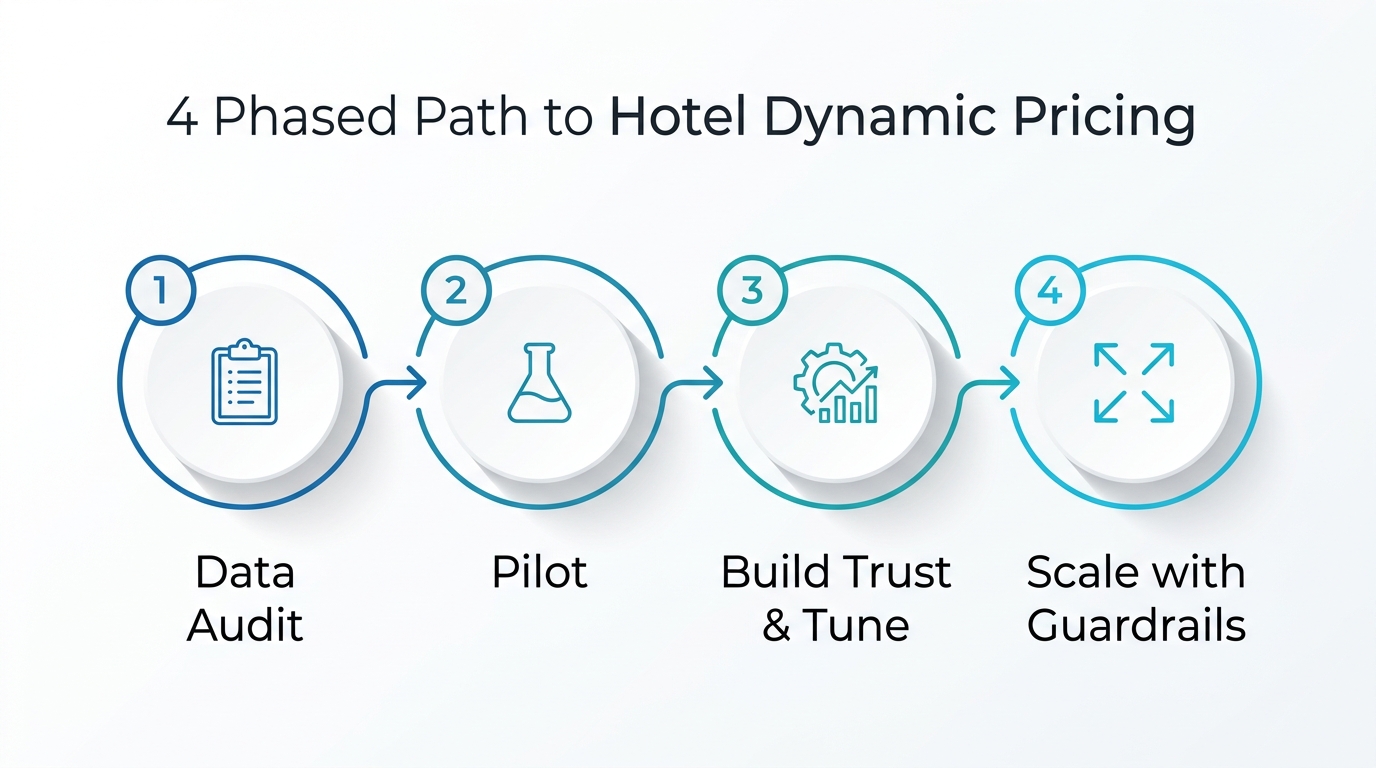
The journey to hotel dynamic pricing doesn’t begin with a multi-million-dollar system. It starts with a practical, phased approach:
Step 1: Data audit. Map out every data source you have PMS, booking engine, OTA extranets, rate shopper, events data and identify what’s missing, what’s inconsistent, and what can be integrated easily. This audit is where a partner like AI consulting for revenue and pricing decisions brings immediate clarity.
Step 2: Pilot with a segment or property. Choose one property or a specific segment, such as weekend leisure, and deploy an AI recommendation tool. Don’t automate the prices yet; just let the model make suggestions. Have your revenue manager compare them to manual decisions for 60–90 days.
Step 3: Build trust and tune. Track forecast accuracy and ADR impact during the pilot. Adjust model parameters based on your team’s domain knowledge; for example, increase the weight on events if your property is convention-driven. This is where the human-AI partnership solidifies.
Step 4: Scale with guardrails. Once the pilot proves value, expand to more properties and segments. Implement automated rate updates within bands you define. Keep the revenue manager in the loop for outlier days and strategic overrides.
A regional hotel group we worked with followed this exact path. They started with a 90-day pilot at one property and saw meaningful ADR improvement, then rolled out AI-driven pricing across all properties within months. The group’s RevPAR grew year-over-year, and revenue managers reported spending significantly less time on manual rate adjustments. This is the power of phased hotel dynamic pricing adoption.
For a deeper dive into how AI is reshaping operations beyond pricing, explore our piece on autonomous AI in hospitality operations. It shows that hotel dynamic pricing is one piece of a much larger puzzle but a piece that directly hits the bottom line.
The Blindfold is Off
The destination is clear: a revenue engine that learns faster than the market moves. The blindfold is off, the radar is live. The question is no longer whether to adopt hotel dynamic pricing; it’s how fast you can partner with the right intelligence. That partnership starts with one deliberate step: an honest assessment of your data, your processes, and your readiness to augment your team with AI.
If the scenario at the beginning of this article feels familiar, our AI consulting for revenue and pricing decisions can help you take that first step without getting lost in jargon or hype. We help hotel groups build the data foundations, custom models, and integration layers that make predictive pricing a practical reality not just a slide deck promise. Your coffee can stay hot. Your weekend sell-outs can start weeks earlier. Let’s talk.
Frequently Asked Questions
How does AI improve hotel revenue management?
AI improves revenue management by analyzing thousands of demand signals in real time: booking pace, competitor rates, events, weather and recommending or setting optimal room rates. This replaces periodic manual updates with continuous optimization, reducing discounting and capturing more high-value bookings. Hotel dynamic pricing is the core mechanism.
What is hotel dynamic pricing?
Hotel dynamic pricing uses machine learning models to forecast future demand at a granular level and determine the rate that will maximize revenue for each room type, date, and guest segment. It adapts automatically as new data arrives, rather than relying on fixed rules.
Can AI set hotel room rates automatically?
Yes, but typically within defined boundaries. Most hotels start with AI recommendations that require human approval, then move to automated adjustments within guardrails. Human oversight remains important for unusual events. This balanced approach is key to successful hotel dynamic pricing.
How accurate is AI demand forecasting for hotels?
AI demand forecasting for hotels often achieves MAPE below 10% for short-term forecasts, compared to 20–30% for manual methods. Accuracy varies based on data quality and market volatility, but it consistently outperforms traditional approaches. High forecast accuracy enables confident hotel dynamic pricing.
How does AI increase RevPAR?
AI increases RevPAR by optimizing both average daily rate (ADR) and occupancy. It raises rates during high-demand periods that static pricing would miss, and reduces last-minute discounting by recognizing demand drops early. The combined effect typically lifts RevPAR by 8–20%. Hotel dynamic pricing drives these gains.

Loading...