
AI Didn’t Replace Programming. It Raised the Abstraction Layer.
AI programming is not the death of software engineering. It is the next way software work gets expressed.
That distinction matters more than it first appears. When the conversation swings between “AI will replace developers” and “AI is just autocomplete,” it misses the real shift entirely. The change is not that software stopped needing engineers. The change is that engineers can now express intent at a higher level, with the machine doing more of the translation.
For founders, CTOs, engineering leaders, and enterprise buyers, that shift affects hiring, delivery, governance, tooling, and risk. AI programming changes what humans should do directly and what the system can accelerate. If that line is fuzzy, adoption tends to become either reckless or timid.
Our view at Webuters is simple:
Programming has always moved upward through abstraction layers. We went from physical machine configuration to machine code, from assembly to compilers, from higher-level languages to frameworks, from local files to source control and open collaboration. AI programming belongs in that same story. It sits one layer higher, closer to intent.
In this article, we’ll move through that progression step by step. First, we’ll look at how programming moved away from the machine and toward human language. Then we’ll use a simple price-and-tax example to show how the same business rule changes form across layers. After that, we’ll look at why AI programming inherits both the strength and risk of the software ecosystem around it. Finally, we’ll get practical about governance, rollout, and what the next generation of developers actually needs to do.
Programming Has Always Moved Away From the Machine and Toward Human Intent
Before programming was code, it was structured thought. Ada Lovelace’s notes on Charles Babbage’s Analytical Engine described how a machine could follow symbolic instructions, which is why she is widely remembered as the first computer programmer in Britannica’s overview of Ada Lovelace. That detail matters because programming did not begin with syntax. It began with the idea that human logic could be expressed in a form a machine could execute.
The contrast becomes sharper with ENIAC. Penn Engineering’s history of ENIAC shows how early programming was tied closely to the machine’s physical configuration rather than the text-based coding most developers recognize today. In other words, the “program” was often the machine’s setup. Software was still glued tightly to hardware.
The first major relief came from distance. Machine code created a formal way to express instructions directly for the processor. Assembly language then gave humans symbolic mnemonics instead of long strings of bits. The machine still needed exact instructions, but humans finally gained a more manageable way to describe them.
That pattern kept repeating. The software world did not progress by removing rigor. It progressed by moving rigor into better tools and better layers.
Grace Hopper’s work made that direction even clearer. The push toward automatic programming appeared long before today’s large language models, including the A-0 system discussed in the Computer History Museum’s history of higher-level languages. The lesson is not nostalgia. It is that engineers have spent decades trying to narrow the gap between human logic and machine instructions.
That is the real historical pattern. Every major leap in programming made software more expressive and less tied to raw machine detail, while keeping humans responsible for what the machine was asked to do.
For teams turning this pattern into production work, Webuters’ AI services can help connect the technical layer with business delivery.
Higher-Level Languages Proved That Abstraction Could Still Be Serious Engineering
The next turning point was not just technical. It was psychological.
High-level languages had to prove they were not a soft compromise. FORTRAN became one of the clearest proofs. IBM’s history of FORTRAN explains how it showed compiled high-level programming could be practical for serious work, not just theoretical convenience. That mattered because engineers could write closer to the problem they were solving, while the compiler handled translation into lower-level instructions.
That distinction still matters today. The compiler did not write the software. It translated human intent into machine-executable form. The programmer still chose the logic, the structure, the trade-offs, and the outcome.
C and Unix pushed that lesson further. Bell Labs’ classic publication on the C programming language in the Unix time-sharing system shows how C became a milestone for systems programming and portability. Good abstraction does not remove control. It relocates complexity into a layer humans can manage more effectively.
That is why AI programming should not be treated as a strange break from software history. It follows the same arc. The next layer is not about escaping engineering. It is about expressing engineering intent at a higher level.
AI Programming Works Like an Intent Compiler, Not an Autonomous Replacement
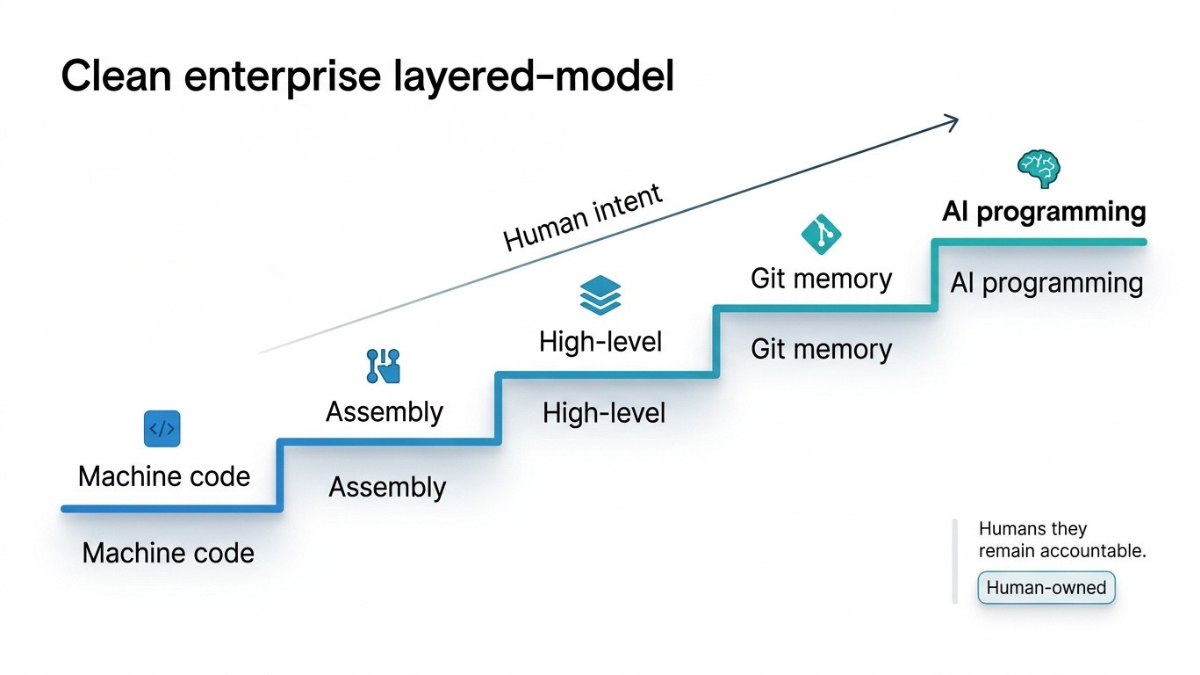
A practical way to understand AI programming is this: a compiler translates code into instructions a machine can run. AI programming sits one layer above that. It helps translate goals, context, constraints, and examples into drafts of code, tests, queries, workflows, and documentation.
That is why prompt engineering is often misunderstood. Strong prompts are not just clever English. They require system thinking: what service owns the rule, what edge cases matter, what data is trusted, what failure modes are acceptable, what security boundaries exist, and what should be tested before merge. Natural language is only the surface layer. The real work is still architecture.
This is also why AI programming should increase human responsibility, not reduce it. When code generation becomes easier, judgment becomes the bottleneck. Someone still owns the problem definition, the system boundaries, the performance trade-offs, the security testing, the code review, and the production outcome.
AI programming doesn’t end software engineering. It moves software engineering one level higher—from writing instructions for machines to defining intent for systems.
| Programming layer | Primary human input | What changed | What stayed human-owned | Example |
|---|---|---|---|---|
| Machine code | Exact numeric instructions | Direct control of hardware behavior | Logic, correctness, responsibility | Set registers and perform arithmetic |
| Assembly language | Symbolic mnemonics | Easier expression over raw binary | Algorithm choice and debugging | LOAD, ADD, STORE |
| FORTRAN / high-level languages | Problem-oriented statements | Compilers handled lower-level translation | Program design and expected output | Scientific or business formula |
| C / Unix | Portable systems logic | Greater reuse across machines | Memory, performance, system behavior | A reusable function in C |
| Git / open source | Collaborative change history | Shared memory, review, iteration | Quality control and maintainership | Pull requests and version history |
| AI programming | Intent, context, constraints | Fast draft generation across many artifacts | Architecture, validation, security, accountability | Generate a tax calculation service and tests |
If that table makes AI programming look less magical, good. It should. The real story is not replacement. It is another translation layer.
The Same Business Rule Looks Different at Every Layer
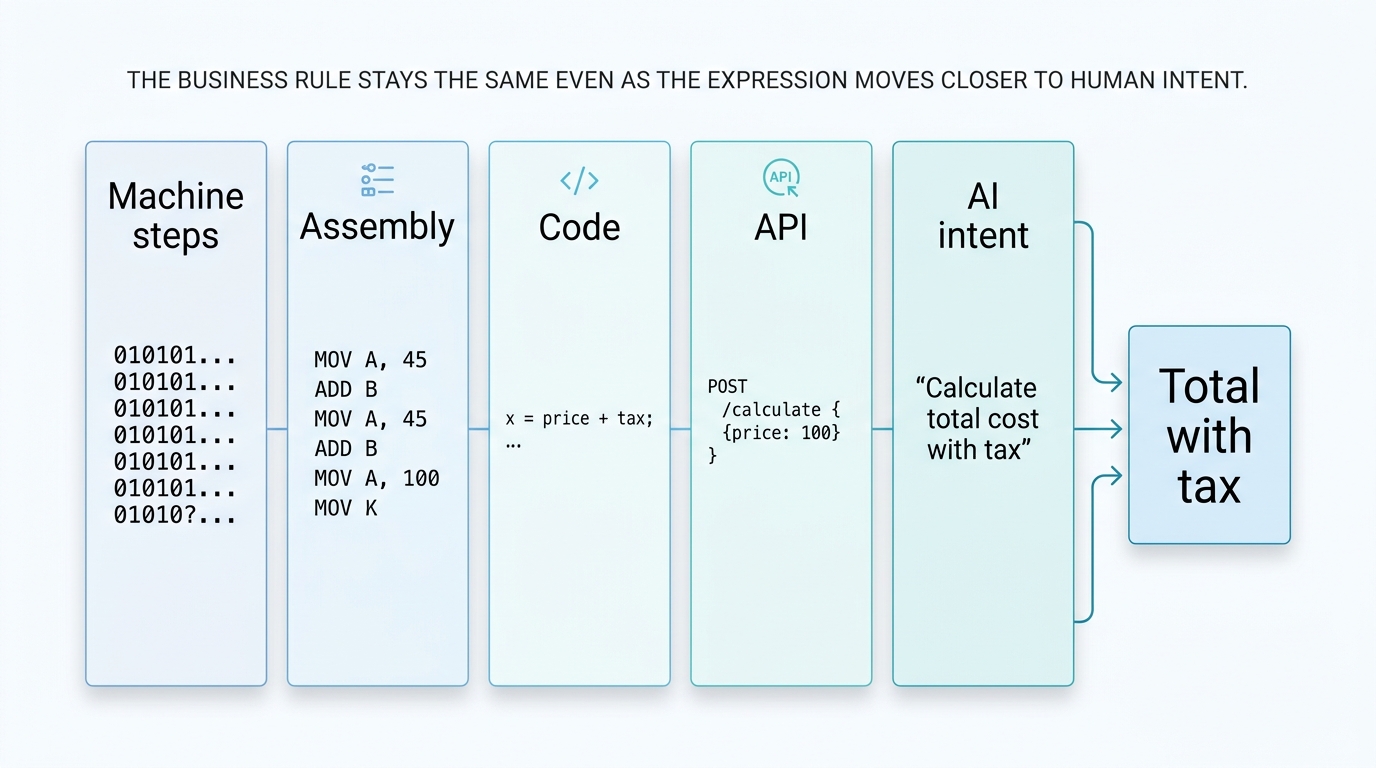
Take a simple business rule: add tax to a base price. The business requirement barely changes. What changes is how humans express it.
At a machine-level mindset, the developer is thinking in terms of memory locations, registers, and explicit arithmetic steps. In assembly language, that becomes symbolic instructions. In C, it becomes a function. In JavaScript, it becomes a browser or service utility.
In an API-driven system, the pricing logic is no longer the whole system. It becomes one callable step inside a larger workflow, such as checkout, invoicing, or tax calculation orchestration. That is an interpretation of how modern software is usually assembled, and it is exactly why abstraction matters: the business rule survives even as the surrounding system becomes more distributed.
In AI programming, the human can express the desired behavior, edge cases, and test expectations as intent-first instructions.
Machine-level thinking:
Load price from memory
Load tax rate from memory
Multiply price by tax rate
Add result to price
Store total
; Assembly-style expression
LOAD PRICE
LOAD TAX
MUL
ADD PRICE
STORE TOTAL
float total_with_tax(float price, float tax_rate) {
  return price + (price * tax_rate);
}
function totalWithTax(price, taxRate) {
  return price + price * taxRate;
}
POST /pricing/calculate
{
  "basePrice": 100,
  "region": "CA"
}
AI programming intent:
"Draft a pricing function that calculates total price with regional tax,
handles rounding rules, rejects negative values, and includes unit tests
for zero tax, standard tax, and invalid input."
The business problem stays the same, while the expression of that problem becomes more human-centered. The machine wants instructions. The business wants outcomes. AI programming sits between the two and helps compress the distance.
But the higher the layer, the more dangerous vague thinking becomes. If the tax rule changes by region, depends on exemptions, or must comply with finance policy, a vague prompt will produce vague software. Intent-driven coding only works when the human supplying intent understands the system.
AI Programming Inherits the Strengths and Weaknesses of the Software Ecosystem Around It
Modern AI coding tools did not appear in a vacuum. They became useful because software engineering already built a rich memory layer of public code, documentation, tests, examples, issue discussions, and review habits. Git matters here. Britannica’s entry on Git presents it as a distributed version-control system that became central to modern software collaboration. That version history became part of how programming remembers itself.
Open collaboration changed the shape of developer workflow long before AI programming arrived. Repositories, pull requests, forks, comments, changelogs, and issue threads turned software into a searchable record of decisions. AI coding tools operate effectively in that environment because the ecosystem already stored patterns in reusable form.
That strength also creates the hidden risk. Good code taught AI good patterns, but the same ecosystem also contains insecure shortcuts, outdated dependencies, incomplete examples, and flawed assumptions. So responsible code generation cannot mean blind acceptance. It means recognizing that AI programming can compress patterns from open source code, but it cannot guarantee which pattern it picked.
GitHub frames Copilot as an AI pair programmer, not an autonomous software owner. And GitHub’s Octoverse report shows AI-related signals are now part of mainstream developer activity, which is useful as a workflow indicator even if it should not be treated as proof of code quality or business value by itself. The right reading is not “AI has arrived, remove review.” It is “AI programming is becoming normal, so governance now matters more.”
A Practical Rollout Model for Enterprise Teams
This is where the conversation becomes operational.
Most enterprise teams do not need a manifesto. They need a clear rollout model.
A practical starting point looks like this:
- Define which tasks are safe for AI assistance: scaffolding, documentation, test drafts, internal tooling, and repetitive code.
- Define which decisions stay human-owned: architecture, domain rules, data handling, release approval, and customer-facing logic.
- Create review gates for code quality, security, and compliance before anything reaches production.
- Assign an explicit owner for every AI-assisted workflow so accountability does not disappear into the tool.
- Measure whether AI is reducing cycle time without increasing rework, defects, or policy exceptions.
That last point matters. The goal is not to produce more code. The goal is to produce better decisions with faster execution.
The teams that get this right usually treat AI like a governed capability, not a novelty layer. The output may be a working draft in minutes, but the system behind it still needs standards, roles, and escalation paths. That is where tools, process, and leadership have to line up.
Mature Teams Keep Humans Explicitly in the Loop
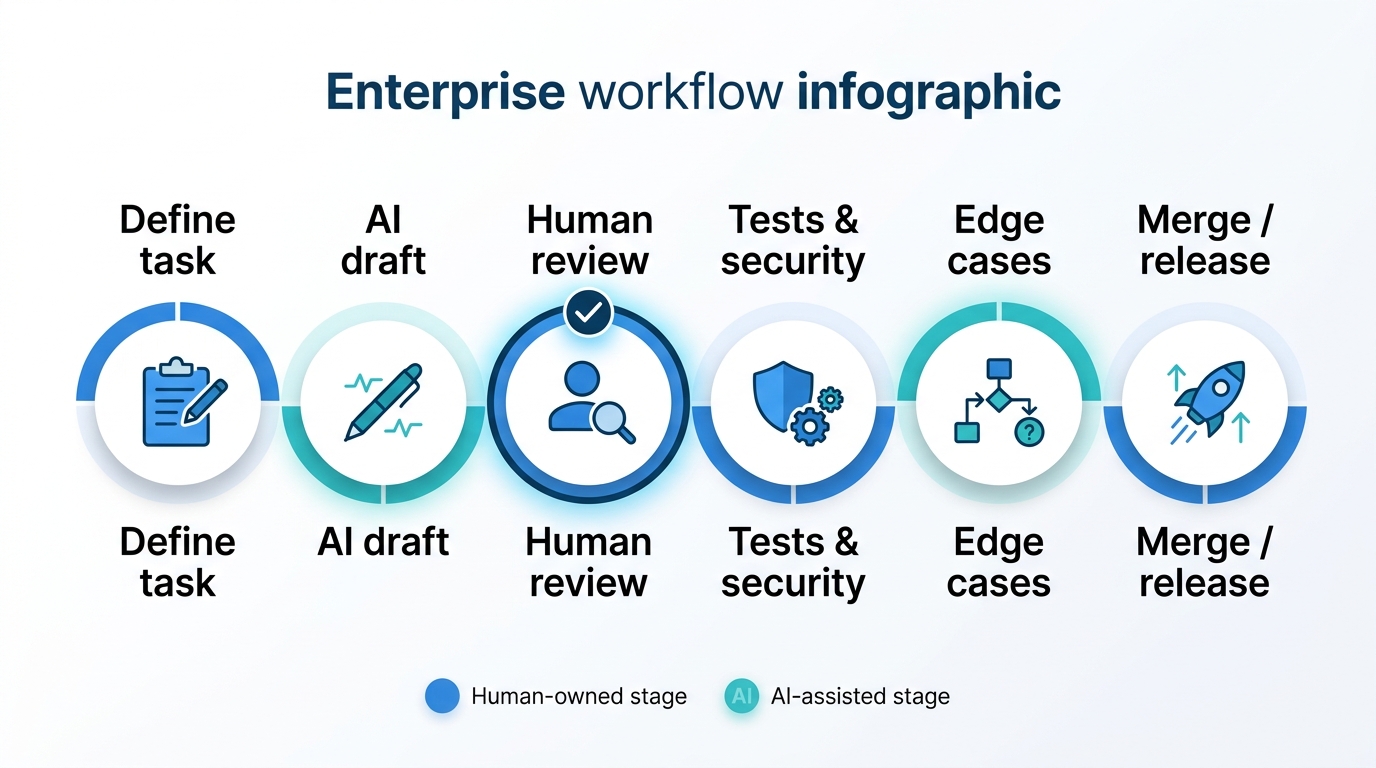
This is where mature teams separate productivity from recklessness. The Linux kernel community offers one of the clearest examples. Its documentation on AI coding assistants makes the submitter responsible for understanding and standing behind any AI-assisted contribution. That is a strong operating principle for enterprise engineering teams as well.
Linus Torvalds has made the same point in plain language, describing AI as a useful tool, but still just a tool in a TechRadar interview covering his comments. That position is healthy because it keeps authorship, accountability, and engineering judgment in the right place.
Human-in-the-loop AI is not a slogan. It is an operating model. A mature flow looks more like this:
- A developer or product engineer defines the task with constraints.
- The model produces draft code, tests, or documentation.
- A human reviews logic, architecture fit, and dependencies.
- Automated tests and security checks run.
- Edge cases, compliance needs, and failure modes are checked.
- Only then does code move toward merge or release.
This governance mindset is consistent with the NIST AI Risk Management Framework, which emphasizes governance, mapping, measuring, and managing risk. It is reinforced by NIST’s AIRC appendix on human-AI interaction, which highlights the importance of designing accountability and usability into how humans work with AI systems. And for teams building workflow automation or AI agents, the security layer becomes even more important: OWASP provides specific guidance on LLM prompt injection prevention and AI agent security.
In other words, speed without review is not maturity. It is deferred risk.
The Developer’s Job Is Becoming More Strategic, Not Less Relevant
Once you see AI programming as a higher abstraction layer, the future role of the developer becomes clearer. The valuable engineer is not just the fastest typist in the room. The valuable engineer is the one who can define intent precisely, evaluate trade-offs, inspect generated output, design safe workflows, and know when the model is confidently wrong.
That is why future developers become system thinkers, architects, reviewers, testers, security checkers, and AI orchestrators. AI programming changes the expression of work, but not the ownership of the work. If anything, human accountability expands because one person can now generate more change, more quickly, across more parts of the stack.
For enterprise engineering teams, the shift is practical. Use AI programming to accelerate scaffolding, refactoring ideas, documentation, test creation, repetitive code, internal tooling, and early discovery. Keep humans firmly responsible for architecture, domain rules, data boundaries, compliance, security, and production approval.
This is also where strategy matters more than tooling. Teams usually do not struggle because they lack access to models. They struggle because they have not decided how AI programming fits their delivery model, governance standards, or platform roadmap. That is exactly where AI consulting services and Generative AI services and solutions become useful: not as hype purchases, but as structured ways to align workflow, risk, and implementation. The same is true when leaders are deciding between packaged copilots and custom AI solutions vs off-the-shelf tools. The tool choice is rarely the first decision. The operating model is.
Programming Is Not Ending. It Is Becoming More Strategic.
The real problem is not whether AI will write code. It already can. The real question is who defines the system, who validates the output, who manages the risk, and who is accountable when software touches customers, revenue, compliance, or operations.
Programming has always moved upward. Ada Lovelace showed that programming began as structured thought before modern computers existed. ENIAC reminds us how physically close software once was to the machine. FORTRAN proved that higher-level expression could still be serious engineering. C and Unix showed that abstraction and control could coexist. Git and open collaboration turned programming into a persistent memory and collaboration layer. AI programming is the next layer in that long arc.
The companies that benefit most from this shift will not be the ones that let models generate the most code. They will be the ones that combine AI speed with human architecture, review, security, and accountability. That is the difference between novelty and capability.
If your team is working through that transition, Webuters can help you make it practical. From AI services and workflow design to governed implementation and engineering support, the goal is not to chase the loudest tool. It is to modernize how software gets built without losing control of quality, security, or business logic. If you want to see how that looks in real delivery environments, explore our case study list. The future is not human versus AI. It is AI programming guided by human intelligence, discipline, and accountability.
Frequently Asked Questions
Is AI programming replacing developers?
No. AI programming changes how software work is expressed and accelerates draft generation, but humans still own requirements, architecture, testing, security, review, and accountability. The higher the abstraction layer, the more important human judgment becomes.
What does it mean to call AI an intent compiler?
It means AI programming works one layer above code by translating goals, constraints, and context into draft code or workflows. Like a compiler, it translates; unlike a compiler, it starts from intent rather than fully specified syntax.
Can AI coding tools be trusted for production code?
They can be useful for drafting production candidates, but not for blind acceptance. Mature teams still require human review, testing, dependency checks, security validation, and approval gates.
Why are Git and open source important to AI-assisted development?
They created the memory and collaboration layer of modern programming. Public repositories, examples, and review patterns made software development more reusable and helped create the ecosystem AI coding tools now reflect.
What should enterprise leaders do before rolling out AI-assisted development?
Define where AI programming fits in the workflow, what review and security controls apply, which decisions remain human-owned, and whether off-the-shelf tools or custom systems better match the organization’s architecture and risk profile.
If your team is evaluating AI programming, Webuters can help you design the right operating model—one that combines AI speed with human architecture, review, security, and accountability. Explore our AI services, consulting support, and practical delivery models to modernize how software gets built without losing control of quality or business logic.

Loading...