
Stop Planning Like It’s 2019: Why AI Supply Chain Is the Only Way Forward
An AI supply chain never sleeps. Imagine a 3 a.m. phone call: a critical shipment is stuck because a new tariff just hit, and your team’s static plan can’t cope. In an AI supply chain, that call never happens….the system already rerouted the order. That moment captures the gap most supply chains live with: the space between disruption and response. It’s a gap measured in lost revenue, missed deliveries, and eroded customer trust.
For years, we’ve treated supply chain planning like a predictable machine. Build a plan, execute it, adjust once a quarter. That worked when lead times were stable, tariffs predictable, and supplier risks slow to change. But those days are over. Today, volatility is the baseline. Trade policies shift overnight. A supplier’s financial health can crumble in a week. A weather event can choke a port for days. When an organization needs days or weeks to replan, the business bleeds cash before anyone picks up the phone.
That is the real problem. An AI supply chain changes the equation. AI doesn’t just predict: it watches, learns, and acts. This article shows how an AI supply chain strengthens resilience through autonomous supply chain planning, continuously monitoring supplier risk, forecasting demand accurately, optimizing inventory and costs in real time, and executing sourcing and scheduling decisions; all while integrating with the ERP and procurement systems you already run.
In a world where a tariff can change before your morning coffee, your supply chain needs a brain that thinks faster than your competitors. That brain is an AI supply chain.
Why Static Planning Breaks Under Volatility
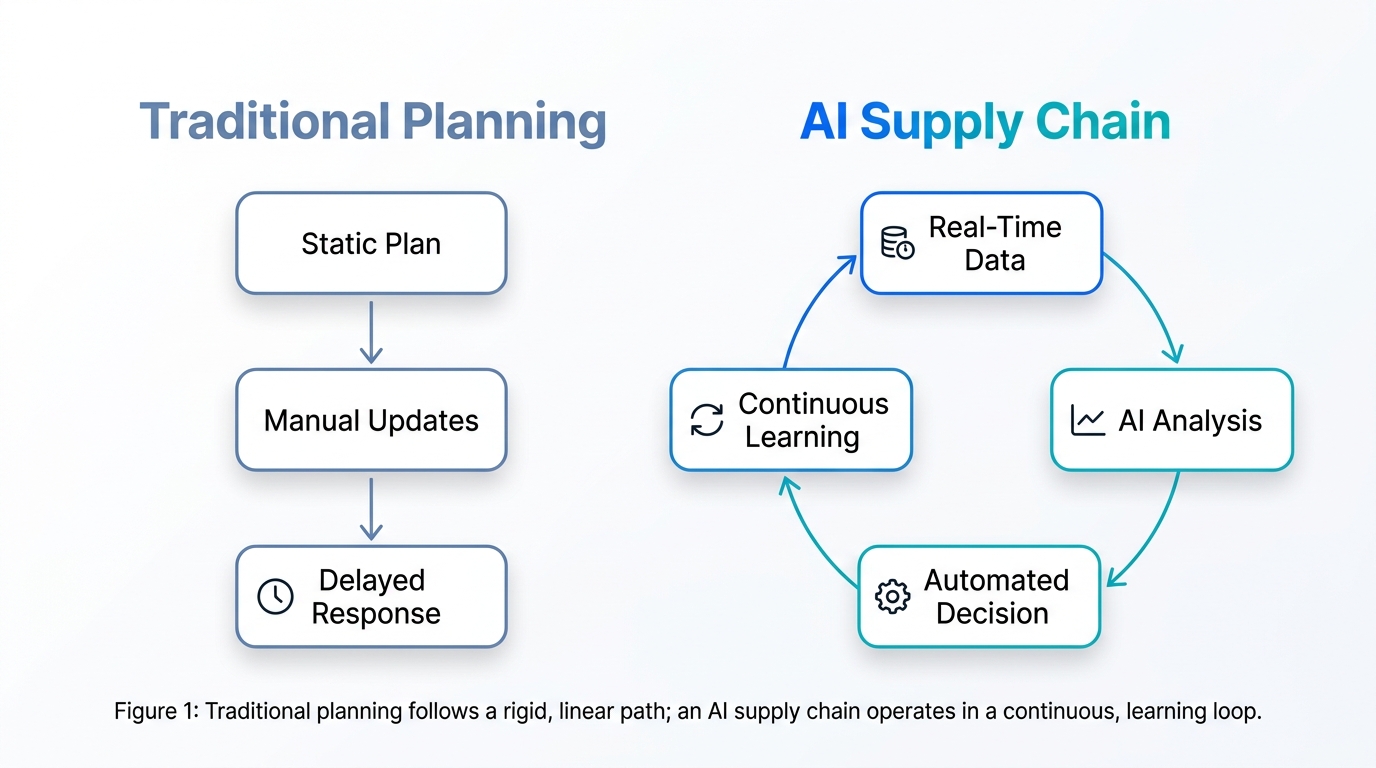
Traditional supply chain planning relies on fixed assumptions. Lead times don’t change. Demand forecasts are generated monthly and become stale within days. Supplier risk is reviewed periodically, often by spreadsheet. This planning model treats the supply chain as a well-behaved system, but in reality it is complex, adaptive, and buffeted by shocks that no static model can anticipate. An AI supply chain thrives in this chaos.
When a disruption hits: a port closure, a sudden tariff, a tier-2 supplier bankruptcy; the time between the event and a coordinated response is pure exposure. Teams scramble to check contracts, recalculate landed costs, identify alternative sources, and re-approve purchase orders. It’s a manual, error-prone process that often takes weeks. The cost is immediate: expedite fees spike, production lines sit idle, orders miss delivery windows, and customers question your reliability. An AI supply chain closes that gap by enabling real-time replanning. Even minor disruptions consume planners’ attention for days, pulling them from strategic work. Static planning cannot shrink that window. AI can.
How AI Continuously Monitors Supplier Risk
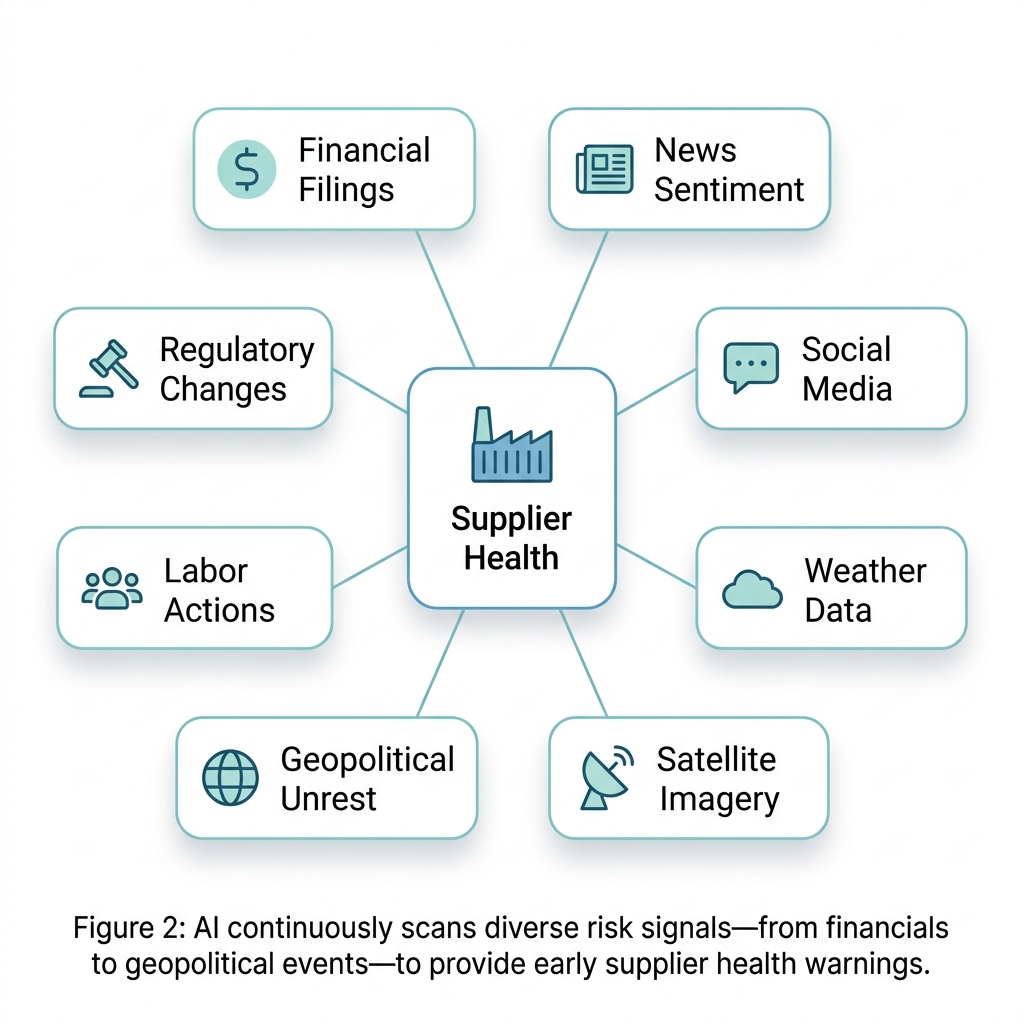
AI ingests a broad set of risk signals that planners rarely see in one place: financial filings, news sentiment, social media chatter, weather data, satellite imagery, geopolitical unrest, labor actions, and regulatory changes in every geography where your suppliers operate. This continuous scanning creates an early warning system that alerts you days or weeks before a problem becomes a shipment delay. In an AI-powered supply chain, these signals feed directly into supplier risk models, sharpening early warnings.
Deloitte’s agentic supply chain report highlights how AI can monitor supplier health and trigger proactive actions. When a risk score crosses a threshold, AI can automatically search a pre-vetted alternative supplier identification database. It evaluates capacity, quality certifications, lead times, and current pricing, then surfaces the best option or even drafts and sends an RFQ. That means a planner goes from “we have a problem” to “here are three viable backups” in minutes, not days.
Consider a consumer electronics company that uses AI to screen tier-2 suppliers’ financial health. The model picks up a subtle decline in working capital and flags the supplier months before a credit downgrade. The sourcing team gradually shifts volume to a healthier partner, avoiding a line-down situation. That’s the difference between reactive firefighting and proactive resilience. An AI supply chain makes this proactive stance the norm.
AI Demand Forecasting That Actually Works
Traditional demand forecasting relies on historical averages and simple seasonality. It cannot account for sudden changes in consumer behavior, weather events, competitor promotions, or macroeconomic shifts. AI demand forecasting models ingest hundreds of external variables: local weather, foot traffic, online search trends, even major events and learn how they influence demand at a granular level. In manufacturing and retail, deep learning models can improve forecast accuracy significantly over traditional methods, as noted in industry discussions. That improvement translates directly into right-sized inventory. Better accuracy can reduce safety stock levels, freeing up working capital while maintaining or improving service levels. AI also provides prediction intervals, so planners understand the range of likely outcomes and can make risk-aware decisions. An AI supply chain leverages AI demand forecasting manufacturing to achieve this.
A mid-size pharmaceutical distributor uses AI to forecast demand for flu medication. The model correlates doctor visit data, weather patterns, and social media symptom mentions, predicting demand spikes two weeks ahead. By pre-positioning inventory in regional hubs, they cut expedite costs and virtually eliminated stockouts. That kind of precision is impossible with spreadsheets.
Inventory and Cost Trade-Offs AI Can Model
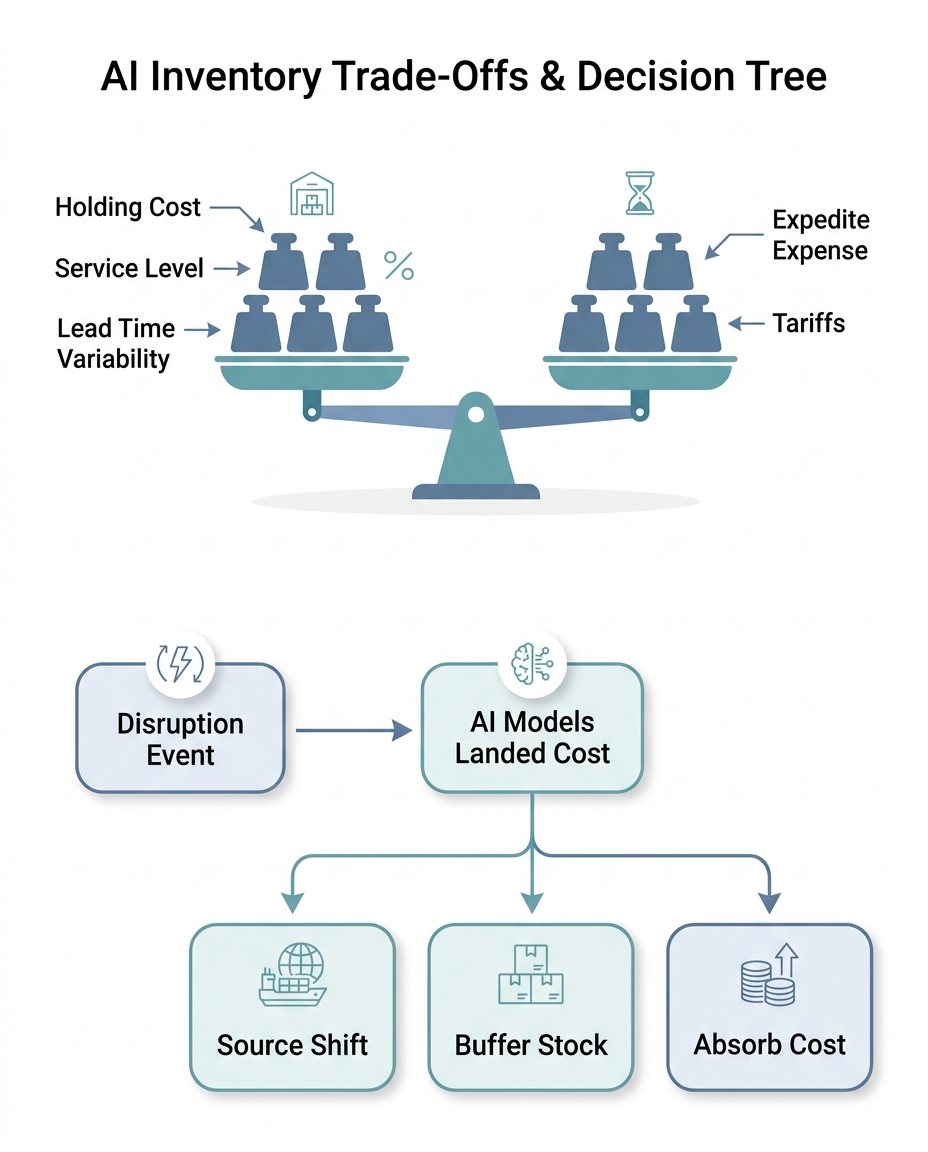
Inventory decisions are never about a single variable. They trade off holding cost, service level, lead time variability, expedite expense, and increasingly, tariffs. AI can model these multi-dimensional trade-offs dynamically, running thousands of scenarios to find the best balance. When tariffs shift, the immediate question is: should we source elsewhere, absorb the cost, or build buffer stock? AI can simulate the landed cost impact of a tariff change across multiple origin-destination pairs, considering freight rates, duties, and lead times. It then recommends the optimal combination of source shifts and inventory buffers to minimize total cost. This is a core capability of an AI supply chain.
For instance, a consumer electronics firm used AI to model tariff scenarios. The AI recommended shifting a portion of sourcing to Vietnam, increasing safety stock for the remaining Chinese orders, and adjusting reorder points for parts with high lead-time variability. The result: a total landed cost increase far below what a static plan would have incurred.
| Factor | Traditional Planning | AI Supply Chain Planning |
|---|---|---|
| Data sources | Historical sales, limited external data | Real-time internal + external (news, weather, social, financial) |
| Forecast update frequency | Monthly / weekly | Daily / hourly |
| Supplier risk detection | Manual, periodic | Continuous, automated |
| Inventory optimization | Static safety stock | Dynamic, multi-echelon, cost-aware |
| Response time to disruption | Days to weeks | Minutes to hours |
| Decision autonomy | Manual only | Recommendations + autonomous actions with human oversight |
From Recommendations to Autonomous Replanning
Autonomous supply chain planning means the system not only suggests actions but executes them within defined guardrails. It closes the loop: monitor, detect, recommend, act, learn. This is not about replacing planners; it’s about freeing them from routine, high-volume decisions so they can focus on strategic exceptions. Consider a multinational electronics company that deployed AI agents to manage component orders. When a supplier signals a two-day delay, the AI automatically reroutes the order to a backup supplier, adjusts the production schedule, and notifies the planner for review all within minutes. This dropped coordination downtime significantly and allowed the planning team to focus on new product introductions instead of firefighting. An AI supply chain with this level of autonomy drives AI supply chain resilience.
Human oversight remains critical. For decisions involving contract changes, high-value commitments, or strategic supplier shifts, the AI escalates to a human with a full impact analysis. The system learns from these overrides, improving its recommendations over time. Webuters’ integration for ERP and supplier systems enables the real-time data flow that makes autonomous execution possible.
Integrating AI with ERP and Procurement Workflows
AI doesn’t work in a vacuum. It needs real-time data from your ERP, TMS, WMS, and supplier portals. A phased integration approach starts with a pilot on a high-impact product line or region. APIs and event-driven architectures allow AI to consume order statuses, inventory levels, and supplier scorecards—and write back plan updates, purchase order exceptions adjustments, or alerts. A chemical company combined AI-generated purchase recommendations with RPA for procurement and order processing. The AI identified optimal reorder quantities, and the RPA bots executed the transactions in SAP, cutting manual PO processing time significantly. Integration ensures that insights turn into actions without friction. A robust AI supply chain depends on this seamless integration.
Webuters’ AI consulting for supply chain intelligence helps define the architecture, select the right models, and build the integration layer. The goal is not a rip-and-replace but a gradual infusion of intelligence into existing processes.
Building Resilience: Your Next Step
The supply chains that will dominate the next decade won’t be defined by the lowest cost supplier, but by the fastest, most intelligent decision-making. That intelligence is an AI supply chain, and it’s available now the only question is whether you’ll act before your next disruption.
Start with your biggest pain point. Is it supplier visibility? Demand volatility? Inventory bloat? Pick one and run a focused pilot. A mid-sized manufacturer reduced inventory substantially in six months by applying AI demand forecasting to their top 20 SKUs. A logistics provider slashed disruption response time from days to hours by automating supplier risk monitoring and alternative sourcing recommendations. Build trust and guardrails. Begin with AI recommendations in parallel with manual decisions, then move to semi-autonomous execution once planners see the accuracy. Measure clear KPIs: forecast error, stockout rate, expedite cost, and response time. The technology is mature; the real work is change management and data readiness.
If you’re ready to build resilience with an AI supply chain, talk to our AI team about supply chain use cases and let’s explore what’s possible for your organization.
Frequently Asked Questions
How does an AI supply chain improve resilience?
An AI supply chain improves resilience by continuously monitoring supplier risk, forecasting demand more accurately, optimizing inventory dynamically, and enabling rapid, data-driven replanning. This cuts response time to disruptions from weeks to hours.
Can AI find alternative suppliers automatically?
Yes. AI scans supplier databases and real-time risk signals to identify, qualify, and recommend alternative sources. It can even trigger RFQs, giving planners immediate options when a primary supplier fails.
How does AI help with tariff and trade disruption?
AI models the landed cost impact of tariff changes across sourcing options and recommends optimal supply base shifts and inventory buffers to minimize total cost.
What is autonomous supply chain planning?
It’s a closed-loop system where AI not only recommends but executes decisions such as rerouting orders or adjusting production schedules—within human-defined guardrails.
How accurate is AI demand forecasting?
AI demand forecasting, using techniques like deep learning, can improve accuracy significantly over traditional methods, as noted in industry discussions, leading to reduced safety stock levels and higher service levels.
What’s the first step to adopting an AI supply chain?
Start with a pilot focused on your most critical pain point such as demand forecasting for a key product line and gradually expand as trust builds.

Loading...