
Shopify vs Adobe Commerce in 2026: An Implementer’s Honest Guide to Making the Right Platform Bet
When you choose Adobe Commerce, you're not just picking a shopping cart—you're choosing an architecture that will shape your team, your costs, and your growth trajectory for years. Picture a founder staring at two demo screens. On the left, a drag‑and‑drop store builder promises a live site by next week. On the right, an open‑source framework whispers infinite possibilities—if you can assemble the right team. That moment of hesitation is the platform bet every serious ecommerce leader faces. Choose quickly and you risk technical debt. Choose carefully and you might delay your launch by months. Both paths carry a price tag measured in more than dollars.
The problem isn't a lack of information. It's an oversupply of feature lists, pricing tiers, and marketing narratives that treat the decision like a spreadsheet exercise. But architecture isn't a feature. It's the DNA that shapes everything from page load speed to team morale. Search for a platform comparison and you'll find plenty of opinions. Most skip the implementer's perspective—the messy, real‑world truth about what it actually takes to build, run, and scale a store on either platform. That is the real gap this guide fills. Adobe Commerce requires serious consideration, but only for the right use case.
Different platforms serve different merchant profiles. The right choice depends on your business complexity, your in‑house technical capability, and your long‑term growth strategy—not on which logo looks more modern. Mistaking one for the other is the costliest error in ecommerce, and it happens far more often than anyone admits.
In the sections ahead, we'll compare the two platforms through the lens of someone who has implemented both. We'll look at performance architecture, usability, total cost of ownership, customization depth, the app ecosystem, and what AI actually changes for merchants today. A decision table and a plain‑language verdict bring clarity to your next move.
Architecture as Destiny: Why Performance Depends on Where You Host
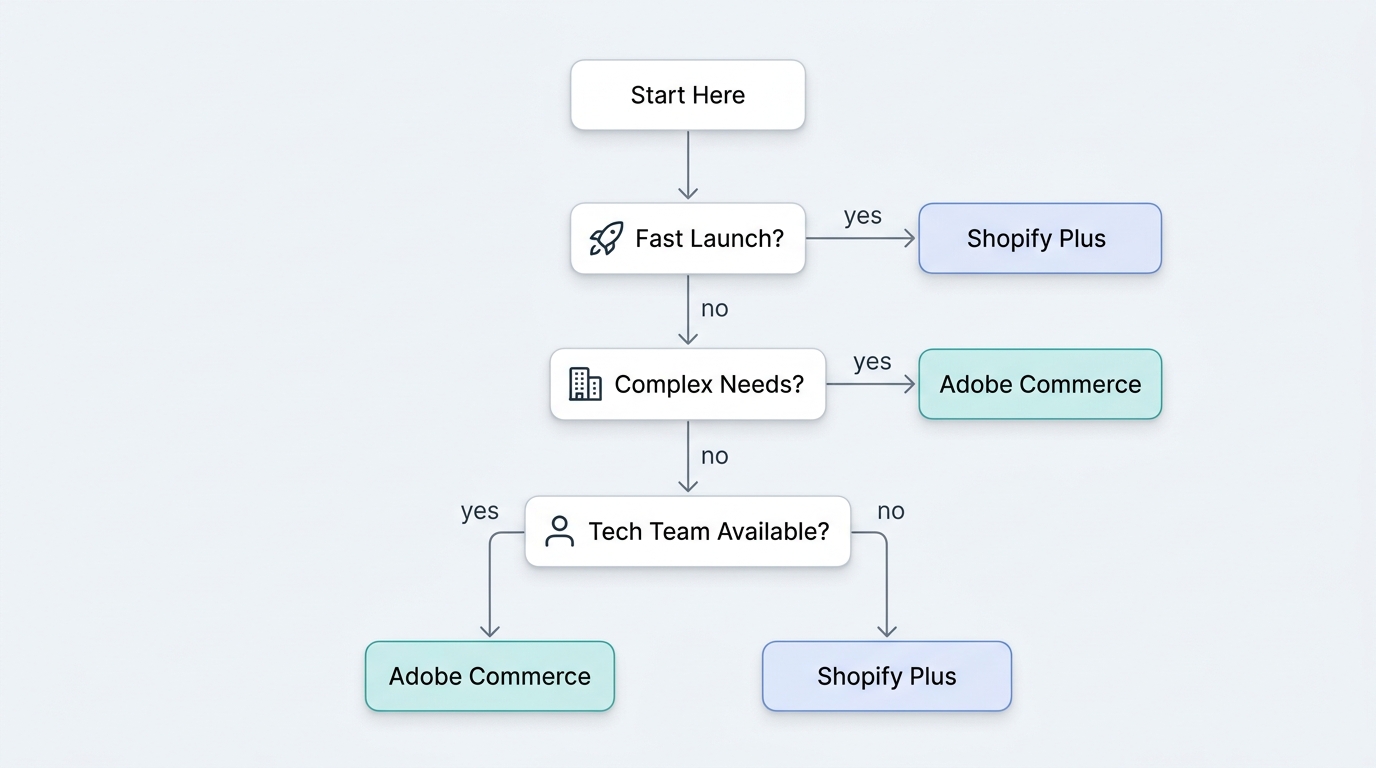
Shopify runs as a fully managed hosted SaaS platform. That means someone else handles the servers, the CDN, the security patches, and the auto‑scaling. For a merchant, it translates into consistent page loads and a checkout that just works. Upgrades happen silently in the background. Black Friday traffic spikes get absorbed without a midnight DevOps call.
Adobe Commerce, by contrast, offers self-hosted flexibility. You choose the infrastructure—cloud or on‑prem—and you carry the responsibility. That responsibility brings power: Varnish caching can be finely tuned, server‑level optimizations can squeeze out extra milliseconds, and peak performance can surpass a standard Shopify store when engineered correctly. But it also requires a team that understands what a CDN configuration actually does. This self-hosted flexibility is a double‑edged sword.
In practice, performance differences are often less about the platform label and more about who is behind the keyboard. A well‑optimized store running on Adobe Commerce with a dedicated DevOps engineer can outperform a Shopify store choked with poorly chosen apps. Yet for most mid‑market businesses, Shopify's out‑of‑the‑box SaaS infrastructure removes a whole category of operational risk. You trade some control for the confidence that your store won't buckle under a sudden surge.
Consider a catalog with 5,000 SKUs and moderate daily traffic. Shopify's integrated CDN and caching handle that workload without a second thought. Now imagine a B2B operation with 200,000 SKUs, real‑time inventory sync, and regional pricing tables. The platform can be tuned to deliver sub‑second page loads for such complexity, but only if someone configures Varnish and Redis correctly. The performance equation is straightforward: if you have a DevOps team and unique traffic patterns, Adobe Commerce can fly higher. If you don't, Shopify's default flight path is safer.
Time to First Sale vs. Time to Full Control
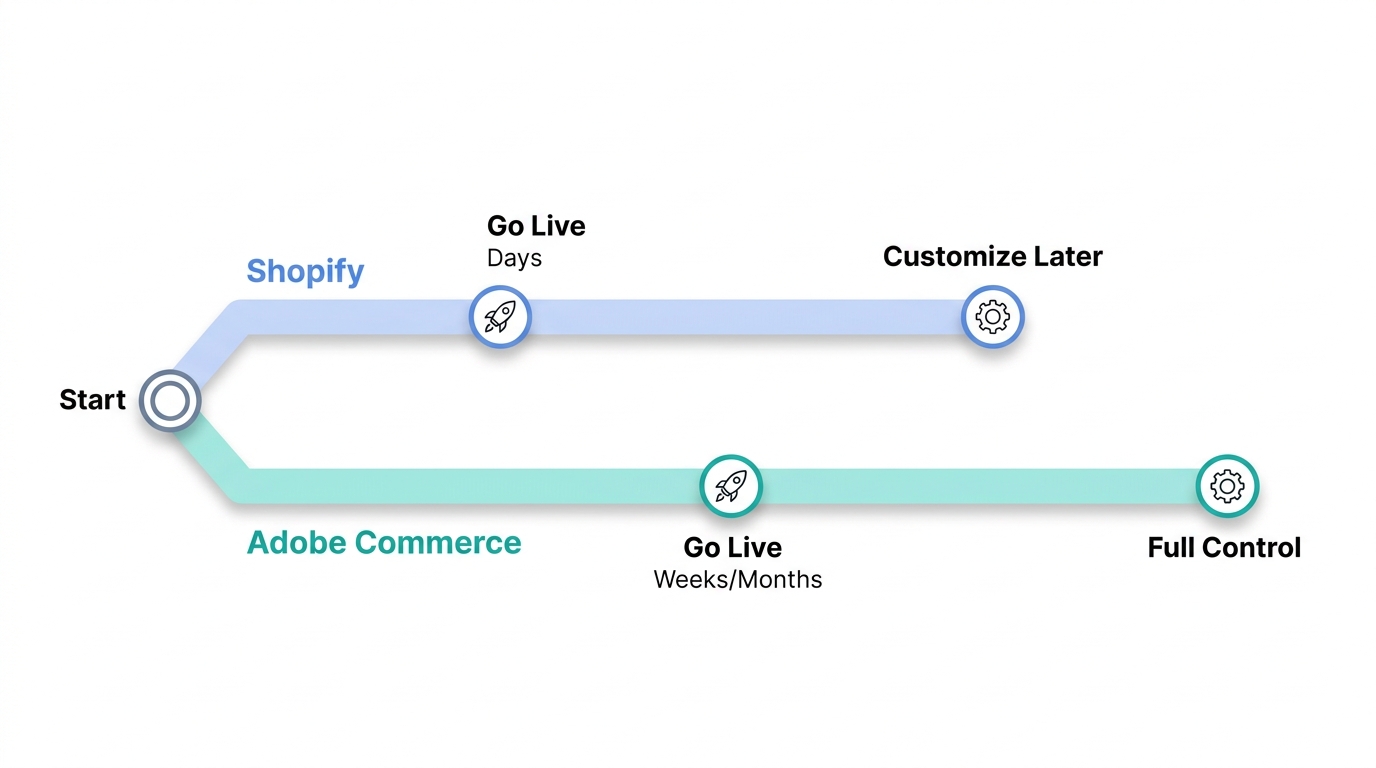
Shopify's promise is speed to market. A brand‑new store can be live in days. The admin panel is intuitive, the theme editor works like a website builder, and apps install with a click. For a small‑to‑midsize team, that usability is a competitive advantage. There's no need to understand store views, attribute sets, or compilation commands. You just start selling.
Adobe Commerce operates on a different clock. Its learning curve is genuinely steep. Developers and merchants alike report weeks to months before a first launch, even with experienced implementers. This platform uses concepts like websites, stores, and store views that demand upfront architectural planning. Admin UIs are powerful but dense. The trade‑off is that this complexity buys you depth: multi-store management, complex product relationships, and custom checkout flows that Shopify simply cannot match on lower plans. As we often tell clients, picking Adobe Commerce means choosing a platform that expects you to have a developer. If you don't, the learning curve becomes a cliff.
For a fashion brand launching a single store with 500 products, Shopify's admin streamlines every step from product import to launch. For a manufacturer running five country‑specific stores with different tax rules and customer groups, Adobe Commerce's multi-store architecture is the right fit—but only if you can afford the ramp‑up. That's why we frequently see teams partner with a Shopify development company to compress the Shopify timeline even further, or engage ecommerce development services to tackle the learning curve head‑on. Adobe Commerce development is a significant investment.
The True Price Tag: Total Cost of Ownership Beyond the Subscription
Sticker price tells a fraction of the story. Shopify's plans start at $39/month for Basic, scale to $399/month for Advanced, and reach $2,900/month for Shopify Plus. Hosting, security, PCI compliance, and a global CDN are baked into the subscription. App costs add up—often $200–$800/month for a solid stack—but they're predictable and ratchet up only as you grow.
The license for Adobe Commerce starts around $22,000/year, but that's just the entrance fee. Hosting runs $500–$2,000/month depending on traffic. Development costs typically range from $100–$200/hour, and a full build can take three to six months. Annual maintenance—patches, security updates, performance tuning—can be a significant portion of the initial development cost, depending on complexity. Over three years, the total cost of ownership for a mid‑market merchant routinely lands 2–3x higher than Shopify Plus when you factor in the full team. (These figures are rough estimates based on industry experience, not exact quotes.)
Consider a merchant processing 50,000 orders per year. On Shopify Plus, they might pay roughly $3,500/month in platform fees plus $500/month in apps. On Adobe Commerce, a rough breakdown is $2,000/month licensing, $1,000/month hosting, and $8,000/month for a part‑time developer. That's the arithmetic of ownership. For enterprise operations with 500,000+ orders and a full‑time in‑house team, this platform can break even or become cheaper over five years—especially if the alternative is a Shopify Plus setup with dozens of high‑cost apps. But for most teams, Shopify's all‑inclusive model reduces both financial risk and the need for a dedicated ops team.
What You Can Build: Customization Depth and Ecosystem Reach
The Shopify App Store houses over 8,000 apps, built for one‑click installation. Need subscriptions? ReCharge. Loyalty? Smile.io. Translation? Langify. The ecosystem is vast because the barrier to entry is low. For many common use cases, there's a proven, supported app that gets you moving quickly. The catch is that apps run in Shopify's sandbox; they can't modify the core checkout (on plans below Plus) or deep architectural layers. Too many apps can also become a performance drag.
The Adobe Commerce Marketplace lists around 3,000 extensions, but each one tends to be more surgical. Where Shopify apps are often standalone, extensions from this marketplace integrate deeply with the platform's architecture. Developers can also write custom modules from scratch, using the full power of PHP and XML. The checkout, the cart, the customer account area—all are open for modification. This depth is invaluable for B2B commerce with complex pricing or for retailers who need custom ERP integrations. The extension marketplace offers specialized solutions, but each requires more technical know‑how than a typical Shopify app. The customization depth is unmatched for complex needs.
In practice, a merchant who wants to add subscription functionality might find Shopify's ReCharge app does most of the job quickly. On Adobe Commerce, achieving the same might involve installing an AheadWorks extension, configuring cron jobs, and customizing email templates—requiring a developer but yielding a tightly integrated result. Customization depth is often a question of control versus convenience. When you need full control, Adobe Commerce delivers; when you need speed, the Shopify App Store is hard to beat.
AI in 2026: Shopify Magic and Sidekick vs. Adobe's Intelligent Suite
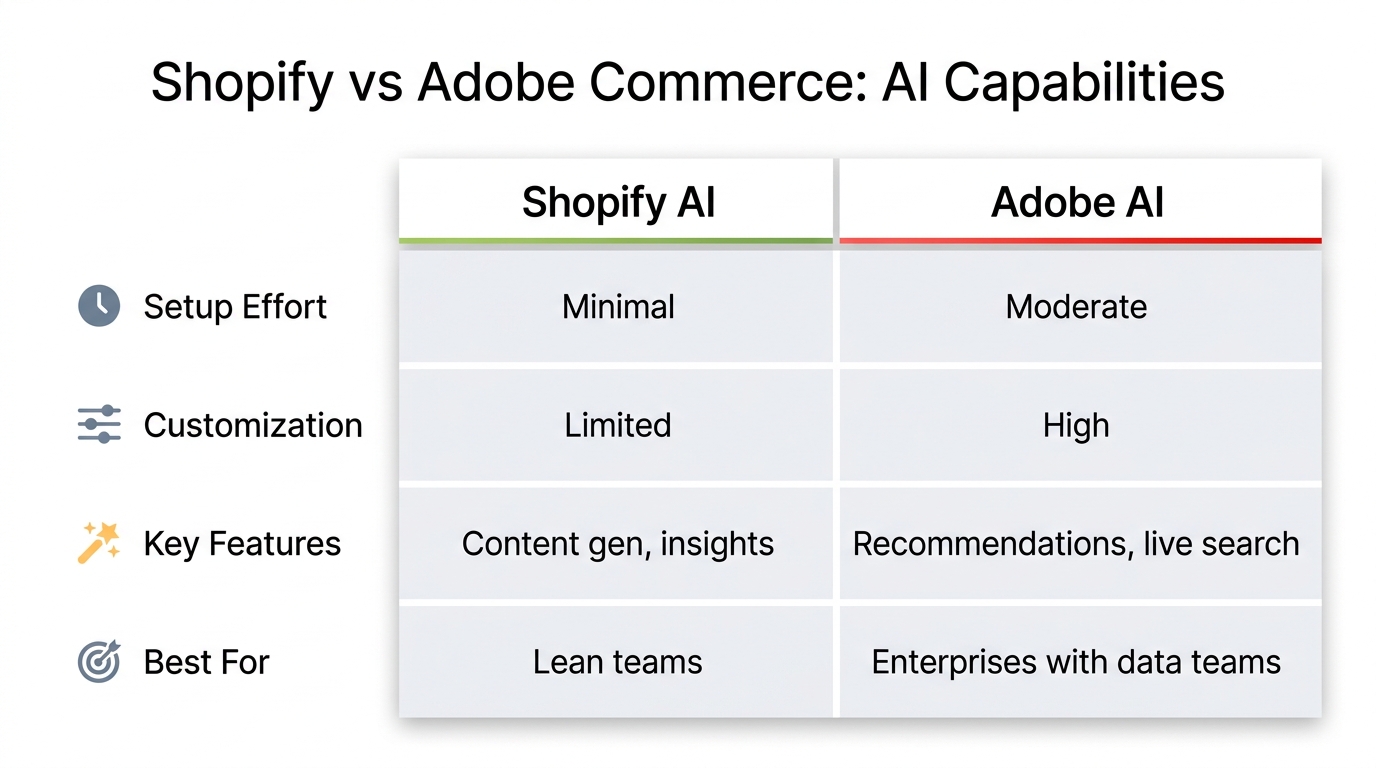
AI is no longer a checkbox; it's reshaping how stores operate. Shopify Magic embeds generative AI directly into the admin. Merchants can generate product descriptions, FAQ content, and email copy from natural language prompts. It feels like having a junior copywriter on demand. Sidekick, Shopify's AI assistant, takes this further: you can ask "show me top‑selling products last month by category" and get an instant analysis without writing a single SQL query. These tools are on by default, designed for merchants who want AI to reduce grunt work immediately.
Adobe Commerce leans on Adobe Sensei, a mature AI layer that powers product recommendations, live search, and visual similarity lookups. The product recommendation engine uses shopper behavior to surface cross‑sells and upsells across massive catalogs, and it can be fine‑tuned by category or customer segment. Live Search brings NLP capabilities—synonyms, faceted navigation, typo tolerance—that handle large catalogs effectively. However, these capabilities are opt‑in and require configuration. They shine when integrated with other Adobe Experience Cloud products, but they presume a technical team that can wire them into the customer journey.
The difference is philosophical. Shopify's AI democratizes intelligence for lean teams. Adobe Commerce's AI is a precision tool for organizations that already invest in data science. If your team lacks a data analyst, Shopify Magic can provide much of the benefit instantly. If you're building bespoke personalization models across multiple channels, this platform offers a more flexible canvas. This isn't about which AI is "better"—it's about which one matches your team's operating model. We often help clients evaluate their AI readiness through our AI consulting services, ensuring they don't over‑invest in capabilities they can't operationalize.
When Adobe Commerce Is the Right Choice
Adobe Commerce isn't the right answer for everyone. But for certain profiles, it's the only answer. Complex B2B commerce is the most common scenario: customer‑specific catalogs, negotiated pricing, bulk ordering, quote management, and company accounts. Shopify Plus can handle some B2B through apps and custom functions, but this platform was built for it. The native B2B module supports shared catalogs, quick order forms, and requisition lists that map to real procurement workflows.
Multi-store management is another sweet spot. A single instance can power dozens of country‑ or brand‑specific stores, each with its own domain, pricing, and tax rules, all sharing a master catalog. Managing 12 separate Shopify stores can become an operational headache; the website‑store‑store view hierarchy collapses that complexity into a single admin.
Deep customization is where open‑source DNA shines. Custom ERP integrations, headless commerce with PWA Studio, and completely bespoke checkout flows are table stakes for enterprises. Adobe Commerce's API‑first architecture and event‑driven plugin system let developers build precisely what the business needs. The prerequisite, however, is a capable development team. This platform is not something you learn on the fly. It's a platform you hire for.
Your Platform, Your Future
By now, the pattern should be clear. The right platform depends on the match between your business complexity, your team's technical muscle, and your growth trajectory. The following decision table distills the comparison into a single view. (Note: Cost ranges are approximate and based on typical implementations; actual costs vary.)
| Criteria | Shopify Plus | Adobe Commerce |
|---|---|---|
| Performance | Managed cloud, consistent speed, auto‑scaling | Self‑hosted, peak performance requires DevOps, can surpass Shopify when tuned |
| Usability | Low learning curve, launch in days | Steep learning curve, launch in weeks/months |
| Total Cost (3yr) | ~$100k–$150k (Plus + apps + development) | $150k–$300k (license + hosting + dev + maintenance) |
| Customization | Deep via APIs, Liquid, checkout.liquid (Plus) | Full control, custom modules, any integration possible |
| Ecosystem | 8,000+ apps, plug‑and‑play | 3,000+ extensions, deeper configuration required |
| AI Features | Shopify Magic, Sidekick (on by default) | Adobe Sensei: recommendations, live search (setup required) |
| Ideal For | Mid‑market to enterprise, lean teams, speed‑to‑market | Complex B2B, multi‑store, enterprises with in‑house dev |
The platform you choose will either fade into the background as your brand grows, or it will become a recurring item on the board meeting agenda. The best implementation of a "less powerful" platform often outperforms a botched attempt at the "more powerful" one. So assess honestly. If your roadmap demands complex B2B features and you have an engineering team, Adobe Commerce is a strategic asset. If you need speed, simplicity, and a predictable cost base, Shopify Plus is the pragmatic bet.
Deciding between these platforms is one of the most consequential bets you'll make this year. We help teams make that bet wisely—and then execute it, whether that means accelerating a Shopify launch through our shopify development company or architecting an enterprise rollout of this platform with our ecommerce development services. The right conversation today can avoid years of regret tomorrow. Contact us to discuss your 2026 plan.
Frequently Asked Questions
Is Adobe Commerce really that hard to learn?
Yes, the learning curve is steep compared to Shopify. This platform assumes technical knowledge of PHP, XML, and database architecture. Merchants without a developer will struggle to launch and maintain a store. However, this complexity is intentional—it enables advanced features like multi-store management, custom catalogs, and deep integrations that Shopify's simpler admin cannot replicate. Mastering Adobe Commerce takes significant time and developer resources. Dedicated learning is required.
Can I use Shopify for B2B commerce?
Yes, especially with Shopify Plus, which includes B2B features like company profiles, price lists, and net payment terms. The Shopify App Store also offers B2B‑focused apps. However, for very complex B2B scenarios—such as customer‑specific catalogs or extensive quote management—Adobe Commerce's native B2B module is more robust.
Which platform is more cost‑effective in the long run?
For most mid‑market businesses, Shopify Plus is more cost‑effective when factoring in hosting, development, and maintenance. Adobe Commerce can become cheaper at enterprise scale (500,000+ orders/year) if you already have an in‑house development team. Over three years, this platform often costs 2–3 times more for a comparable feature set. (These are rough estimates based on typical projects.)
How do the AI features compare?
Shopify Magic and Sidekick are built for speed and ease: they generate content and provide operational insights with minimal setup. Adobe Sensei offers more powerful personalization and search capabilities, but requires configuration and integration. Choose Shopify AI for instant value; choose Adobe Commerce's AI for customizable, enterprise‑grade intelligence. The AI tools in this platform integrate deeply when configured properly.
Can I migrate from Shopify to Adobe Commerce later?
Yes, but it's a significant replatforming project. Data migration, custom feature rebuilds, and team retraining are required. Many businesses start with Shopify for speed and migrate to Adobe Commerce when complexity outgrows the platform. Planning for this eventuality from day one can reduce future friction.
Contact us to discuss your ecommerce platform needs for 2026. We'll help you choose the right foundation and implement it without drama.

Loading...