The AI Agent Decision Line: Automate, Escalate, or Keep Human-Only
A three-tier decision line for enterprise AI agents, with five tests that place any workflow step in the right tier before you build.

Enterprise AI agents are the new frontier for operational efficiency, yet many leaders struggle with where to draw the line between automation and human control. It’s Monday morning, and the operations lead is pitching an enterprise AI agent for the claims intake process. The room splits. On one side: “This will cut our turnaround time.” On the other: “What if it approves the wrong claim?” The CEO listens, then asks the only question that matters: “Who owns the mistake if the agent gets it wrong?” The room goes quiet.
That silence is the real gap. Most leaders have moved past asking what an enterprise AI agent is; they are now deciding which work to hand to one. But without a clear decision line, the conversation swings between full automation and full caution, and neither extreme is workable. The answer is not a list of use cases or a technical architecture; it is a three-tier framework that places every workflow step into one of three buckets: automate, escalate, or keep human-only.
When you deploy enterprise AI agents, they should operate in three tiers: automate, escalate to a named approver, or keep human-only. Decide based on how reversible the action is, what a wrong answer costs, and whether one person owns the workflow. Steps that are cheap to reverse, low-risk, and owned are automation candidates; everything else needs an approval checkpoint.
If you need a quick refresher on what an AI agent actually is, read our plain-English guide to AI agents. The rest of this article assumes you already know that an agent can act autonomously within defined rules.
In the sections ahead, we’ll walk through the three tiers, then the five tests for placing any step in the right tier, then two everyday workflows—a hotel guest request and an insurance claim to see the framework in action. After that, we’ll cover the control mechanisms that make the line real: role-based permissions, approval checkpoints, audit trails, and measured outcomes. By the end, you’ll know how to draw the line for your own operation. Enterprise AI agents are not a one-size-fits-all tool; they demand a deliberate, governed approach.
The Three Tiers Every Workflow Step Falls Into
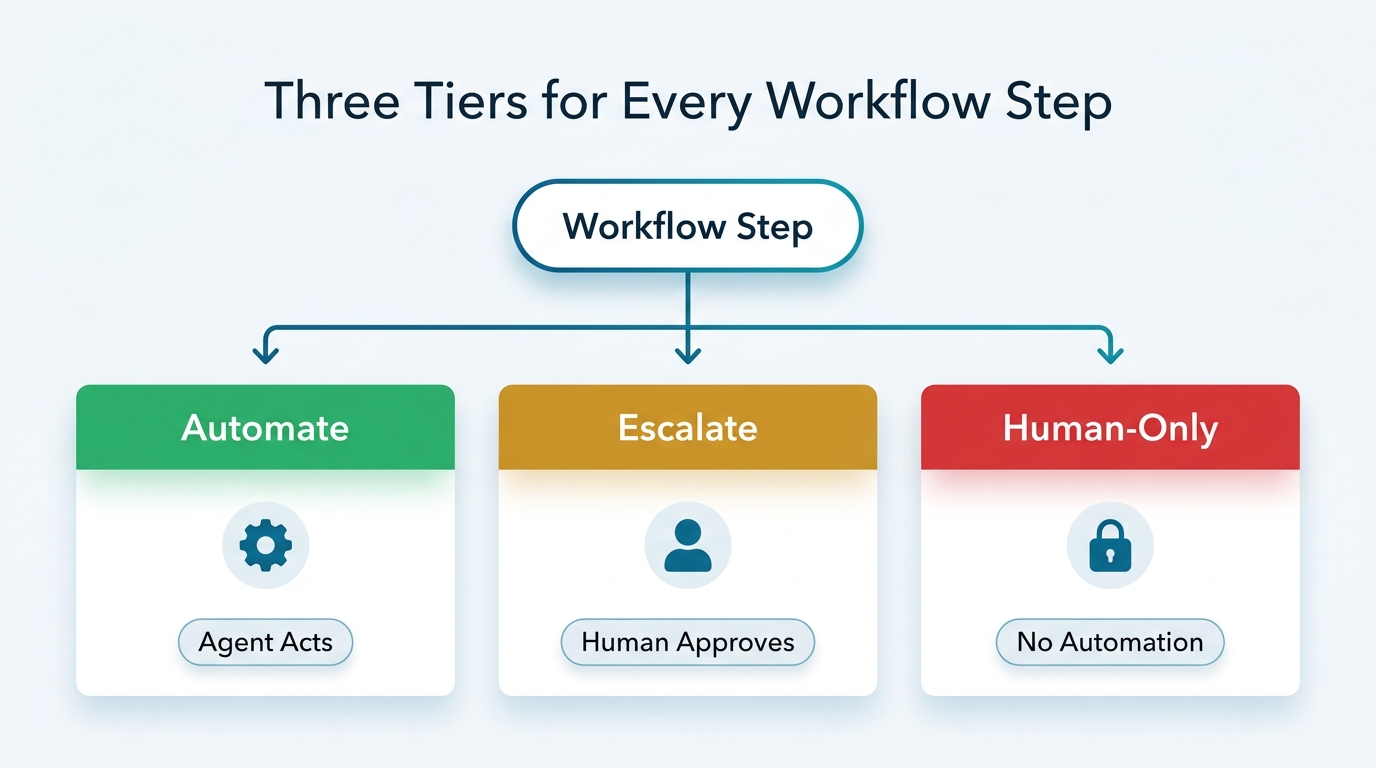
Every workflow step, every task, decision, or action, fits into one of three tiers. The first tier is automate: the agent acts on its own, and the system records that it acted. There is no human in the loop for that specific step, but the action is logged and reversible. The second tier is escalate: the agent prepares the work like it drafts the message, compiles the data, recommends the next action, but nothing leaves the building until a named person approves. The human checkpoint is the gate. The third tier is human-only: the agent may inform or assist, but it never acts. The step stays with a person, full stop.
This is not a capability decision; it’s an ownership decision. The contrarian insight is that the real question is not “Can the agent do this?” but “Who owns the mistake if it’s wrong?” If you cannot name that person, the step does not belong in automate. If the cost of a mistake is more than the time saved, it belongs in escalate or human-only. This is the same logic you use with a trusted chief of staff: she books your travel without asking, prepares the budget for your sign-off, and never signs a contract in your name. The skill is drawing those lines deliberately, and then revisiting them as trust builds.
Automate what you can afford to get wrong. Escalate what you can’t. Keep human what you must.
Now, many teams want to skip this classification and just deploy the agent everywhere. That is how how agentic AI projects go wrong. The agent gets loose, the audit trail is thin, and the business pulls back. Instead, treat the three tiers as a governance foundation, not a hurdle. Agentic AI systems, as described by IBM, are designed to pursue complex goals with limited supervision, which makes this governance even more critical. When planning enterprise AI agents, this governance foundation becomes the difference between a controlled rollout and a costly experiment. Effective AI agent governance starts with this tiered approach.
Five Tests for Placing Any Step in the Right Tier
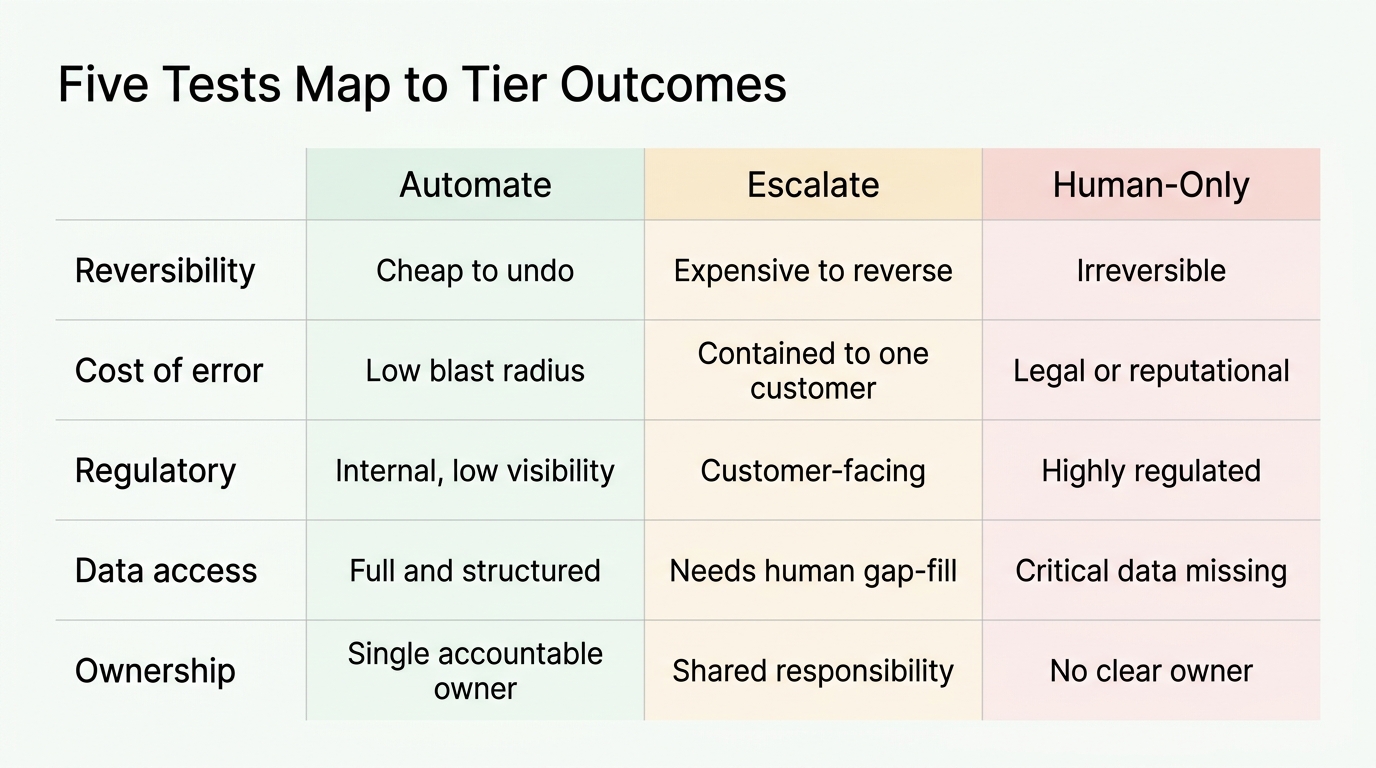
To decide which tier a step belongs in, run it through five questions. Each question forces you to look at the step from the perspective of risk, ownership, and reversibility. The table below summarizes the placement, and then we’ll go through each test in detail. These tests are the same ones we apply when designing enterprise AI agents for clients.
Table: Placement of workflow steps across the three tiers
| Criterion | Automate | Escalate | Human-only |
|---|---|---|---|
| Reversibility | Action is cheap to undo | Action is expensive to reverse | Action is irreversible |
| Cost of error | Low cost, low blast radius | High cost, contained to one customer | Reputational or legal risk |
| Regulatory / customer-facing | Internal, low-visibility | Customer-facing, moderate regulation | Highly regulated or public |
| Data accessibility | Data fully accessible and structured | Data partially available, needs human gap-fill | Critical data missing |
| Workflow ownership | Single owner, accountable | Multiple owners or shared responsibility | No clear owner |
Can the action be undone cheaply?
If the agent takes an action and it turns out wrong, can you reverse it without significant cost or damage? Sending a routine confirmation email is cheaply reversible; issuing a $5,000 refund is not. For automation, the action should be easy to undo or low-stakes. If reversal requires customer notification, financial adjustment, or regulatory reporting, the step should escalate for human approval. Irreversible actions like terminating a contract or deleting customer data—are human-only.
What does a wrong answer cost, and who bears it?
Consider the blast radius. A wrong answer that affects one internal process and can be corrected within minutes might be fine to automate. A wrong answer that affects a customer relationship, a regulatory filing, or a legal obligation deserves a human checkpoint. Calculate the cost not just in dollars but in trust, reputation, and employee time. If the cost of the error is higher than the cost of the human review, escalate or keep human.
Is the decision regulated or customer-facing?
Regulated decisions—lending, claims settlement, healthcare advice, employment actions almost always require human accountability, either by law or by customer expectation. Customer-facing communications can be automated if they are informational or low-risk, but anything that commits the company, expresses regret, or negotiates terms should escalate. Internal, low-visibility steps are the best candidates for automation.
Can the agent actually reach the data it needs?
An agent is only as good as the data it can access. If the data is fully accessible via APIs, structured, and current, the agent can act confidently. If the data is spread across systems, stored in unstructured documents, or requires human interpretation, the agent should escalate so a person can fill the gaps. If critical data is missing or inaccessible, the step should stay human until the data pipeline is fixed. This is a common reason where AI implementations stall.
Does one named person own this workflow end to end?
Workflow ownership is the foundation. If one person is accountable for the workflow’s outcomes, that person can define the tiers, set the checkpoints, and review performance. If ownership is diffuse: multiple departments, no clear owner—the step should not be automated yet. Escalate to force a decision, or keep human until ownership is clarified. In our experience, many automation failures trace back to missing ownership, not missing technology. Enterprise AI agents, without clear ownership, become a liability rather than an asset.
The Framework in Action: Two Everyday Workflows
Hotel Guest Request: From Intake to Closure
Imagine a mid-size hotel chain. A guest sends a request via the app: “Can I get a late checkout tomorrow?” The agent receives the request, identifies the guest and reservation, and checks policy. If the request is for a checkout before 1 PM and the room is not booked, the agent sends a confirmation automatically. That step is automate: cheap to reverse, low cost, internal.
If the guest asks for a 4 PM checkout, which has a fee and may affect housekeeping, the agent drafts a response with the fee and suggests a time, but it does not send. The request escalates to the front desk manager, who approves, adjusts, or denies. The manager is the named approver; the audit trail shows the escalation.
If the guest reports a safety issue…say, a broken lock or a suspicious person—the agent does not act. It alerts the security team and logs the message. That step is human-only.
Insurance Claims Intake
A property insurance claim arrives by email. The agent extracts the policy number, date of loss, and description, and creates a claim record. That’s automate: the data extraction is reversible (a human can correct it) and low-cost.
The agent then suggests a coverage determination based on policy rules. Because this is a customer-facing decision with regulatory implications, the step escalates to a claims adjuster. The adjuster reviews the recommendation, makes the final call, and the decision is recorded.
If the claim involves suspected fraud or exceeds a certain dollar threshold, the agent stops and flags it for special investigation. That’s human-only; a senior adjuster or investigator takes over.
The split is not static. After the agent has processed a few hundred claims with low error rates and few human overrides, the organization might move the coverage determination for simple, low-value claims into automate, while keeping high-value or complex claims escalated. That shift happens only after the measured outcomes justify it. This iterative approach is how mature enterprise AI agents earn their keep. But there is a critical step that many teams overlook: defining the escalation path. An escalation path ensures that when the agent flags an issue, it reaches the right human quickly, with all the context needed. This is a key part of AI agent orchestration. Without a clear escalation path, even the best-intentioned approval checkpoint can become a bottleneck.
Making the Split Real: Permissions, Checkpoints, and Audit Trails

The three-tier split is only as good as its enforcement. Without explicit controls, the agent can drift outside its lane, and humans will lose trust. Four mechanisms make the split real:
Role-based permissions bound what the agent can touch. The agent’s role determines which systems it can access, which actions it can take, and which data it can read. For example, an agent handling customer service can read the CRM but not the billing system; it can create a case but not issue a credit. Permissions are the first line of defense. For enterprise AI agents, this is the first control to put in place. Role-based permissions also support audit trails because they define what the agent is authorized to do.
Approval checkpoints enforce the escalate tier. When a step is marked for escalation, the agent stops and waits for a named approver. The approver sees the agent’s proposed action, the evidence, and the reasoning. They can approve, reject, or modify. This checkpoint is non-negotiable for escalated steps. In Microsoft Foundry’s agent service, for example, you can define multi-step approval workflows and human-in-the-loop checkpoints as part of the agent orchestration. The same principle applies to any platform. Effective AI agent orchestration relies on these checkpoints to maintain control. This is where human in the loop AI becomes tangible: the human is not just a spectator but an active decision-maker at the right moments. For enterprise AI agents, this human involvement is what builds trust. Approval checkpoints are a cornerstone of AI agent governance.
Audit trails record what the agent did, when, and why. Every action—every data access, every message sent, every escalation is logged with context. This supports accountability, regulatory compliance, and post-incident review. The NIST AI Risk Management Framework emphasizes auditability as a core governance practice. If something goes wrong, you can trace exactly what happened and who (human or agent) made each decision. An audit trail is also what allows you to demonstrate compliance to regulators and auditors, a non-negotiable for enterprise AI agents. Audit trails are the backbone of AI agent governance.
Measured outcomes close the loop. Define a small set of metrics that matter for each workflow: resolution time, escalation rate, error rate, and human overrides. Review them on a fixed cadence, weekly or monthly, with the workflow owner. If the numbers show the agent is consistently accurate and escalations are low, you can move more steps into automate. If overrides are high, tighten the rules or move steps back to escalate. This is how trust is earned, not assumed. For AI agents for business, this measurement is the difference between a toy and a tool that delivers measurable outcomes. Without it, you are flying blind. Enterprise AI agents need this feedback loop to keep improving. Measurable outcomes are what allow you to expand the automate tier safely.
The closing sequence is simple: pick one workflow that your team knows well, draw the three-tier line using the five tests, deploy with the measurement framework in place, and then widen the automate tier only as the numbers earn it. That is how you avoid the agentic AI disaster pattern and build a foundation that scales. Strong AI agent governance turns these mechanisms into a competitive advantage. Remember, autonomous AI agents are powerful, but they need guardrails. The combination of role-based permissions, approval checkpoints, and audit trails creates a safety net that allows you to trust the agent a little more each day. For enterprise AI agents, this governance isn’t optional, it’s the price of admission.
Frequently Asked Questions About Enterprise AI Agents
What are enterprise AI agents?
Enterprise AI agents are software systems that can act autonomously to perform tasks, make decisions, or interact with other systems on behalf of a business, within defined rules and permissions. They differ from simple chatbots by their ability to take actions across multiple steps and tools. For a deeper explanation, see our plain-English guide to AI agents. IBM’s definition similarly describes agents as systems that can independently perform tasks and interact with their environment. Google Cloud also defines AI agents as software that can reason, act, and interact to achieve goals. When considering AI agents for business, these definitions provide a solid starting point.
Which processes should AI agents automate first?
Start with steps that are cheap to reverse, have a low cost of error, are not customer-facing or regulated, and have a single clear owner. Internal data entry, status updates, and routine notifications are good candidates. Avoid starting with high-stakes decisions or processes with murky ownership. The five tests above give you a structured way to identify these. When you begin with enterprise AI agents, these criteria will keep your rollout safe. This is where human in the loop AI can be minimized initially, but only for low-risk steps.
What is human-in-the-loop AI?
Human-in-the-loop AI means that humans are involved in the decision loop at critical points, typically to approve, reject, or override an AI system’s proposed action. For enterprise agents, this usually takes the form of approval checkpoints for escalated steps. It ensures accountability while still leveraging the agent’s speed for preparation and execution. This is the essence of human in the loop AI in a business context. AI agent governance ensures these checkpoints are consistently applied.
How do you keep control of autonomous AI agents?
Control comes from governance mechanisms: role-based permissions to limit what the agent can access and do, approval checkpoints for high-risk actions, a comprehensive audit trail of every action, and regular review of measurable outcomes. Microsoft’s Cloud Adoption Framework specifically recommends governance and security controls for AI agents across the organization, including access controls and logging. NIST’s AI Risk Management Framework provides a broader risk management approach. This is the backbone of AI agent governance. Autonomous AI agents require these controls to remain trustworthy. Enterprise AI agents demand this level of control.
How do you measure whether an AI agent is working?
Define a small set of metrics that reflect the workflow’s goals: resolution time, escalation rate, error rate, and human overrides. Review these on a fixed cadence with the workflow owner. If resolution time drops while escalation and error rates stay low, the agent is performing well. If human overrides are high, the agent may need better training data or tighter rules. Measurement should drive the decision to expand or contract the automate tier. This is how you ensure measurable outcomes and continuous improvement. For enterprise AI agents, these metrics are non-negotiable. Measurable outcomes are the evidence that AI agents for business are delivering value.
Your Next Move: Draw the Line for One Workflow
The goal is not to automate everything. The goal is deliberate delegation: knowing exactly which steps can be safely handed to an agent, which need a human checkpoint, and which must stay human. That knowledge is your competitive advantage, because it lets you move fast without losing control.
Your next move is to pick one workflow that your team knows well, maybe a customer request intake, an invoice processing flow, or a claims triage. Sit down with the workflow owner and map each step to a tier using the five tests. Then define the permissions, checkpoints, and audit trail, and agree on the metrics you will review. Do not start with the hardest, highest-stakes process; start with one where the line is relatively clear. As the agent earns trust through measured performance, you can move the line. This is how you treat enterprise AI agents as a long-term capability, not a one-off experiment.
That is how we approach AI agent development services at Webuters. We help you draw that line, build the agent with the right governance, and measure what matters. If you want to see what this looks like in a platform, take a look at Webly, our enterprise AI operations platform, which bakes role-based permissions, approval checkpoints, and audit trails into every deployment. Or start with a free AI Readiness Assessment to see where your operations stand today.
The question is not whether you will adopt enterprise AI agents; it is whether you will draw the line before they act. Draw it now.
AI adoption and workflow automation
Start with one workflow, prove it in production, then scale what works.
See AI services
Krishna is the Founder and CEO of Webuters, a technology leader specializing in Generative AI, intelligent automation, enterprise software, and digital transformation. He helps organizations leverage emerging technologies to drive innovation, operational efficiency, and business growth. Through his writing, Krishna shares insights on AI adoption, technology leadership, product innovation, and the future of work, helping leaders navigate change and build future-ready organizations.
Follow Krishna on LinkedIn