

Success Story
Predictive maintenance for a manufacturer
How predictive maintenance on OT/IoT data reduced unplanned downtime and lifted equipment effectiveness.
Know moreThe connected factory. That's AI-first.
Most plants don't have a data problem—they have a connection problem. Machine telemetry sits in OT and IoT systems, production status in the MES, quality in inspection tools, and demand in supply planning, none of them talking to each other. So issues surface as unplanned downtime, scrapped batches, and stockouts after the cost is already absorbed. AI for manufacturing changes the timing. When these systems share one intelligence layer, patterns become visible while the shift is still running—vibration drifting toward failure, a defect trend forming, demand shifting ahead of the plan. Teams act early: they schedule maintenance before the breakdown, catch defects before they ship, and align production and inventory to real demand. The result is higher OEE, less waste, and a factory floor that predicts problems instead of reacting to them.
We connect OT, IoT, MES, and supply data into one intelligence layer—so the line, quality, and inventory move on live signals instead of yesterday's reports.
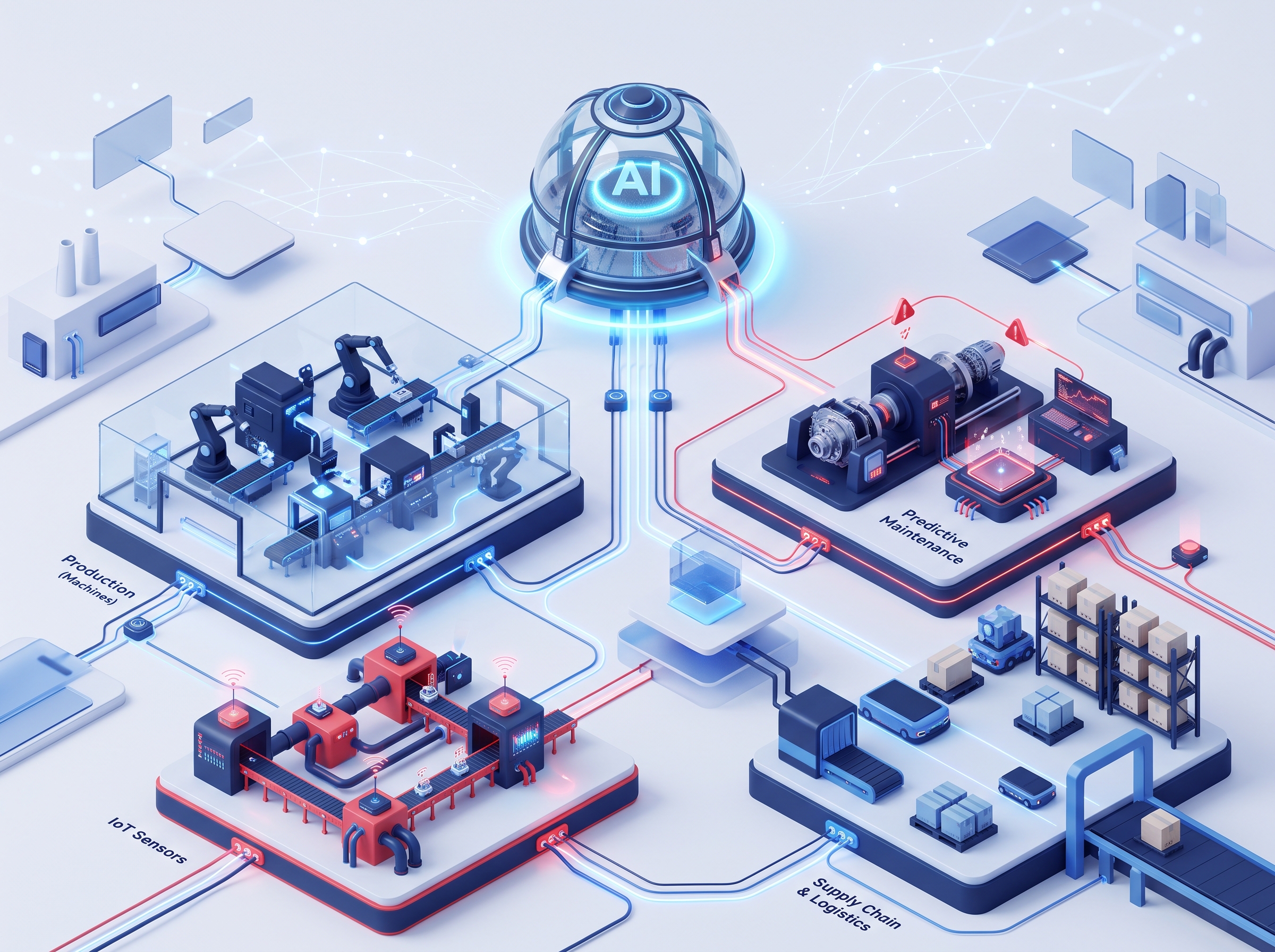
Spot vibration, temperature, and current drift before a critical asset fails, and turn the alert into a scheduled work order instead of an emergency stop.
Inspect every part at line speed with computer vision, flagging defects and drift the human eye misses and routing rejects before they move downstream.
Track availability, performance, and quality in real time to expose the true source of losses and rank the fixes that lift throughput fastest.
Forecast demand and align raw material, WIP, and finished goods so the line keeps running without tying up cash in excess stock.
Connect energy use to production and occupancy so consumption adapts to real load—cutting cost per unit without slowing output.
Use vision and sensor signals to catch PPE gaps, restricted-zone entries, and unsafe conditions in real time, escalating before an incident occurs.
How Webuters helps manufacturers connect the factory and act before the line stops.
View moreAI connects a plant's disconnected systems—OT, IoT, MES, quality, and supply data—into one intelligence layer, so teams predict equipment failures, catch defects on the line, lift OEE, and align production to real demand instead of reacting to problems after the cost is absorbed.
Predictive maintenance uses machine learning on sensor and machine telemetry—vibration, temperature, current, and more—to forecast failures before they happen. Instead of fixed schedules or run-to-failure, maintenance is scheduled on evidence, reducing unplanned downtime and extending asset life.
No. Our approach connects to your existing PLCs, SCADA, MES, and IoT systems and adds an AI layer on top, rather than requiring a rip-and-replace. The goal is to unify the signals you already generate, not to start over.
Computer-vision inspection is trained on your parts and defect types, so it improves as it sees more examples. It inspects every unit at line speed—catching surface, assembly, and spec issues consistently—while routing edge cases to human reviewers for judgment.
Start with our free AI Readiness Assessment. It scores your organization across eight dimensions and returns a personalized report with your gaps and a 90-day roadmap to a connected, AI-first factory.
Talk to our manufacturing AI team about predictive maintenance, computer-vision quality, and smart-factory analytics that keep the line moving.
Tell us about your plant and goals—we'll show you where AI can cut downtime, protect quality, and lift throughput.
Get a clear picture of your AI readiness across strategy, data, technology, and operations—and a practical roadmap to the connected factory.
Take the free AI Readiness Assessment