
From AI Chaos to AI Clarity: A Workflow-First Framework for Shopify Stores
Stop buying AI tools. Start owning workflows. Learn a practical framework to prioritize AI automation in Shopify, assign ownership, measure ROI, and keep…

Shopify development services are the starting point for many merchants looking to integrate AI, but they need a workflow-first framework to turn tools into business outcomes.
Imagine installing smart lights, automated blinds, and voice assistants in every room of your house, only to realize the dimmer switch overrides the schedule and the garage door won’t sync. That is the reality for many Shopify store owners after investing in AI chatbots, recommendation engines, inventory predictors only to find that their tools delivered no real transformation. Shopify development services that skip workflow design often produce expensive fragmentation with no clear owner and zero measurable ROI.
The root cause is not just the technology but also the approach. Most merchants hook up AI tools in isolation, without first designing the workflows that tie those tools to real business outcomes. Successful AI adoption demands a workflow-first strategy. Before you buy another plugin or hire another developer, you need a framework that prioritizes specific customer journeys, assigns accountability, defines measurable KPIs, and bakes in human oversight. That is the real shift, from random AI experiments to orchestrated commercial workflows. And it is precisely where the right shopify development services can bridge the gap between ambition and execution.
In the sections ahead, we’ll walk through four high-impact commerce workflows you can automate with confidence, explore how to assign clear workflow ownership and measure success, and outline a phased implementation roadmap that ties AI investments directly to revenue and trust.
Why the Smart Home Approach Fails
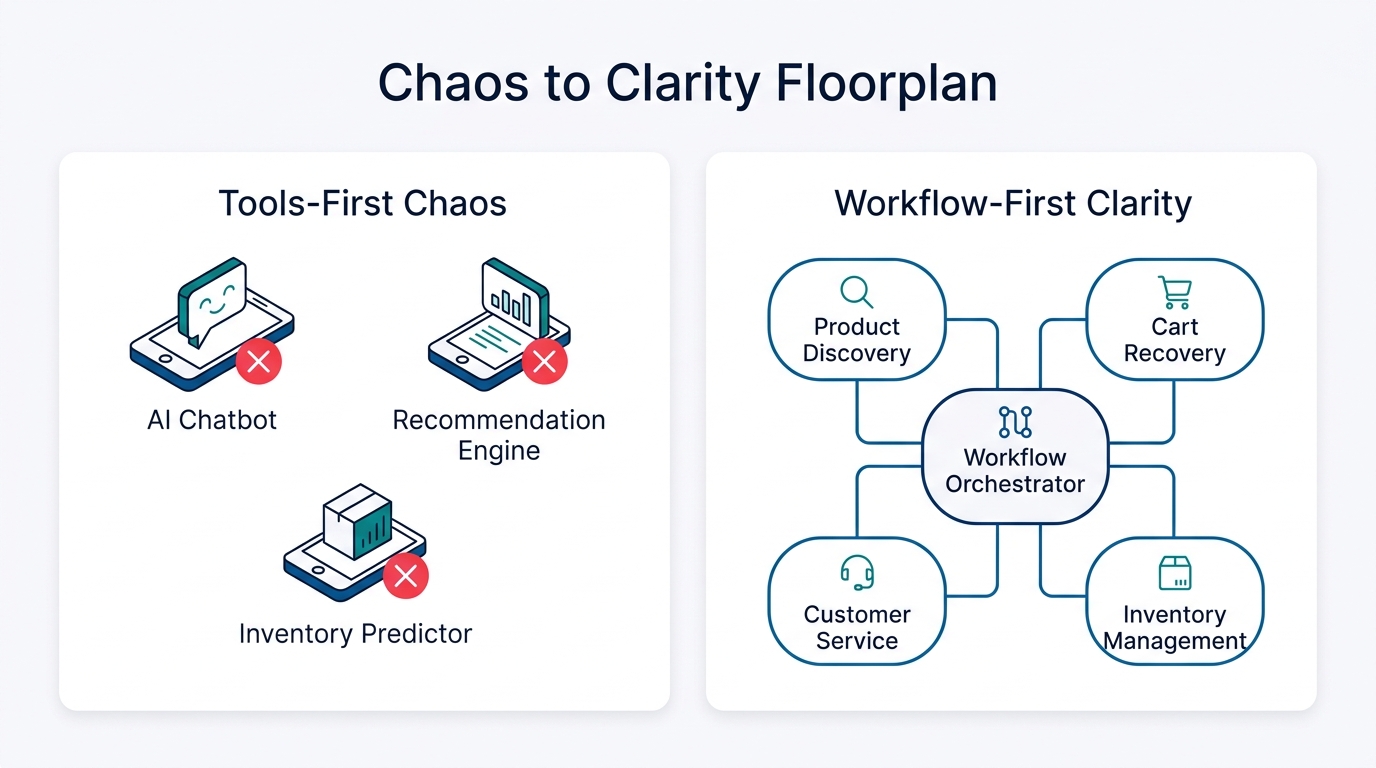
The appeal of plug-and-play AI is undeniable. Shopify’s app marketplace is flooded with solutions promising instant personalization, automated support, and predictive analytics. Yet the reality for many stores is a patchwork of disconnected tools. A product recommendation engine pulls from stale inventory data; a chatbot responds with irrelevant promotions; an inventory predictor misses supplier lead times. Each tool works in its own silo, generating noise rather than revenue.
Think of it this way: wiring each room independently without a master plan might get the lights on, but they’ll never work in harmony. The same logic applies to shopify development services. Technology must serve the business process, not the other way around. When services skip workflow design, you end up with costly integrations that confuse your team and disappoint customers.
That’s why the smartest merchants are pivoting away from tool-first thinking. They’re mapping their commerce operations end to end and asking a different question: which workflows, if automated intelligently, would unlock the most value? The answer invariably points to a handful of core revenue-critical processes. That is the real opportunity for ecommerce AI workflows.
The Four Workflows That Deserve Your AI Investment
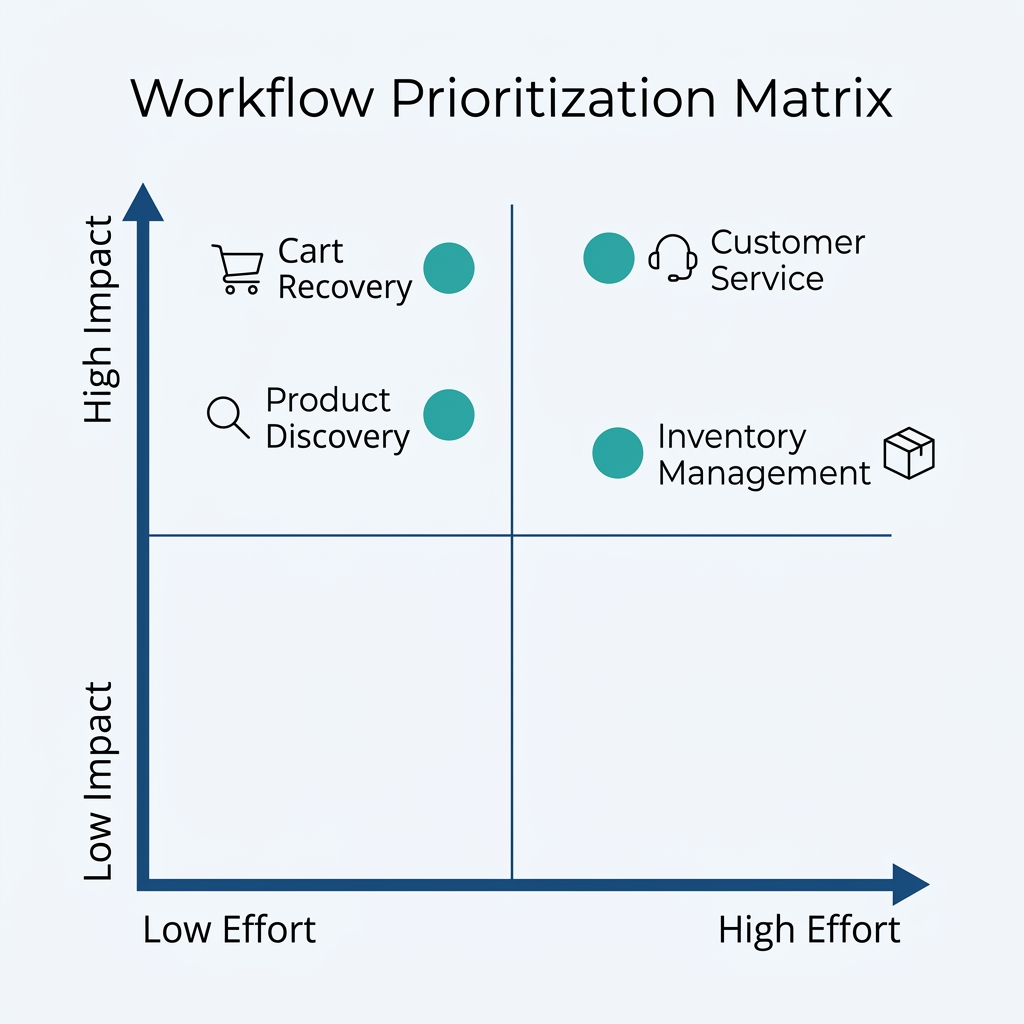
Not all workflows are created equal. Based on our work with D2C brands and enterprise merchants, four consistently deliver outsized returns when anchored in clear metrics and ownership.
Product Discovery. AI-powered recommendations and personalized search directly lift average order value and conversion rates. When a merchandising manager owns the workflow and can tweak algorithms based on buyer behavior, the impact compounds. Consider an apparel brand we worked with: after integrating behavioral signals into its recommendation engine, average order value rose meaningfully. The lift came from close collaboration between the merchandising team and developers. Reliable shopify development services often begin with this workflow because the data is readily available and the metrics are clear.
Cart Recovery. Abandoned carts plague every store. Baymard Institute pegs the average abandonment rate at roughly 70%. A well-crafted cart abandonment recovery sequence: dynamic reminders, personalized offers can reclaim a significant portion of those lost sales. This is not a set-and-forget plugin; it requires ongoing optimization. A marketing lead who interprets recovery data and adjusts thresholds can turn a cost center into a profit center. Shopify development services that focus on cart recovery build sequences with clear ownership and measurement.
Customer Service. AI chatbots can handle most routine inquiries like order status, return policies, freeing human agents for complex issues. But without scripts that escalate sensitive topics, you risk brand damage. When a support operations head owns the CSAT and first-response metrics, and the chatbot is continuously trained on real interactions, satisfaction scores climb while costs drop.
Inventory Management. Demand forecasting and dynamic replenishment reduce stockouts and excess inventory. A supply chain manager monitoring forecast accuracy can prevent lost sales from empty shelves and write-offs from overstock. For example, a consumer electronics store integrated historical sales data with weather trends via AI, improving forecast accuracy noticeably and cutting stockouts significantly. Such outcomes are the hallmark of well-designed shopify development services.
All four workflows share a common thread: they directly affect revenue, cost, or customer experience. The table below summarizes the ownership, KPIs, and trust controls we recommend.
| Workflow | Owner | Primary KPI | Human-in-the-Loop Checkpoint |
|---|---|---|---|
| Product Discovery | Merchandising Manager | AOV, Conversion Rate | Approve discount tiers >10% |
| Cart Recovery | Marketing Lead | Recovery Rate, Revenue Recovered | Approve dynamic offer thresholds |
| Customer Service | Support Operations Head | CSAT, First Response Time | Escalate sensitive queries |
| Inventory Management | Supply Chain Manager | Stockout Rate, Forecast Accuracy | Approve orders >20% above forecast |
When the goal is responsible implementation rather than isolated tool use, Webuters’ Generative AI services and solutions give teams a practical way to plan and build the workflow.
Assign Clear Ownership to Each Workflow
A common pitfall in shopify development services projects is treating them as purely technical initiatives. The development team installs a tool, and everyone expects magic. But AI is a business accelerator, not a substitute for process ownership. Each workflow needs a named person responsible for outcomes, not just a developer who implemented the feature. That is why workflow ownership is a cornerstone of any successful shopify development services engagement.
When ownership is murky, handoffs break down. A recommendation engine might serve outdated offers because no one updates the promotion rules. A cart recovery sequence might fire once and never optimize because the marketing team assumes IT owns it, and IT assumes marketing drives it. Clear ownership slashes these gaps.
Consider a Shopify store that assigned a checkout optimization owner from the marketing team. This person had authority over the cart recovery AI, a clear recovery-rate KPI, and a monthly review cadence. Within one quarter, recovery rate jumped notably. The technology didn’t change; the governance did. Shopify development services that embed ownership from the start consistently outperform those that don’t. The same principle applies to any development services initiative for Shopify.
For a practical example of how ownership drives results, see our case study on seamless student lifecycle management with zoho CRM and moodle LMS.
Measure What Matters Beyond the Dashboard
Ownership without measurement is gut-feel management. To justify investment and fuel iterative improvement, you need hard numbers. The KPIs we tied to each workflow: AOV, recovery rate, CSAT, forecast accuracy are lagging indicators. But you also need leading indicators to spot trouble early. Measurable business outcomes are the yardstick for any shopify development services investment.
For product discovery, watch click-through rate on AI product recommendations and the diversity of products seen. For cart recovery, monitor open rates and click rates on recovery emails, not just recovered revenue. For customer service, track deflection rate which is the percentage of queries the chatbot resolves without manual review. For inventory, measure the bias in your forecast to detect drift.
Before scaling any AI workflow, run a controlled experiment. A/B test the AI-enabled version against a control group for at least two inventory cycles or a full month of traffic. In one grocery store pilot that used this approach for inventory predictions, the AI-managed stores showed noticeably fewer stockouts with no increase in overstock after eight weeks. The ROI was clear. Shopify development services that insist on measurement build confidence across the organization.
Keep Humans in the Loop
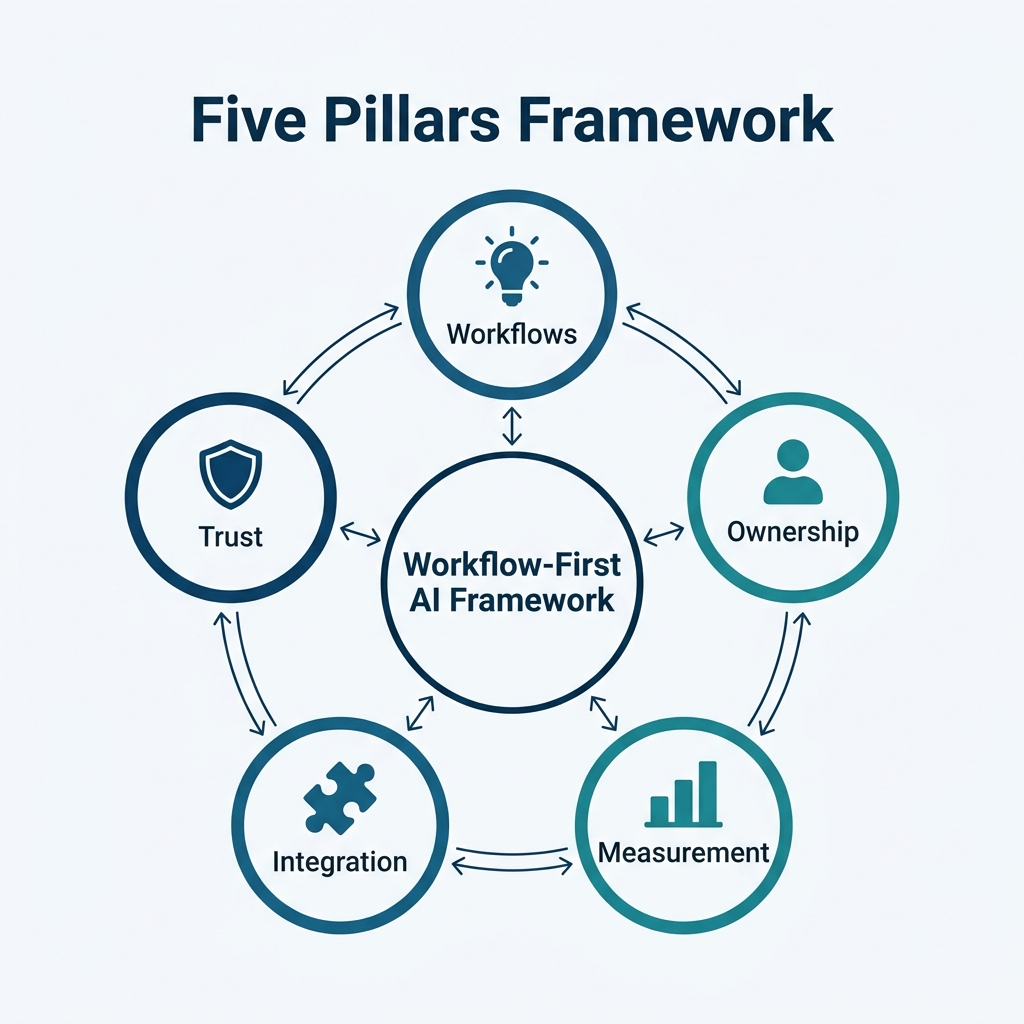
Measurement builds confidence, but trust comes from knowing when to let AI act autonomously and when to pause for human judgment. The checkpoints in the table: discount tiers, offer thresholds, query escalation, order limits, are safety nets. These trust controls are a critical component of responsible shopify development services.
Consider a scenario that could happen to any store: an AI chatbot trained on broad data might suggest a 70% discount to a high-value customer during a pricing glitch. Fortunately, if the support team has a manual review policy for offers exceeding a certain threshold, they can catch it and turn the interaction into a personalized white-glove discount. Without that human approval gate, it could be a costly embarrassment. Manual review points are especially critical for pricing, promotions, and supplier commitments decisions where brand equity and cash flow are on the line.
Similarly, a D2C fashion brand might implement an inventory reorder threshold: any AI-proposed order exceeding 20% of the 90-day average requires manual approval from the supply chain manager. That simple gate could prevent a significant overstock during a seasonal demand fluctuation. When selecting shopify development services, ensure they build in trust controls like these. The best partners prioritize governance alongside automation.
Systems and Data: The Foundation
AI models are only as good as the data they ingest. If your product catalog is incomplete, inventory counts are stale, or customer profiles are fragmented, no amount of algorithm tuning will save you. Before automating any workflow, you must connect the right systems. This is a prerequisite for effective shopify development services.
Shopify’s REST Admin API provides a robust backbone for pulling product, order, and customer data into a unified layer. But most stores also rely on a CRM like Zoho or Salesforce, and an inventory management or ERP system (see our CRM ERP services). The goal is a single source of truth that AI can rely on. Shopify development services that include data integration lay the groundwork for reliable automation.
We’ve seen the power of integration firsthand. A Shopify store using Zoho CRM to centralize customer notes and purchase history enriched their AI product recommendations with personal context, leading to meaningfully higher click-through rates. A higher education bookstore integrated Shopify with their campus ERP to automate textbook reordering based on real-time enrollment data, eliminating manual spreadsheets and stockouts during rush week. These wins happened because the data pipeline was solid before the AI layer was added.
For many merchants, the initial step is a minimal viable integration: connect Shopify to your core CRM (see our zoho services and solutions) and your inventory system. Once that data flows reliably, you can layer on the workflows we discussed. Trying to skip this step is like building a smart home on a foundation that hasn’t cured.
If Salesforce is your CRM, Webuters’ salesforce development services can help integrate Shopify and build AI workflows on a unified data layer.
A Phased Implementation Roadmap
Moving from chaos to clarity is not a weekend project, but it doesn’t need to be a year-long transformation either. A phased approach lets you deliver value quickly while building organizational muscle. This implementation roadmap is a blueprint for any merchant seeking shopify development services that deliver real impact.
Phase 1 – Audit and Prioritize (Weeks 1–2): Map your commerce workflows, identify bottlenecks, and baseline current KPIs. Score each workflow on potential impact vs. implementation effort. This prioritization often surfaces a clear first mover usually cart recovery or product discovery.
Phase 2 – System Integration (Weeks 3–4): Connect Shopify with your CRM and inventory systems. Ensure data quality. If you’ve been operating with silos, this is where you close the gaps. A rapid integration sprint with a partner experienced in AI consulting services can compress this timeline.
Phase 3 – Pilot One Workflow (Weeks 5–8): Select the high-priority workflow and build a controlled experiment. For cart abandonment recovery, implement AI-driven email sequences with a hold-out group. Define the success metric in advance and set review milestones. Keep the scope tight. Shopify development services that pilot one workflow at a time reduce risk and build momentum.
Phase 4 – Review, Trust, and Scale (Weeks 9–12): Analyze pilot results, implement trust controls identified during testing, and document the playbook. Then expand to the next workflow. Within six months, a merchant following this sequence can automate two to three core workflows and start compounding gains.
In our experience, a D2C electronics brand that piloted cart abandonment recovery AI in Phase 3 saw a noticeable recovery rate lift. Because they had clear ownership and measured consistently, they had the confidence to apply the same framework to product recommendations and customer service. Over the following year, their overall revenue per visitor grew steadily. Measurable business outcomes like these justify broader investment in shopify development services.
Leading with Workflows, Not Tools
We opened with the image of a smart home in disarray. The fix wasn’t more gadgets; it was a coherent floor plan that gave each device a purpose. Shopify AI works the same way.
The future of commerce isn’t about replacing human judgment with algorithms. It’s about orchestrating workflows where AI handles the routine at scale, humans own the exceptions, and both grow stronger together with trust and precision. That’s the real opportunity behind shopify development services not just coding features, but designing operational systems that breathe. Effective ecommerce AI workflows are built on this principle.
If you’re tired of fragmented tools and underwhelming results, start with the four workflows we outlined. Assign owners. Measure relentlessly. Build trust controls. And connect your data. These steps don’t require a massive budget, but they do require a disciplined approach.
Frequently Asked Questions
How should teams evaluate shopify development services for AI integration?
Focus on whether the provider starts with business workflow analysis, assigns clear ownership, sets measurable KPIs, and incorporates human oversight. Avoid proposals that just list AI tools without tying them to revenue or customer experience outcomes.
Which workflow should leaders prioritize for shopify development services?
Cart recovery often delivers the quickest ROI because the data is readily available and the revenue uplift is immediate. Product discovery is another strong candidate if you have sufficient traffic and product variety. Base the decision on a scoring of impact vs. implementation effort.
What should teams measure before scaling shopify development services?
Define workflow-specific KPIs (e.g., recovery rate, AOV, CSAT) and run controlled A/B tests for at least one business cycle. Document baseline metrics so you can quantify the lift AI provides.
Where should humans stay involved in AI-driven commerce?
Set approval gates for decisions that impact margins (e.g., discounts above 10%), customer sensitivity (e.g., complaint escalations), and supply chain risk (e.g., orders exceeding historical averages). Humans should also review AI performance dashboards regularly.
What systems and data should connect before implementing shopify development services?
At minimum, integrate your Shopify store with your CRM (like Zoho or Salesforce) and your inventory management system. Clean, unified customer and product data is non-negotiable for reliable AI predictions.
Ready to move from chaos to clarity? Webuters’ team brings over a decade of experience in shopify development services to help you build a workflow-first implementation roadmap. Let’s talk about where you are and what’s possible. Schedule a free workflow audit today.
Shopify development
Store builds, migrations and speed work for teams that sell online.
See Shopify services
Ashish leads cross-functional engineering teams at Webuters to deliver scalable, AI-powered digital solutions. His expertise spans React, Node.js, Generative AI, Ecommerce, Shopify Plus, SFCC, and modern JavaScript frameworks like MERN and MEAN. From ecommerce migrations to AI consulting and adoption, he bridges complex tech with real business outcomes. As a hands-on leader in architecture, cloud, and full-stack innovation, he shares insights to help development teams build smarter and stay ahead in an evolving tech landscape.
Follow Ashish on LinkedIn