
AI Hotel Reporting Is Not About Better Dashboards. It’s About Better Decisions.
AI hotel reporting matters most on the mornings when yesterday’s numbers look fine and today’s operation is already starting to slip.
A GM opens the daily summaries and, at first glance, everything seems under control. Occupancy looks healthy, revenue appears stable, and the front desk numbers do not raise a warning flag. But by midday, housekeeping is behind on room turns, service-demand patterns are climbing, and the team is suddenly under pressure on early check-ins. The report was not wrong. It was simply too incomplete for the decision that had to be made.
That is the real issue. Traditional hotel management reporting is built to confirm what happened, while hotel leaders need signals they can act on while the day is still unfolding. In many hotel environments, that fragmentation is real: summaries, occupancy snapshots, guest feedback review, and department performance often live in separate views, and the gap between reporting and action becomes a business issue, not just a reporting issue. Reputation is one of those signals: see how AI turns raw hotel reviews into a feedback flywheel.
AI hotel reporting closes that gap. Not because it makes reporting look more modern, but because it connects operational, guest, revenue, and service signals into earlier direction. In plain terms, AI hotel reporting helps leaders see what is changing, what may be causing it, and what deserves attention next.
In this article, we will look at why traditional hotel reports are not enough, what AI hotel reporting can detect across hotel data, why live hotel insights matter more than static summaries, how AI hotel reporting changes executive decision-making, and what it takes to turn reporting into operational action. We will finish with a practical readiness check and a clear next step.
Why AI hotel reporting is not just another dashboard
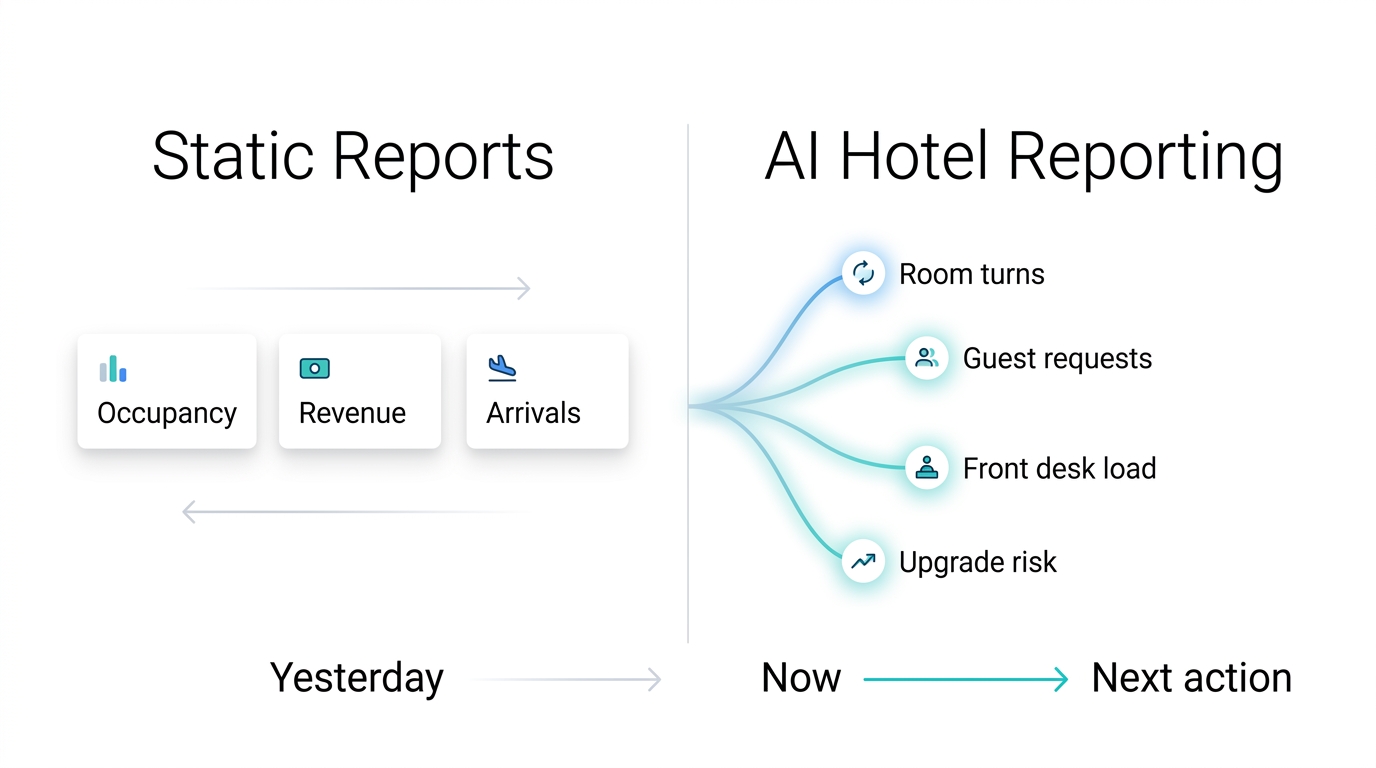
AI hotel reporting is useful because it makes the real operating picture easier to read. Traditional reports are still valuable for governance, review, and accountability. The problem is that most of them are retrospective by design. A daily summary can show occupancy, ADR, arrivals, departures, and revenue pacing, but it often does not show how those numbers are creating pressure across housekeeping, front desk operations, service response times, or guest sentiment.
That fragmentation is easier to understand when you look at how hospitality systems are typically organized. Oracle Hospitality solutions and Oracle Hospitality documentation show the structured software and workflow layer hotel teams often operate around. AWS travel and hospitality guidance is also useful context for connected cloud environments, while OpenTravel standards can support data exchange across travel and hospitality systems. Those references do not prove every hotel operates the same way, but they do reflect the kind of connected-data environment many teams are trying to unify.
What these reports miss without AI hotel reporting is usually not the headline number. It is the relationship between numbers. A strong occupancy report can hide housekeeping pressure. A healthy revenue report can miss complaint risk. A stable front desk view can fail to show that guest requests are building faster than the operation can absorb them.
A simple way to think about it is this: traditional reporting gives you the rearview mirror. AI hotel reporting gives you the windshield. AI hotel reporting makes that operating rhythm visible before a static report turns it into history.
| Traditional hotel reports | What they show | What they miss | What AI adds | Business impact |
|---|---|---|---|---|
| Daily summaries | Yesterday’s arrivals, departures, occupancy, and revenue | Cross-department causes behind operational strain | Exception detection across service, staffing, and revenue signals | Faster prioritization in the morning operating review |
| Occupancy snapshots | How full the property is and how pickup is pacing | Whether room turns, check-in promises, or upgrade capacity are under pressure | Connected view of occupancy plus room readiness, guest requests, and upgrade patterns | Better control of service risk and missed revenue opportunities |
| Revenue reports | Rate performance, ADR, pickup, and mix | Whether service delays are undermining guest experience or future loyalty | Correlation between revenue strength and service friction | Better balance between short-term revenue and operational execution |
| Housekeeping reports | Room status, cleaning queues, and productivity snapshots | Guest arrival pressure and downstream complaint exposure | Early warning when room-turn delays may affect arrivals and service commitments | More proactive staffing and task prioritization |
| Guest feedback | Reviews, survey comments, and complaint themes | The operational triggers behind recurring feedback | Pattern recognition linking sentiment to departments, shifts, or service events | Quicker root-cause action instead of reactive apology management |
A practical example makes the gap obvious. Imagine a morning report that shows high occupancy and healthy pacing. It still may not reveal that housekeeping is already stretched, room readiness will slip by early afternoon, premium rooms are being held too long to sell upgrades effectively, and complaint risk is building with every delayed arrival. That is the difference between reporting and decision support.
Once leaders see that limitation, the next question becomes more useful: what can AI detect when those separate signals are connected?
What AI can detect across hotel data
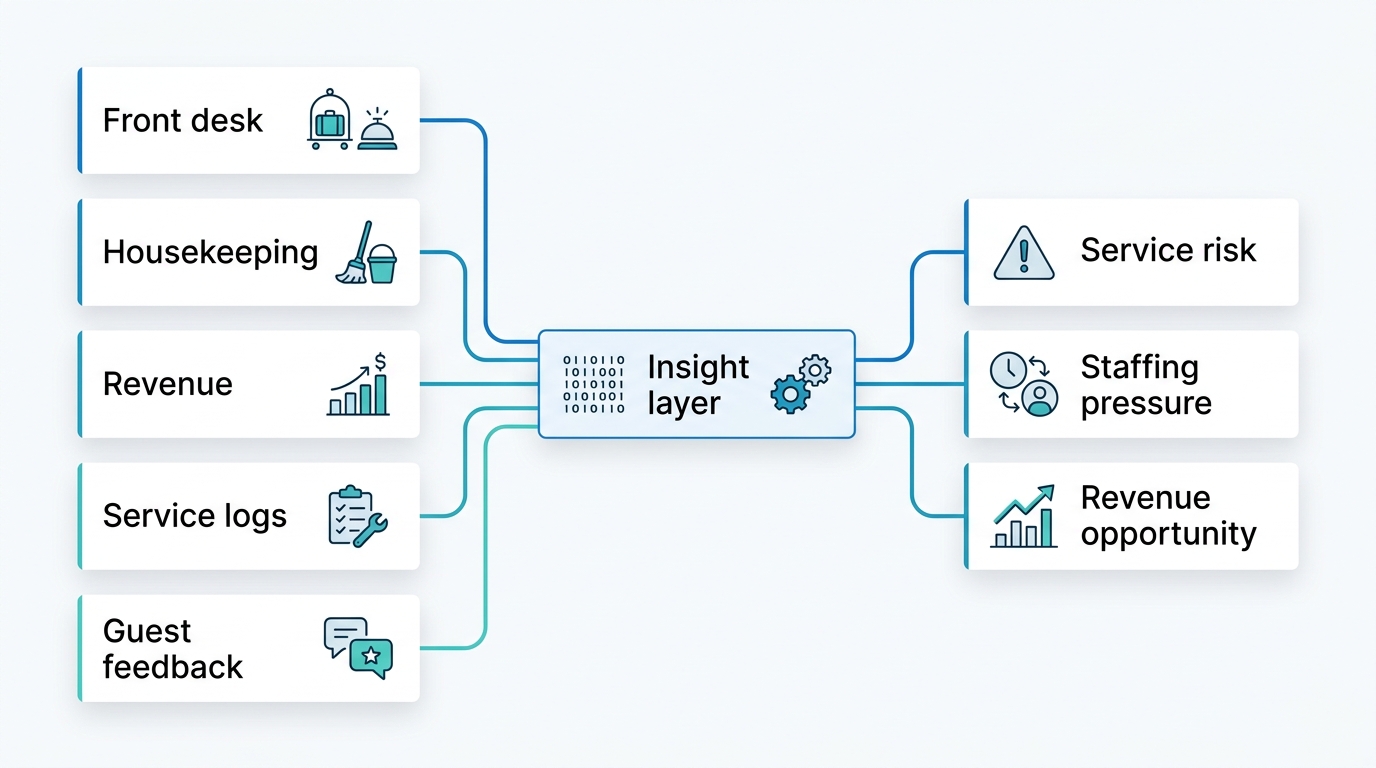
AI hotel reporting is strongest when it connects what leaders already track but rarely review together. That includes front desk metrics, housekeeping reports, revenue reports, guest sentiment review, service tickets, and guest request trends. The shift is not from reports to magic. It is from isolated review to connected interpretation.
Patterns across departments matter more than single metrics
AI hotel reporting can analyze hotel performance better than manual review in one important sense: it can review more signals, faster, and surface patterns a human reading separate spreadsheets or dashboards is likely to miss.
For example, a rise in guest request trends may not look serious on its own. But if that same pattern appears alongside slower room turns, longer check-in queues, and a change in customer language, AI hotel reporting can flag that combination as an issue worth action. That is where hotel decision intelligence becomes practical: it helps leaders see that one department’s pressure is already affecting another department’s outcomes.
Earlier signals, not perfect predictions
Predictive hotel insights should be understood correctly. AI is not promising certainty about the future. What it can do is identify emerging risk and likely pressure points earlier than manual review, using the signals already flowing through the property.
A useful example is service delay detection. If one property starts showing repeated mentions of slow room readiness, a rise in arrival-time requests, and a gap between expected and actual room release times, AI hotel reporting can flag that combination as an exception worth action. The model is not replacing the operations leader. It is helping the operations leader focus on the right issue sooner.
This is also why AI for hotel leaders should be framed as an attention system, not a replacement system. The value is faster prioritization, clearer escalation, and better context for human judgment.
Real-time dashboards vs static reports
Static reports help leaders review performance. Real-time dashboards help leaders manage the day. That is the essential difference.
Hotel leaders can get real-time hotel insights by connecting live operational feeds and event-driven updates into a decision layer that highlights exceptions instead of waiting for end-of-day reporting. In practice, that can mean a dashboard that combines occupancy pressure, room readiness, service backlog, front desk load, and guest request trends in one place, with alerts when the pattern moves outside expected bounds.
Timing is where the value shows up
A morning occupancy report may say the property is on pace. A live view may show that room-turn delays are already reducing the ability to honor early check-ins, creating pressure at the front desk and narrowing upgrade inventory. That is not a cosmetic improvement. It changes the timing of the decision.
This is where hotel reporting automation matters. If department heads spend less time assembling yesterday’s story, they get more time to interpret today’s signals. And if those signals are routed into AI hotel reporting in a useful way, leaders can manage by exception rather than hunting through disconnected tabs.
Dashboards only help when they reflect the operation
The biggest reporting mistake is assuming that one more dashboard solves the problem. It does not. If the underlying logic is still siloed, the dashboard simply displays the same blind spots faster.
That is why the design question matters. For some organizations, the real decision is whether they need packaged BI or something closer to custom AI solutions vs off-the-shelf tools that reflect their actual workflows, service rules, and data realities. The goal is not more screens. It is a better decision layer on top of hotel data.
Better decisions for hotel leaders
AI hotel reporting improves decision-making because it tells leaders where risk, friction, or opportunity is forming across the business. That matters differently to each role, but the underlying benefit is the same: less time interpreting disconnected signals, and more time acting on what matters.
For the GM: clearer operational trade-offs
A GM does not just need to know whether occupancy is strong. The GM needs to know whether strong occupancy is creating strain elsewhere. A connected view can show that a good-looking day is also creating housekeeping pressure, higher complaint risk, and a missed upgrade opportunity because room readiness is lagging in premium categories.
That example matters because it reflects how hotel performance analytics work in the real world. A single number can look positive while the operation underneath it is already paying a price.
For the CFO and revenue leader: better context around performance
A CFO or revenue leader often sees the property through pacing views and forecast adjustments. That lens is important, but it becomes stronger when it is combined with service quality and operational execution.
If revenue is holding but guest feedback review shows recurring friction around the arrival experience, the question changes. The issue is no longer just whether the property hit the day’s targets. It becomes whether short-term performance is being supported by an operating model that can sustain it.
For operations leaders: faster prioritization
Operations leaders usually know there is too much data and not enough time. AI business intelligence for hotels helps by reducing noise. Instead of asking teams to review every metric equally, it can identify the few patterns most likely to affect service, revenue, or guest satisfaction today.
That is why hotel decision intelligence is about better prioritization, not just better visibility. The dashboard matters only because it helps the team know where to move first.
Turning reporting into operational action
This is where a lot of reporting programs stall. The insight appears on a screen, everyone nods, and nothing changes in the workflow.
The real value of AI business intelligence for hotels appears when insight is tied to ownership, escalation, and response. If a pattern suggests rising room-readiness risk, that insight should trigger a review by operations, not just sit in an executive view. If guest feedback review starts clustering around one service issue, the responsible department should know what action is expected and by when.
A simple operating pattern for action
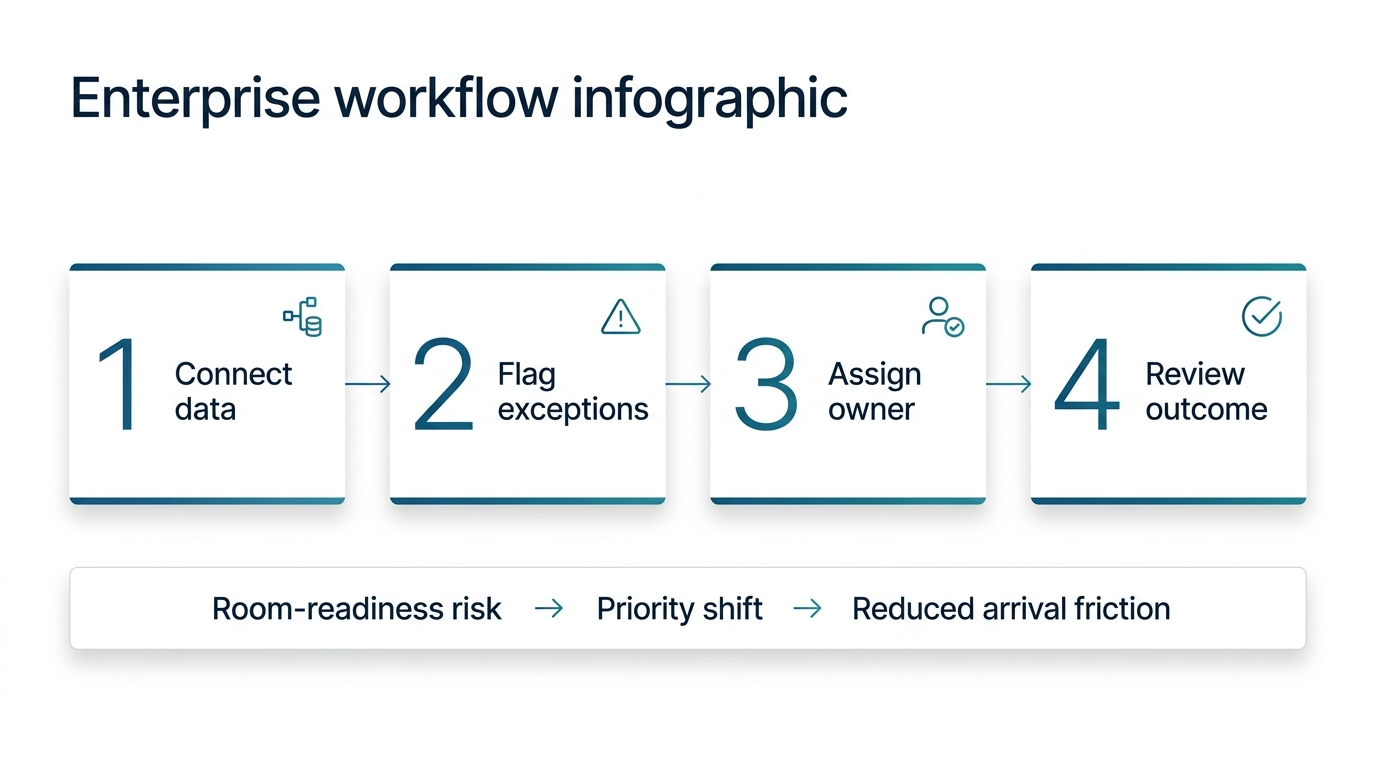
A practical operating model can be simple:
- Connect the data sources that matter most: daily hotel reports, occupancy snapshots, housekeeping updates, revenue performance views, service logs, and guest feedback.
- Define the exceptions worth surfacing: delayed room turns, rising check-in pressure, repeated complaint themes, or upgrade leakage.
- Assign owners to those signals so alerts drive action instead of awareness alone.
- Review outcomes so the team learns which signals were useful and which need refinement.
Responsible AI also needs governance, measurement, and human oversight, which are core elements of the NIST AI Risk Management Framework. Microsoft’s AI adoption guidance also emphasizes readiness, operating models, and planned adoption rather than ad hoc experimentation.
This is often the point where AI consulting services become useful, because the hard question is usually not model selection. It is deciding which signals matter, who owns them, and how reporting should trigger operational response. Once that foundation exists, generative AI solutions can also make AI hotel reporting more usable by turning complex exceptions into plain-English briefings for GMs and department heads.
A practical AI hotel reporting readiness checklist for hotel leaders
Before investing in AI hotel reporting, it helps to ask a simpler question: is your reporting environment ready to support action?
Use this short checklist:
- Can you access the core data you already rely on across summaries, occupancy snapshots, housekeeping updates, revenue views, service logs, and guest feedback?
- Do different departments define key metrics consistently enough to compare signals across teams?
- Do your current reports lead to clear action, or do they mainly circulate information?
- Is there a named owner for reporting quality, exception review, and follow-through?
- Can your teams connect front desk metrics, department performance, and guest request trends in one operating conversation?
- Do you have a governance approach for human review, escalation, and trust in AI-supported recommendations?
If the answer to several of these is no, that is not a reason to avoid AI hotel reporting. It simply means the right first move may be clarifying definitions, ownership, and workflow before adding more technology.
Frequently asked questions
How can AI improve hotel reporting?
AI hotel reporting improves hotel reporting by connecting fragmented operational, guest, and revenue data into earlier, more actionable insight. Instead of only summarizing what happened, it can surface exceptions, explain likely relationships across departments, and help leaders prioritize where attention is needed now.
What do hotel reports miss without AI?
Without AI hotel reporting, hotel reports often miss relationships between separate data sets. A report may show strong occupancy or stable revenue while failing to reveal housekeeping strain, rising service backlog, complaint risk, or missed upgrade opportunities building underneath those numbers.
How can hotel leaders get real-time insights?
Hotel leaders get real-time hotel insights by connecting live operational systems, event updates, and service data into dashboards and alerts that highlight exceptions as conditions change. The goal is a live decision layer, not just a faster version of end-of-day reporting.
Can AI analyze hotel performance better than manual reports?
AI can analyze hotel performance better than manual reports when the need is to review more signals, faster, and catch patterns across departments that manual review may miss. It does not replace hotel staff or leadership judgment; it strengthens them with better context and earlier warnings.
Why do hotels need AI dashboards?
Hotels need AI dashboards when static reporting is too slow or too siloed to support timely action. The best AI hotel reporting connects data, surfaces exceptions, and helps teams respond to operational, service, and revenue issues before they spread.
What hotel leaders should remember about AI reporting
The future of hotel reporting is not a world where leaders receive more charts. It is a world where yesterday’s numbers, today’s workload, and emerging guest signals are connected well enough to support faster, better judgment.
That is why AI hotel reporting is ultimately about the gap between reporting and action. The same occupancy report that once looked complete can, with the right intelligence layer, reveal housekeeping strain, guest-service risk, and a missed upgrade opportunity before the day is over. That changes how a GM runs the property, how a revenue leader protects opportunity, and how an executive team interprets performance.
AI hotel reporting should feel less like a reporting upgrade and more like a new operating habit. Hotels do not need more reports; they need earlier signals that turn into action.
If hotel reports show what happened but not what to do next, Webuters can help create AI hotel reporting across operations, service, and revenue workflows. The practical starting point is a clear look at reporting gaps, data connections, and the decisions your teams need to make faster, so leaders can move from summary mode to real-time decision making without adding more noise.

Loading...