
From Fire Hose to Feedback Flywheel: AI-Driven Hotel Reputation Management for Strategic Action
Hotel reputation management requires seeing patterns instantly, not after the damage compounds. It’s Monday morning. A General Manager opens her laptop to find 347 new guest reviews waiting across three OTAs, TripAdvisor, Google, and the post-stay survey system. She knows buried inside that avalanche is a complaint about the broken elevator on the fourth floor, the same elevator that’s been mentioned in five reviews over two days. But she has a 10 AM owners’ meeting, and by the time she might spot the pattern, three more guests will have complained, and the average rating will have slipped another tenth of a point.
That is the real problem: the volume of feedback has outgrown human attention. The old playbook of reading top-level summaries and glancing at star ratings no longer works. A single 200-room property can easily accumulate over 500 reviews per month. A regional director overseeing a dozen properties faces a tsunami of unstructured opinion. Reading them all is impossible. More importantly, reading them one by one, star rating by star rating, is a flawed way to spot the operational issues that actually hurt revenue. Hotel reputation management demands a smarter approach.
Here is the thesis: AI-driven hotel reputation management turns those scattered comments into a prioritized, department-level action plan. It surfaces patterns your team would never see, ranks fixes by guest impact, and helps craft on-brand responses at scale—without turning your voice into corporate robotic boilerplate. The question is not whether AI can help; it’s how to build a system that listens like an owner, not a machine.
In this article, I will walk through exactly how AI analyzes hotel reviews, categorizes complaints by department, quantifies the damage to ratings, assists with human-scaled responses, and closes the loop by tying feedback to work orders and training. You will also find concrete answers to the practical questions every hotel operator asks: How does sentiment analysis for hotels work? Can AI really write a review response that sounds like us? And how do we find the recurring complaints that are silently costing bookings? Effective hotel reputation management makes these answers routine.
Why Manual Review Reading Fails the Modern Hotel
The average hotel manager reads reviews in sporadic bursts—usually when a complaint goes viral or a monthly report is due. This approach is not only slow but statistically blind. Humans are pattern-seeking, but we’re biased toward the most recent or emotional comments, not the data that matters. I have seen a GM spend three hours scanning reviews and flag only two complaints about breakfast, yet miss a third that revealed cold food every Tuesday—because the phrase used was “the eggs were chilly” and didn’t match her mental keyword “cold.” A 4-star review praising “great service” but casually mentioning “room 312’s AC was faulty” gets filed away. A 3-star review complaining bitterly about “noisy neighbors” gets disproportionate attention. Neither gets linked to the five other mentions of that same AC unit in the past week. Hotel reputation management requires connecting those dots automatically.
Consider the scale problem: a 150-room property might receive 30 reviews a day across platforms. A cluster manager tracking six hotels must digest 180 daily. That is over 1,200 per week. No team can read, categorize, and act on that volume consistently. What is more, manual tagging—typing “housekeeping” or “front desk” into a spreadsheet—is subjective. One person’s “check-in complaint” is another’s “front desk issue.” Over time, you lose the ability to see trends because the data is too noisy. AI review analysis for hotels is the only scalable solution for modern hotel reputation management. Voice of the guest analytics becomes actionable only when automated.
So how can AI analyze hotel reviews? The core technology is natural language processing (NLP). AI models trained on hospitality language can parse free text, extract entities (like the room number, department, or specific item), and assign sentiment scores at scale. Instead of a person reading 500 reviews over days, an AI can process 10,000 reviews in minutes, mapping each one to departments, topics, and sentiment. This is not futuristic; it is practical pattern recognition that turns an inbox fire hose into a manageable stream. Real hotel reputation management AI uses these methods to surface actionable insights.
Turning Free Text into Department-Level Themes
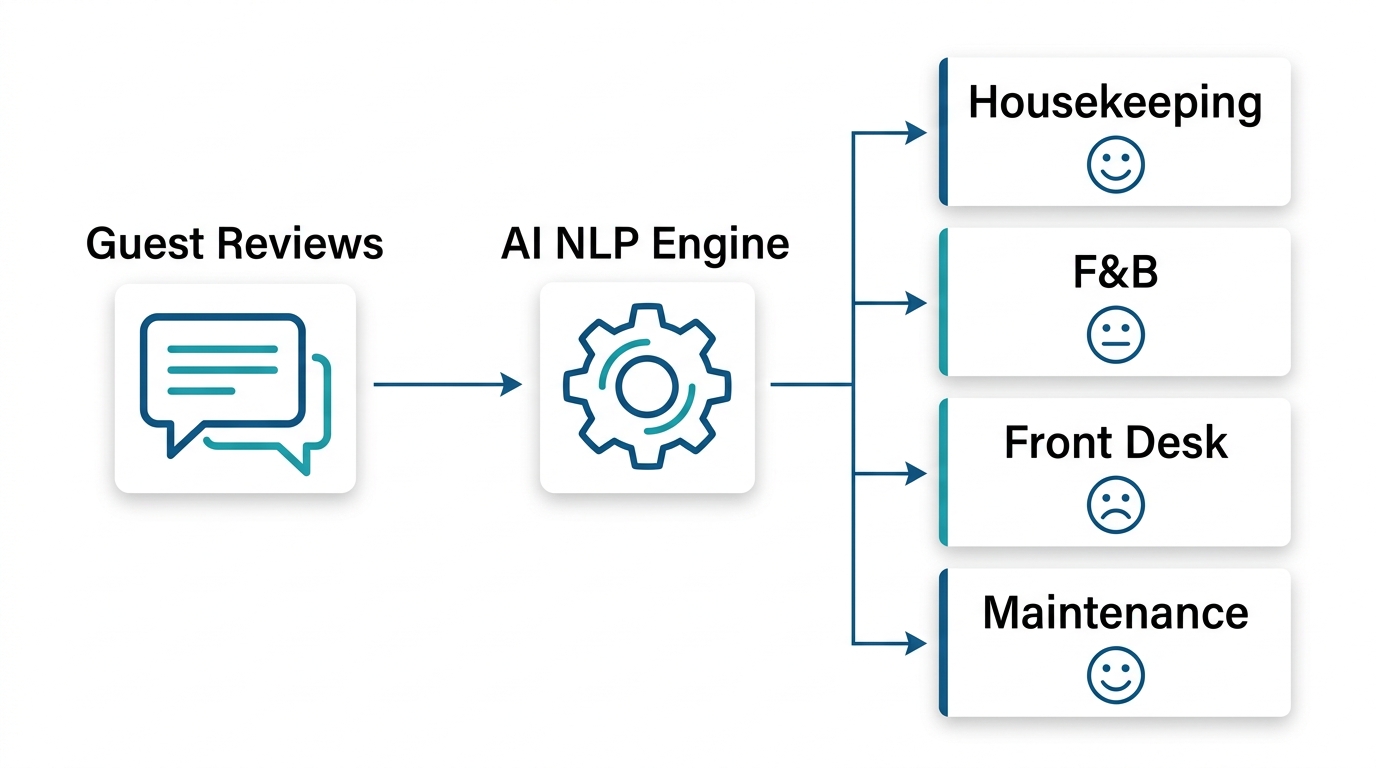
Once NLP has parsed the text, the real value emerges: structured, department-level themes. This is where sentiment analysis for hotels becomes more than a positive/negative label. AI models can detect nuanced emotions—frustration, delight, urgency—and attribute them to specific aspects of the stay. The Google Cloud Natural Language API, for example, can identify entities and assess sentiment magnitude, enabling hotels to go beyond generic scores. Sentiment scoring at this level supports deeper hotel reputation management.
In practice, this means a single review saying “The front desk agent was amazing, but the room smelled musty and the pool was too cold” gets instantly tagged: front desk (positive, high magnitude), housekeeping (negative, moderate magnitude), and maintenance (negative, low magnitude). Over thousands of reviews, these tags coalesce into themes. A property in Orlando discovered through AI analysis that a majority of housekeeping complaints were about “musty towels” in one wing, traced back to a humidity issue that no human reviewer would have connected. Recognizing such recurring complaint themes is a key outcome of hotel reputation management.
How do hotels find recurring guest complaints? AI clusters similar phrases and tracks frequency over time. A sudden spike in “elevator out of service” triggers an alert. A long-term upward trend in “slow WiFi” in the lobby flags an infrastructure issue. These patterns are invisible to manual scanning. AI can even correlate them with specific shifts or days of the week, giving managers precise, actionable intelligence. This is the essence of hotel reputation management: proactive detection before reputation suffers. Review velocity and complaint pattern analysis become routine.
For teams evaluating this next step, Webuters’ AI models for text and sentiment analysis can provide a practical reference point.
Prioritizing Fixes by Revenue and Rating Impact
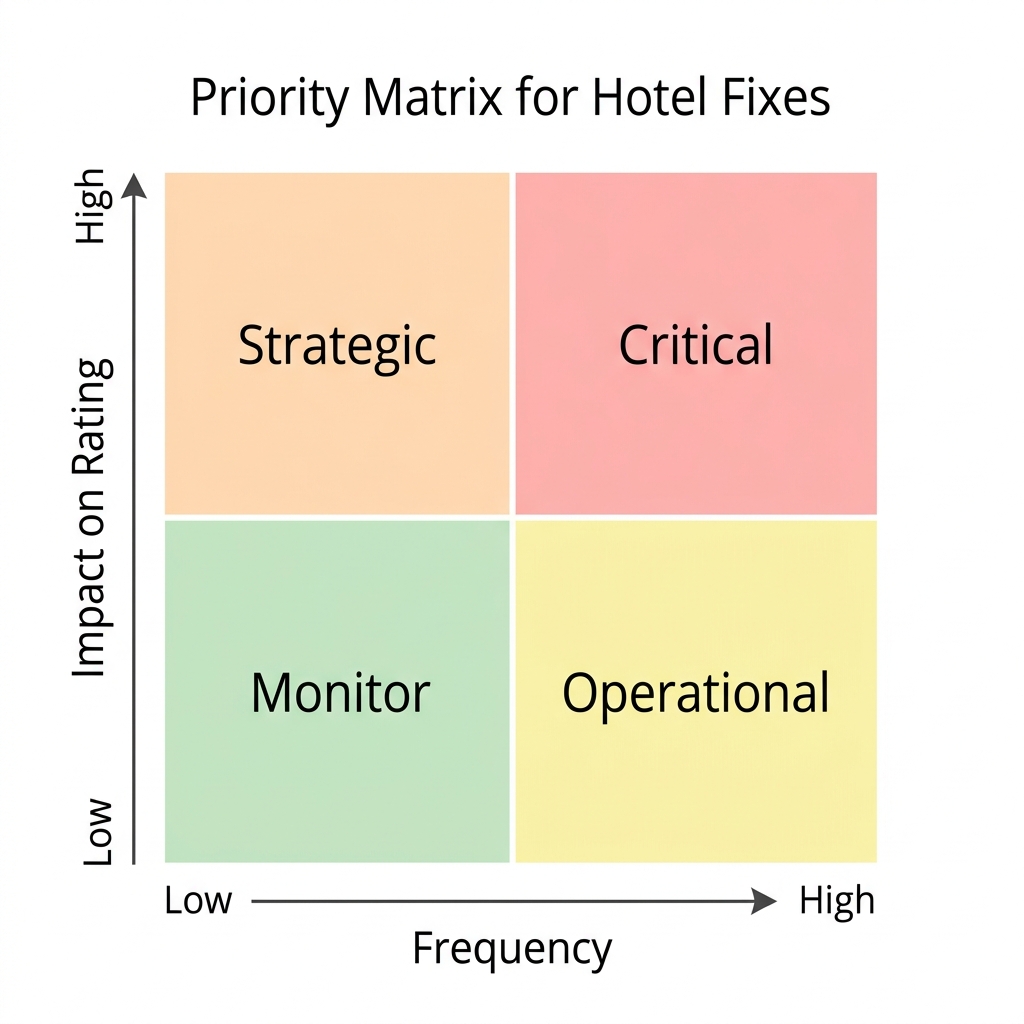
Identifying problems is step one. Step two is knowing which problem to fix first. Not all complaints are equal. A broken AC unit and a slow elevator evoke very different reactions. AI can correlate complaint categories with star rating drops to calculate impact. For instance, analysis might show that a noise complaint reduces the rating by 0.3 stars on average, while a cleanliness issue drops it by 0.8 stars. Combined with revenue impact—a one-star drop can reduce RevPAR by a percentage that varies but is often material—you can build a clear ROI for each fix. Spending $500 on an AC repair might save $5,000 in potential lost bookings. That is how hotel reputation management directly affects the bottom line. Department-level attribution helps pinpoint responsibility.
A practical tool is the priority matrix. Here is a simplified version:
| Priority Level | Frequency | Impact on Rating | Example Issue | Recommended Action |
|---|---|---|---|---|
| Critical | High | High | Air conditioning broken | Immediate fix, offer compensation, follow up |
| Strategic | Low | High | Bed bugs mention | Investigate immediately, deep clean, inform QA |
| Operational | High | Low | Weak WiFi in lobby | Plan upgrade, but not urgent |
| Monitor | Low | Low | Slow elevator | Track trend; address if frequency increases |
This matrix moves the guesswork out of budgeting. Instead of fighting over which department gets capex, you point to the data. A beach resort found that “pool temperature” complaints had low frequency but caused severe rating drops. They invested in a smart thermostat—ratings recovered within weeks. A business hotel saw “slow WiFi” as high frequency but moderate impact; an upgrade improved satisfaction scores quickly. With AI, you stop reacting to the loudest complaint and start acting on the most impactful one. Hotel reputation management becomes a data-driven discipline. NPS improvement AI can further refine these priorities.
Assisted Responses That Still Sound Human
Speed of response matters, but so does authenticity. Can AI write hotel review responses? Yes, but with an important distinction: AI assists, not replaces, the human touch. An AI system can draft a response based on the review’s sentiment, mentioned issues, and your brand voice guidelines. The draft pulls in the guest’s name, references the specific complaint, and offers a tailored resolution. The manager gets a high-quality draft that only needs a personal touch before sending. This is how AI review response supports hotel reputation management.
This is how AI improves guest satisfaction scores—not by sending robot replies, but by ensuring every review gets a timely, relevant acknowledgment. If a guest complains about a broken AC, the AI drafts: “Dear [Name], We’re sorry about the AC issue in your room. Our maintenance team has repaired it, and we’d like to offer you a complimentary drink on your next visit.” The manager can then adjust the offer or add warmth. For a luxury brand, AI enforces consistent language across 50 properties while allowing local managers to customize. It flags priority reviews—those with angry tone, low rating, or mentions of safety—so humans can intervene immediately. Service recovery becomes both fast and personal.
Faster, personalized responses show guests they are heard. That directly impacts loyalty and repeat bookings. A franchise hotel using this approach saw response times drop dramatically, and their response rate rose significantly. The brand voice remained consistent, yet every reply felt personal. This is guest feedback analytics in action, powered by AI review response capabilities that elevate hotel reputation management. Brand voice consistency is maintained across all responses.
Linking Feedback to Work Orders and Training
The true power of feedback intelligence is closing the loop between guest comments and operational action. AI can automatically generate a work order when a threshold of complaints about a specific room or facility is reached. If three reviews mention a leaky faucet in room 205, a maintenance ticket is created and assigned without anyone lifting a finger. This transforms inert text into an executable task. Issue to work order automation is a game-changer for hotel reputation management.
Recurring complaints about the same department signal a training need. If “rude front desk staff” appears frequently in reviews over a month, AI can trigger a training module for the front desk team, specifically on the shifts where the complaint is most common. Multi-property review benchmarking becomes straightforward: AI compares complaint profiles across locations, highlighting outliers. A chain of 20 properties identifies that one location consistently receives complaints about “noise from construction.” AI notifies the GM and suggests proactive communication to guests. Another property sees front desk complaints peak between 3-5 PM (check-in rush); management adds a second person to that shift. These insights used to require a full-time analyst; now they arrive in a dashboard each morning. This is complaint pattern analysis and hotel quality management analytics at scale. Benchmark against comp set helps gauge competitive standing.
These automation workflows are the backbone of a modern quality management system. To see how automation can streamline service operations beyond reviews, check our automation insights for service teams.
The Feedback Flywheel: A Connected System for Continuous Improvement
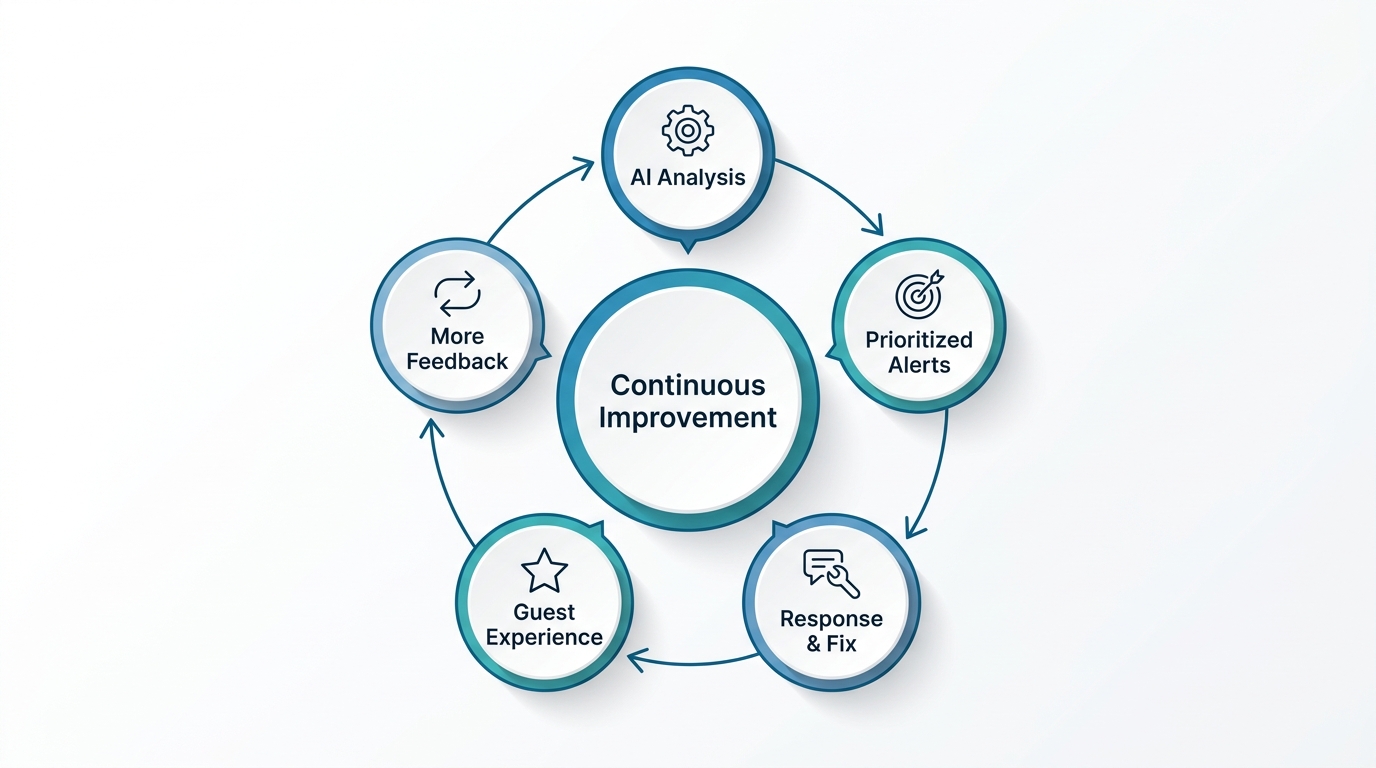
All these capabilities—analysis, prioritization, response, action—coalesce into a single feedback intelligence system. Think of it as a flywheel: guest feedback flows into AI analysis (sentiment, department, severity), which generates prioritized alerts. Managers review and send assisted responses, automated work orders are created, and training modules are triggered. Operational fixes improve the guest experience, which generates more positive feedback, continuing the cycle. This flywheel works best when it plugs into a unified hotel AI layer, and the same connected intelligence that protects reputation also works for protecting F&B and energy margins. Hotel reputation management becomes a self-reinforcing loop.
A boutique hotel group that implemented such a system saw notable improvements: a higher response rate, fewer repeat complaints, and a measurable rating improvement within months. The regional manager now spends Monday mornings reviewing exception reports instead of reading 1,000 reviews. The GM no longer dreads the inbox; she trusts that the system has captured every critical signal. This is the promise of hotel reputation management: turning noisy feedback into a strategic asset.
This is not a futuristic vision. It is a practical application of AI that respects your team’s expertise and multiplies it. With the right AI consulting and custom development, any hotel group—whether three properties or three hundred—can build a tailored feedback flywheel that fits their brand, property mix, and existing tech stack. Hotel reputation management AI makes this possible. As your AI development partner, Webuters can help design and build this system end to end.
Frequently Asked Questions
What is hotel reputation management?
Hotel reputation management is the practice of actively monitoring, analyzing, and responding to guest feedback across multiple channels to protect and improve a hotel’s online reputation. It involves tracking reviews on OTAs, Google, and social media, as well as survey free text, and using insights to drive operational improvements. Effective hotel reputation management is essential for maintaining a competitive edge.
How can AI analyze hotel reviews?
AI uses natural language processing (NLP) to parse free text, identify entities (like room numbers, departments, or specific items), and assign sentiment scores. Machine learning models trained on hospitality language can process thousands of reviews in minutes, categorizing them by topic, department, and urgency. This is AI review analysis for hotels, a cornerstone of modern hotel reputation management.
What is sentiment analysis for hotels?
Sentiment analysis goes beyond positive/negative. It detects nuanced emotions (frustration, delight, urgency) and attributes them to specific aspects of the stay. This lets hotels quantify how guests feel about housekeeping, service, amenities, etc., and track changes over time. When integrated with hotel reputation management, it provides deep guest satisfaction insights AI.
Can AI write hotel review responses?
Yes, AI can generate draft responses that follow brand voice guidelines and address specific guest concerns. A human manager then reviews and personalizes the draft before posting. This dramatically speeds up response time while keeping the human touch. It’s a key part of guest feedback analytics and hotel reputation management.
How do hotels find recurring guest complaints?
AI clusters similar phrases and tracks frequency over time. It can detect spikes (e.g., “elevator out of service” suddenly appears in 10 reviews) or slow-burning trends (e.g., “slow WiFi” complaints rising slowly). Alerts notify managers before the pattern becomes a crisis. This is a core function of hotel reputation management.
How does AI improve guest satisfaction scores?
By ensuring every review gets a timely, relevant response, and by routing feedback directly into operational fixes (work orders, training). Guests who feel heard are more likely to return and leave higher ratings. Over time, resolving recurring issues lifts overall scores. This is how hotel reputation management directly boosts satisfaction.
From Fire Hose to Flywheel: Your Next Step
The hotels that win the next decade won’t be the ones with the fanciest lobbies, but the ones that listen with intelligence and act with speed. AI doesn’t replace human care—it amplifies it. It gives you the superpower to hear every whisper across your properties and respond with consistency and heart.
If you are ready to build a feedback intelligence system tailored to your brand and operations, talk to Webuters about a practical AI audit. Our AI consulting for service quality improvement and generative AI solutions for enterprise workflows can help you design and implement the right solution—whether a modular pilot or a full-scale flywheel. Let’s start a conversation about what your properties could gain from truly intelligent hotel reputation management.
For teams evaluating this next step, Webuters’ AI and ML insights for business leaders can provide a practical reference point. If you’re ready to build a feedback intelligence system tailored to your brand and operations, talk to Webuters about a practical AI audit.

Loading...