
The Margin Protector: How AI Forecasts Covers, Cuts Waste, and Automates Energy in Hotels
Effective hotel energy management is no longer just about swapping light bulbs or scheduling HVAC runtimes. It is now a data-driven discipline that, when combined with AI-powered F&B forecasting, can protect margins that have quietly eroded for years. A chef watches untouched salmon head to the bin. A chief engineer sees a conference room AC blasting for an empty room. These moments aren’t just operational hiccups…they’re the quiet, daily erosion of hotel margins. Food waste and energy overuse, long accepted as unavoidable costs, are now precision problems with a data-driven solution. Hotel energy management and F&B profitability don’t have to fight each other; they can be two sides of the same AI-powered coin.
The real leak isn’t in a single spill but in hundreds of small, repeated miscalculations. Overproduction for a buffet, HVAC running on fixed schedules irrespective of occupancy, inventory orders based on last year’s spreadsheets these practices, conservatively estimated, can add up to a significant drag on food revenue and energy bills. That is not a guest experience investment; it’s simply avoidable waste. Solid hotel energy management targets these leaks first.
AI is not about futuristic robots or replacing the gut feel of a seasoned chef. It’s about giving that chef and engineer a reliable, real-time prediction of tomorrow’s covers and tonight’s occupancy so they can adjust prep lists and HVAC setpoints before waste occurs. Think of AI as the master chef who knows exactly how many covers to prep for and the chief engineer who dims the lights the moment the last guest leaves a banquet hall not by instinct, but by data. Good hotel energy management depends on this kind of precision.
In this post, we’ll walk through the two biggest margin-draining areas food and beverage and energy and show how AI can turn them from cost centers into margin protectors. We’ll examine where F&B margin quietly disappears, how AI forecasts covers and production volumes, how it cuts waste, and then how occupancy-driven energy optimization and automated ESG reporting complete the picture. Hotel energy management is the thread that ties these efforts together. Protecting margins is one side of hospitality AI; the other is turning guest feedback into a flywheel. Webuters offers AI development services to build both.
Where F&B Margin Quietly Disappears
Food waste in hotels isn’t a single event; it’s a pattern. Overproduction for buffets, spoilage from inaccurate ordering, and plate waste from oversized portions can collectively consume a significant portion of food costs. The financial case for reducing food loss is stark: every dollar invested in waste reduction yields a median $14 return, according to Champions 12.3. Yet most F&B operations still rely on gut-feel forecasting last year’s numbers plus a hand-adjustment for this weekend’s wedding.
The result? On a slow Tuesday, the breakfast buffet is stocked as if 300 guests will appear; only 180 do. That translates to roughly 730 eggs, 45 loaves of bread, and 90 pastries thrown away, every day. For banquets, overproduction is often built into the planning to avoid the risk of running short, leading to a notable percentage of prepared food going uneaten. Kitchen inventory optimization and buffet production planning are prime candidates for AI intervention. An integrated hotel energy management approach includes these F&B improvements.
The root cause is not carelessness; it’s that data lives in silos. The point-of-sale system knows what sold, the property management system knows how many guests checked in, and the inventory spreadsheet sits on a clipboard. No single view connects tomorrow’s forecast with today’s purchasing. That is exactly where AI steps in, enabling hotel food waste reduction AI to tackle overproduction at its source. This is why hotel energy management cannot ignore F&B operations.
Forecasting Covers and Production Volumes with AI
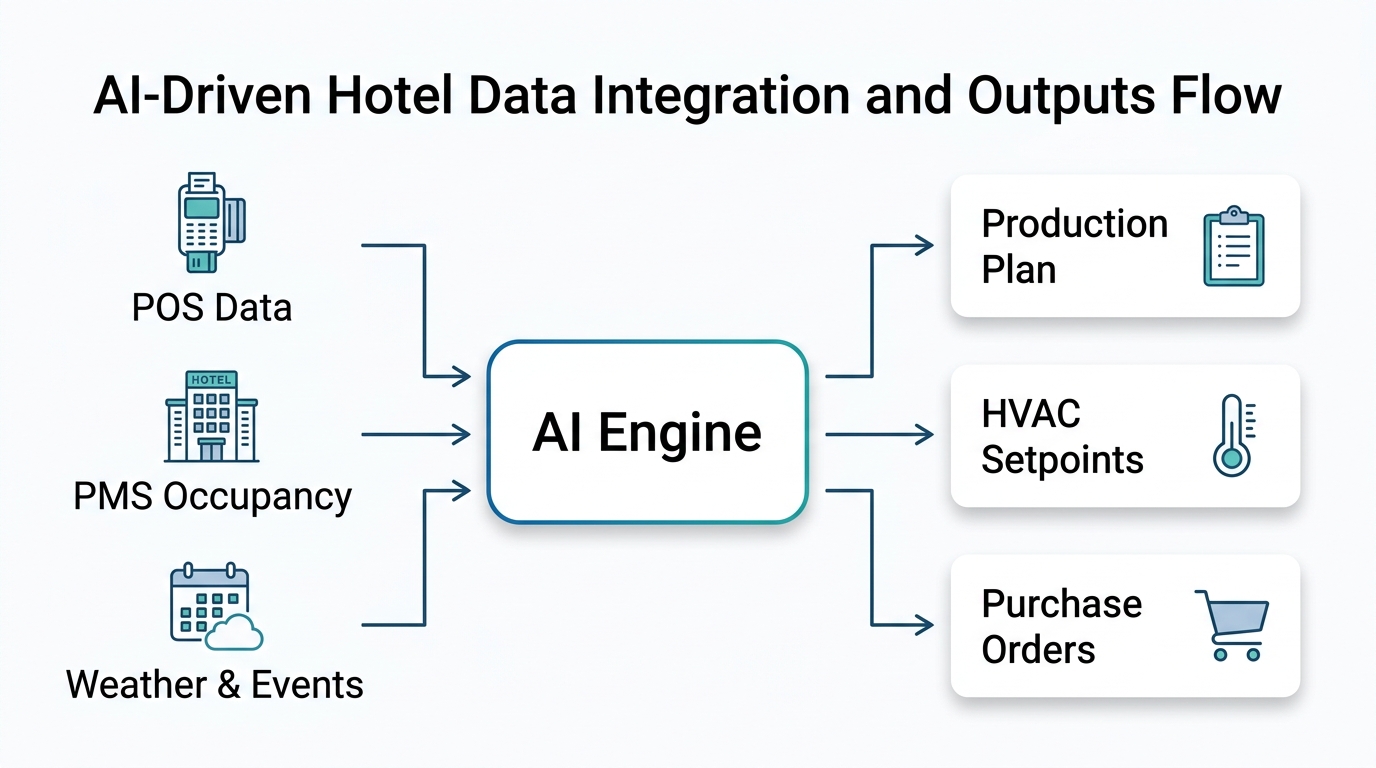
Accurate cover forecasting is the foundation of margin protection. When a hotel can predict exactly how many meals it will serve down to the outlet and daypart overproduction crumbles. This is how AI answers the question: How does AI forecast restaurant covers? F&B demand forecasting becomes a core capability. The same forecasting engine can feed predictive pricing for smarter revenue management.
An AI forecasting model ingests several streams: historical POS transaction data, PMS occupancy (arrivals, departures, in-house guests), weather feeds, local event calendars, and even flight schedules. It learns patterns that humans might miss: for example, rainy weekends can spike in-room dining, or a major concert in town can lift the lobby bar. The model outputs a daily cover count for each outlet, restaurant, banquet, room service, along with a confidence interval. Banquet forecasting AI helps predict large events with precision. This data directly feeds into hotel energy management for kitchen and HVAC scheduling.
In practice, this means a production plan that tells the kitchen: “Tomorrow, expect 220 breakfast covers, 150 lunch, and a 60-person banquet. Prep accordingly.” Chefs stop cooking for 300 when 180 are likely. Resorts have used this approach to substantially cut overproduction, a transformation that requires AI forecasting for operations expertise to tune models to property-specific patterns. Cover forecasting becomes a daily habit.
The model handles seasonality, day-of-week swings, and holiday spikes automatically. It also updates in near real-time: if a group cancels, the forecast adjusts, and the kitchen scales back. That kind of responsiveness is impossible with manual spreadsheets. Supplier order automation can then align deliveries with actual needs. Linking this to hotel energy management allows energy to be adjusted based on expected F&B volume.
“In hospitality, you can’t control the market, but you can control the waste. AI doesn’t just tell you what’s happening—it tells you what’s about to happen, so you can act before the red ink dries.”
Cutting Waste with Data
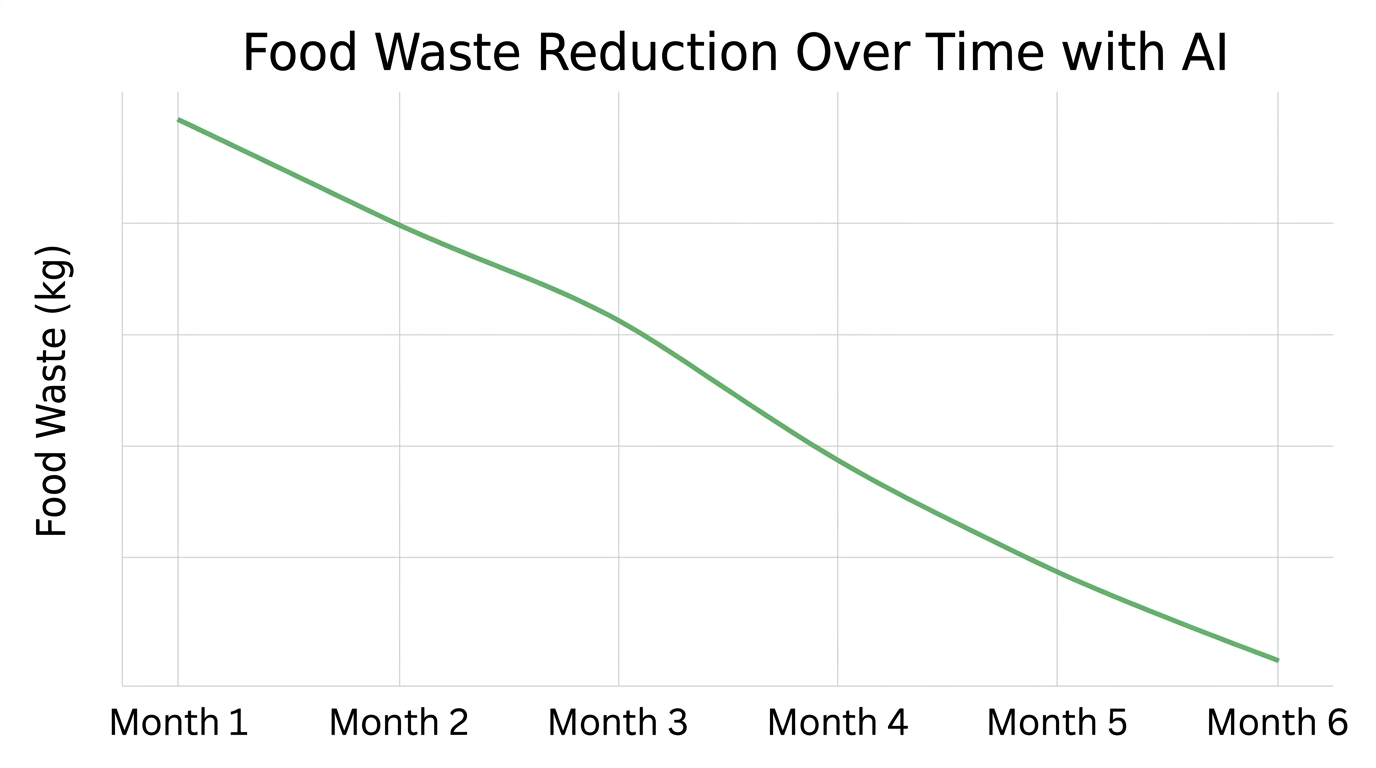
Once you know your covers, the next margin leak plug is the food itself: ingredients that spoil before use, and plates that return half-eaten. How can hotels reduce food waste with AI? By applying AI in two layers: inventory optimization and plate waste analytics. Par level optimisation and menu adjustments are key tactics.
First, AI-driven inventory management analyzes historical usage, spoilage records, and forecasted covers to calculate dynamic par levels. It replaces the old “order the same every Tuesday” approach. For example, if a model sees that parmesan blocks consistently spoil before use, it might recommend a smaller order twice a week instead of a bulk monthly delivery. Research on AI-driven food waste management suggests that such data-driven adjustments can substantially reduce spoilage. Purchasing becomes a precise, automated function, not a best-guess act. This contributes to overall hotel energy management by reducing the embedded energy in wasted food.
Second, AI tackles plate waste. By tracking which menu items return with the most uneaten food—often via simple weigh-in stations or smart waste bins—AI identifies costly offenders. A buffet’s carved roast beef might have high waste; switching to pre-plated slices can drop waste significantly. AI can also suggest portion size adjustments or ingredient swaps. This is menu engineering powered by data, not just chef intuition, targeting waste.
All of this requires connecting POS, PMS, and building systems. The AI only works when the data pipes are open. But once they are, the feedback loop is continuous: forecast → produce → track waste → refine forecast. An effective hotel energy management platform can integrate these data streams.
| Area | Traditional Approach | AI-Driven Approach | Typical Improvement |
|---|---|---|---|
| F&B Covers Forecasting | Gut feel + last year’s numbers | Historical POS, PMS, weather, events model | Substantial reduction in overproduction |
| Inventory & Purchasing | Fixed par levels, weekly orders | Dynamic par levels, auto purchase orders | Substantial reduction in spoilage |
| Energy (HVAC/Lighting) | Fixed schedule, manual overrides | Occupancy-based real-time adjustment | Notable reduction in energy costs |
| ESG Reporting | Manual data gathering, spreadsheets | Automated aggregation and report generation | Significant time savings, improved accuracy |
Energy That Adapts to People, Not Schedules
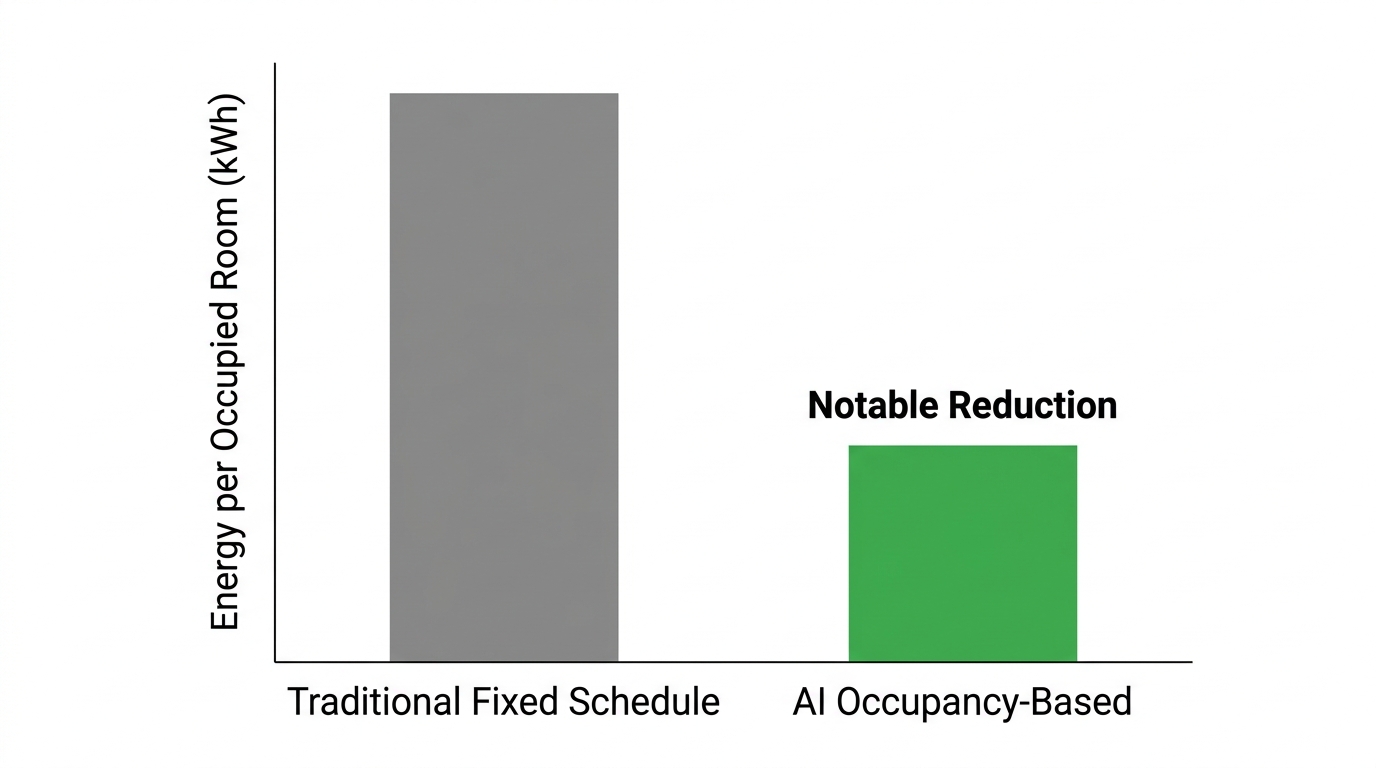
Energy is the hotel’s second-largest operating expense after labor, and much of it is wasted on empty rooms and unused spaces. What is occupancy-based energy management? It’s a control strategy that ties HVAC and lighting to real-time occupancy signals from the PMS, door sensors, motion detectors, and even Wi-Fi access points. Smart HVAC control and occupancy sensors work in concert to improve hotel energy management.
Instead of cooling a floor at a fixed schedule, AI learns guest patterns: rooms are usually empty during breakfast (8-10 AM) and conference rooms clear after 5 PM. It adjusts setpoints and lighting accordingly. Can AI cut hotel energy costs? Absolutely. Pilot projects have shown a notable reduction in energy consumption without compromising guest comfort. This is the essence of AI energy management hotels rely on. A comprehensive hotel energy management strategy leverages these AI capabilities.
Consider a 500-room hotel where AI reduces overnight HVAC runtime based on checkout data alone. That can save a significant amount every year. Conference centers that use occupancy sensors to lower setpoints when no movement is detected have cut energy bills substantially in a few months. These savings go straight to the bottom line, contributing to utility cost reduction hotels urgently need. Effective hotel energy management targets such high-impact areas.
ASHRAE Standard 241 now provides guidance on ventilation design for infection risk control, and AI helps meet these standards efficiently by modulating airflow only when spaces are occupied. Peak load shifting can further reduce demand charges. The technical backbone is system integration: PMS, building management system, and IoT sensors all feeding a central AI engine. This is where AI consulting for cost and margin control becomes essential—identifying the right sensors and integration points for each property. Occupancy-based energy control ensures energy is used only when needed. Modern hotel energy management depends on such integration.
Good hotel energy management requires looking beyond just lights and HVAC. The same AI platform that optimizes energy can also drive food waste reduction, creating a unified approach to margin protection. Tracking kWh per occupied room makes performance visible. This is a key metric in any hotel energy management program.
Automating ESG and Cost Reporting
With F&B and energy data flowing into one AI platform, sustainability reporting transforms from a quarterly headache into a real-time dashboard. How is AI used for hotel sustainability reporting? AI aggregates data on food waste volumes, energy consumption, water usage, and occupancy to calculate carbon emissions automatically—aligned with ESG frameworks like GRI, SASB, and GRESB. Hotel sustainability reporting AI and ESG data automation hospitality streamline compliance. This is an often overlooked benefit of robust hotel energy management.
Instead of spending two weeks manually compiling spreadsheets, a head of sustainability gets a report in minutes. Cost-per-meal analytics combine food cost, energy cost per meal, and waste data to reveal which outlets are truly profitable. For instance, a resort discovered its pool bar was losing money per meal due to overprep and inefficient HVAC; after AI-driven adjustments, it saved a significant amount each year. At the portfolio level, owners can see kWh per occupied room, waste diversion rates, and carbon footprint trends in one place. Carbon reporting and ESG disclosure data become accessible. Strong hotel energy management provides the data foundation for these reports.
This automation not only saves time but improves accuracy and readiness for compliance. Hotels can submit data to GRESB or investors with confidence, turning ESG from a cost center into a competitive advantage. A practical first step is an AI use-case identification framework that maps your property’s data landscape to such reporting capabilities. This framework often starts with evaluating current hotel energy management practices.
Turning Cost Centers into Margin Protectors
We opened with a chef watching salmon go to waste and an engineer seeing a conference room AC run for no one. Those daily losses aren’t inevitable—they’re signals. AI reads those signals and acts on them, turning F&B and energy from cost centers into margin protectors. Hospitality data platforms that unify these systems are now available. The result is more effective hotel energy management.
The hospitality industry’s next efficiency leap won’t come from cutting staff or raising rates. It will come from eliminating the hidden waste in food and energy that hides in plain sight. AI gives a unified view: forecast demand, optimize production, adjust energy in real time, and report results automatically. A 300-room hotel that deploys this system might see a substantial drop in food waste and a significantly lower energy cost per occupied room in a year, all while slashing the time spent on ESG reporting. Reducing cost per meal and improving margins. This is the promise of modern hotel energy management.
That is the real shift. AI is not a futuristic experiment; it is a practical margin tool you can deploy today. It takes three things: the right data connections, the right AI models tuned to your operation, and a partner who understands both hospitality and technology. Solid hotel energy management starts with this foundation.
If this resonates, the next step isn’t a massive overhaul—it’s a focused conversation. Use our AI consulting for cost and margin control to identify the highest-impact waste points in your property. A low-risk, high-value first move is to map your data landscape with our AI use-case identification framework and then pilot an AI forecast in one outlet or one energy zone. The returns come quickly, and the data tells you where to scale next. The question is not if AI can protect your margins, but where you’ll start. Let’s find that first win together.
Frequently Asked Questions
What is hotel energy management?
Hotel energy management is the practice of monitoring and optimizing a property’s energy use — HVAC, lighting, kitchens, and back-of-house systems — to cut utility costs without hurting guest comfort. Modern hotel energy management pairs occupancy and weather data with AI so systems run only when and where they’re needed.
How does AI forecast F&B covers in hotels?
AI models combine historical covers, occupancy on the books, day-of-week patterns, events, and weather to predict how many guests will actually show up for each meal period. Kitchens then prep and order to the forecast instead of gut feel, which reduces both food waste and stockouts.
How much can hotels save with AI-driven energy management?
Savings vary by property age and systems, but the biggest wins come from aligning HVAC runtimes with actual occupancy, catching equipment running out-of-hours, and fixing drift early. Because energy is one of the largest controllable costs after labor, even single-digit percentage reductions protect margins meaningfully.
Do hotels need new hardware to use AI for energy and F&B?
Usually not to start. Most properties begin by connecting the data they already have — PMS occupancy, POS covers, utility meters, and BMS logs. Hardware like submeters or smart sensors can come later, once the forecasts prove where the money is.

Loading...