The Silent Revolution: How Agentic AI is Running Hotels Without Replacing Your Staff
Discover how agentic ai hotels are automating housekeeping, guest requests, and distribution behind the scenes without replacing staff. A 90-day practical…

Agentic AI hotels solutions are quietly transforming how hotel operations run, handling the invisible coordination that used to consume hours of staff time every day. A hotel GM’s 7 a.m. looks like this: a VIP guest is arriving in an hour, the designated room isn’t ready, a maintenance call blinks on the console, and housekeeping staff are stretched thin. The next 60 minutes will be a scramble of phone calls, manual checks, and stressed-out team members.
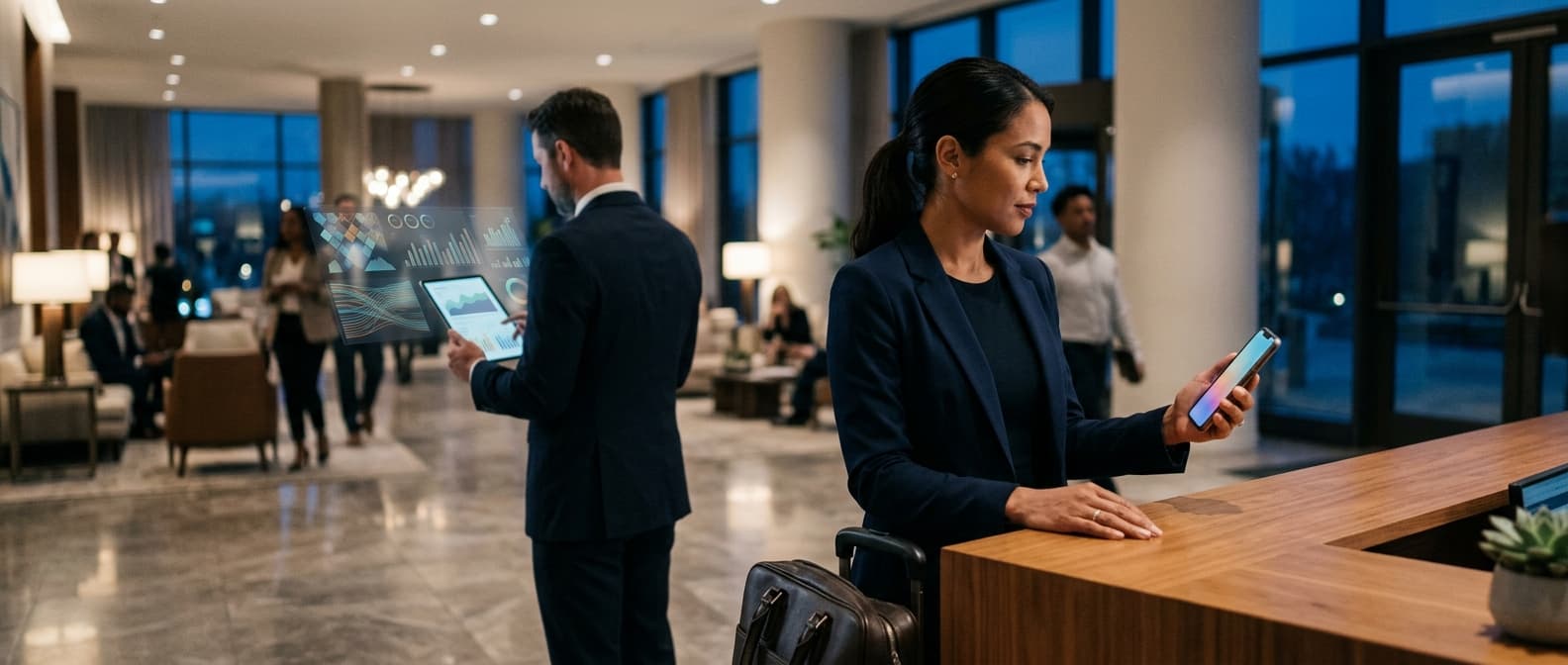
Now imagine that same morning if agentic ai hotels quietly orchestrated the behind-the-scenes work. The housekeeping agent reassigned a cleaner based on room readiness. The front desk agent automatically updated the PMS and sent the guest a mobile check-in alert. The maintenance agent scheduled a non-urgent repair during low occupancy. The GM walked into the lobby calm and focused on welcoming the VIP.
That is the real promise of agentic ai hotels. It’s not about robots at the front desk or chatbots answering questions. It’s about autonomous software agents that handle the invisible, repetitive coordination tasks, tasks that eat up hours of staff time every day. These agents act within safe boundaries, escalating only the decisions that need human judgment. In the sections ahead, we’ll look at what agentic ai hotels actually means for hoteliers, where they are deploying it first, how agents coordinate among themselves, the guardrails that keep autonomy safe, and a practical 90-day plan to start your first pilot.
We’ve explored the broader shift toward autonomous AI in hospitality operations; now let’s focus on the specific agentic layer that runs your back office. For agentic ai hotels, this layer is the key to operational resilience.
What Agentic AI Actually Means for a Hotelier
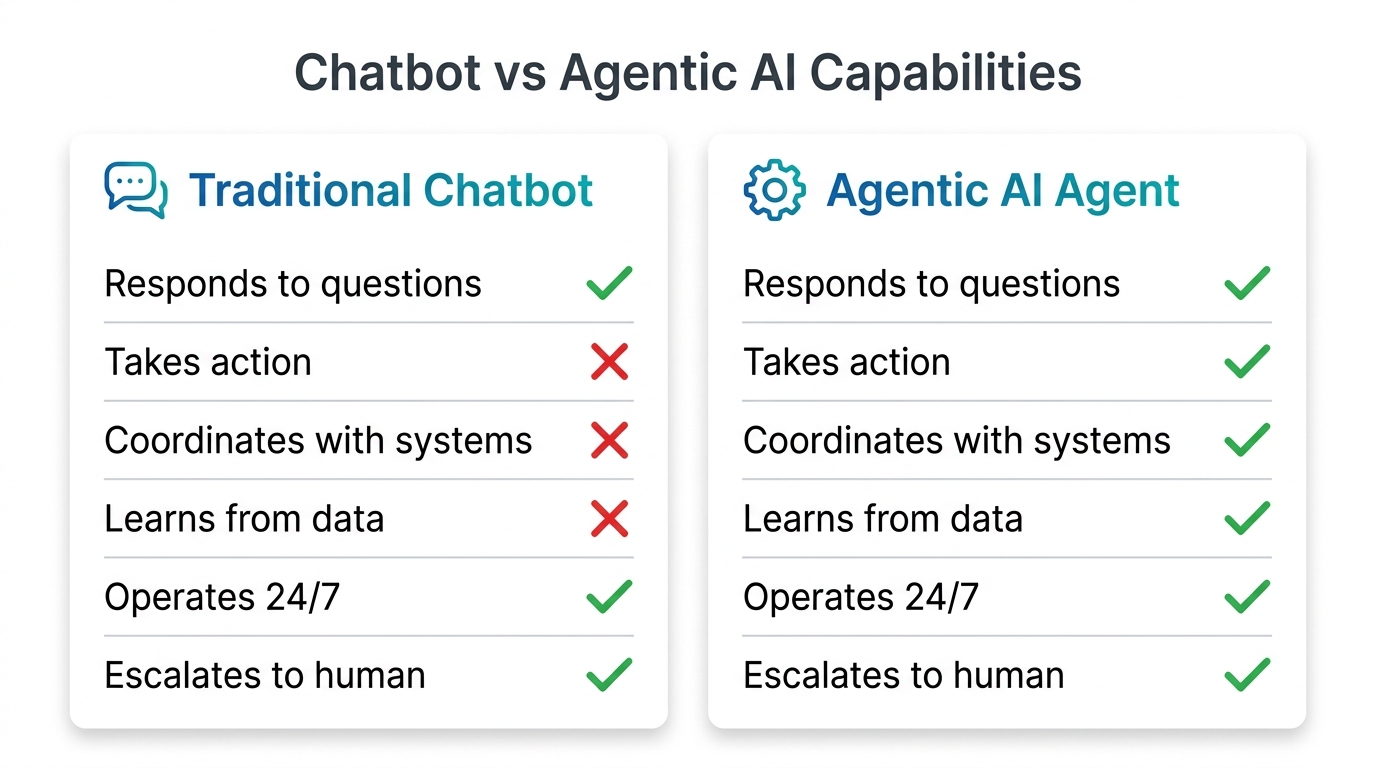
If you’ve used a hotel chatbot, you know the drill: a guest types “I need a late checkout,” the bot replies with a canned message, and the request sits until a human reads it. That’s conversational AI…it talks, but it doesn’t do.
Agentic AI is different. An AI agent doesn’t just respond to a request; it takes action. When a guest asks for late checkout, the agent checks the property’s policy and room availability, updates the reservation in the PMS, notifies housekeeping to adjust cleaning schedules, and sends the guest a confirmation. This is autonomous hotel operations in action.
That distinction matters because it shifts the operational burden from people to software. The agent becomes a 24/7 operator that follows rules, learns from patterns, and escalates only true exceptions. In a hotel, this means the front desk team stops being a manual relay station and starts focusing on guest interactions that build loyalty. The agent can also proactively initiate work, when a room has been marked dirty for two hours, it can autonomously dispatch a cleaner without anyone asking. That’s the move from reactive to proactive. For agentic ai hotels, this shift is foundational for operational gains.
To make this concrete, here’s how traditional chatbots compare with AI agents:
| Capability | Traditional Chatbot | Agentic AI Agent |
|---|---|---|
| Responds to questions | Yes | Yes |
| Takes action (e.g., update system) | No | Yes |
| Coordinates with other systems | No | Yes |
| Learns from data patterns | Limited | Yes (with machine learning) |
| Operates autonomously 24/7 | No | Yes |
| Escalates to human | Manual | Automated with rules |
Now that we understand what agentic AI is, let’s look at where agentic ai hotels are already deploying these agents first—and seeing results.
Where Hotels Are Deploying Agentic AI First
The most practical starting point for agentic ai hotels isn’t the guest-facing front desk; it’s the back-office engine of housekeeping, maintenance, and distribution. BCG’s 2026 report on AI-first hotels shows that leaner, smarter operations are no longer a future state, they’re already taking root. For agentic ai hotels, the first deployments are often in housekeeping coordination and other high-friction back-office areas.
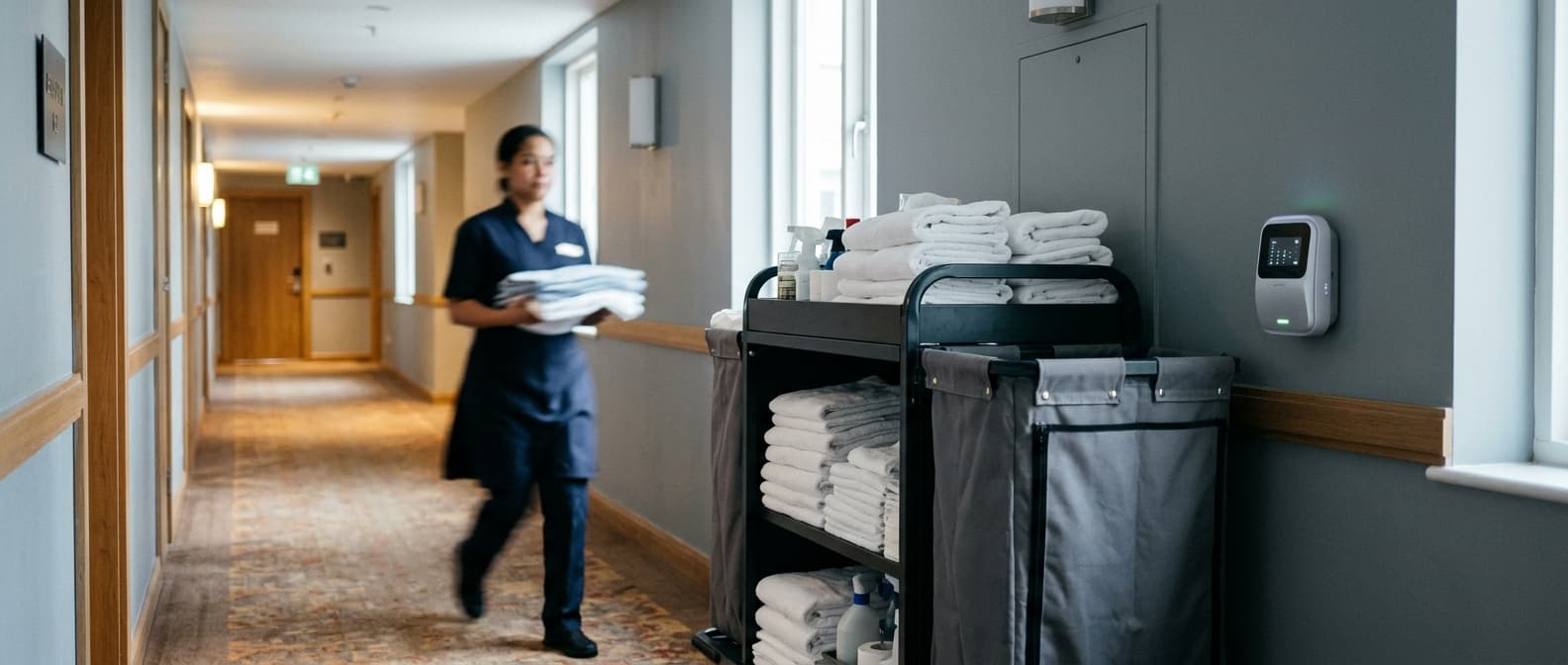
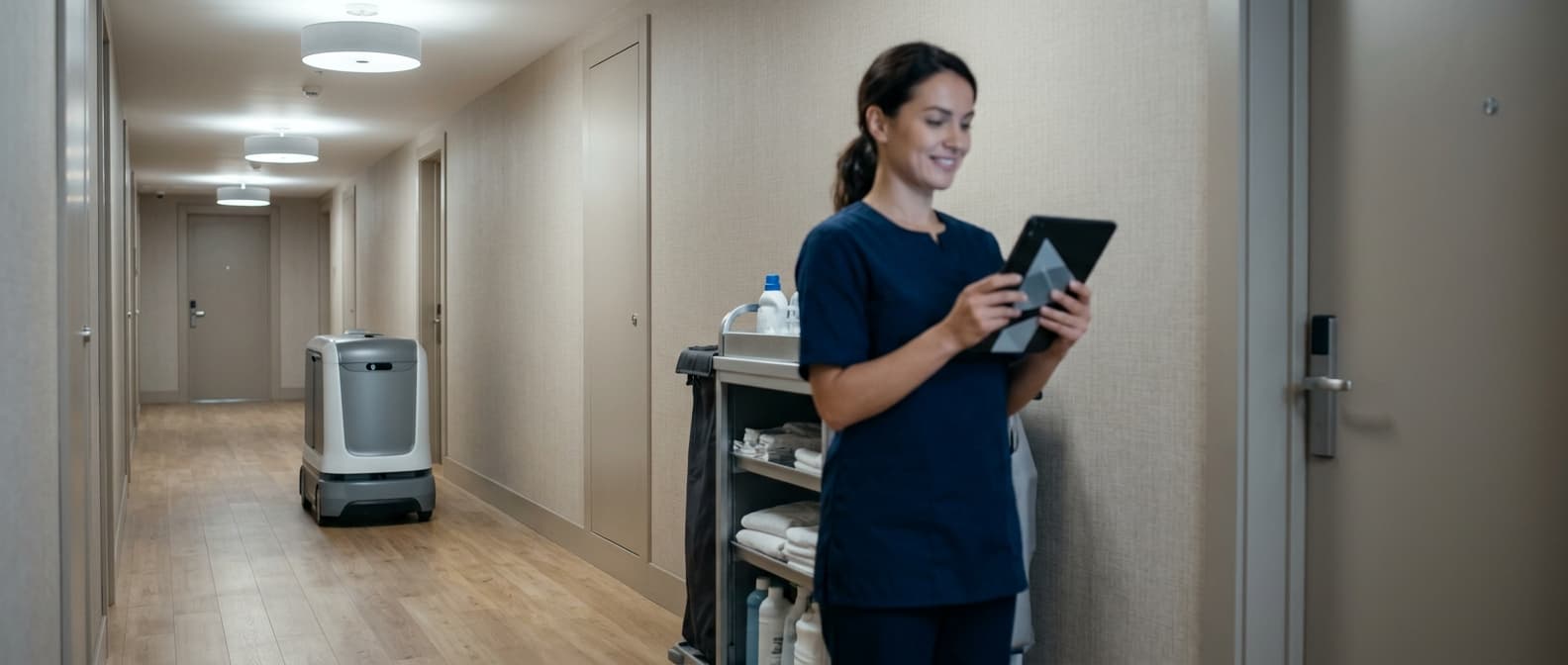
Housekeeping coordination is the classic entry point for agentic ai hotels. An AI agent can assign cleaning tasks based on room readiness, VIP status, and staff proximity. The room assignment logic ensures that the closest available cleaner gets the task. When a guest vacates early, the agent reroutes a cleaner to that room without any front desk involvement. In our experience, room turnaround time improves noticeably after deploying specialized agents for task assignment and status updates. The agent autonomously handles standard room turnover; it escalates only when a VIP arrival requires a priority override.
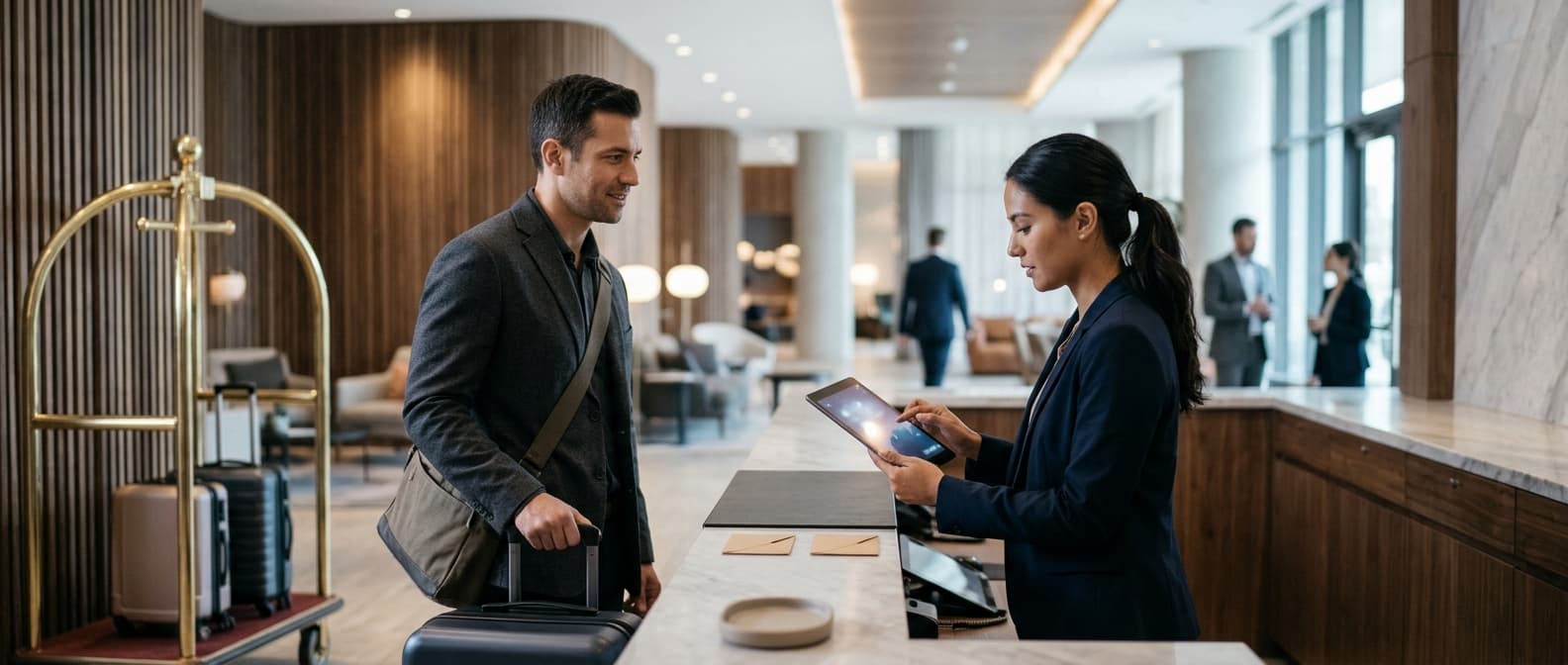
Front desk operations benefit from agents that can process late checkout requests, extra amenity orders, and basic room moves. Imagine a guest messaging “Can I stay until 1 p.m.?” The agent checks occupancy, confirms availability, updates the PMS, notifies housekeeping to delay cleaning, and sends the guest a confirmation, all in seconds. The front desk team is free to handle more complex guest needs. The agent can act without human approval for requests within policy (e.g., a late checkout up to two hours), but it flags any exception to a manager. This is agentic AI hospitality in practice, showing how agentic ai hotels reduce friction.
Maintenance and distribution are two other ripe areas. A maintenance agent can trigger work orders from guest complaints or IoT sensor data (e.g., an HVAC anomaly) and schedule non-urgent repairs during low occupancy. A distribution agent can adjust rate and availability updates across channels within revenue management rules, only alerting a revenue manager when a threshold is breached. In all these cases, the agent works quietly in the background, turning a chaotic morning into a calm operation. Starting with these back-office areas proves value without touching guest interfaces, building momentum for agentic ai hotels.
Agent-to-Agent Coordination: The Invisible Handshake
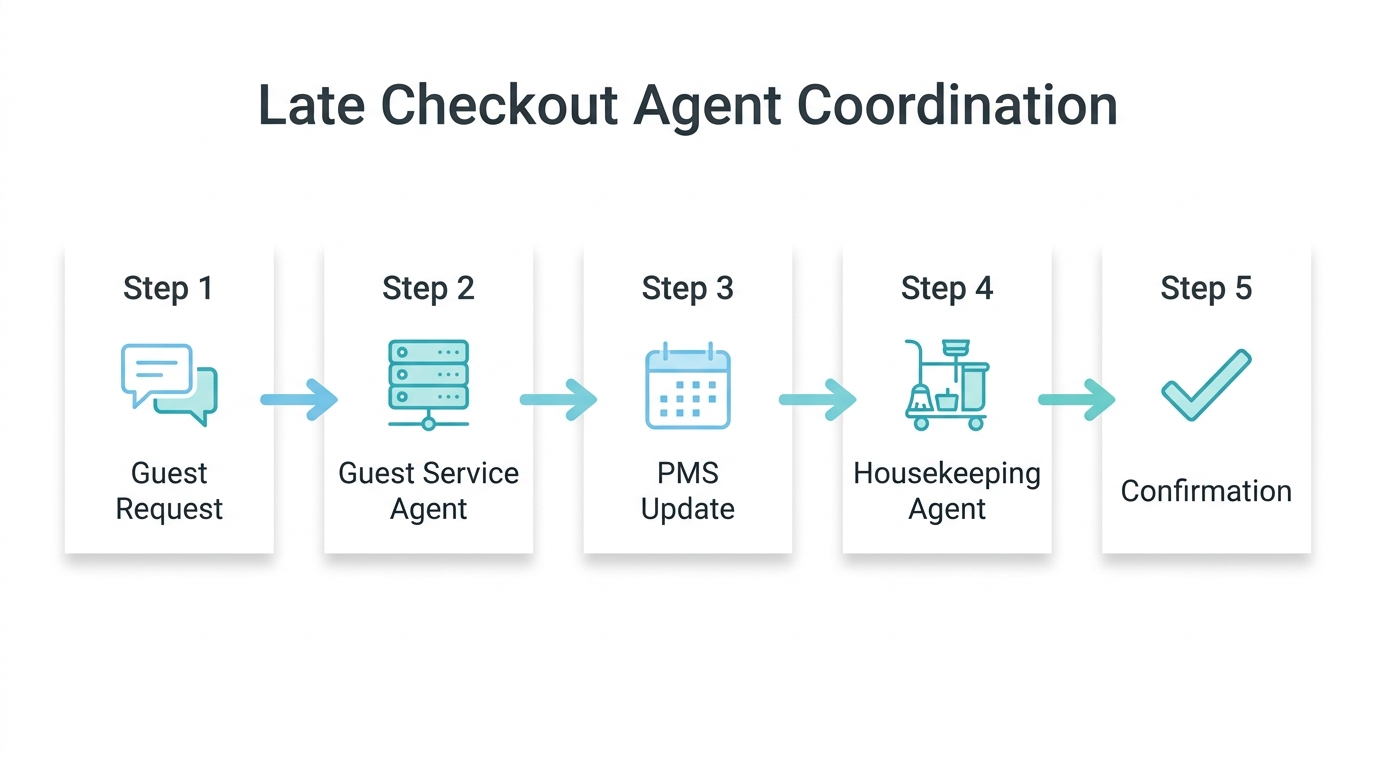
The real power of agentic AI emerges when agents talk to each other. Instead of isolated workflows, you get a coordinated system where a housekeeping agent updates a front desk agent, which triggers a guest notification, which logs the interaction for the CRM. This is how AI agents run hotel operations such as a silent, event-driven layer. The agent-to-agent communication in agentic AI in hotels is the invisible handshake that makes everything seamless. The agentic ai hotel ecosystem thrives on such connections.
Consider a guest who requests a late checkout via a messaging app. The guest request routing begins: the guest service agent checks policy, finds availability, and updates the PMS. It then notifies the housekeeping agent to reschedule cleaning for that room. The housekeeping agent confirms the new time slot, and the front desk agent sends the guest a confirmation message. Each agent performs its role and passes the baton without any human handoff. EHL’s research on AI in hospitality confirms that such service orchestration enhances the guest experience while reducing staff workload. For agentic AI for hotels, this coordination is a core capability that drives efficiency.
This coordination relies on APIs and modern integration layers. Agents connect to existing PMS, housekeeping software, and maintenance systems through connecting AI agents to hotel systems. They respond to events like room status changes or new guest requests using pre-defined business logic. The result is a hotel that feels like it runs itself during peak pressure, because the invisible handshakes have already handled the logistics.
Guardrails: Where Autonomy Stops and Human Judgment Begins
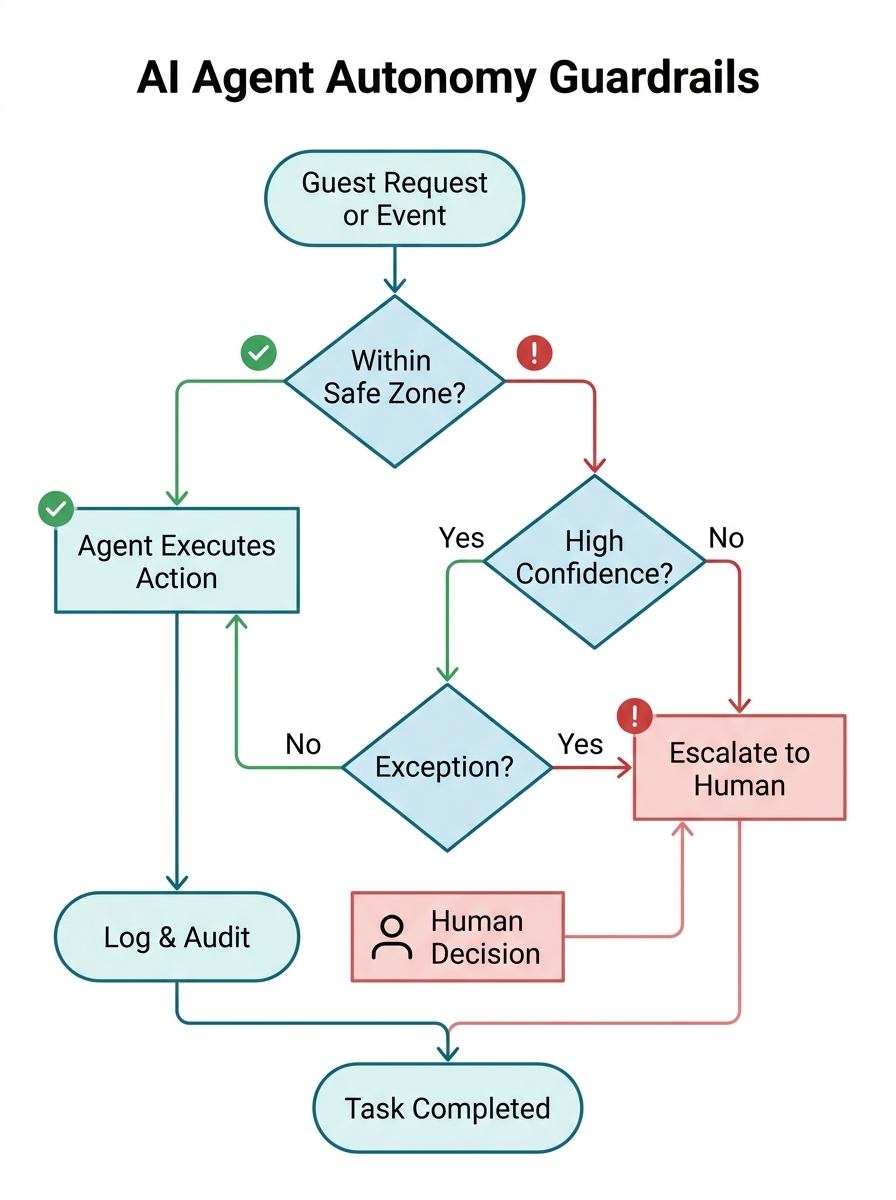
Skepticism about AI autonomy is healthy. No hotelier wants an agent making pricing decisions that hurt revenue or denying a loyal guest’s request without human oversight. That’s why guardrails are the most important part of any deployment. For agentic ai hotels, these guardrails define the operational autonomy limits that keep the system safe.
The principle is simple: let agents own the routine, and escalate the edge cases. For housekeeping, an agent can autonomously assign rooms, reroute cleaners, and mark rooms clean, but if a VIP arrives early and no room is ready, the agent flags the front desk for a manual decision. For revenue management, an agent can adjust rates within a predefined safe band, and any change beyond that requires the revenue manager’s approval. For guest requests, an agent can fulfill standard asks like extra towels, but if a guest complains about cleanliness, it escalates immediately to the housekeeping manager. This hybrid model is central to agentic ai hotel operations.
Designing these guardrails starts with mapping workflows and identifying the approval points that really matter. A common approach is to define a “safe zone” for each agent type: a set of actions with a high confidence score that can be executed automatically. Outside that zone, the agent pauses and triggers a human review. All agent actions are logged and auditable, so staff can see what the agent did and why. This transparency is critical for building trust with operations teams. For agentic ai hotels, clear operational autonomy limits are non-negotiable.
This hybrid model, autonomous execution with human exception handling, is what makes agentic AI safe for hotels. It’s not about replacing judgment; it’s about reserving it for the moments that truly need it. Agentic AI hotels rely on this balance to maintain guest satisfaction.
A 90-Day Starting Point: Your First Agentic AI Pilot
If you’re convinced that agentic AI can help your hotel, the next question is: where do you begin? The answer is a focused 90-day pilot in one department, one property, with clear success metrics. Here’s a practical blueprint for agentic ai hotels.
Days 1–30: Scope and Design. Choose housekeeping, it’s the department with the most visible back-office friction and the safest automation potential. Identify two or three repetitive workflows: room status updates, task assignment, and VIP room prep. Map the current manual process, define the business rules (e.g., priority levels, time limits), and document the escalation triggers. Select a single property for the pilot and get buy-in from the housekeeping manager. This is a typical starting point for agentic ai hotels looking to test the waters. Also consider how shift handover will be handled by the agent: when shifts change, the agent can transfer pending tasks to the incoming team without loss.
Days 31–60: Build and Test. Leverage custom AI agent development services to build the agent with simple rule-based autonomy. Integrate it with the PMS via APIs (whether it’s Oracle Opera, StayNTouch, or a proprietary system). Train the housekeeping team on the dashboard and the escalation flow. Then run a parallel operation for two weeks: the agent suggests assignments while the team continues manually. Compare outcomes to validate accuracy. For agentic ai hotels, this testing phase is critical to ensure reliability.
Days 61–90: Expand Autonomy and Measure. Gradually hand over more decisions to the agent: first only room status updates, then dynamic task reassignment. Connect the housekeeping agent to the front desk agent so that when a room is marked clean, the front desk is automatically notified. Measure the KPIs: room turnaround time, number of successful autonomous actions, staff satisfaction, and any guest complaints. In our experience, a well-run pilot can lead to noticeable reductions in turnaround time and a more satisfied housekeeping team, as staff focus on higher-value tasks. This proves the value of AI agents and builds confidence in agentic ai hotels.
This 90-day sprint proves value without disrupting a single guest stay. Once you’ve built internal trust, you can expand to maintenance, front desk, or distribution. The key is starting small, with clear guardrails, and a partner who understands how to connect agents to your existing hotel systems.
Frequently Asked Questions
What is agentic AI in hotels?
Agentic AI in hotels refers to autonomous software agents that go beyond answering questions, they take action. They can update room statuses, assign tasks, trigger maintenance, and coordinate across departments without constant human input, all within pre-set safe boundaries. For agentic ai hotels, this means a silent revolution in back-office efficiency.
How is agentic AI different from a hotel chatbot?
A hotel chatbot only responds to queries; it can’t execute back-end actions like modifying a reservation or notifying housekeeping. AI agents connect to hotel systems (PMS, housekeeping, maintenance) and perform those actions autonomously, often coordinating with other agents in the process. This is why agentic ai hotels achieve greater efficiency than hotels relying on chatbots alone. The shift toward agentic ai hotels is reshaping service delivery.
How do AI agents run hotel operations?
AI agents run hotel operations by acting as event-driven coordinators. They respond to triggers (e.g., a room is marked dirty, a guest requests late checkout), apply business rules, and execute multi-step workflows across systems. For example, a late checkout request can trigger the agent to update the PMS, reschedule housekeeping, and confirm with the guest, all automatically. This is the core of agentic ai hotel operations.
What can AI agents do without human approval in a hotel?
AI agents can autonomously handle routine, rule-based tasks with low risk. Examples include updating room statuses, assigning standard housekeeping tasks, granting late checkout within policy limits, adjusting rates within a predefined band, and triggering maintenance for known issues. Any exception or action outside the safe zone escalates to a human. These operational autonomy limits are key to safe deployment for agentic AI for hotels.
Where should hotels start with AI agents?
Hotels should start with a single back-office department housekeeping is the most common and low-risk choice. A 90-day pilot that automates two or three messy workflows can prove value, build staff trust, and create a blueprint for scaling to other areas like maintenance or front desk operations. Agentic ai hotels that start this way accelerate their journey.
Your Next Step: From Chaos to Calm
Agentic AI doesn’t replace your team; it removes the invisible friction that wears them down. As labour pressure relief becomes a priority, agentic AI hospitality offers a path to back-office automation that reduces manual overhead while maintaining quality. A focused pilot with the right partner can turn that chaotic 7 a.m. into a calm, coordinated operation.
If you’re ready to explore what agentic AI can do for your hotel, AI consulting for agentic workflow design is the natural first step. We’ll help you map your workflows, identify safe autonomy zones, and build your first agent within 90 days—without disrupting a single guest. That is the shift from chaos to calm, and it starts with a single conversation.
AI adoption and workflow automation
Start with one workflow, prove it in production, then scale what works.
See AI services
Ashish leads cross-functional engineering teams at Webuters to deliver scalable, AI-powered digital solutions. His expertise spans React, Node.js, Generative AI, Ecommerce, Shopify Plus, SFCC, and modern JavaScript frameworks like MERN and MEAN. From ecommerce migrations to AI consulting and adoption, he bridges complex tech with real business outcomes. As a hands-on leader in architecture, cloud, and full-stack innovation, he shares insights to help development teams build smarter and stay ahead in an evolving tech landscape.
Follow Ashish on LinkedIn