
EventBridge vs SQS vs SNS: How to Choose the Right AWS Messaging Service
Stuck choosing between Amazon EventBridge, SQS, and SNS? See clear comparisons, real architecture scenarios, combination patterns, and a decision flowchart for…

You set out to build a flexible, event-driven pipeline with Amazon EventBridge. Rules, targets, schema discovery—it seemed like the right move. But a week in, you realize that a single SQS queue would have handled the same workload with less code and fewer moving parts. This scenario is all too common: the real pain in AWS messaging often comes not from the services themselves but from choosing the wrong one.
Amazon offers three powerful options—SQS, SNS, and Amazon EventBridge—and each fits a different need. Picking the right one can mean the difference between a clean, scalable system and an over-engineered headache.
In the sections ahead, we'll first explain why this decision matters, then walk through each service on its own terms: SQS as the reliable queue, SNS as the push-based fan-out, and Amazon EventBridge as the smart bus. After that, we'll compare them side by side, explore real-world scenarios and combination patterns, and finish with a simple decision flowchart you can apply immediately. By the end, you'll have a clear mental model for making the right choice without drowning in AWS docs.
Why the Right Messaging Service Matters
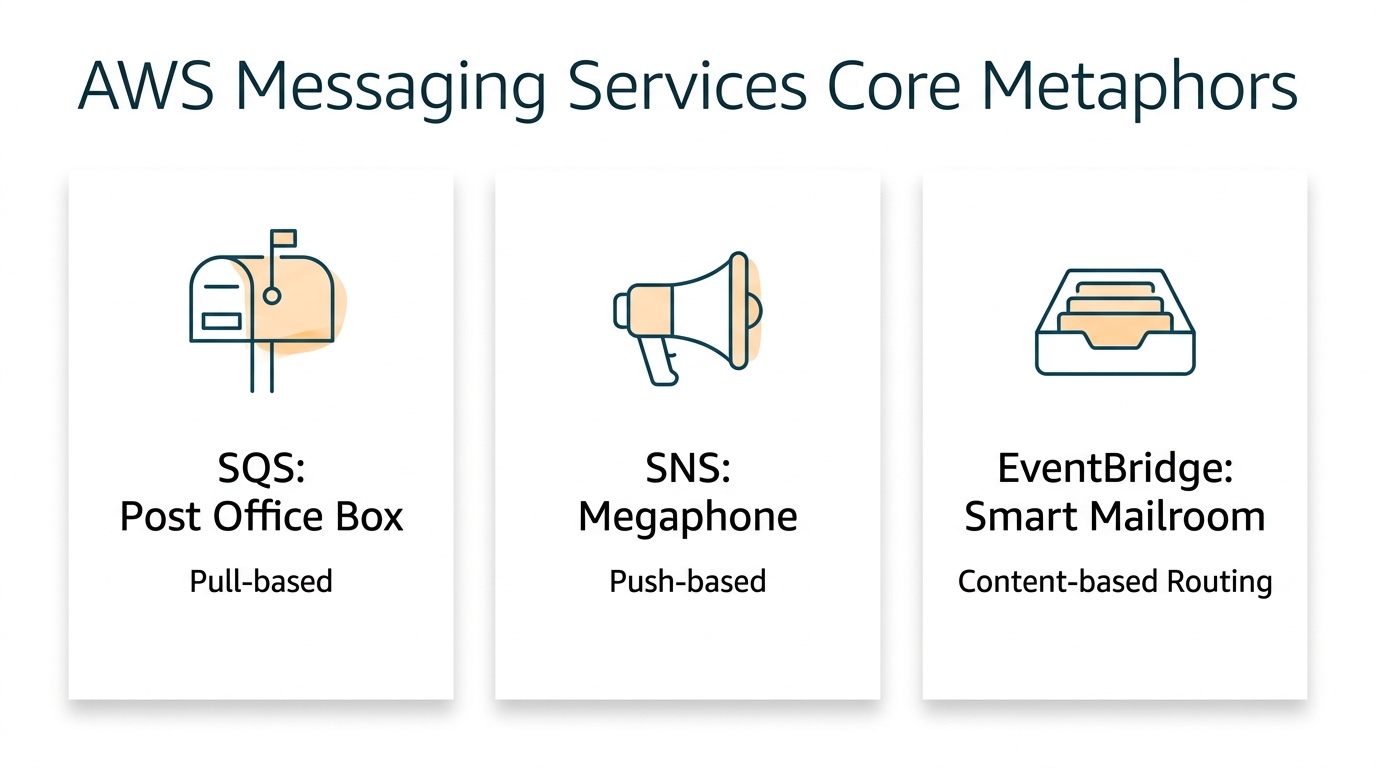
Messaging services are the silent backbone of decoupled architectures. They let your application components scale independently, absorb traffic spikes, and recover from failures gracefully. But the wrong choice doesn't just slow you down—it compounds operational overhead, increases latency, and often forces painful re-architecting later.
Serverless and event-driven patterns have become the norm for many AWS workloads. Whether you're migrating a monolith or building a new microservices platform, the messaging layer directly impacts cost, performance, and team velocity. That makes the queue-versus-fan-out-versus-bus question a design decision with real consequences.
Here's a quick mental model: think of SQS as a post office box (you pull out messages when ready), SNS as a megaphone (one message instantly reaches many listeners), and Amazon EventBridge as a smart mailroom (packages are routed to the right department based on their labels). This analogy will anchor the details that follow.
Amazon SQS: The Reliable Queue for Decoupling Work
Amazon Simple Queue Service (SQS) is a pull-based message queue. Consumers poll for messages and process them at their own pace. It's the AWS original for decoupling microservices and remains the simplest, most battle-tested option for work distribution.
When you send a message to an SQS queue, it stays there until a consumer picks it up and deletes it. If a consumer fails, the message becomes visible again after a configurable timeout. This safety net is why SQS is ideal for workloads where message loss isn't an option. The AWS documentation explains that standard queues offer at-least-once delivery and nearly unlimited throughput, while FIFO queues provide exactly-once processing and message ordering. That distinction matters when your business logic can't tolerate duplicates.
A classic example: an order processing system. The order service drops a message into an SQS queue; a separate worker polls the queue and handles payment, inventory, or fulfillment. The two services don't depend on each other's uptime, and the queue buffers against sudden spikes. Without a queue, a traffic burst could overwhelm the downstream service; with SQS, the worker simply catches up when it can.
SQS also supports dead-letter queues (DLQs) to isolate messages that repeatedly fail processing, giving you a safety valve for debugging without losing data. If you only need a simple work queue, SQS alone is often the best choice—even if a routing bus feels more modern.
In AWS messaging, the wisest choice is often the simplest one—because the real cost isn't the service, it's the complexity you didn't need.
SQS shines when you need one consumer per message, reliable buffering, and simple retry mechanics. But what if you need to reach many receivers at once? That's where Amazon SNS steps in.
Amazon SNS: The Push-Based Fan-Out for Immediate Broadcasts
Amazon Simple Notification Service (SNS) flips the model: it's push-based pub/sub messaging. When you publish a message to an SNS topic, it's pushed to each subscriber according to the endpoint type—SQS queues, Lambda functions, HTTP(S) endpoints, email, and mobile text messages (SMS) are all supported. Think of it as a megaphone: the message goes out to every listener at once.
SNS is the go-to when you need to broadcast an event and let multiple systems react independently. It's not about buffering work; it's about instant fan-out. The AWS documentation emphasizes that a topic acts as a logical access point, ensuring messages are delivered to multiple subscribers across different platforms.
Picture a user signup event. You want to send a welcome email via SES, trigger an onboarding workflow with Lambda, and log the event to a data warehouse with Kinesis. With SNS, you publish once to a topic, and all three subscribers receive the message at once. No custom fan-out code; SNS handles the plumbing.
The service also supports message filtering by attributes, so individual subscribers can receive only the messages they care about. And when combined with SQS, you get the best of both worlds—more on that later.
SNS is your tool for simple, one-to-many notifications. But what if you need to route events based on their content, not just a topic subscription? That's Amazon EventBridge territory.
Amazon EventBridge: The Smart Event Bus for Complex Routing
Amazon EventBridge is the serverless event bus designed for event-driven architectures at scale. It ingests events from AWS services, custom applications, and over 140 SaaS partners—think Shopify, Datadog, or Zendesk—and routes them to targets based on rules that inspect event content. The AWS documentation describes it as a service that uses events to connect application components, making it easier to build scalable event-driven applications.
Where SQS cares about message delivery and SNS cares about fan-out, Amazon EventBridge cares about routing logic. You define event rules like "if the event source is aws.ec2 and the detail state is pending, send to this Lambda function." That content-based routing is what sets it apart.
The service also includes a schema registry that automatically discovers and versions event structures, making it easier for teams to understand event shapes and reduce errors from mismatched payloads.
A real-world example: an e-commerce platform catching "order placed" events. Based on the order value, Amazon EventBridge can route high-value orders to a premium inventory service, send all orders to a fraud detection system, and forward international orders to a different fulfillment pipeline—all from the same bus. This kind of fine-grained routing would be cumbersome with SNS alone.
Targets include SQS queues, Lambda functions, Step Functions, and more. By sending events to an SQS queue, you combine the routing intelligence of Amazon EventBridge with the reliable buffering of SQS—a pattern we'll explore shortly.
Now that we've met each service, let's put them side by side.
EventBridge vs SQS vs SNS: A Side-by-Side Comparison
Here's a quick reference that answers the pairwise questions many engineers search for. Use it to spot the fundamental differences at a glance.
| Service | Delivery Model | Consumers per Message | Filtering | Ordering / FIFO | Typical Use Case | Failure Handling |
|---|---|---|---|---|---|---|
| SQS | Pull (poll) | One consumer | None (all messages consumed) | Supports FIFO for ordering | Work queues, decoupling producers and consumers | Dead-letter queues, visibility timeouts |
| SNS | Push (fan-out) | Many subscribers (SQS, Lambda, HTTP) | Message attributes | No ordering across subscribers | Notifications, alerts, broadcast events | Retries, DLQs for SQS subscribers |
| EventBridge | Push (bus with routing rules) | Many targets (SQS, Lambda, Step Functions) | Content-based rules | No across targets (FIFO via SQS target) | Event-driven architectures, SaaS integrations, complex routing | Retry policies, DLQs for targets |
These distinctions map directly to three critical questions. EventBridge vs SQS: Amazon EventBridge routes events by content rules; SQS buffers work for a single consumer. EventBridge vs SNS: Amazon EventBridge uses content-based rules and SaaS sources; SNS does simple fan-out by topic. SQS vs SNS: SQS is pull-based with one consumer per message; SNS is push-based with many subscribers.
The official AWS decision guide reinforces this: choose based on how many consumers you need and whether you need to filter or route events.
Real-World Scenarios: Which Service Fits Which Architecture?
Let's ground these comparisons in concrete architectures you'll recognize.
Order Processing with an SQS Buffer
An order service needs to hand off work to a payment processor. The order service doesn't care when payment happens; it just needs a reliable handoff. A single SQS queue is perfect: the order service drops a message, the payment service polls and processes, and the queue protects against overload. If payment slows down, messages simply wait. No extra infrastructure.
This is the classic "decouple producer from consumer" pattern. It works because there's one logical consumer per message, and processing can happen asynchronously.
Notification Fan-Out with SNS
After an order is placed, you need to notify three systems: an email service, an analytics data pipeline, and a mobile push notification service. You want the notification to happen immediately, and all three systems should receive the same event.
SNS is the natural fit. One topic, three subscribers—each can be a Lambda function, an SQS queue, or an HTTP endpoint. No code changes are needed when you add or remove subscribers.
Event-Driven Microservices with Amazon EventBridge
Now imagine an order processing pipeline that behaves differently based on order attributes. Orders over $500 go to a fraud review service. All orders go to inventory management. International orders go into a customs documentation queue.
Amazon EventBridge makes this straightforward. A single bus receives all order events, and content-based rules route them to the appropriate microservices. Each team can own its own rules and targets, reducing the coordination overhead that would plague a purely SNS-based approach.
These scenarios aren't mutually exclusive. In fact, most real systems mix and match. Let's see how.
Combining Forces: SNS + SQS and EventBridge + SQS Patterns
AWS messaging services are lego blocks, not islands. The most resilient architectures often chain them together to get the best of multiple worlds.
SNS to SQS Fan-Out
This is the classic "reliable fan-out" pattern. You publish to an SNS topic, and multiple SQS queues subscribe. Each queue can be polled by a different consumer group, and the queues buffer messages if a consumer falls behind. This pattern is documented by AWS as a way to achieve parallel, asynchronous processing with guaranteed delivery.
Example: A retail platform broadcasts a "price change" event via SNS. One SQS queue feeds a cache invalidation service; another feeds a search index updater. Each service scales independently, and the queues absorb bursts.
EventBridge to SQS for Durable Delivery
Amazon EventBridge can target SQS queues directly, giving you content-based routing plus the buffering and retry logic of SQS. Rules inspect the event and send it to the right queue; the queue ensures delivery even if the consumer is temporarily unhealthy. When sending to an SQS FIFO queue, the SqsParameters API lets you specify a message group ID—a crucial control for preserving ordering within groups.
Example: A rule routes all "customer churn risk" events to an SQS queue. A machine learning model polls the queue asynchronously, allowing for backpressure without losing events.
Mixing All Three
It's entirely valid to have Amazon EventBridge receive events from SaaS sources, route some to SNS for fan-out, and have SNS subscribe to SQS queues for asynchronous processing. This gives you a composable messaging fabric that can adapt as your needs evolve.
But with great power comes the temptation to over-engineer. Let's talk about when to resist that urge.
The Case for Simplicity: When a Plain SQS Queue Beats an Event Bus
Amazon EventBridge is powerful, but power isn't always the answer. If you only need to do work asynchronously with a single consumer, a simple SQS queue is more than enough. Adding a bus introduces rules to manage, schemas to maintain, and an extra hop that increases end-to-end latency.
I've seen teams replace a perfectly functional SQS queue with Amazon EventBridge because "event-driven" sounded more modern. The result was a slower system with more points of failure and no new business value. The operational cost of complexity is real: you spend more time debugging routing issues and less time shipping features.
This doesn't mean Amazon EventBridge is bad—it's just often more than you need. Start with the simplest service that meets your requirements. You can always introduce the bus later when you truly need content-based routing or SaaS integrations. If your team is modernizing a legacy application, our cloud migration and modernization services can help you evaluate the right messaging backbone without over-engineering.
Your Decision Flowchart: How to Choose Like a Pro
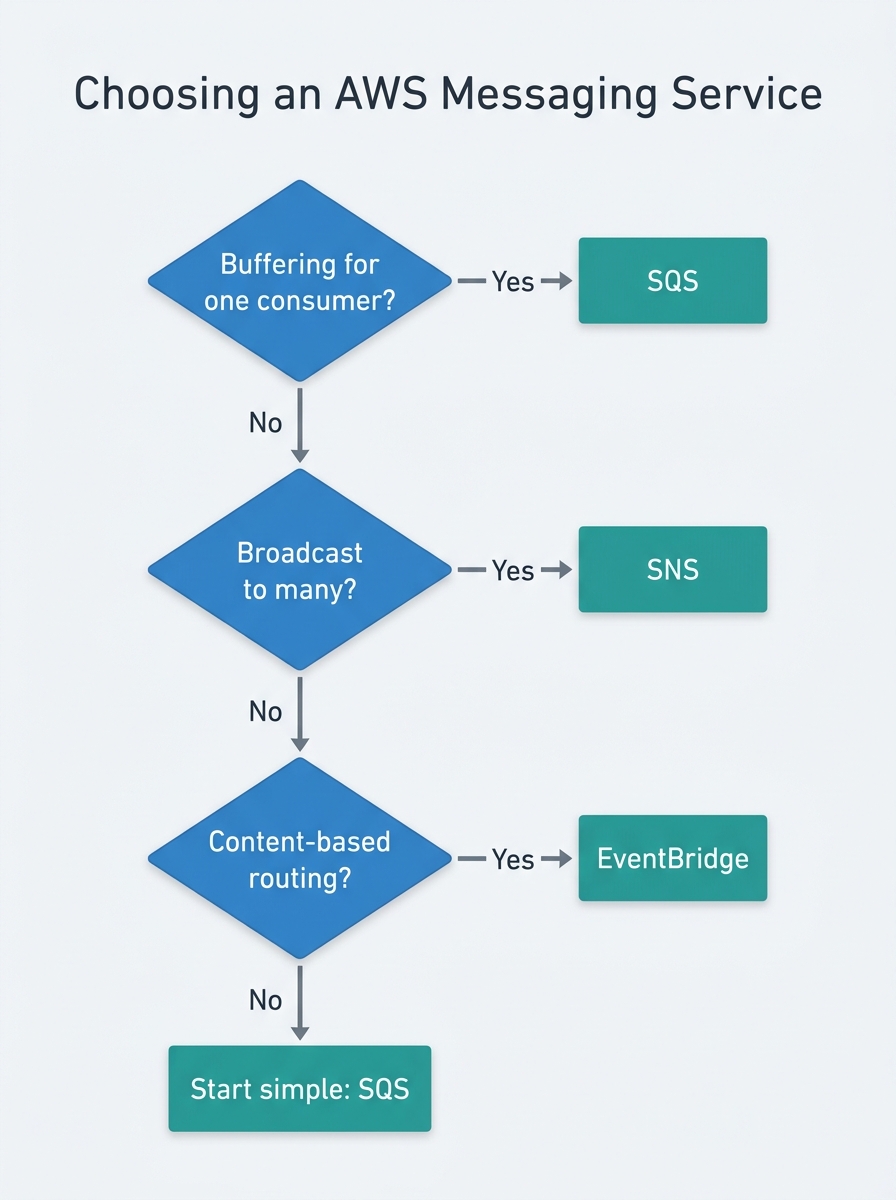
When I'm standing at a whiteboard with a team, here's the decision tree I walk through. It's a practical starting point—not a rigid rulebook. Adapt it to your own context, and you'll likely find it covers the most common scenarios.
- Do you need to buffer work for one consumer? → Start with SQS. Keep it simple.
- Do you need to broadcast one message to many receivers, with no complex routing? → Use SNS. Good for notifications and fan-out.
- Do you need to route events based on content, integrate with SaaS, or give different teams autonomy over their own rules? → Amazon EventBridge is your tool.
- Need both fan-out and buffering? → Combine SNS with SQS queues.
- Need routing plus buffering? → Amazon EventBridge targeting SQS queues.
- Need strict ordering (FIFO)? → SQS FIFO or Amazon EventBridge to SQS FIFO. SNS does not preserve order across subscribers.
This isn't a rigid framework—it's a starting point. Every architecture has trade-offs, and the right choice depends on your specific latency, throughput, and operational requirements.
Final Thought: Balancing Power and Simplicity in AWS Messaging
Choosing among SQS, SNS, and Amazon EventBridge isn't about picking the most popular service or the one with the longest feature list. It's about understanding how your application needs to communicate—pull or push, one or many, simple or content-driven—and using the service that matches that need perfectly.
Often, that means reaching for SQS when a queue will do, despite the siren song of the bus. The best architectures are the ones that deliver business value with the least operational overhead. And in AWS messaging, the wisest choice is frequently the simplest one.
If you're in the middle of a cloud migration or rethinking your event-driven architecture, Webuters can help you design a messaging layer that fits your scale and your budget—not someone else's blueprint. Explore our DevOps and cloud engineering services to see how we support teams with hands-on architecture and implementation. And for deeper dives into AWS monitoring best practices, check out our CloudWatch vs CloudTrail guide.
Still unsure which service fits your architecture? Webuters cloud engineers can help you design a messaging layer that matches your scale and budget—without over-engineering. Contact us for a practical architecture review.
Frequently Asked Questions
What is the main difference between Amazon EventBridge and SQS?
Amazon EventBridge is an event bus that routes events based on content rules to multiple targets, while SQS is a message queue for decoupling a single consumer from a producer. Use Amazon EventBridge when you need smart routing; use SQS when you just need to buffer work.
When should I use SNS instead of Amazon EventBridge?
Use SNS when you need simple fan-out (one message to many subscribers) without content-based routing. SNS is often faster to set up and sufficient for notifications and broadcast events. Choose Amazon EventBridge when you need to filter or route events based on payload fields or integrate with SaaS partners.
Can I combine SQS and Amazon EventBridge?
Yes. A common pattern is to use Amazon EventBridge rules to route events to SQS queues. This gives you content-based filtering plus the durable buffering and backpressure handling of SQS.
Does Amazon EventBridge guarantee message ordering?
Amazon EventBridge itself does not guarantee ordering across multiple targets. However, you can achieve ordering by sending events to an SQS FIFO queue, which preserves order for a given message group.
Which service is best for a decoupled microservices architecture?
It depends on your needs. For simple work queues, SQS is best. Broadcasting events to many services calls for SNS. Complex event routing, where different microservices react to different event types, Amazon EventBridge is the most flexible. In practice, many microservices architectures use all three in combination.
What is a dead-letter queue and which services support it?
A dead-letter queue (DLQ) holds messages or events that couldn't be processed successfully after a set number of attempts. SQS has native DLQ support. SNS can send undeliverable messages to an SQS DLQ when subscriptions fail. Amazon EventBridge supports DLQs for failed event deliveries to targets like Lambda or SQS.
Cloud migration and modernization
Plan, migrate and keep systems patched without stopping the business.
See cloud services
Deepak leads the AI engineering team and software development team at Webuters, driving innovation across custom AI solutions, automation workflows, and data-driven platforms. He specializes in building intelligent systems that are scalable, secure, and impactful. From NLP to backend logic, he’s hands-on with every layer of the tech stack. On the blog, he shares technical how-tos, AI trends, and practical tips for building with Python—always aiming to support developers and businesses navigating the AI landscape.