Why Your Hotel’s Labor Budget Is Bleeding (And Occupancy Alone Can’t Stop It)
Discover how AI staff scheduling cuts overtime, reduces turnover, and aligns hotel staffing with real demand by forecasting workload—not just room count.

Your AI staff scheduling is a daily tightrope walk. Yesterday you were overstaffed by three housekeepers on a slow Tuesday. Next Saturday’s checkout tsunami will force overtime on your best people, the ones you can least afford to lose. That’s the gut punch of scheduling by occupancy alone.
We often treat staffing as headcount math: rooms divided by an average productivity rate. But two properties at the same occupancy level can require very different labor hours because of arrival and departure patterns, room mix, and service standards. Staff your hotel for the room count, and you leak cash every day. AI staff scheduling solves this by forecasting workload not just occupancy and automating skill-based task allocation. It cuts overtime, protects staff wellbeing, and keeps your service sharp. For our clients, this shift starts with AI consulting for workforce planning that turns operational data into fair, cost-efficient schedules.
In this article, we’ll explore where hotel labor budgets actually leak, why occupancy deceives you, how AI staff scheduling predicts real workload, matches skills, ensures compliance, and the KPIs that prove it works. By the end, you’ll see why a smarter schedule starts with a single step.
Where Hotel Labor Budgets Actually Leak?
Overtime, agency spend, and mismatched staffing are the three biggest drains on your labor budget. Unscheduled overtime adds premium pay typically 1.5x the hourly rate under US law, yet many properties allow it to accumulate. Agency staff plugs gaps at a premium, but it also disrupts team cohesion and consistency.
Then there’s low productivity on overstaffed days. Those three extra housekeepers on a slow Tuesday still draw full pay while output barely moves. A recent CoStar analysis shows hotel F&B labor cost growth outpacing revenue in 2024, a trend that sharpens the need for smarter deployment. The hidden cost is burnout. Forced overtime and erratic schedules push good people out. Replacing a single housekeeper costs a significant portion of their annual salary in recruiting, training, and lost know-how. That leak compounds across the property. To stop these leaks, you first need to see them. The problem is that most hotels plan staffing based on a number that hides the true story: occupancy.
Why Occupancy Alone Deceives You?
Occupancy is a vanity metric in scheduling; workload is the truth. Consider two identical Mondays at 80% occupancy. One has 150 departures and 120 arrivals; the other has 30 departures. The first demands far more labor for turnover cleaning, luggage help, and front-desk volume. Yet traditional scheduling staffs both identically. Room mix matters, too. A suite taking 45 minutes to clean versus a standard room at 25 minutes adds up fast. Time-of-day clustering a 200-checkout wave compressed into four hours creates peak demand that a headcount average completely misses. These arrival and departure peaks and the true minutes per room required are invisible to occupancy-only planning.
Seasonal events, weather, and local conferences further distort the picture. Relying on occupancy alone is like navigating with a photo instead of live traffic data. The real question isn’t “how many rooms?” but “how many minutes per room, when, and what kind?” AI staff scheduling answers that question directly.
Forecasting Workload, Not Just Room Count
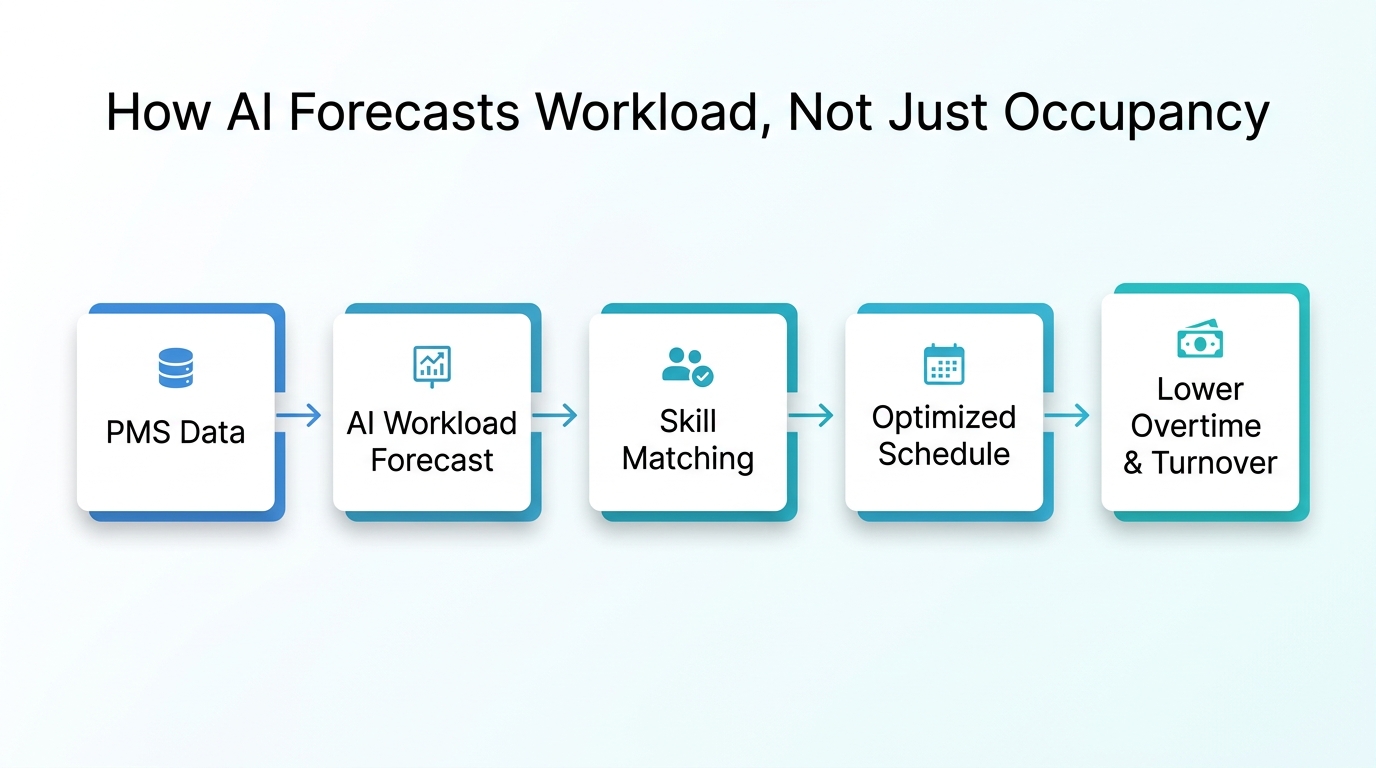
AI models ingest property management system data: arrivals, departures, stayovers, room type, VIP flags plus historical patterns, local events, weather, and even group booking pace. The output is an hour-by-headcount demand curve per skill set, showing exactly how many housekeepers, front desk agents, and public area attendants are needed each shift. This is predictive staffing in action. AI staff scheduling forecasts occupancy accurately but also goes far deeper. It models the exact workload: for example, a 300-room hotel with 70% occupancy might have 100 departures and 110 arrivals on a given day. The system calculates that turnover cleaning requires 90 minutes per room for departures and 30 for arrivals, adding extra time for VIP rooms and suite deep cleans. It predicts a need for 12 housekeepers from 10 AM to 2 PM, but only 6 after 3 PM. The morning front desk wave requires 4 agents, dropping to 2 later. This granularity eliminates over- and under-staffing.
The forecast evolves as data refreshes. If a group cancels 48 hours out, the AI trims tomorrow’s headcount automatically, avoiding overstaffing. A 7- or 14-day outlook gives managers time to adjust, not react. This workload-based forecasting reduces overtime spend significantly. Here’s how it works in practice: The AI looks at occupancy and it also models the exact workload. Integrating these systems is not magic; it’s method. connecting PMS and workforce systems ensures the data flow is seamless, so the AI always sees the latest booking picture.
Matching Skills to Tasks Automatically
Each team member carries a skill profile: trained for deep cleaning, turndown, VIP service, or supervisory duties. AI staff scheduling matches tasks to those profiles, so a trained housekeeper doesn’t strip beds while a floater handles turndown. This is a core part of AI staff scheduling for hotels. Preferences, certifications, and past performance also factor in. A bilingual agent is scheduled during international arrival peaks; a senior room attendant gets the hardest checkout cluster. When a call-out happens, the system instantly reassigns the right floater to the right block, notifying both via app. This reduces the need for agency labour cost and improves skill matching.
Consider a practical scenario: In a large resort, a pool of 40 housekeepers has varied certifications 10 trained for VIP suites, 5 for deep-cleaning after events, and the rest for standard rooms. On a day with a VIP group departure, the AI automatically assigns the VIP-trained staff to those suites, while standard rooms are covered by others. If a call-out occurs, the system checks availability and skills, and reassigns a trained staff member from a less critical area, all within minutes. This skill matching reduces idle time and ensures quality. This skill-based matching is a key advantage of shift optimization. It cuts friction and idle time, and gives staff more purposeful work, which strengthens engagement. Engaged teams deliver better service with lower turnover.
Protecting Wellbeing and Staying Compliant
Labor laws aren’t optional. The EU Working Time Directive and US overtime rules set clear boundaries, but manual scheduling often misses them. AI staff scheduling applies these constraints automatically: maximum consecutive days, minimum rest periods, and overtime caps are built into the algorithm. More importantly, it flags burnout signals. A housekeeper who worked 48 hours last week is blocked from extra shifts even if demand is high. Staff can trade shifts via app with manager approval, increasing autonomy. Fairer schedules reduce resentment and unplanned absenteeism patterns.
For example, under the EU Working Time Directive, workers must have at least 11 consecutive hours of rest per day and cannot work more than 48 hours per week on average. The AI enforces these rules by checking each employee’s schedule against the limits. In the US, overtime rules require 1.5x pay for hours over 40 per week. The AI caps overtime and tracks it, preventing accidental violations and costly lawsuits. This ensures compliance with rest rules and reduces legal risk.
This directly answers: does AI staff scheduling improve staff retention? Yes, by preventing the forced overtime and erratic patterns that contribute to high turnover in many hotels. Properties that adopt AI staff scheduling often see attrition improve within the first year, simply because schedules become predictable and respectful.
KPIs That Prove AI Staff Scheduling Works
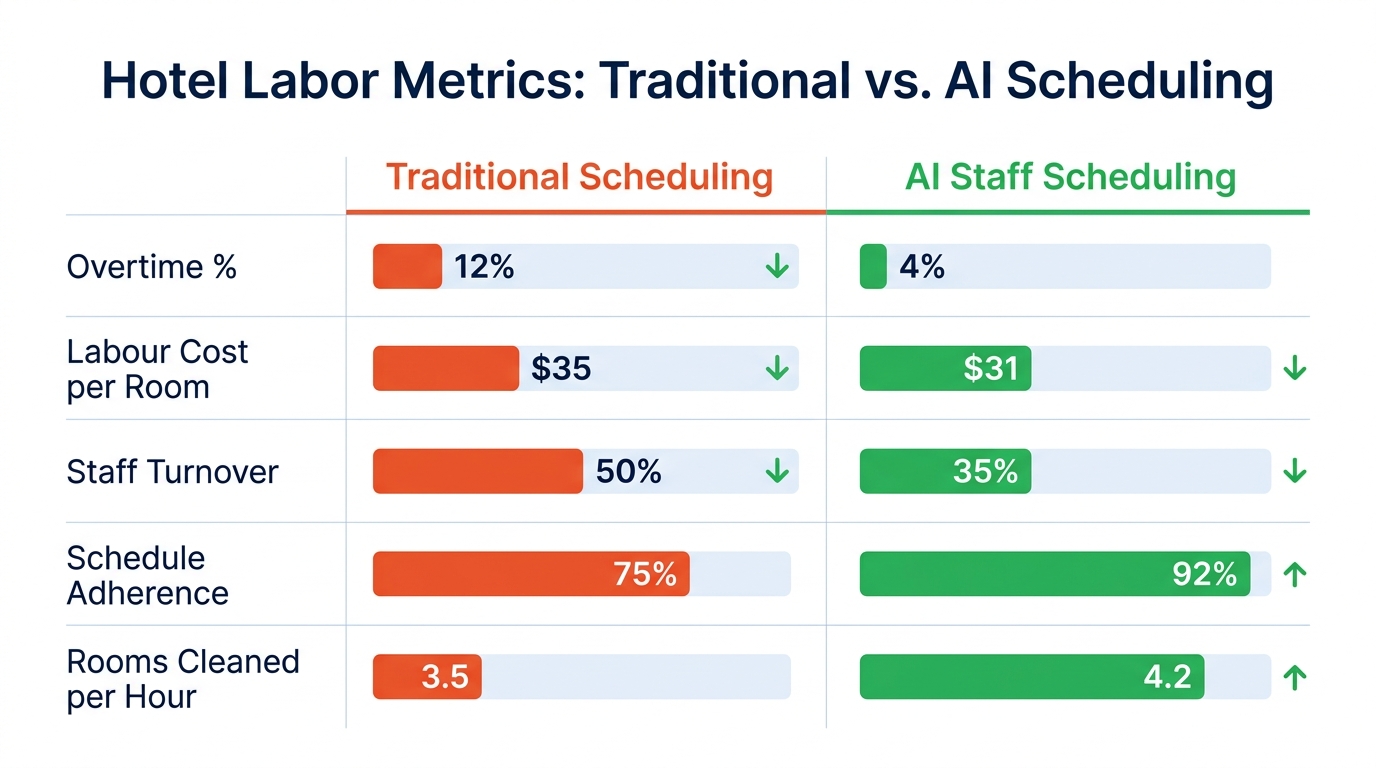
The following metrics illustrate typical improvements from AI staff scheduling. Illustrative example; actual client results may vary.
| Metric | Before AI | After AI (Typical) | Improvement |
|---|---|---|---|
| Labour cost per available room | $35 | $31 | -11% |
| Overtime spend as % of total hours | 12% | 4% | -67% |
| Annual staff turnover rate | 50% | 35% | -30% |
| Schedule adherence | 75% | 92% | +23% |
| Rooms cleaned per hour (peak) | 3.5 | 4.2 | +20% |
A 300-room hotel at 70% occupancy, for example, can save over $400,000 annually just from the labour cost per available room reduction. Overtime premiums often drop significantly, freeing funds for better wages or training. But these numbers are not just theoretical. Consider the impact on overtime spend: Before AI, overtime was 12% of total hours, often due to last-minute call-outs or inaccurate forecasts. With AI, the system anticipates peaks and assigns staff proactively, dropping overtime to 4%. That 8% reduction in a hotel with 100,000 labor hours annually translates to $120,000 saved (at 1.5x base pay of $15/hour). Similarly, schedule adherence jumped from 75% to 92%, meaning managers spend less time chasing replacements and more time on guest experience.
Common Questions About AI Staff Scheduling for Hotels
How can AI optimize hotel staff scheduling?
AI staff scheduling forecasts workload per hour based on multiple data streams, matches skills to tasks automatically, and embeds compliance rules. The result is a lean, fair schedule that adapts in real time.
Can AI staff scheduling reduce hotel labor costs?
Yes. It eliminates overstaffing, cuts overtime premiums, and improves productivity. For many properties, the effect on labour cost per available room can be significant—think double-digit percentage savings—plus additional savings from lower agency spend.
How does AI staff scheduling handle housekeeping?
It predicts cleaning times by room type and status, then assigns staff with the right skills and availability. It also reacts to call-outs by reassigning tasks instantly, keeping the shift on track.
How do hotels forecast staffing needs with AI?
AI models ingest PMS data, historical patterns, local events, and real-time inputs to output an hour-by-headcount demand curve. This replaces gut-feel planning with data-driven precision.
Does AI staff scheduling improve staff retention?
Yes. By enforcing rest rules, limiting forced overtime, and enabling shift swaps, AI staff scheduling creates fairer schedules that reduce burnout. Properties often see noticeable drops in turnover.
Building a Smarter Schedule: Your Next Step
We started with a question: why is your labor budget bleeding? The answer is clear: occupancy alone cannot capture the complexity of real workload. AI staff scheduling shifts the focus to what matters: minutes of work per skill set, compliant with labor laws, and aligned with your team’s strengths. The hotels that will win on margin and morale treat scheduling as a continuous intelligence function, not a weekly spreadsheet chore. If your property still schedules by room count, you’re leaving money and morale on the table.
Webuters helps hotel leaders build scheduling intelligence that fits their property’s unique workload patterns—starting with an AI consulting for workforce planning audit that reveals your biggest labor leaks. For more insights, explore our business automation insights. Ready to move from firefighting to forecasting? Let’s talk about the first steps.
For teams evaluating this next step, Webuters’ automating repetitive back-office tasks can provide a practical reference point.
AI adoption and workflow automation
Start with one workflow, prove it in production, then scale what works.
See AI services
Ashish leads cross-functional engineering teams at Webuters to deliver scalable, AI-powered digital solutions. His expertise spans React, Node.js, Generative AI, Ecommerce, Shopify Plus, SFCC, and modern JavaScript frameworks like MERN and MEAN. From ecommerce migrations to AI consulting and adoption, he bridges complex tech with real business outcomes. As a hands-on leader in architecture, cloud, and full-stack innovation, he shares insights to help development teams build smarter and stay ahead in an evolving tech landscape.
Follow Ashish on LinkedIn