The Hidden Formula for Higher Ed CRM: Workflow Ownership + AI That Stays in Its Lane
The real benefits of higher ed CRM come from workflow ownership, clean data, and trust controls. Learn a phased, AI-native approach that improves enrollment…

A higher education CRM should eliminate manual exports. But too often, AI fails because no one owns the inquiry-to-application workflow, and data is a mess of duplicates and incomplete fields. Sarah, dean of admissions, stared at her screen. Her team had just finished manually exporting lead data from the sparkly new CRM into a shared spreadsheet, again. “We bought the AI add-on so this wouldn’t happen,” she muttered. The system was supposed to solve this, but it didn’t, because the foundation was missing.
That scene plays out in enrollment offices everywhere. Institutions pour into platforms and AI tools, then see almost none of the promised benefits. The instinct is to blame the technology. But the root cause is simpler and fixable. What’s missing isn’t more AI; it’s a disciplined foundation of workflow ownership, clean data, and trust controls. Here is the real shift: the outcomes aren’t hiding in a magical algorithm. They’re unlocked by a sequence that puts operational hygiene before automation. A higher education CRM becomes powerful when you do that. AI agents become safe, high-value assistants that live inside your existing CRM not risky replacements that require a rip-and-replace. A true higher education CRM serves as the operational backbone that makes AI effective.
In the sections ahead, we’ll walk through the six silent killers of CRM value, why workflow ownership must come before any AI layer, how to embed AI agents inside your current system, a phased implementation map, and the governance layer that keeps everything trustworthy. By the end, you’ll have a practical framework to turn your higher education CRM into a disciplined enrollment engine that improves admissions conversion without falling into the hype trap.
The Six Roadblocks That Turn Your CRM into a Data Graveyard
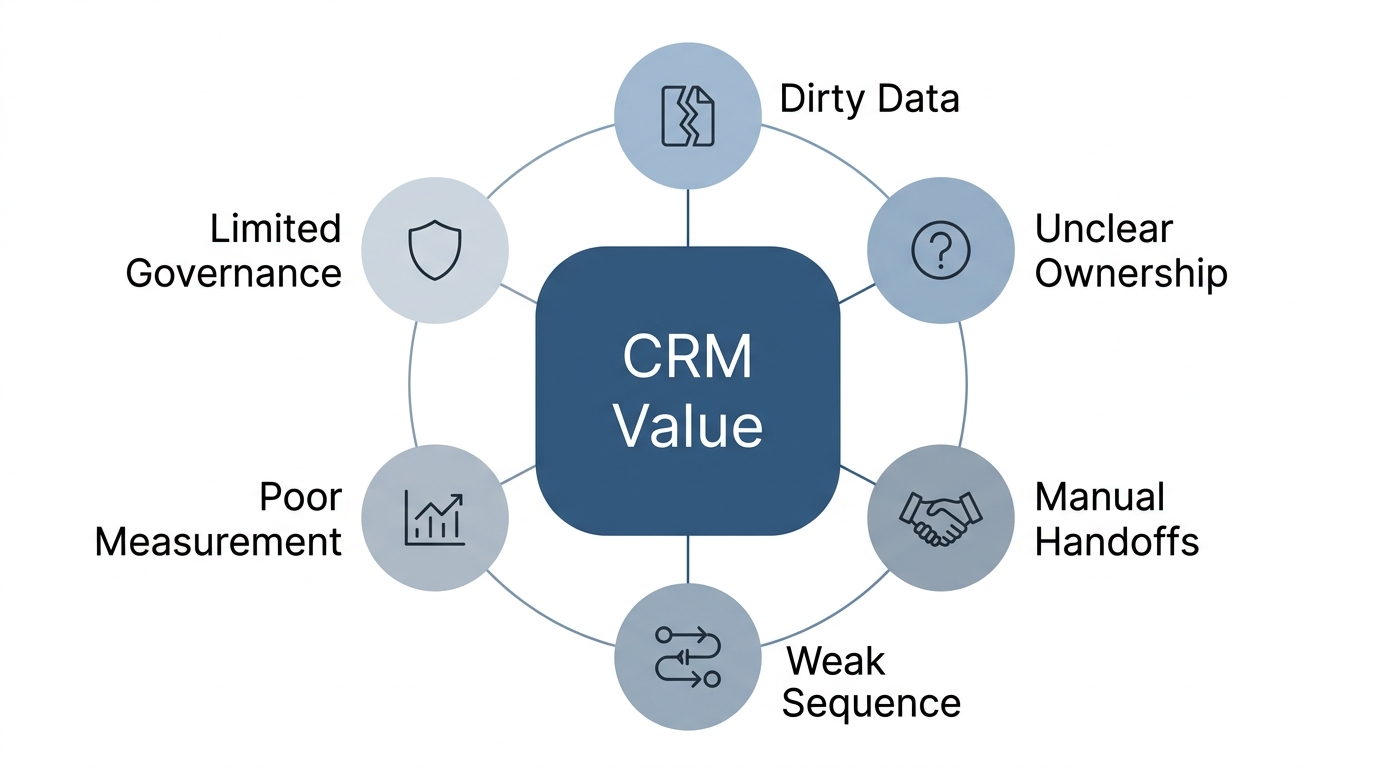
Most institutions don’t fail because they chose the wrong platform. They fail because they skipped the unglamorous groundwork. Six patterns show up again and again.
Dirty CRM data blocks automation and reporting. Duplicate records, missing contact details, stale status fields, every one of these turns a trigger-based workflow into a guessing game. An AI model trained on that data only amplifies the noise.
Unclear workflow ownership. When inquiry, application, financial aid, and advising are handled by different teams but no one is accountable for the whole funnel, leads slip through. The CRM becomes a passive repository, not an engine.
Manual handoffs that kill speed. Admissions passes a file to financial aid via email. Financial aid sends a PDF to advising. Each touchpoint adds days and introduces human error. A higher education CRM is supposed to orchestrate these transitions; instead, spreadsheets take over.
Weak implementation sequence. Many teams deploy analytics dashboards or AI chatbots before they’ve deduplicated records. The result: dashboards that report fiction and bots that give wrong answers.
Poor measurement discipline. Without clear KPIs tied to funnel stages inquiry-to-application rate, application-to-enrollment conversion, the team can’t tell whether a change actually helped. The value of the platform remains a matter of faith, not data.
Limited governance controls. Who can override a lead score? Who approves an automated scholarship offer? When the answer is “anyone,” trust erodes and so does compliance.
AI in your CRM is not a magic wand; it’s a mirror. It reflects the quality of your workflows and data, so make them worth reflecting.
These roadblocks aren’t theoretical. From what we’ve observed across numerous engagements, these six patterns consistently eat up the bulk of CRM value before AI ever gets a chance. The good news: they’re solvable in a specific order. And the first step is granting real ownership. A higher education CRM that lacks ownership will never deliver its full potential.
Why Workflow Ownership Comes Before AI
The case for workflow ownership is simple: you can’t automate what no one is responsible for. Before any AI agent writes an email or scores a lead, every stage of the enrollment funnel needs a named owner and documented handoffs. Picture an inquiry stage. Marketing generates leads, but who qualifies them? If admissions doesn’t pick up the baton within hours, the lead cools. An AI can flag the delay, but it can’t force a human response. Only an agreed-upon owner can. Assigning that owner inside your higher education CRM with automated alerts and SLA timers, cuts response time dramatically, even before AI arrives.
Now imagine financial aid verification. When the workflow is owned by the financial aid team and the CRM enforces a “handoff complete” status before advising can see the record, nobody falls through the cracks. That’s the shift ownership brings: each team keeps responsibility for its data and decisions, and the CRM becomes the single source of truth. Once ownership is solid, you can introduce AI as an assistant to the owner, automating routine checks and surfacing anomalies, while human approval points remain mandatory for high-stakes decisions. This is not a philosophical stance; it’s a practical sequencing rule. Without it, even the best AI assistant will stumble on broken handoffs. A well-structured higher education CRM enforces this ownership model.
For teams evaluating this next step, Webuters’ zoho services and solutions and Generative AI services and solutions can provide a practical reference point for responsible implementation.
For teams evaluating this next step, Webuters’ CRM ERP can provide a practical reference point.
How AI Agents Work Inside Your Existing Higher Ed CRM
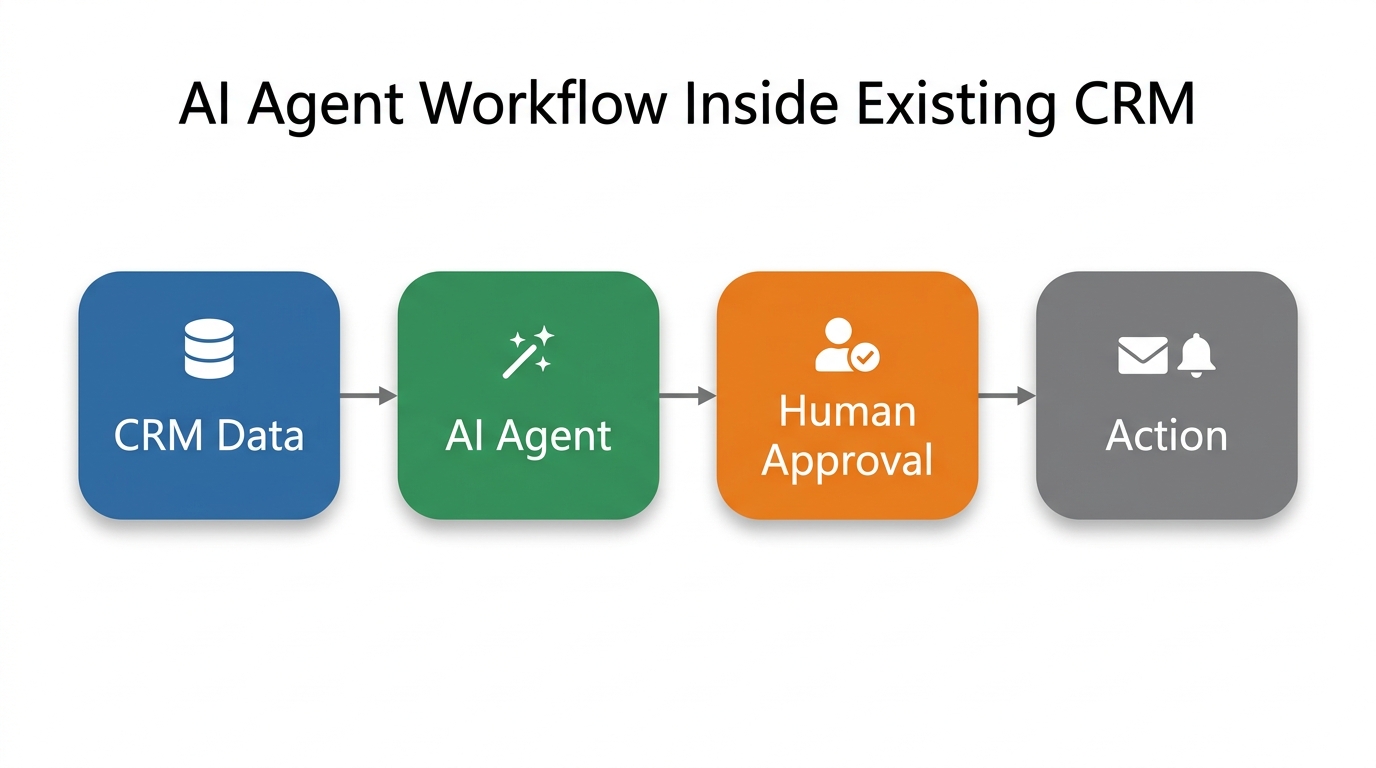
“Can AI agents work inside our current system without replacing it?” That’s the most frequent question we hear and the answer is yes. Today’s platforms offer native intelligence that can be activated right where your data lives. Salesforce, for instance, embeds Einstein capabilities that power lead scoring, opportunity insights, and automated activity capture. An admissions team can implement a Salesforce-native AI workflow that scores applicants based on historical conversion patterns, then routes high-scoring leads to the right counselor with a human-in-the-loop checkpoint before any outreach goes out. Salesforce Einstein’s predictive models work within the same permission and sharing rules you’ve already set, so governance isn’t an afterthought. Leveraging native AI capabilities within a higher education CRM can dramatically improve efficiency.
Zoho’s Zia assistant follows a similar philosophy. Within Zoho CRM, Zia can suggest workflow automations, flag at-risk applicants through sentiment analysis, and even recommend the best time to send a follow-up email. All of this runs inside the CRM you already use: no data migration, no separate tool and each suggestion can be configured to require human approval. Zoho’s Zia capabilities leverage the CRM’s existing data structures, keeping your team in full control.
In practice, this means an AI assistant that reads the same records your counselors do, respects the same access controls, and escalates only the edge cases. It can draft personalized emails to admitted students, schedule campus visits automatically, and alert the financial aid team when a verification deadline is approaching, all while an owner can review and override any action. That distinction matters because it turns AI from a black box into a teammate. This alignment with a robust higher education CRM ensures that every automated action is grounded in your institution’s reality.
For teams evaluating this next step, Webuters’ salesforce development can provide a practical reference point.
A Phased Implementation Roadmap for Measurable Results
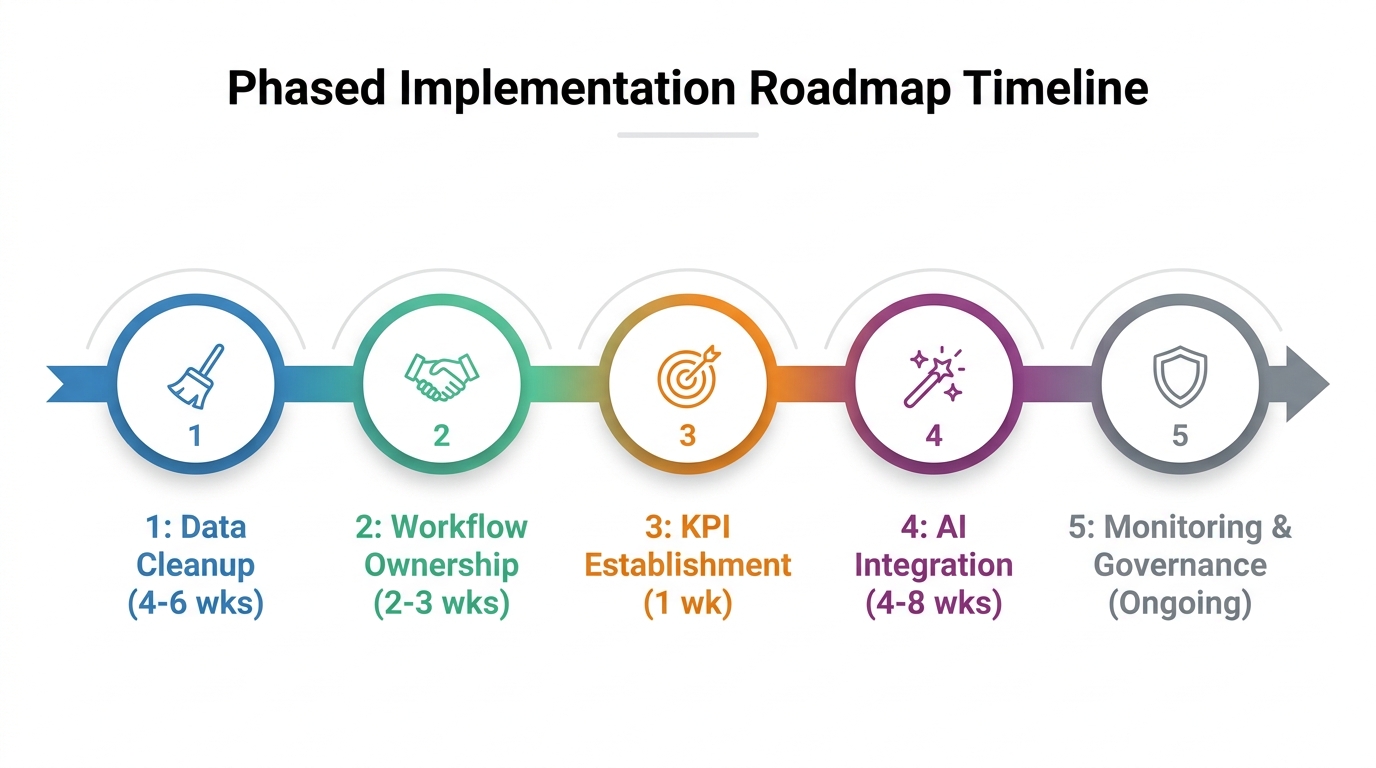
Knowing what’s possible is one thing. Sequencing it to capture measurable results is another. The institutions that see the fastest gains follow a deliberate, five-phase path.
| Phase | Activities | Timeline | Key Metric |
|---|---|---|---|
| 1: Data Cleanup | De‑duplicate, standardize fields, remove outdated records | 4–6 weeks | Record accuracy rate |
| 2: Workflow Ownership | Assign owners, define handoffs, set approval points | 2–3 weeks | Handoff completion time |
| 3: KPI Establishment | Define metrics per funnel stage (inquiry to enrollment) | 1 week | Conversion rate by stage |
| 4: AI Integration | Deploy lead scoring, chatbot, auto‑emails with human approval | 4–8 weeks | Automation rate, AI acceptance rate |
| 5: Monitoring & Governance | Set up dashboards, audit logs, bias checks | Ongoing | AI accuracy, compliance rate |
Start with data cleanup. If your system is a landfill, every report is a falsehood. From there, locking in workflow ownership typically cuts handoff delays by half or more, because every team knows exactly what it’s accountable for. Only then do you establish KPIs that give you a true baseline. Phase 4 is where AI joins the game. With clean data and owned workflows, an AI assistant can be deployed to score, route, and nurture leads with confidence. For a deeper example of how workflow and integration drive results, see our seamless student lifecycle management with zoho CRM and moodle LMS case study. This phased implementation roadmap, when applied to a higher education CRM, delivers results that are both measurable and sustainable.
Governance and Trust: The Forgotten Layer
Even a perfectly implemented roadmap can unravel if trust controls aren’t embedded. The question is simple: “Who sees what, who can override a recommendation, and how do we audit outcomes?” Without clear answers, staff will abandon the AI’s suggestions and sometimes the CRM itself.
Every AI action should leave a log: what was recommended, who approved or rejected it, and what outcome followed. High-stakes decisions scholarship adjustments, admission probability flags must always pass through a human-in-the-loop checkpoint. That’s not a weakness; it’s a design principle. It also protects against bias, which can creep into predictive models when historical data contains systemic patterns. Strong trust controls within a higher education CRM maintain staff confidence.
Regular audits close the loop. Compare AI-predicted enrollment rates with actuals. If a model consistently over-predicts for a particular demographic, the bias must be corrected and the correction itself logged as a governed change. This isn’t just risk management; it’s what turns a pilot into an institutional standard. Embedding trust controls ensures your higher education CRM remains a reliable partner.
Frequently Asked Questions
Can AI agents work inside your existing higher education CRM without replacing it?
Absolutely. Platforms like Salesforce (with Einstein) and Zoho (with Zia) provide native AI that operates directly within your current higher education CRM, using your existing data, permissions, and workflows. Custom AI agents can also be built on top of the CRM’s API, so there is no need to migrate to a separate system.
How do you improve admissions conversion with your higher education CRM?
Start with workflow ownership and data cleanup. Assign a responsible owner to each funnel stage, enforce automated handoffs, and establish KPIs. Only then layer in AI for lead scoring, automated follow-ups, and dashboards that surface real bottlenecks. A well-configured higher education CRM is central to this approach, and the combination of disciplined process and targeted AI typically lifts conversion rates by double digits.
How should teams evaluate the benefits of higher ed CRM?
Evaluate through measurable outcomes, not feature lists. Focus on metrics like inquiry-to-application conversion rate, handoff completion time, and staff time saved on manual data entry. A phased implementation with clear governance will surface these incremental gains, giving you a true picture of ROI. The benefits become clear when you track these numbers.
What is the biggest mistake institutions make when implementing a higher education CRM?
The biggest mistake is skipping data cleanup and workflow ownership in favor of flashy AI features. Without clean data and clear ownership, AI amplifies existing problems rather than solving them. That’s why we always advise starting with the operational foundation before adding intelligence.
How long does it take to see results from a higher education CRM implementation?
With a phased approach, initial results can appear in as little as 6–8 weeks after data cleanup and workflow ownership are in place. Full AI integration and governance typically take 4–6 months, but improvements in conversion rates become measurable much earlier.
Is a higher education CRM worth the investment for smaller institutions?
Yes. Smaller institutions often have fewer resources, so the need to maximize efficiency is even greater. A well-implemented higher education CRM can centralize operations, reduce manual labor, and improve enrollment outcomes without requiring a large team.
From CRM Investment to Enrollment Growth: The Big Picture
The question is not whether AI can improve admissions. It’s whether your institution has the operational discipline to make AI a force multiplier instead of a costly experiment. The institutions that win in enrollment won’t be those with the most AI features, but those that first mastered workflow ownership and data trust. That is the real opportunity inside every higher education CRM. When you embed ownership before automation, and layer governance on top of intelligence, the system stops being a data graveyard and starts behaving like an enrollment engine. Faster response times, higher conversion, clearer accountability, these stop being aspirational and become measurable.
If your team is ready to move from frustration to a disciplined, AI-ready foundation, explore how seamless student lifecycle management yields real results. Or, let our AI consulting services help build a tailored roadmap for your institution. When the fundamentals are right, the technology finally fulfills its promise.
Ready to move your higher education CRM from data graveyard to enrollment engine? Explore how Webuters helped a college with seamless student lifecycle management, then start a conversation about your own AI‑ready roadmap.
CRM and ERP transformation
Pick the right platform, clean the data and connect it to the rest of the business.
See CRM and ERP services
Karan is a seasoned Project Manager who leads digital transformation projects across Salesforce, Zoho, CRM platforms, mobile apps, AI, and web development. At Webuters, he works closely with cross-functional teams to ensure smooth delivery, clear communication, and measurable results. He regularly shares tips on what's new, practical how-tos, and articles that help teams and decision-makers choose the right tech path. Always approachable, he's committed to helping clients and teams make smarter, faster decisions with confidence.
Follow Karan on LinkedIn